The Taiping Rebellion, explained in one line: from 1850 to 1864, the Taiping Heavenly Kingdom — a theocratic state founded in Guangxi by Hong Xiuquan, who believed he was the younger brother of Jesus Christ — fought the ruling Qing dynasty for China, held Nanjing for eleven years, and was destroyed only after the Qing handed the war to provincial armies; Britannica calls it probably the most important event in China in the 19th century and puts its cost at an estimated 20 million lives.
Key takeaways
- A failed examinee founded a rival state: Hong Xiuquan proclaimed the Taiping Tianguo in January 1851 (1 January on Britannica's dating; ChinaKnowledge gives 11 January). Within two years his movement held Nanjing, renamed Tianjing, until July 1864 (see Overview).
- The toll is a range, not a number: Britannica gives an estimated 20 million dead; Meyer-Fong notes conventional totals of twenty to thirty million and warns a precise count is impossible; ChinaKnowledge gives 20 to 50 million (see How many people died?).
- The Qing won by decentralising: Zeng Guofan's Hunan Army was paid for by the new likin tax and provincial revenues, not the imperial treasury — the expedient that saved the dynasty and, in Britannica's judgement, left it never again able to establish an effective hold (see Economic effects).
- The name itself is disputed: Meyer-Fong argues "rebellion" takes the victors' side and that the conflict should be called a civil war, perhaps the most violent in human history (see What historians debate).
Contents
- Overview
- Why did the Taiping movement grow so fast?
- How did the war unfold?
- How many people died?
- Economic effects
- How did it shape the world?
- What historians debate
Overview
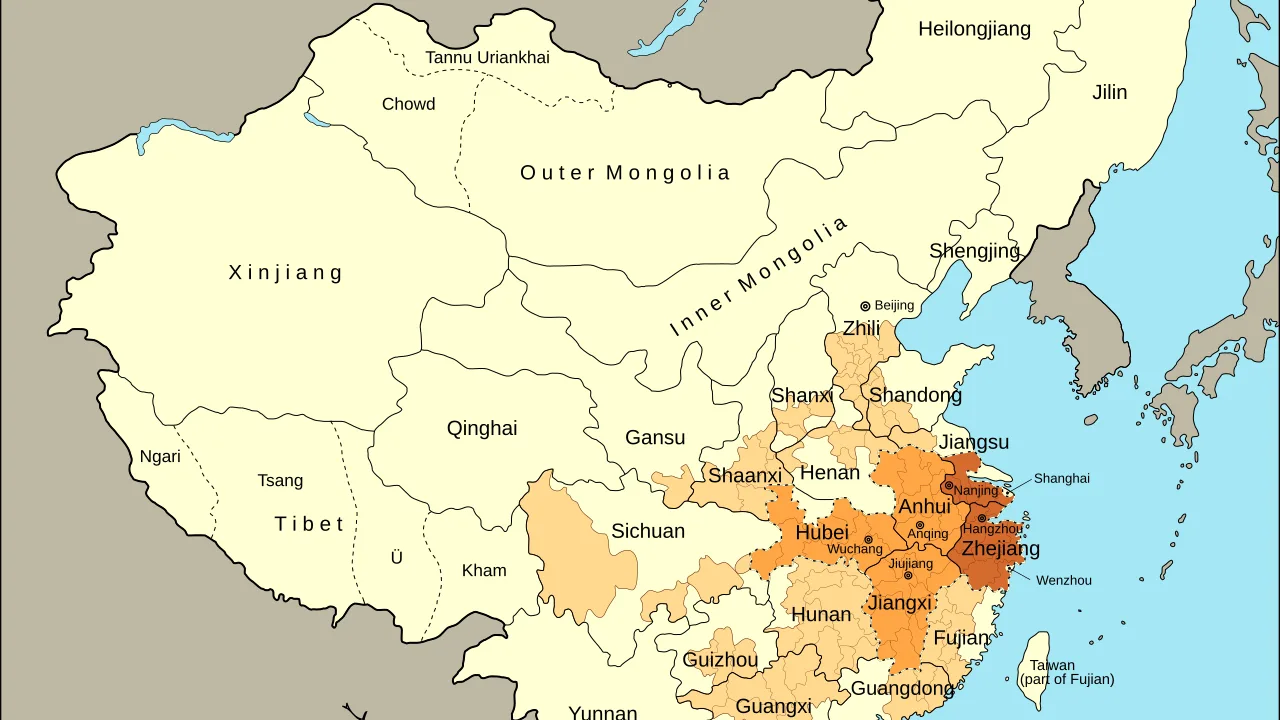
The Taiping Rebellion was a radical political and religious civil war in China fought from 1850 to 1864 between the ruling Qing dynasty (1644–1911/12) and the Taiping Heavenly Kingdom. Britannica dates it to some 14 years, records that it ravaged 17 provinces, and frames its leader plainly: Hong Xiuquan (1814–64) was a disappointed civil service examination candidate who, influenced by Christian teachings, had a series of visions and believed himself to be the son of God, the younger brother of Jesus Christ, sent to reform China. His friend Feng Yunshan organised those ideas among the impoverished peasants of Guangxi as the God Worshippers' Society. Hong joined Feng in 1847, led the society in rebellion three years later, and on 1 January 1851 proclaimed the Taiping Tianguo — "Heavenly Kingdom of Great Peace" — taking the title Tianwang, or Heavenly King. ChinaKnowledge, drawing on the Cambridge History tradition, gives the proclamation as 11 January 1851 with 20,000 followers; the day differs between the accounts, the sequence does not. The kingdom the proclamation founded was destroyed by the Qing in July 1864, after eleven years holding Nanjing.
The kingdom fielded armies that Britannica says grew from several thousand to more than one million soldiers, in separate men's and women's divisions, swept through the Yangtze valley, and took Nanjing in March 1853 (Britannica gives 10 March; ChinaKnowledge 19 March), renaming it Tianjing, the Heavenly Capital. It governed the lower Yangtze, China's economic hub on ChinaKnowledge's account, for eleven years. The Qing destroyed it in July 1864, but only by rebuilding their war effort around provincial leaders — and, Britannica concludes, the dynasty was so weakened that it never again established an effective hold over the country.
Why did the Taiping movement grow so fast?
Because its credo answered material misery with a total alternative — shared property, equality decreed between men and women, and a war against the Manchu rulers cast as demons. Britannica gives the recruitment mechanism directly: the credo "to share property in common" attracted many famine-stricken peasants, workers and miners, as did propaganda against the foreign Manchu rulers of China. ChinaKnowledge adds the Guangxi conditions: huge population growth in the 18th and early 19th centuries, large-scale migration in search of jobs, contact with Western ideas and religion, and a countryside where bandits, triads and opium smugglers held sway and Hakka immigrants fought local Punti communities while local government looked helpless.
Hong's path ran through the examination hall. ChinaKnowledge records repeated failures in Guangzhou, his encounter with Liang Fa's evangelical pamphlet Good Words to Admonish the World, the 1837 vision in which he was the younger brother of Jesus, and a further failure in 1843 after which he turned against the state. Jonathan Spence's God's Chinese Son (1996), built in part on a British Library record of some 180 sessions in which God and Jesus were held to communicate with the Taiping leaders, tells the story from inside that belief: the demons Hong was charged to destroy came, by 1850, to be identified as the Manchus. The programme was radical: Britannica lists prohibitions on prostitution, foot-binding and slavery as well as opium, adultery, gambling, tobacco and alcohol; equality between men and women decreed; and all property to be held in common, with equal distribution of land planned. ChinaKnowledge adds the qualification: under the Land System of the Heavenly Dynasty private ownership was abolished in theory, but in practice the tenant–landlord relationship more or less continued.
How did the war unfold?
In three phases: a two-year march from Guangxi to Nanjing, an eleven-year rival state that broke on its own leadership in 1856, and a slow Qing reconquest after 1860 fought by provincial armies and a Western-officered mercenary force. ChinaKnowledge traces the march: about 120,000 strong at Changsha in September 1852, half a million after Wuchang, and about 2 million adherents claimed after Nanjing and Zhenjiang fell in March 1853, giving the Taiping the Grand Canal junction. A northern expedition to take Beijing failed — defeated near Tianjin in early 1855 on ChinaKnowledge's account — while a western expedition scored many victories on Britannica's. The kingdom was then confined as a regional regime in the lower Yangtze.
The break came from inside. Britannica records that Yang Xiuqing, the minister of state, attempted to usurp much of the Heavenly King's power and was slain with thousands of followers — ChinaKnowledge, citing Kuhn (1978), puts the 1 September 1856 killing at 20,000 supporters — that Wei Changhui, who killed Yang, was himself murdered on Hong's orders, and that Shi Dakai abandoned Hong with many followers. Against that self-destruction, the Qing effort was rebuilt by the men the Taiping programme had mobilised against it: the gentry, alienated by Taiping anti-Confucianism, organised under Zeng Guofan, who from late 1852 built the Hunan Army — bound by personal chains of command, paid substantially more than Qing regulars and indoctrinated in Confucian principles, on ChinaKnowledge's account.
The last phase turned on Shanghai and money. In 1860 a Taiping attempt to take Shanghai was stopped by the Western-trained Ever-Victorious Army, commanded by the American adventurer Frederick Townsend Ward and later by Charles George ("Chinese") Gordon — Britannica's account; ChinaKnowledge adds Henry Burgevine between them. Hong Rengan, Hong's cousin, had meanwhile taken over the government in 1859 and proposed, in his Zizheng xinpian, banks, railways and examination reform — a programme the kingdom no longer had the cohesion to carry out. By 1862 Zeng had surrounded Nanjing, on Britannica's account. Suzhou was retaken in December 1863, and Nanjing fell in July 1864 — the breach on 19 July on ChinaKnowledge's account. Hong was already dead: Britannica reports he committed suicide in June after installing his 15-year-old son; ChinaKnowledge reports simply that he had died of illness. The manner of his death, like the founding date, is published here as the sources give it — disputed. Sporadic resistance continued until 1868, on Britannica's account.
How many people died?
At least 20 million on the most-cited estimate, conventionally twenty to thirty million, and possibly far more — and historians are explicit that no precise count is possible. Britannica's figure is an estimated 20 million lives. Tobie Meyer-Fong, in the work summarised by JSTOR Daily from her American Historical Review article, gives the proportions: five to ten percent of the Chinese population died, twenty million is the figure typically seen, higher figures have been proposed, and "the absence of accurate demographic data makes it impossible to know with any precision how many people died," while the sources "testify insistently to unprecedented carnage of appalling scope and scale." In What Remains (2013) she gives the conventional range: twenty to thirty million, on which basis it has been termed the most devastating civil war in human history, while postwar gazetteers refer to population loss approaching or surpassing 50 percent in lower Yangzi towns. The Times Higher Education review of Stephen Platt's history summarises its estimates as ranging from 20 million to 80 million, and Ulrich Theobald's ChinaKnowledge history gives 20 to 50 million in its consequences section. Those upper figures are not reconciled with each other, and this article does not reconcile them: they count different things — battle, massacre, famine and disease across fourteen years and concurrent rebellions — over records the victors partly destroyed.
Single episodes show the scale inside the total. When Zeng Guoquan's army breached Tianjing on 19 July 1864, it looted and burnt the city, massacring perhaps 100,000 people — the figure ChinaKnowledge cites to Kuhn (1978: 309). Britannica separately records Zeng Guofan's astonishment that almost 100,000 Taiping followers preferred death to capture after Nanjing's fall; the two reports are not the same claim and are not merged here. Meyer-Fong's comparison fixes the order of magnitude: the toll was surely much larger than the contemporaneous American Civil War, in which she gives some 620,000 soldiers and perhaps 50,000 civilians dead.
Economic effects
The war was fought over China's richest region, financed by inventing provincial taxation, and paid for by a court driven to debased coinage and paper money. The Taiping held the economic hub of the lower Yangtze and cut the Qing off from tribute grain and mint metal supply. The wealthy southeast was occupied and then devastated, and tax, military and (unsuccessful) monetary reforms followed, on ChinaKnowledge's account; the court's emergency measures included issuing base copper currency, heavy high-denomination coins, and several types of paper money.
The durable invention was on the Qing side. Zeng Guofan had to create new revenue to finance his army: apart from selling ranks and titles, he introduced the likin tax, a new mercantile transit tax. More fiscal power passed, with the court's consent, into provincial hands, the regular machinery was sometimes bypassed, and army units levied likin directly. In the east, Li Hongzhang secured the Maritime Customs revenue of Shanghai and the likin of Jiangsu, and with those funds bought 15,000 rifles and Western artillery and hired Western officers. The Ever-Victorious Army itself was financed from the joint United Defence Bureau. The Taiping state never matched that fiscal machine: its land system abolished private ownership in theory while tenant–gentry relations continued in practice, and its tax quotas were somewhat lighter than normal, on Kuhn's (1978) figures via ChinaKnowledge — a lighter-touch system set against the likin-and-customs machine opposite it.
How did it shape the world?
It saved the Qing by hollowing it out, and it made China's 19th century a global event rather than an internal one. Britannica's verdict is unqualified: the dynasty was so weakened that it never again established an effective hold over the country. The mechanism was delegation: reliance on local armies financed by the gentry led to increased military and financial autonomy for provincial governors, and ChinaKnowledge states it more bluntly — the court handed military, financial and administrative power to local leaders like Zeng, a change its cited source (Dillon 2009) says perhaps initiated the autonomous warlords of the Republican period (1912–1949). The dynasty's attempted answer was the Tongzhi Restoration and self-strengthening. And the losers entered their successors' mythology: Britannica records that both the Chinese communists and the Nationalists trace their origin to the Taipings, and Meyer-Fong shows how, after 1912, the war became a cornerstone of revolutionary nationalism — Sun Yat-sen fancied himself a modern Hong Xiuquan.
Internationally, Stephen Platt's Autumn in the Heavenly Kingdom (Knopf, 2012), winner of the 2012 Cundill Prize in History, is the standard statement that the war cannot be told as a closed Chinese story. The McGill prize record summarises Platt's China of the 1860s as deeply integrated into the world's economy, its civil war intertwining with the simultaneous American Civil War, and its resolution to a significant degree determined by outsiders. Britain — fighting the Qing in the north even as it defended Shanghai — ultimately backed the dynasty its merchants could trade with; ChinaKnowledge attributes that choice to Western merchants judging the Taiping kingdom a threat to peaceful trade and to its condemnation of the opium trade. The Qing thus survived a fourteen-year civil war while simultaneously fighting Britain and France in the Second Opium War (1856–60) — a survival ChinaKnowledge calls rather a surprise.
What historians debate
Historians debate three things: what to call the war, whether Hong's religion caused it or merely gave misery its idiom, and whether the Taipings were forerunners of modern Chinese revolution or a catastrophe whose survivors had to be understood on their own terms.
- Rebellion, civil war, or revolution? Meyer-Fong argues "rebellion" is biased in favour of the victorious Qing — the Qing were first to write the war's history and tried to destroy Taiping records — and that it should definitely be called a civil war, perhaps the most violent in human history. Platt's subtitle makes the same choice: the Epic Story of the Taiping Civil War. Other scholars have called it a revolution for the rebels' radical objectives. This article keeps the conventional title for findability and uses "civil war" in the text.
- Was Hong's religion the cause, or the idiom? Spence reconstructs the movement from Hong's visions outward, treating the theology on its own terms, including its roots in indigenous messianic traditions identified by R. Wagner and R. Weller. The social-history accounts start from the other end: population pressure, migration, famine, misgovernment and anti-Manchu feeling, with the credo's material promises doing the recruiting. The evidence supports at least this much of both: a vision supplied the kingdom's form, and misery supplied its million soldiers.
- Precursors or catastrophe without heirs? The revolutionary reading — the Taipings as forerunners, claimed by 20th-century communists and adopted by Sun Yat-sen — required, Meyer-Fong writes, that "much uncomfortable detail had to be erased," including Hong's purges of his own allies. Her own work starts from survivors: families who had to bury the dead, rebuild shattered cities and argue over loyalty and loss. On her account the struggle over the war's meaning continued until the dynasty ended in 1912 — the historiographical war lasted almost fifty years longer than the fighting.
This explainer is drawn from the sources listed below, all opened or read during this run. Casualty and cost figures are published strictly as the attributed ranges and estimates those sources give.