The First Sino-Japanese War, explained in one line, was a nine-month war in which a modernised Japan defeated a much larger Qing China and took its place as East Asia's leading power: from 25 July 1894 to 17 April 1895, Japan and China fought for supremacy in Korea, Japan won every major engagement on land and at sea, and the Treaty of Shimonoseki ended the war with Korea declared independent of China, Taiwan and the Penghu Islands ceded to Japan, and a huge indemnity imposed on the Qing. Britannica summarises the verdict the war delivered: it "marked the emergence of Japan as a major world power and demonstrated the weakness of the Chinese empire".
Key takeaways
- Size predicted the wrong winner: foreign observers, the German General Staff among them, expected the more massive Chinese forces to win. Japan's conscript army and navy — centrally commanded, uniformly trained and equipped — beat a Qing military split into regional armies with no common logistics, in which, the standard summary records, 40 percent of troops at the outbreak had no rifle at all.
- Disease, not battle, was Japan's main killer: of 17,069 Japanese casualties, 11,894 were deaths from disease, against 1,132 killed in action. Qing losses are put at 35,000 killed or wounded, without an equivalent published breakdown.
- The peace cost China more than the war cost Japan: China paid 200 million Kuping taels, recorded as 311,072,865 yen, for a war Japan had funded with 250,000,000 yen — a net profit for the victor, before the extra 30 million taels paid for the return of Liaodong.
- The settlement lasted ten years, not a generation: the Triple Intervention stripped Japan of Liaodong within a week of the treaty, Russia leased that same peninsula in 1898, and the rivalry the war created over Manchuria and Korea produced the Russo-Japanese War of 1904-05.
Contents
- Overview
- Why did China and Japan fight over Korea?
- How did the war unfold?
- Casualties
- Economic effects
- How it shaped the world
- What historians debate
Overview
The First Sino-Japanese War — the Jiawu War in China, after the sexagenary name of the year 1894; the Japan-Qing War in Japan — was the test of two rival modernisation programmes. After the Meiji Restoration of 1868, Japan built a centralised state, a conscript army modelled first on France and then on Germany, and a navy modelled on Britain's Royal Navy, with officers trained abroad. Qing China pursued the Self-Strengthening Movement (1861-1895) in parallel, buying modern ships and guns and founding arsenals, but, the standard accounts stress, without central coordination, and against bureaucratic resistance and corruption. By 1894 China remained largely agrarian, its forces divided among the Eight Banners, the Green Standard Army, irregular Braves and regional armies such as Li Hongzhang's Huai Army.
The numbers underline why contemporaries misread the balance. In the northern theatre the Qing could list 357,100 men — 180,310 bannermen, 125,030 trained men and 51,760 Green Standard troops, in the figures compiled by N. W. H. Du Boulay in 1896 — against 240,616 Japanese. But only a fraction of the Qing total could be moved, supplied or commanded together: there was no railway in the combat zone, no unified national army, and, the summaries note, a complete absence of engineers, quartermasters, signals and medical services. Japan fielded fewer men as a single instrument.
Why did China and Japan fight over Korea?
Because Korea was at once China's most important tributary state and the territory Japan's strategists said they could not allow a rival to hold. Korea's position opposite the Japanese islands, and its coal and iron, drew Japanese interest from the 1870s; Japan forced Korea open to trade in 1876 and backed Korean reformers, while China sponsored the conservative court around the royal family — the contest that produced the failed pro-Japanese coup of 1884 and the Li-Itō Convention of 1885, under which both sides agreed to withdraw troops and to notify each other before sending more.
The trigger came in 1894. The assassination in Shanghai of the exiled reformer Kim Ok-gyun outraged Japanese opinion, and then the Tonghak (Donghak) rebellion broke out in Korea. At the Korean king's request, China sent about 2,700 to 2,800 troops to help suppress it. Japan treated the dispatch as a breach of the 1885 convention — China maintained it had notified Tokyo — and landed 8,000 troops. On 23 July 1894 Japanese forces occupied the Gyeongbokgung palace in Seoul, seized King Gojong and installed a pro-Japanese government, which renounced Korea's treaties with China and authorised Japan to expel Qing forces. China refused to recognise the new government. Its remaining troops in Korea could now be supplied only by sea.
How did the war unfold?
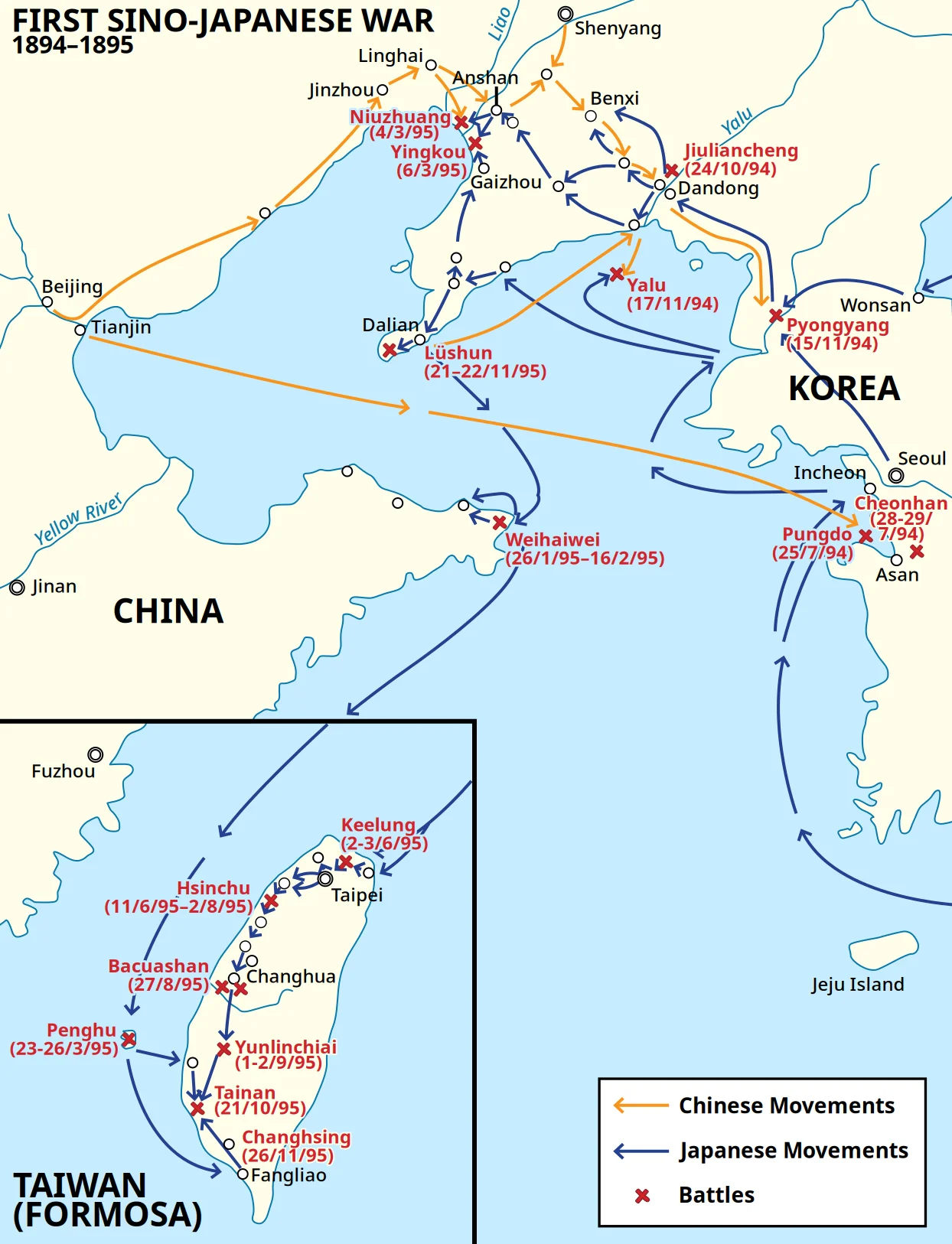
In a sequence of Japanese victories, each of which closed off a Chinese option: Korea in September, command of the sea on 17 September, Port Arthur in November, and the Beiyang Fleet itself at Weihaiwei in February.
The first shots came before any declaration. On 25 July 1894, at the Battle of Pungdo, Japanese cruisers sank the British-chartered steamer Kowshing, carrying Qing reinforcements to Asan — 1,100 troops in the detailed account, 1,200 in the summary account. On land, a Japanese brigade outflanked the Chinese at Seonghwan on 28-29 July and took Asan; the Chinese lost 500 killed and wounded, the Japanese 88. War was formally declared on 1 August.
At Pyongyang on 15 September, 23,800 Japanese converged from four directions on 13,000 Qing defenders who had spent two months building 27 forts; the city fell in a day, and the survivors retreated across the Yalu River into Manchuria. Two days later, on 17 September, the Japanese Combined Fleet met the Beiyang Fleet off the mouth of the Yalu. Japan's advantage, in David Evans and Mark Peattie's analysis in Kaigun (1997), lay in speed and in the number of quick-firing guns on its first-line warships, which outweighed the heavier armour and broadside of the two German-built Chinese battleships, Dingyuan and Zhenyuan. The main summary records that Japan destroyed eight of the ten Chinese warships engaged and thereby gained command of the Yellow Sea; Britannica's battle account gives the narrower count of five Chinese ships lost and none Japanese, with 1,350 Chinese and 380 Japanese casualties. Either way, the surviving Beiyang ships retreated and did not contest the sea again.
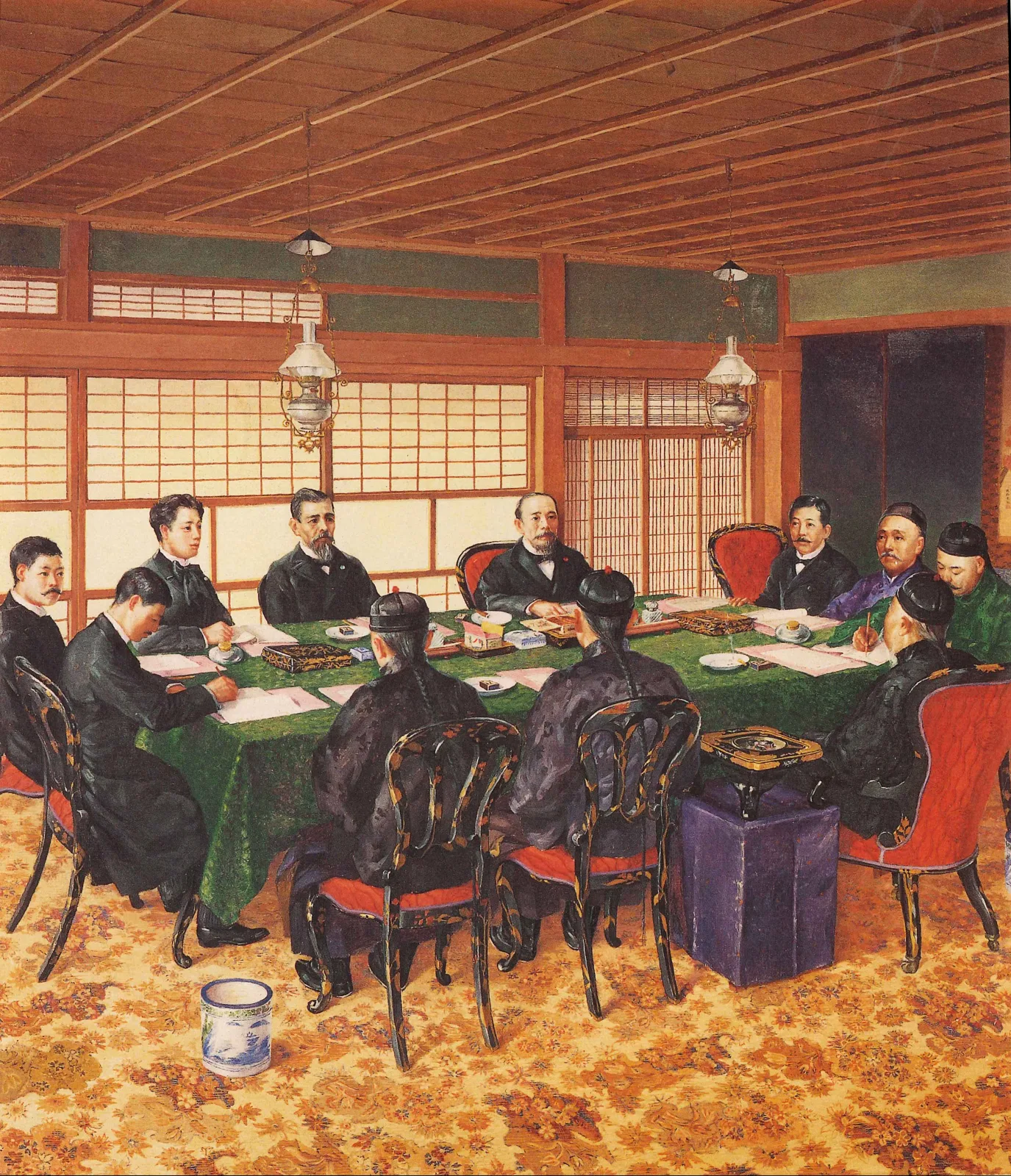
Japanese armies then crossed the Yalu into Manchuria in October, while a second army landed on the Liaodong Peninsula. Port Arthur (Lüshunkou), the Beiyang Fleet's fortified base, fell on 21 November with minimal resistance — and was followed by the massacre discussed under Casualties. In January-February 1895 the Japanese took Weihaiwei from the landward side in a 23-day siege (major engagements 20 January to 12 February); the trapped Beiyang Fleet was destroyed or captured, and its admiral, Ding Ruchang, took his own life — Jonathan Spence, in The Search for Modern China, notes that Ding had retired the fleet behind a curtain of contact mines and took no further part in the fighting. In March, Japanese forces took Liaoyang and Yingkou, commanding the approaches to Beijing, and seized the Penghu (Pescadores) Islands on 23-26 March, losing 28 killed and wounded against about 350 Chinese casualties and nearly 1,000 prisoners. Qing envoys without full powers had been turned away in February; Li Hongzhang himself opened talks at Shimonoseki in March, survived an assassination attempt by a Japanese nationalist on 24 March, and signed the treaty on 17 April 1895.
Casualties
This war's military totals are comparatively well documented; its most notorious death toll is not, and the two should not be confused.
- Qing forces: 35,000 killed or wounded, the figure given by Philip Jowett (2013) and carried in the standard summary. No comparably settled split between killed, wounded, disease and missing is published alongside it.
- Japanese forces: 17,069 casualties in total — 1,132 killed, 3,758 wounded, 285 who died of wounds, and 11,894 who died of disease. Disease thus killed more than ten times as many Japanese soldiers as Chinese fire did, a pattern Stewart Lone examines in Japan's First Modern War: Army and Society in the Conflict with China, 1894-95 (Macmillan, 1994), including the 153,000 contracted labourers and the shortages of medicine and winter clothing that slowed the field armies late in the war.
- Port Arthur, 21 November 1894 and the following days: after the city fell, troops of General Yamaji Motoharu's 1st Division killed soldiers and civilians in the town, Western correspondents including James Creelman of the New York World and Thomas Cowan of The Times witnessing the aftermath. The toll remains disputed by an order of magnitude. A scouting report to Li Hongzhang by the official Liu Hanfang counted 2,600 to 2,700 civilians killed inside the city, explicitly excluding the surrounding hills and soldiers. The cemetery built in 1948, the Wanzhong Tomb, marks 20,000 dead, a figure that includes soldiers killed in action and became the orthodox figure in Chinese communist sources. Creelman asserted up to 60,000, with only 36 spared. Lone, writing in 1994, treated the highest claim sceptically, arguing that the speed with which Port Arthur's streets refilled under occupation suggests the civilian population had not been destroyed outright. The article therefore reports the range — roughly 2,600 at the documented city count to 60,000 at the highest contemporary claim — rather than a single number.
Economic effects
- The indemnity transferred a state-building fund from China to Japan: the treaty set reparations at 200 million taels of silver, plus a commercial treaty allowing Japanese ships on the Yangtze, Japanese-owned manufacturing in treaty ports and four more open ports. The Qing ultimately paid 200 million Kuping taels, recorded as 311,072,865 yen, against a Japanese war fund of 250,000,000 yen — and then paid a further 30 million taels, about 450 million yen, as the price of Japan returning Liaodong after the Triple Intervention. Payment was exacted in British pounds in London, and the burden fell on a Qing treasury that had to borrow abroad to meet it.
- For Japan, the indemnity bought monetary credibility as well as ships and steel: using the proceeds of the Chinese indemnity, Japan adopted the gold standard under the Coinage Act of 29 March 1897, Finance Minister Matsukata Masayoshi's long-sought reform — the step that placed the yen on the same footing as the currencies of the Western great powers. S. C. M. Paine, in The Sino-Japanese War of 1894-1895: Perceptions, Power, and Primacy (Cambridge University Press, 2003), stresses the perceptual half of the same transfer: the war changed outside assessments of which East Asian state was rising, and the scramble for concessions that followed was those assessments made concrete.
- For China, defeat was also a fiscal and industrial exposure: the war demonstrated, in the standard verdict, the failure of Self-Strengthening to produce effective naval power despite heavy spending on the Beiyang Fleet, and it accelerated foreign demands — railway concessions above all — on a government whose weakness had now been measured in public.
How it shaped the world
- It reversed the East Asian hierarchy: Paine's formulation, quoted in the standard summary, is that "a new balance of power had emerged. China's millennia-long regional dominance had abruptly ended. Japan had become the pre-eminent power of Asia, a position it would retain throughout the twentieth century." Taiwan remained under Japanese rule until 1945; Korea, declared fully independent of China, moved into Japan's sphere and was annexed in 1910.
- It taught the great powers to carve, and Japan to ally: China's defeat encouraged the Western powers to press further demands, and in 1897-98 Germany took Qingdao, France Guangzhouwan, Britain Weihaiwei and the New Territories, and Russia a 25-year lease on the very Liaodong Peninsula Japan had been forced to hand back — Port Arthur included. Japan answered its diplomatic isolation with the Anglo-Japanese Alliance of 1902, whose terms were designed, the accounts note, to prevent a repetition of the Triple Intervention by deterring a third power from joining a future war against Japan.
- It set up the next war: Russian expansion in Manchuria after 1900, stalled Russo-Japanese negotiations over respective spheres — Russia over Manchuria, Japan over Korea — and Japan's refusal to see Korea fall under Russian domination led directly, in the standard causal chain, to the Russo-Japanese War of 1904-05, in which Port Arthur was again a focus of Japanese attacks.
- Inside China, it broke the old confidence: defeat by an Asian power China had traditionally regarded as culturally subordinate was, the accounts stress, a bitter psychological blow beyond the material losses. It fed Kang Youwei's reform petitions, the beginnings of revolutionary organisation under Sun Yat-sen, growing xenophobia that culminated in the Boxer Rebellion five years later, and, in the longer run the sources trace, the upheavals ending in the 1911 Revolution and the fall of the Qing.
What historians debate
- Was it corruption, or institutions? The popular story blames the Empress Dowager Cixi for diverting naval funds to rebuild the Summer Palace. The Wikipedia summary of the later Chinese historiography reports that extensive research found Cixi was not the cause of the navy's decline: funding was cut under the Guangxu Emperor, whose tutor Weng Tonghe advised that Japan was no true threat and that natural disasters were the more pressing claim. Evans and Peattie locate the naval failure less in any single diversion than in maintenance, training, ammunition and tactics — advantages that were "more apparent than real" on the Chinese side.
- How complete was Japan's modernity? Lone's social history complicates the clean modernisation story from the Japanese side as well: an army equal to European forces in organisation still could not supply itself, contracted 153,000 labourers, and routinely delayed operations for want of food, medicine and winter clothing. Paine, reading the war through contemporary journalism in five countries, argues its largest effect may have been perceptual — it reordered what the world, China and Japan believed about East Asian power, and both later Chinese policy (undoing the settlement) and Japanese policy (confirming it) were built on that reordering.
- What happened at Port Arthur — and who gets to count it? The dispute is not whether a massacre occurred — Japanese participants' diaries, Western correspondents and the Japanese Foreign Ministry's own 16 December 1894 statement acknowledging troops who "inflicted vengeance without discrimination" all attest to killing after the city fell — but its scale, and the politics of each figure since: a Qing official's street-by-street count, a reporter's round 60,000, a memorial's 20,000, and Lone's logistical scepticism. The range, with its sources, is the finding.