The Bangladesh Liberation War, explained in one line: between March and December 1971, the eastern wing of Pakistan — Bengali-speaking, holding the country's larger population but a minority of its power — fought its way out of the state, first as a guerrilla insurgency against the Pakistan Army and then, after India intervened in December, in a thirteen-day conventional war that ended with the largest surrender since 1945 and a new nation of some 75 million people. It is also the war whose death toll is disputed more widely than any other since the Second World War: the estimates published below run from 26,000 to 3 million.
Key takeaways
- The state broke on a democratic result: Pakistan's first free general election, in December 1970, gave Sheikh Mujibur Rahman's Awami League an outright National Assembly majority. When the military regime blocked the transfer of power and answered protest with Operation Searchlight on 25 March 1971, negotiation gave way to war.
- The refugee crisis made it India's war: an estimated 10 million Bengalis fled into India and some 30 million were displaced inside East Pakistan. Gandhi's government concluded that sustaining the refugees would cost more than war, armed the Mukti Bahini, and — after Pakistan's air strikes of 3 December — invaded.
- The superpowers were in it from the start: the United States "tilted" toward Pakistan, its secret channel to China, and sent a carrier task force into the Bay of Bengal; the Soviet Union signed a friendship treaty with India in August 1971 and shadowed the American fleet.
- The numbers are the war that never ended: Bangladesh's official figure of 3 million dead, Pakistan's official inquiry's 26,000, and the scholarly estimates between them are the historiography's central unresolved argument — hence every figure here is an attributed range.
Contents
- Overview
- What caused the war?
- How was the war fought?
- Casualties
- Economic effects
- How it shaped the world
- What historians debate
Overview
Pakistan was born in 1947 as a geographical anomaly: two wings of one state separated by some 1,600 kilometres (1,000 miles) of Indian territory, united by Islam and little else. The eastern wing held slightly more of the population — an estimated 75 million people against the West's 55 million by 1971 — yet political and military power sat in the West throughout. The war ran in two phases: a nine-month internal war from 26 March 1971, in which the Bengali Mukti Bahini ("Liberation Army") fought a guerrilla campaign against the Pakistan Army and its pro-Pakistan militias — the Razakars, Al-Badr and Al-Shams; and a thirteen-day interstate war from 3 to 16 December, in which India and the Bangladesh forces defeated Pakistan in the east while fighting also ran in the west. Srinath Raghavan, in 1971: A Global History of the Creation of Bangladesh (Harvard University Press, 2013), calls it "the most significant geopolitical event in the Indian subcontinent since its partition in 1947" — and argues the outcome was not inevitable but "the product of conjuncture and contingency, choice and chance."
What caused the war?
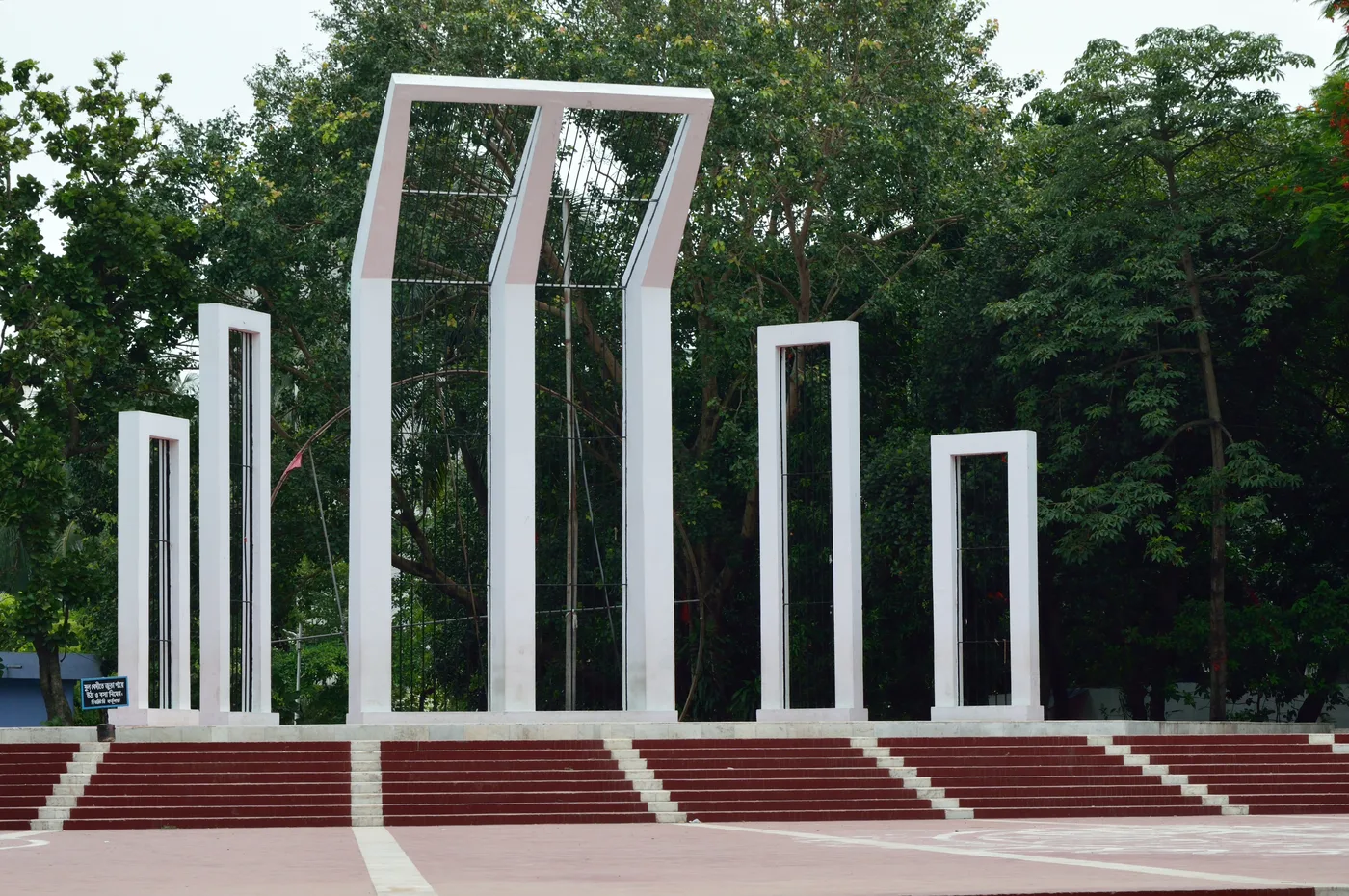
A majority treated as a minority: language, money and an election annulled in practice. In 1948 Governor-General Muhammad Ali Jinnah declared that "Urdu, and only Urdu" would be Pakistan's federal language, although Bengali speakers made up over 56 per cent of the population and only about 4 per cent spoke Urdu; the Bengali Language Movement climaxed on 21 February 1952, when police fired on protesters in Dhaka — a date UNESCO later made International Mother Language Day. The economic ledger pointed the same way: Pakistan's own planning commission figures show spending of 113,340 million rupees on West Pakistan against 45,930 million on the East across 1950–70, and officers of Bengali origin made up just 5 per cent of the armed forces by 1965. Mujibur Rahman's Six Points of 1966, demanding that the Bengalis govern themselves, became the East's programme.
Two events of 1970 converted grievance into rupture. On 12 November the Bhola cyclone killed an estimated 300,000 people in the East, and the central government's relief effort was charged by eleven East Pakistani leaders with "gross neglect, callous and utter indifference." In December's election the Awami League won 167 of East Pakistan's 169 seats and with them a majority of the 313-seat National Assembly. Bhutto, whose party had won the West, refused to yield the premiership to Mujib; Yahya Khan postponed the Assembly's inauguration; strikes shut the East down. On the night of 25 March 1971 the army launched Operation Searchlight, a planned crackdown to take the major cities and eliminate opposition. Mujib was arrested and flown west; on 26 March Major Ziaur Rahman broadcast a declaration of independence on his behalf, and a provisional government formed on 17 April at Meherpur under Tajuddin Ahmad, with Colonel M. A. G. Osmani as commander-in-chief.
How was the war fought?
Nine months of guerrilla war, then thirteen days that decided it. Through the spring and monsoon, the Mukti Bahini — its strength put at about 175,000, organised from July into eleven sectors and trained across the Indian border — raided, ambushed and sabotaged, while the Pakistan Army, reinforced from the West, held the towns. Its signature success was Operation Jackpot on 15 August 1971, when naval commandos mined and sank berthed shipping at Chittagong, Mongla, Narayanganj and Chandpur. Reprisals against civilians ran alongside the fighting (see Casualties), and the exodus — an estimated 10 million refugees by December — transformed India's position: New Delhi armed the insurgency, made growing incursions from October, and on 9 August signed a twenty-year friendship treaty with the Soviet Union.
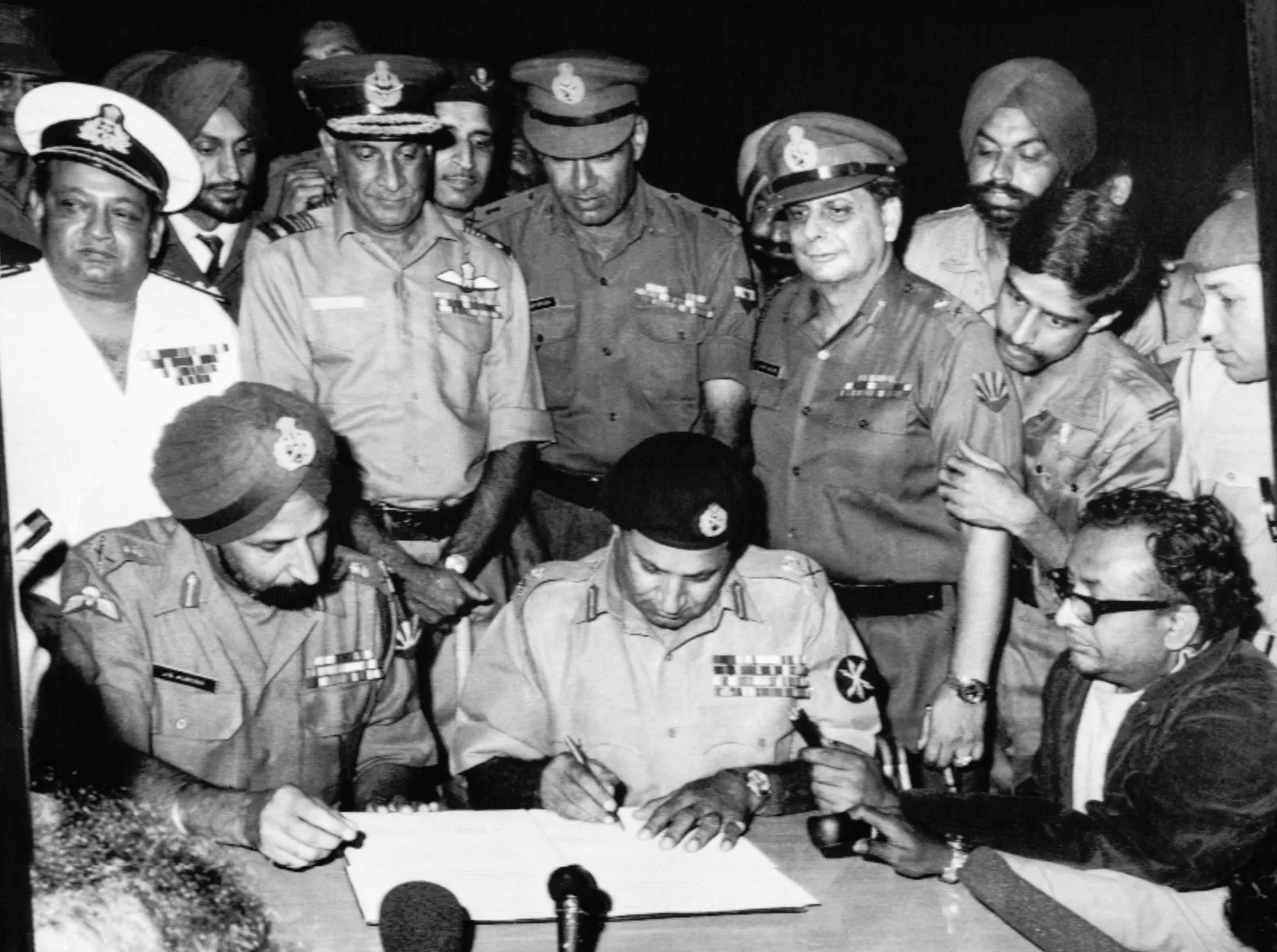
The endgame was fast. On 3 December Pakistan launched Operation Chengiz Khan, pre-emptive air strikes on Indian air stations modelled on Israel's 1967 opening; India declared war the same day. In the east the Indian Air Force won near-total air supremacy within a week, while the carrier INS Vikrant's aircraft struck Chittagong, Barisal and Cox's Bazar and the navy blockaded the eastern ports. Three Indian corps, with Mukti Bahini brigades alongside, bypassed strongholds and converged on Dhaka, in a plan associated with Eastern Command's chief of staff, Major General J. F. R. Jacob. The western front was heavier and indecisive, and the superpower confrontation stayed at signalling distance: USS Enterprise entered the Bay of Bengal on 11 December, and Soviet naval groups trailed it into January. On 16 December 1971, unable to defend Dhaka, Lt Gen A. A. K. Niazi signed the Instrument of Surrender before Lt Gen Jagjit Singh Aurora. Between 90,000 and 93,000 Pakistani personnel became prisoners — 79,676 to 81,000 of them uniformed — the largest surrender of armed personnel since the Second World War.
Casualties
The military figures are tolerably agreed; the civilian toll is the widest dispute in modern war historiography, and this article does not resolve it. Military deaths: Bangladesh Forces about 30,000 killed; Pakistan about 5,866 killed in the east by one accounting, and about 9,000 killed and 25,000 wounded across both fronts in the December war's neutral claims; India 2,500 to 3,843 killed across both fronts.
For civilians, the estimates in the published literature are:
- 26,000 civilian casualties — the Hamoodur Rahman Commission, Pakistan's own official inquiry, the lowest figure on record; the same commission concluded that overwhelming force had been used.
- 50,000 to 100,000 dead on all sides — Sarmila Bose, in Dead Reckoning (Hurst, 2011), a book strongly criticised by Naeem Mohaiemen, Nayanika Mookherjee and others for minimising atrocities; Bose defends it as non-partisan.
- 125,000 to 505,000 civilians — Obermeyer, Murray and Gakidou's 2008 British Medical Journal study, built on a 1976 population survey at Matlab; far above an earlier Uppsala/PRIO estimate of about 58,000.
- About 300,000, killed by all parties — Sisson and Rose, in War and Secession (University of California Press, 1990); independent researchers most commonly cite 300,000 to 500,000. The CIA and State Department, midway through the killing, conservatively estimated 200,000 already dead.
- About 1.5 million — R. J. Rummel's estimate.
- Slightly over 500,000, and no more than 1 million — Christian Gerlach's 2018 paper, concluding most of the dead were rural people who died of hunger, want and exhaustion, many in the year after the fighting.
- 3 million — Bangladeshi authorities' figure, embedded in the country's culture and national memory, though it has "come under strict scrutiny"; Bangladesh's first foreign secretary, Sayyid A. Karim, alleged its source was the Soviet newspaper Pravda.
Sexual violence carries its own disputed range: the generally cited estimate is 200,000 to 400,000 women raped; Pakistani sources put the number much lower while not denying that rapes occurred. Nor was the killing one-directional in every register: Urdu-speaking Biharis, who largely sided with Pakistan, were killed by Bengali mobs and militias in reprisals — some 300 in Chittagong alone in early March 1971, and between 1,000 and 150,000 across the war. What is not disputed in the sources opened is the targeting: US consulate staff reported that Bengali Hindus were singled out, the International Commission of Jurists concluded the campaign involved an attempt to exterminate or forcibly remove a significant portion of the Hindu population, and declassified US documents show American officials on the spot using the terms "selective genocide" and "genocide."
Economic effects
The war completed the economic argument that had started it — by destroying what was left to divide. Bangladesh emerged, in the US Library of Congress Country Study's summary, with the highest rural population density in the world, 8 to 10 million returnees to resettle by 1972, critical food-grain shortages, minuscule foreign-exchange reserves, and inflation on essentials at 300 to 400 per cent. Hundreds of bridges had been destroyed, and the jute trade — the East's great export earner — had lost markets to instability and synthetic substitutes. India, itself poor, committed US$232 million in aid in December 1971–January 1972, including 900,000 tons of food grains.
For Pakistan the loss was structural: more than half its population and its principal jute-producing region, and with them the premise of 1947. For India, the refugee bill had been the war's economic trigger: the reference accounts record Gandhi's conclusion that India would be better off going to war than maintaining the refugees indefinitely.
How it shaped the world
It redrew South Asia and set the terms on which the region still argues. Bangladesh took its place as, at independence, the world's seventh-most populous country; most UN member states recognised it within months, the United States on 8 April 1972 — while China vetoed its UN application in 1972 and withheld recognition until 1975. In Pakistan, Yahya's dictatorship collapsed within days and Bhutto took power; the defeat discredited the army's doctrine that "the defence of East Pakistan lay in West Pakistan."
The Simla Agreement of 2 July 1972 converted the December ceasefire line in Kashmir into the Line of Control, committed both states to settle disputes bilaterally — the clause India has invoked against third-party mediation on Kashmir ever since — and framed the prisoners' repatriation, formalised by the Delhi Agreement of 1973; India returned the roughly 13,000 square kilometres seized in the West. Raghavan's publisher's summary puts the long shadow plainly: the Line of Control, both states' later nuclearisation, Siachen, Kargil and the Kashmir insurgency "can be traced back to the intense nine months in 1971."
For the Cold War, 1971 became the textbook case of values subordinated to alignment. Gary J. Bass's The Blood Telegram (Knopf, 2013), built on the Nixon tapes and winner of the Cundill Prize, documents how Washington backed Yahya Khan — the intermediary for Nixon's secret opening to China — through the crackdown, routing military supplies via Jordan and Iran despite congressional sanctions, while its own Dhaka consulate sent the Dissent Channel's first message on 6 April 1971 accusing it of "moral bankruptcy" and applying the word genocide. Consul General Archer Blood endorsed the dissent; he was recalled and his career stunted.
What historians debate
- How many died — and what the number is for. In Bangladesh the 3 million figure is foundational memory; in Pakistan the low official figure long dominated textbooks; Bose's critics argue her low range minimises a genocide, her defenders that the high range was never evidenced. This article reports the range because the range is the finding.
- Was it genocide? Bangladeshi historiography and the International Commission of Jurists say yes, with Hindus a specifically targeted group; US officials in Dhaka used the word contemporaneously. Sisson and Rose deny a genocide occurred; Bose contests the killing's systematic character; Gerlach disputes a coordinated campaign against the intelligentsia — though the murder of at least 100 physicians, professors, writers and engineers rounded up in Dhaka on 14 December 1971 is documented in the same sources.
- Was Bangladesh inevitable? Raghavan argues 1971 turned on choices — the refused election result, Gandhi's patience, Nixon's tilt — any of which could have run otherwise; the successor states' historiographies treat the outcome as foreordained.
This explainer is drawn from the reference sources listed above, all opened or read during this run. Casualty and displacement figures are published strictly as the attributed ranges those sources give — for this war above all, a single silent number would be a falsehood in either direction.