The Spanish-American War, explained in one line, was a sixteen-week war in which the United States destroyed Spain's empire in the Americas and the Pacific: from 21 April to 13 August 1898, American squadrons annihilated the Spanish fleets at Manila Bay and Santiago de Cuba, American troops took Santiago, Puerto Rico and Manila, and the Treaty of Paris of 10 December 1898 ended almost four centuries of Spanish presence in the Americas, Asia and the Pacific — while making the United States, for the first time, an overseas colonial power. The United States Secretary of State John Hay, writing to Theodore Roosevelt, called it "a splendid little war". The figures below show for whom it was splendid, and for whom it was not.
Key takeaways
- Naval power decided the war in two afternoons: at Manila Bay on 1 May 1898 Dewey's squadron destroyed the Spanish Pacific fleet with nine Americans wounded and no American dead in the battle; at Santiago on 3 July the entire Spanish Caribbean squadron was sunk or beached for the loss of one American killed. Spain, its fleets gone, sued for peace within weeks.
- Disease, not Spain, was the main killer on both sides: of 2,446 American dead, only 385 were killed in action and 2,061 died of disease — 1,590 of them from typhoid in the army's own assembly camps. Of some 15,700-15,800 Spanish dead, about 15,000 died of disease.
- The war's largest death toll was not in the war at all: Spain's reconcentration of rural Cubans, the policy that did most to bring American intervention, killed at least 170,000 civilians by the standard summary's lowest figure, with estimates to 400,000 — before the United States fired a shot.
- The peace was contested from the start: the Senate ratified the Treaty of Paris by one vote, Cuba's independence came with American-imposed restrictions, and the annexation of the Philippines produced, within weeks, a second and bloodier war against the Filipinos who had fought Spain alongside the Americans.
Contents
- Overview
- Why did the United States and Spain go to war?
- How did the war unfold?
- Casualties
- Economic effects
- How it shaped the world
- What historians debate
Overview
The Spanish-American War was the intersection of three separate conflicts: Cuba's war of independence from Spain, begun in February 1895; the Philippine Revolution against Spanish rule, in truce since 1897; and an American debate about whether the republic should become an empire. Spain entered it as a declining power that had already lost most of its American colonies; Cuba, Spanish for almost four hundred years and treated in Madrid as an integral part of the nation rather than a colony, was the possession it would not surrender. The United States entered it as a rising industrial power whose trade already dominated the island — in 1894, 90 percent of Cuba's exports went to the United States — and whose new steel navy, built under the influence of the theorist Alfred Thayer Mahan, had been planned for exactly such a war.
The imbalance showed in preparation rather than numbers. Spain listed some 339,783 men, most of them in Cuba, but the standard summary notes that only 20 to 25 percent of its army was capable of field operations, its soldiers wasted by yellow fever and three years of guerrilla war. The United States mobilised about 300,000 men from a regular army of under 25,000 — chaotically, as Graham Cosmas documents in An Army for Empire (University of Missouri Press, 1971) — but its fleet was modern and ready. David F. Trask's The War with Spain in 1898 (Macmillan, 1981) remains the standard military history; Ivan Musicant's Empire by Default (Henry Holt, 1998) tells the same campaigns as the accidental acquisition of an empire nobody had planned in detail.
Why did the United States and Spain go to war?
Because Spain could neither win its Cuban war nor concede it, and the suffering that war produced ninety miles from Florida made American inaction politically impossible. The Cuban insurgency led by José Martí, Máximo Gómez and Antonio Maceo fought Spain to a standstill after 1895. Madrid replaced the relatively cautious General Martínez Campos with General Valeriano Weyler, who from 1896 herded the rural population into fortified reconcentration areas to separate the rebels from their support. Britannica's account is blunt: Spanish authorities made no adequate provision for shelter, food, sanitation or medical care, and thousands of the reconcentrados died of exposure, hunger and disease. American newspapers — above all Pulitzer's New York World and Hearst's New York Journal — carried the story in sensational form, and American investments in Cuba, estimated by Britannica at $50 million, were being destroyed by a war fought largely against property.
Two Presidents resisted intervention: Grover Cleveland, and then William McKinley, who nonetheless told Spain the United States could not stand aside indefinitely. Then the crisis detonated. Riots in Havana in December 1897 brought the armoured cruiser USS Maine to Havana harbour to protect American citizens. On 9 February 1898 the Journal published a stolen private letter from the Spanish minister in Washington, Enrique Dupuy de Lôme, calling McKinley "weak and a popularity-hunter". On the night of 15 February, Maine exploded and sank at her anchorage, killing 266 of a crew of 355. A United States naval board concluded that an external explosion under the hull had set off her magazines; it named no perpetrator, but American public opinion, encouraged by the yellow press, held Spain responsible anyway. Spain's own investigation concluded the explosion had originated inside the ship.
McKinley's ultimatum of 27 March demanded an end to reconcentration, an armistice, and American mediation. Spain conceded much of it — and on 9 April announced an armistice on its own initiative — but would not concede Cuban independence, which McKinley now held indispensable; Madrid judged that surrendering Cuba without a fight might bring down the monarchy itself. On 11 April McKinley asked Congress for authority to intervene. Congress answered on 20 April with resolutions declaring Cuba independent, demanding Spanish withdrawal, and — in Senator Henry Teller's amendment — renouncing any American intention to annex Cuba. Spain severed relations and declared war on 24 April; Congress declared war on 25 April, retroactive to 21 April.
How did the war unfold?
In two naval annihilations and one grinding land campaign: Manila Bay on 1 May, the Santiago campaign in June and July, and the fall of Santiago on 17 July, after which Spain asked for terms.
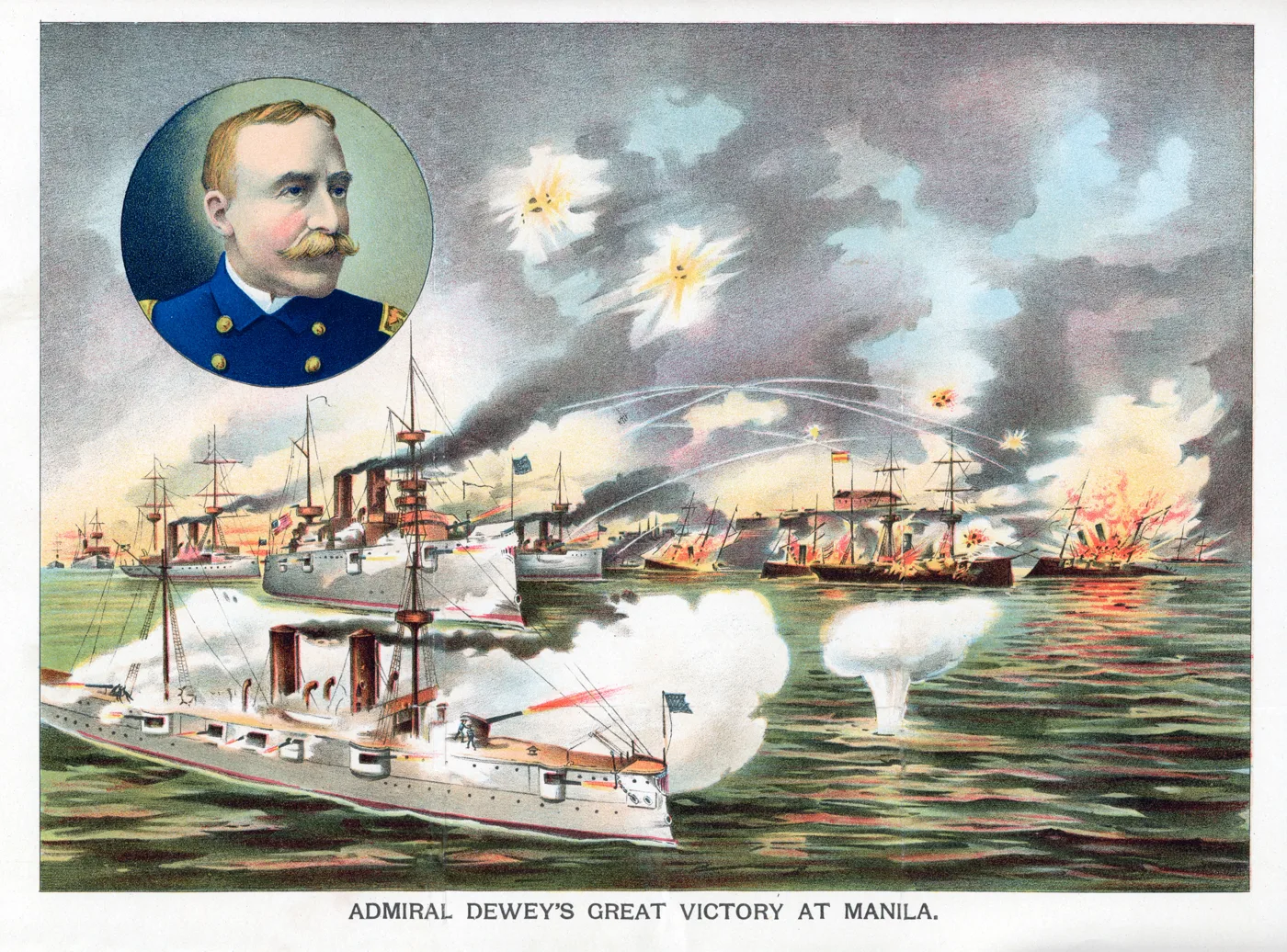
The first blow fell half a world from Cuba. Commodore George Dewey's Asiatic Squadron entered Manila Bay on the night of 30 April and on 1 May destroyed Admiral Patricio Montojo's Spanish squadron in hours, at a cost of nine Americans wounded. Dewey blockaded Manila and ferried the exiled Filipino leader Emilio Aguinaldo back from Hong Kong; by June, Aguinaldo's forces controlled most of the provinces around Manila and had proclaimed Philippine independence on 12 June. American ground troops — some 11,000 were sent — began arriving on 30 June. On 20 June the cruiser Charleston took Guam without resistance, its garrison unaware war had been declared.
In the Caribbean, the campaign turned on Santiago de Cuba, where Admiral Pascual Cervera's squadron had taken refuge. Marines landed at Guantánamo Bay on 10 June; General William Shafter's Fifth Corps, some 15,000-17,000 men, landed east of Santiago from 22 June, aided by Calixto García's Cuban insurgents. On 1 July American forces stormed the outer defences at El Caney and the San Juan Heights — the fight that made Theodore Roosevelt's Rough Riders famous, and in which Black regular regiments, including the Ninth and Tenth Cavalry, did much of the fighting. It cost the United States more than 1,000 killed and wounded — the hardest fighting of the war. On 3 July Cervera's four armoured cruisers and two destroyers, ordered to sea, were destroyed one by one along the coast: Britannica's battle account records Spanish losses of 474 dead or wounded and 1,800 captured, against one American dead and one wounded. Santiago surrendered on 17 July. On 25 July General Nelson Miles landed in Puerto Rico and advanced against light opposition until the armistice.
Spain, both fleets destroyed, sued for peace through the French ambassador Jules Cambon on 26 July. A protocol signed on 12 August ended the fighting — one day before American forces, unaware of it, took Manila on 13 August, in an action from which Filipino forces were deliberately excluded: the end, the standard accounts note, of Filipino-American collaboration. The Treaty of Paris followed on 10 December 1898.
Casualties
This war has three separate ledgers, and they differ by orders of magnitude: the battle deaths, which were small; the disease deaths, which were not; and the Cuban civilian deaths of the independence war that preceded American intervention, which dwarf both.
- United States: 2,446 dead in the standard summary — 369 soldiers, 10 sailors and 6 Marines killed in action (385 in total), 2,061 dead of disease, and 1,662 wounded. Typhoid was the chief killer: 21,738 soldiers contracted it in the assembly camps and 1,590 died. The medical failure produced official boards of inquiry and long-term reforms in military medicine and camp sanitation.
- Spain: 15,700 to 15,800 dead in the standard summary — about 200 soldiers killed and 500 to 600 sailors killed, against some 15,000 dead of disease, with 700 to 800 wounded and more than 40,000 captured, most of them in the Santiago surrender. Spanish forces in Cuba were already being consumed by disease before the Americans landed: about 55,000 of 230,000 troops in Cuba were incapacitated by illness during the campaign.
- **The Maine:** 266 dead — the single deadliest incident for the United States, and the war's casus belli. Its cause remains formally unresolved (see the debate section below).
- Cuban civilians, 1895-98: the reconcentration policy interned 400,000 to 500,000 rural Cubans — by 1898 a third of the island's population. The death toll is disputed across a wide range: the summary of the policy records 170,000 to 400,000 killed, with at least 170,000 as the floor — at least 10 percent of all Cubans; American textbook figures cluster around 200,000. None of these figures is a count; all are estimates. Cuban insurgent and Filipino combatant deaths are not settled in the sources opened for this article and are not stated here.
Economic effects
- The war was cheap for the United States as wars go, and its longest-lived cost was a telephone tax: its cost is put at $250 million in the standard American accounts. To pay for it Congress levied an excise tax on long-distance telephone service, then a luxury of the wealthy; the tax was never repealed and remained in place for more than a century, until the Treasury announced in 2006 that it would no longer be collected.
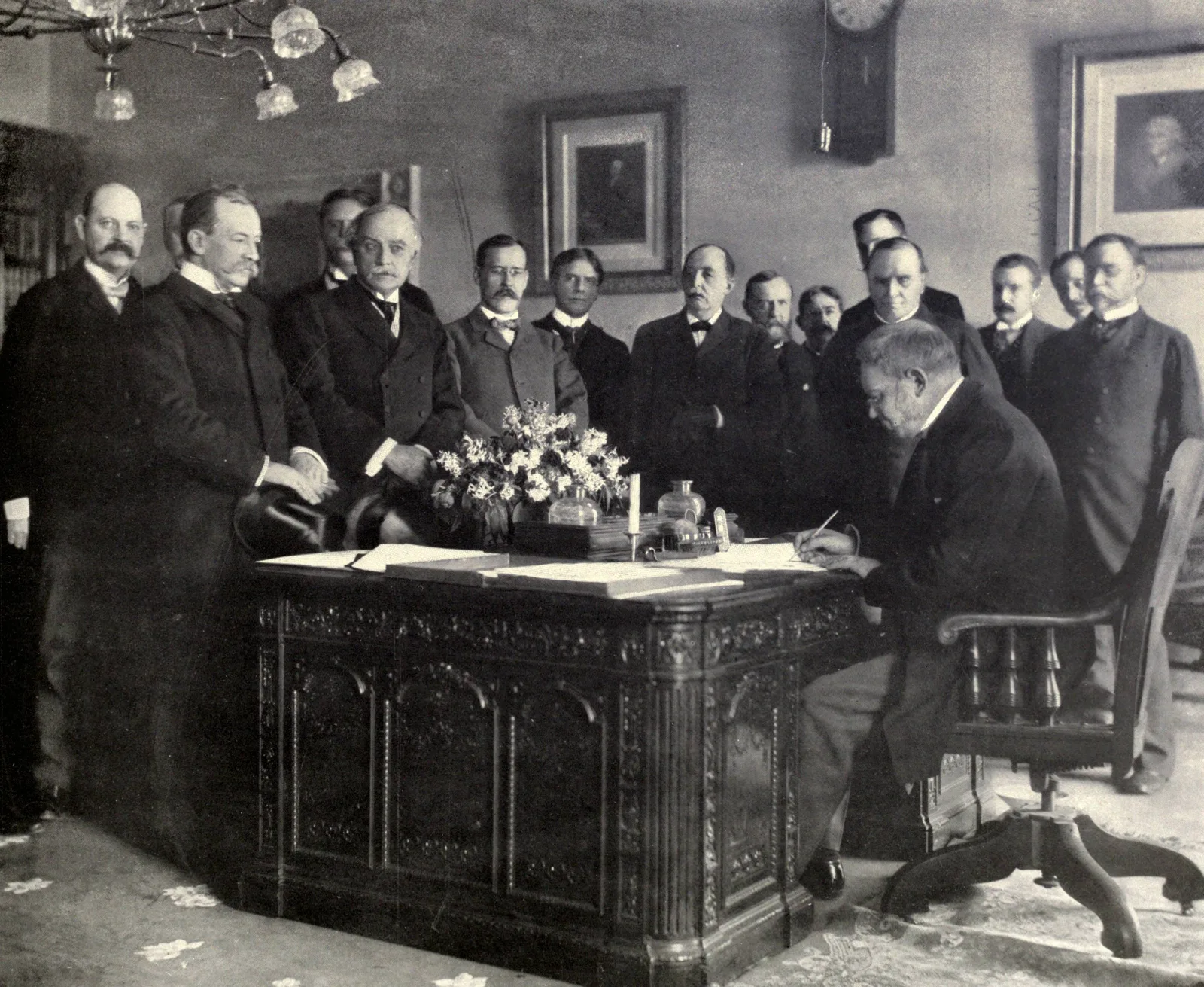
- The peace transferred territory priced at $20 million: under the Treaty of Paris the United States paid Spain $20 million on acquiring the Philippines — described in the treaty framing as payment for Spanish infrastructure there. Puerto Rico and Guam were ceded without payment, and Cuba passed out of Spanish sovereignty entirely, ending the trade and prestige relationship Spain's Restoration governments had treated as central to the national economy; Cuban exports had in any case already reoriented to the United States, which took 90 percent of them by 1894.
- For Spain, defeat paradoxically recapitalised the peninsula: the standard account of the aftermath records that large sums of capital held by Spaniards in Cuba and the United States were repatriated after the war and invested in Spain — a flow equivalent to 25 percent of one year's gross domestic product — helping to develop the large modern firms of Spanish steel, chemicals, finance, textiles, shipbuilding and electrical power. Spain's remaining Pacific possessions, the Caroline and Mariana islands, were sold to Germany in 1899 as untenable without the Philippines.
How it shaped the world
- It ended one empire and founded another: the war closed almost four centuries of Spanish presence in the Americas, Asia and the Pacific. The United States emerged holding Puerto Rico, Guam and the Philippines, predominant in the Caribbean and positioned in East Asia — and annexed Hawaii by joint resolution during the war itself, on 12 August 1898, as a Pacific way-station. The Office of the Historian's summary is that the war "secured the position of the United States as a Pacific power".
- In the Philippines, it started a worse war: Filipino forces had besieged Manila expecting independence; the Treaty of Paris transferred their country to the United States without consulting them. Fighting between American troops and the Philippine Republic began in February 1899 and became the Philippine-American War, which the standard summary notes "would prove to be more deadly and costly than the Spanish-American War".
- In Cuba, independence came with a lease and a right of intervention: Cuba became independent on 20 May 1902, but under the Platt Amendment of 1901 the United States reserved the right to intervene to stabilise Cuba, barred it from treaties or debts that might invite intervention, and obtained what became the perpetual lease of Guantánamo Bay under the 1903 treaty of relations. Louis A. Pérez Jr., in Cuba in the American Imagination (2008), argues the war "fixed permanently how Americans came to think of themselves: a righteous people given to the service of righteous purpose".
- In Spain, 1898 became a byword for national reckoning: the defeat — el Desastre del 98 — provoked the Generation of '98, a philosophical and artistic re-evaluation of Spanish society, and the regenerationist movement. The head of Spain's peace delegation, Eugenio Montero Ríos, is quoted in the standard account: "Everything has been lost, except the Monarchy." Spain turned to its remaining African possessions and, within a decade, to commercial treaties with the United States (1902, 1906, 1910) and the 1907 Pact of Cartagena with Britain and France.
- In the United States, it reopened the question of what the republic was: annexation was debated against an organised anti-imperialist opposition led by William Jennings Bryan and joined by Mark Twain; the treaty survived the Senate by one vote on 6 February 1899. The war also served, in the standard accounts, as a reunion of North and South — four former Confederate generals held United States commissions in 1898 — and it made the reputation of Theodore Roosevelt, who went from the San Juan Heights to the governorship of New York and, in 1901, the presidency.
What historians debate
- **What sank the Maine?** Every investigation has answered differently, and the sequence is the finding. The 1898 United States naval board: an external explosion, a mine, set off the magazines — responsibility unstated. The Spanish investigation of 1898: an internal explosion. In 1974 Admiral Hyman Rickover's staff review concluded the explosion was internal. A 1999 study commissioned by National Geographic, using computer modelling of the hull plating, concluded the destruction "could have been caused by a mine". No investigation has produced evidence identifying a perpetrator, and Britannica's verdict stands: "Responsibility for the disaster was never determined."
- Did the yellow press cause the war? The famous story — Hearst telling his illustrator "You furnish the pictures and I'll furnish the war" — is described in the standard summary as a myth, and modern historiography, including W. Joseph Campbell's work cited there, holds that yellow journalism was largely a New York phenomenon, no longer considered the major force shaping the national mood; business opinion was in fact vocally anti-war until late in the crisis. The consensus position the summary reports is that humanitarian concern over Cuba was the main motivating force. Pérez, in The War of 1898 (University of North Carolina Press, 1998), argues that this framing also served to present a deliberate war of policy as an accident of conscience, and reads the war from the Cuban side, where American intervention arrived as Cuban victory approached and then excluded Cubans from the peace.
- Did McKinley want the war? John L. Offner's An Unwanted War (University of North Carolina Press, 1992) takes its title from its thesis: the diplomacy of 1895-98 was a negotiation both governments mishandled — Spain conceding almost everything except the one thing, independence, that Washington finally required, and Madrid preferring a war it expected to lose over a surrender it feared would topple the monarchy. Nick Kapur's more recent reading, cited in the standard summary, locates McKinley's path to war not in press or business pressure but in his own humanitarian and arbitral values, which left him no exit once Spain would not concede independence.