The American Revolutionary War, explained in one line, was an eight-year war in which Britain's Thirteen Colonies in North America won independence and became the United States: fought from 19 April 1775 to 3 September 1783, it began as a civil war inside the British Empire, became a world war after France and Spain intervened, and ended when Britain recognised American independence in the Treaty of Paris.
Key takeaways
- Survival was the American strategy: Washington's Continental Army rarely numbered more than about 20,000 men at one time. It did not need to destroy Britain's army — it needed to stay in the field until Britain tired of the cost.
- Saratoga made the war international: Burgoyne's surrender in October 1777 persuaded France to ally openly with the United States in February 1778. Spain followed against Britain in 1779, and Dutch finance and recognition widened the war further, as Britannica records.
- Disease killed more than combat: in the most cited American accounting, only about a quarter of Patriot military deaths were battle deaths. Camp disease and the prison ships account for most of the rest.
- Yorktown decided the political outcome: Cornwallis's surrender of more than 7,000 men on 19 October 1781 did not end every theatre of the war, but it ended Britain's willingness to keep fighting for the thirteen colonies.
- The peace created a new map and new debts: the United States gained land to the Mississippi, France gained little territory for a very large bill, and tens of thousands of Loyalists left the new republic.
Contents
- Overview · Why war came · How it unfolded · Casualties · Economic effects · How it shaped the world · What historians debate
Overview
The American Revolutionary War — the American War of Independence in British usage — was fought in eastern North America, the Caribbean and the Atlantic. On the American side stood the Continental Army, created in June 1775 and commanded by George Washington, alongside state militias — seldom more than about 20,000 under arms at any one time, on Britannica's figures. Britain fielded about 42,000 regulars, about 30,000 German auxiliaries and Loyalist units. Sea power was central: Britain's navy moved its armies between coastal cities, while the French navy's later entry removed that guarantee at the decisive moment.
The war was also a civil war. Historians commonly put white Loyalists at roughly a fifth to a quarter of the white population, Native American nations divided between the sides, and enslaved people sought freedom with whichever side offered it — divisions that explain the war's local violence and the departure that followed it.
Why did war come in 1775?
Because a fiscal argument about who should pay for the Seven Years' War became a constitutional argument about who had the right to tax — and neither side would concede the principle.
Britain emerged from the Seven Years' War in 1763 with Canada taken from France and a national debt that had roughly doubled. Parliament expected the colonies to help pay for frontier garrisons. The Sugar Act, the Stamp Act of 1765 and the Townshend duties tested that expectation; colonial assemblies answered that taxation without representation in Parliament was unconstitutional. London repealed the Stamp Act but asserted its authority in the Declaratory Act.
The cycle repeated: the Boston Massacre of 1770 (five killed), the Tea Act of 1773, and the destruction of tea in Boston Harbor that December. Parliament's Intolerable Acts closed Boston's port and restricted Massachusetts self-government. When British troops marched to seize militia stores at Concord, militiamen met them at Lexington and Concord on 19 April 1775. Congress adopted the army, appointed Washington, and declared independence on 4 July 1776.
How did the war unfold?
In three broad phases: British success without a decision in the north, stalemate transformed by French entry, and a southern campaign that trapped Britain's second army at Yorktown.
Britain evacuated Boston in March 1776 after American artillery hauled from Fort Ticonderoga under Henry Knox overlooked the town — the episode David McCullough's 1776 (Simon & Schuster, 2005) made the centrepiece of its account of the war's first year. Britain then took New York, defeated Washington on Long Island and drove him across New Jersey. His counterstrokes at Trenton at Christmas 1776 and Princeton in January 1777 were small; their importance, as Britannica notes, was keeping the struggle alive.
In 1777 Britain divided its effort: Howe took Philadelphia while John Burgoyne advanced from Canada toward Albany. Burgoyne stalled as supplies failed, American forces under Horatio Gates and Benedict Arnold defeated him near Saratoga on 19 September and 7 October, and he surrendered on 17 October 1777. Rick Atkinson's The British Are Coming (2019) tells this opening period from both sides.
Saratoga changed the war's scale. France, secretly supplying the Americans since 1776, signed treaties of commerce and alliance on 6 February 1778. Spain declared war on Britain in 1779 and the Dutch Republic was at war with Britain by late 1780; fighting spread to the Caribbean, the Mediterranean and India. In America the north settled into a watch around New York, the army emerged from Valley Forge better drilled under Friedrich Wilhelm von Steuben, and Britain shifted south, expecting stronger Loyalist support.
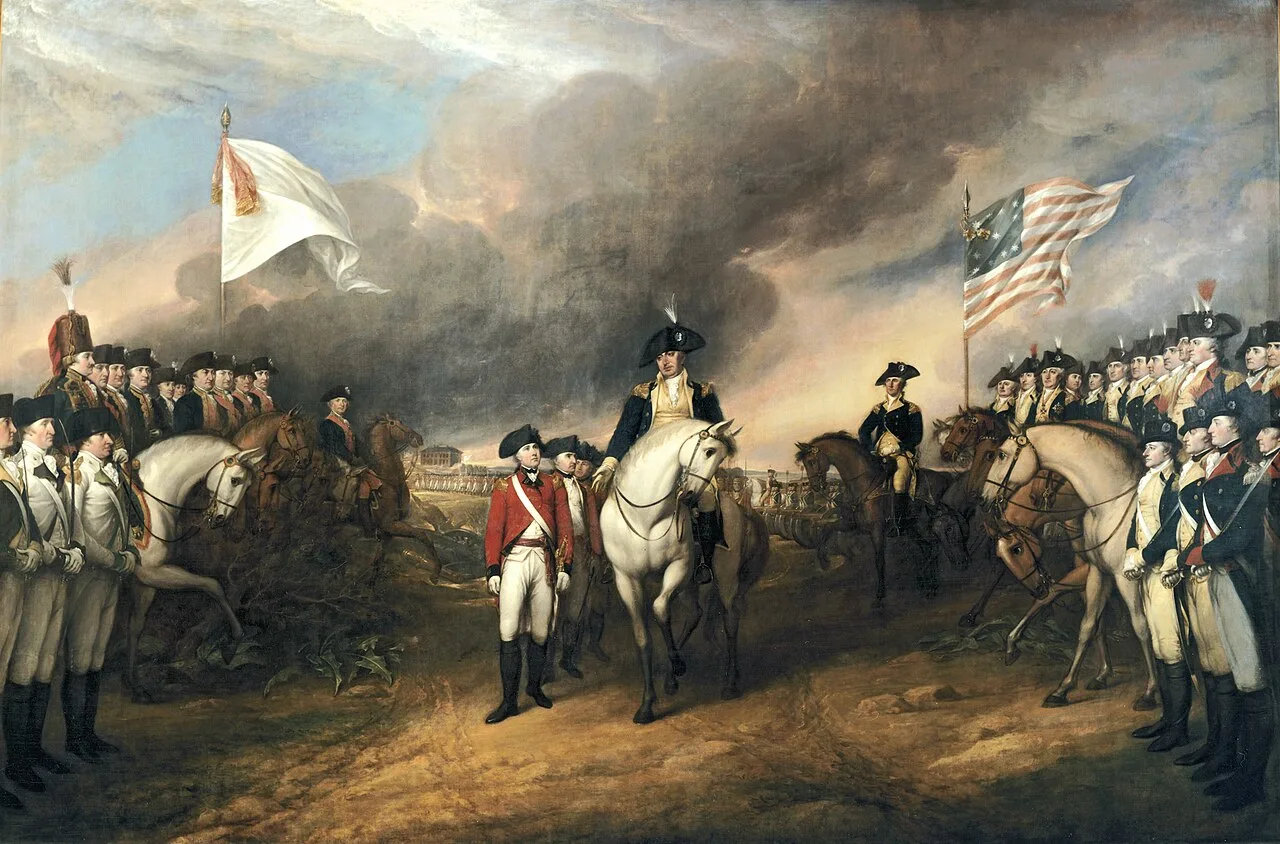
The southern strategy won Savannah and Charleston and destroyed an American army at Camden in August 1780, then thinned: Kings Mountain, Cowpens and a costly victory at Guilford Courthouse weakened Charles Cornwallis, who fortified Yorktown, Virginia. Washington and Rochambeau marched south, a French fleet sealed the Chesapeake, and the National Park Service chronology records the siege: investment on 28 September 1781, first siege line opened in one night on 6 October, redoubts stormed on 14 October, and surrender on 19 October. More than 7,000 troops became prisoners — about a third of Britain's forces in North America.
Land fighting in North America largely stopped. The wider war with France and Spain ran on until the general peace of 1783.
Casualties
No complete count exists for any side, and the figures below are ranges and named estimates rather than a single toll. Record-keeping was fragmentary, armies counted differently, and disease — the largest killer — was recorded worst of all.
- United States: Howard H. Peckham's The Toll of Independence (1974), still described by HISTORY as the most accurate accounting, gives 25,324 to 25,534 American military deaths: about 6,800 to 8,624 killed in battle, about 10,000 dead in camp, and about 8,500 dead in captivity, many on prison ships in New York Harbor.
- Great Britain: the standard table gives 43,633 British military deaths for 1775–83 counting soldiers and sailors in all theatres, with about 8,500 killed in action. The American Battlefield Trust, cited by HISTORY, cautions that the imperial data are unreliable and puts total British casualties in the American theatre at about 24,000 — which is why British figures must be read with their scope stated.
- German auxiliaries and Loyalists: about 7,774 German troops died in British service, about 1,800 of them in battle, and about 4,888 deserted, many settling in America. Loyalist military deaths are put at about 7,000, about 1,700 in battle and 5,300 from disease. French combat deaths in the United States are given as 2,112; Spanish losses in West Florida as 124 to 371 killed, depending on the table.
- Disease beyond the armies: Elizabeth Fenn's Pox Americana (2001) puts the concurrent 1775–82 smallpox epidemic's deaths at at least 130,000 across North America — several times the American military toll — with Native communities hardest hit. Historian Joseph Ellis singles out Washington's 1777 inoculation of the Continental Army as one of his most consequential decisions.
- The population share: with about 2.5 million people in the colonies in 1776, American military deaths of about 25,000 were roughly 1 percent of the population.
Economic effects
- Britain — expensive, but financeable: Britain spent about £80 million and ended with a national debt of about £250 million. Its tax system carried the load, though an estimated 3,386 British merchant ships were seized during the war.
- France — the victory that broke the treasury: France spent about 1.3 billion livres. Its total debt reached about 3,315 million livres, debt service consumed 43 percent of the budget in 1780 and more than half of revenue by the late 1780s, and the fiscal crisis of 1786 is treated as a direct enabling condition of the French Revolution of 1789.
- The United States — inflation, then a fiscal state: Congress, which could not tax under the Articles of Confederation, printed Continental paper money until its collapse coined a phrase for worthlessness, borrowed in France and the Netherlands, and spent about $37 million nationally and $114 million through the states. The debt was addressed only in the 1790s, under Alexander Hamilton's funding system and the First Bank of the United States.
How it shaped the world
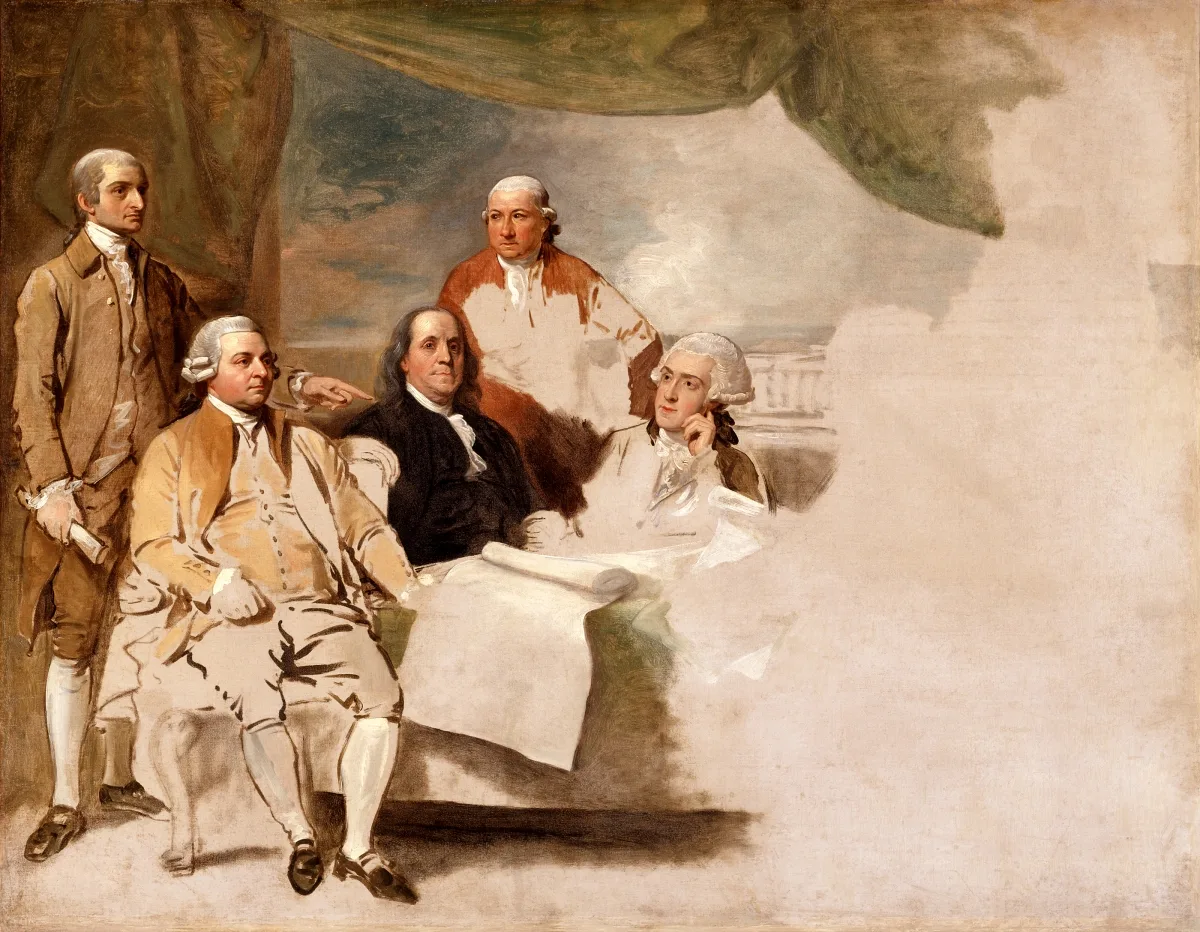
- It created the United States — and its first borders. The Treaty of Paris of 3 September 1783, negotiated by Franklin, John Adams and John Jay, recognised independence and set the western boundary at the Mississippi, as the U.S. Office of the Historian records. Britain kept Canada and Spain recovered Florida. Native nations that had allied with Britain were not parties to the treaty, though much of the ceded land was theirs — a fact whose consequences ran for generations.
- It ended the first British Empire and redirected the second. The loss is conventionally treated as the close of Britain's first Atlantic empire and a turn toward Asia; British power itself continued to grow with early industrialisation.
- It helped trigger the French Revolution. The monarchy's inability to service its war debt without new taxes it could not raise without consent is the mechanism financial histories emphasise: the Estates-General summoned for 1789 became a revolution.
- It displaced the Loyalists and remade Canada. Maya Jasanoff calculates about 60,000 Loyalist emigrants in total; Wallace Brown and Britannica give up to 80,000. About 36,000 went to Nova Scotia and New Brunswick, a province created for them in 1784, and several thousand Black Loyalists were among the evacuees — a founding migration for English-speaking Canada.
- It supplied a model — and a warning. The new republic became a reference point for later independence movements, while its settlement left slavery intact and left debts, fisheries and frontier posts unresolved — issues fought over again in 1812.
What historians debate
- Was the Revolution radical, or conservative? Gordon S. Wood, in The Radicalism of the American Revolution (1992), argues it was radical in its social consequences, dismantling inherited hierarchy and abolishing primogeniture and entail. Bernard Bailyn's The Ideological Origins of the American Revolution (1967) located the radicalism in ideas. Others stress the limits: slavery, women's exclusion and property inequality survived. The debate is over how much of society the Revolution transformed.
- Could Britain have won? One tradition holds Britain's task — holding a continent 3,000 miles away, with no centre whose capture ends a rebellion — was close to impossible once France entered. Another points to Washington's army nearly destroyed in 1776 and American finance near collapse in 1780–81: on this reading, French sea power at the Chesapeake, not inevitability, decided Yorktown.
- How decisive was Saratoga, really? Edmund Morgan's judgement treats Saratoga as the turning point because it won the foreign assistance victory required. Others note France had supplied the rebellion since 1776 for its own reasons — Saratoga supplied the proof, on this view, rather than the motive.
- Who bears the war's largest death toll? Fenn's work re-centres the account on the at least 130,000 North Americans, most of them civilians, whom the concurrent smallpox epidemic killed — a reminder that the war's widest effects were not on its battlefields.