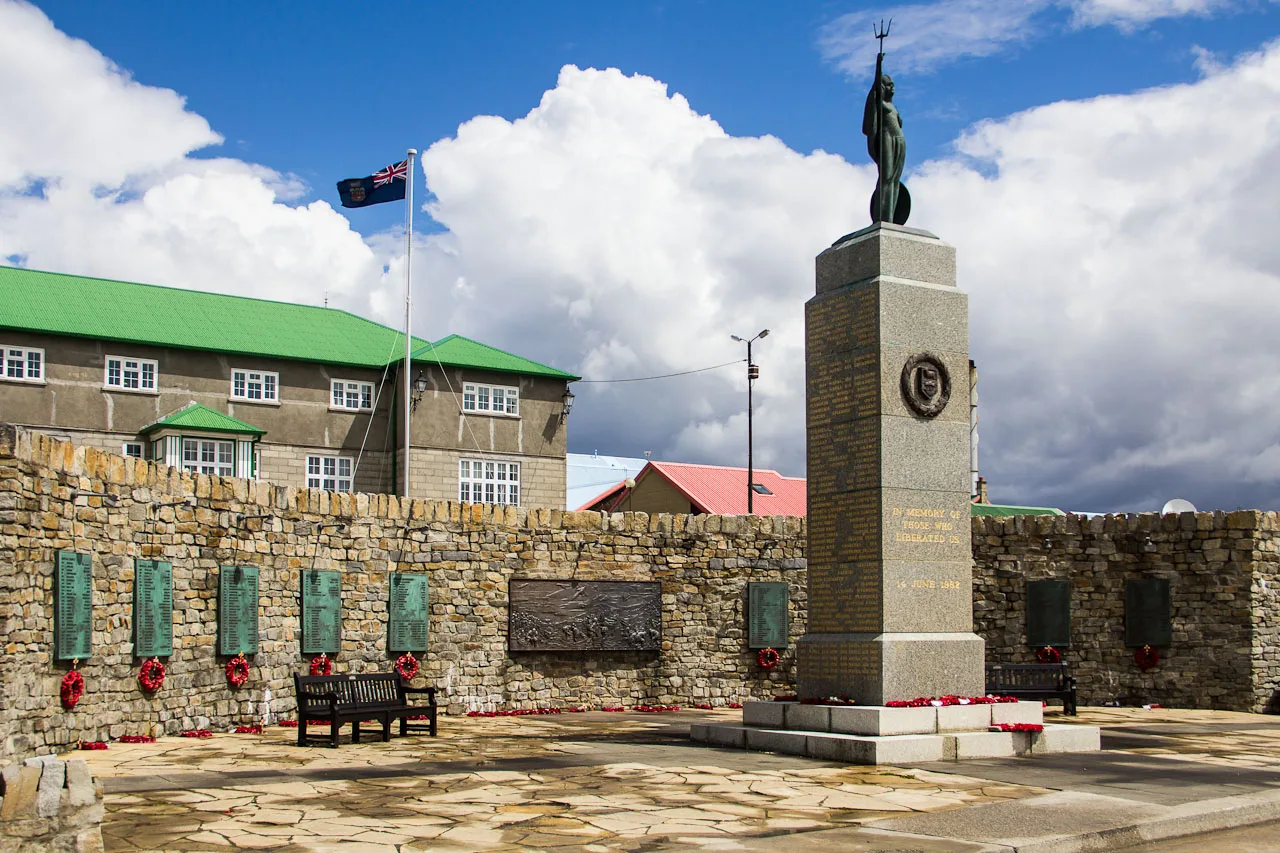
The Falklands War, explained in one line, was a 74-day undeclared war in the South Atlantic: from 2 April to 14 June 1982, Argentina invaded the Falkland Islands — which it calls the Islas Malvinas — along with South Georgia and the South Sandwich Islands, and the United Kingdom, under Prime Minister Margaret Thatcher, sent a naval task force some 8,000 miles (about 13,000 km) to take them back. Britain won. Argentina's ruling military junta fell within a year, Britain's government was re-elected the next, and the sovereignty dispute that caused the war is still not settled.
Key takeaways
- A 19th-century dispute, settled by 20th-century weapons: in 1982 the argument was decided, temporarily, by nuclear submarines, Exocet missiles and carrier aircraft.
- Deterrence failed on signals, not strength: the junta invaded because it expected Britain not to fight; the planned withdrawal of Britain's one South Atlantic patrol ship was read in Buenos Aires as proof of that.
- One sinking removed a navy: after HMS Conqueror sank the General Belgrano on 2 May, the Argentine surface fleet went home and never came out again.
- Professionalism against numbers: Argentina held the islands with roughly 13,000 troops at peak, many of them conscripts short of food and winter clothing; Britain landed a smaller all-volunteer force and marched it to Stanley.
- The fallout outlasted the war: defeat brought down the junta and opened the path to civilian rule in 1983; victory strengthened Thatcher's government, re-elected in 1983.
Contents
- Overview
- Why did Argentina invade in 1982?
- How did the war unfold?
- Casualties
- Economic effects
- How it shaped the world
- What historians debate
Overview
The islands lie about 300 miles (480 km) off Argentina's coast. Argentina's claim, as summarised by Britannica, is that it inherited the territory from Spain and that Britain seized the islands in 1833, expelling the Argentine occupants. Britain's position rests on its own earlier claims, on administration since 1833 — a Crown colony from 1841 — and on the islanders' wishes: mostly of British descent, they favour British sovereignty. The UN recognised a dispute in 1965 and called for negotiations; talks ran for 17 years without settling sovereignty.
Neither country ever declared war. Both declared the waters around the islands a war zone, and the fighting combined submarine operations, missile strikes on warships, amphibious landings under air attack, and infantry battles fought at night in winter — at the end of one of the longest supply lines any navy has operated in the missile age.
Why did Argentina invade in 1982?
Because a failing military government decided that recovering the islands would save it — and calculated that Britain would accept the seizure. Both halves of that sentence are the standard account, and both matter.
Argentina had been ruled since 1976 by a junta whose record included the disappearances of the Dirty War. By late 1981 the economy was stagnating and protests were growing. General Leopoldo Galtieri took over in December 1981; Admiral Jorge Anaya was the leading advocate of solving the islands question by force. Britannica's summary is blunt: the junta believed recovering the islands would unite Argentines behind it, diverting attention from economic mismanagement and human-rights abuses.
The calculation about Britain was not baseless. London had signalled ambivalence for years: a leaseback proposal collapsed in 1980 amid islander and parliamentary opposition, and the 1981 defence review planned to withdraw HMS Endurance, the navy's only permanent South Atlantic presence — a move the ship's captain and others warned would be read as abandonment.
Then the timetable slipped. On 19 March 1982 Argentine scrap-metal workers landed on South Georgia and raised the Argentine flag. London sent Endurance to remove them; Buenos Aires, fearing reinforcement, brought the invasion forward. On 2 April Argentine forces landed outside Stanley. The small garrison — 68 Royal Marines, 11 naval personnel and local volunteers under Governor Rex Hunt — resisted briefly, then surrendered on Hunt's order; Argentine troops had orders to inflict no British casualties, and none were inflicted. South Georgia fell the next day, and large crowds filled Buenos Aires' Plaza de Mayo in support.
How did the war unfold?
Britain's response was faster than Argentina had allowed for, and the campaign fell into three acts: a diplomatic race, a sea-and-air battle, and a land advance on Stanley.
Diplomacy first. On 3 April the UN Security Council passed Resolution 502 by ten votes to one, demanding an immediate Argentine withdrawal; the Soviet Union and China abstained rather than veto. US Secretary of State Alexander Haig shuttled between London and Buenos Aires through April. The talks failed, and on 30 April Washington publicly backed Britain, opening US stocks — including the latest Sidewinder missiles — plus fuel and facilities at Ascension Island, the staging base the British effort depended on. The task force — eventually 127 ships, including the carriers HMS Hermes and HMS Invincible and requisitioned liners such as Canberra and Queen Elizabeth 2 — had sailed from 5 April. One US Navy assessment, reported by the historian Arthur L. Herman, rated a successful counter-invasion a military impossibility, given the distance and Britain's thin carrier air cover.
British forces retook South Georgia on 25 April, disabling the submarine Santa Fe. On 1 May RAF Vulcan bombers from Ascension — an 8,000-nautical-mile round trip requiring chains of tankers — bombed Stanley airfield in the first Black Buck raid; Freedman records that the raids' significance remains contested.
On 2 May the nuclear submarine HMS Conqueror torpedoed the cruiser General Belgrano just outside the declared Total Exclusion Zone, killing 323 of those aboard. Two days later an Argentine Super Étendard hit HMS Sheffield with an Exocet; 20 of her crew died and the destroyer sank under tow on 10 May — the first Royal Navy ship sunk in action since the Second World War. After Belgrano, Argentina's surface fleet stayed in port; after Sheffield, no navy could doubt that a single missile could kill a modern warship.
The land campaign began on 21 May, when some 4,000 men of 3 Commando Brigade landed around San Carlos Water. Argentine aircraft attacked the anchorage — remembered as Bomb Alley — sinking HMS Ardent, HMS Antelope and, on 25 May, HMS Coventry and Atlantic Conveyor, whose loss took most of the force's heavy helicopters. Many Argentine bombs that hit failed to explode, released too low for their fuzes to arm. On 27–28 May 2 PARA took Goose Green after a night battle in which its commander, Lieutenant Colonel H. Jones, was killed and later received a posthumous Victoria Cross. The worst British loss came on 8 June, when aircraft caught Sir Galahad and Sir Tristram at anchor near Fitzroy, killing 48 men, most of them Welsh Guards. In the nights of 11–14 June British troops took the high ground around Stanley — Mount Longdon, Two Sisters, Mount Harriet, Wireless Ridge and Mount Tumbledown — and on 14 June the Argentine commander, Brigadier General Mario Menéndez, surrendered to Major General Jeremy Moore. The last Argentine outpost, on the South Sandwich Islands, surrendered on 20 June.
Casualties
The commonly cited totals, carried by Britannica and the standard casualty tables, are unusually precise for a modern war — the fighting was short, the theatre small, and both sides counted their dead. Totals are not seriously disputed; what is disputed is responsibility for particular losses, above all the Belgrano. The wounded figures also exclude the many Argentine conscripts treated for exposure, trench foot and malnutrition, which Argentine accounts emphasise.
- Total dead: 907 — 649 Argentine military personnel, 255 British military personnel, and 3 Falkland Islander civilians.
- Argentina: 649 killed, 1,657 wounded, 11,313 captured. Roughly half the dead — 321 crew and 2 civilians — were lost in the General Belgrano alone.
- United Kingdom: 255 killed and 775 wounded. The heaviest losses were at sea and in the landing ships: 20 in Sheffield, and 48 in the 8 June attacks at Fitzroy, 32 of them Welsh Guards aboard Sir Galahad.
- Civilians: the 3 islanders killed were women in Stanley killed by British naval shelling — the war's only civilian deaths, recorded on both sides' accounts as accidental.
- Equipment: Britain lost six ships sunk, including two Type 42 destroyers; Argentina lost the Belgrano, the submarine Santa Fe (scuttled after capture), and around 100 aircraft of all types. Published aircraft totals differ by a handful depending on whether captured and damaged-beyond-repair airframes are counted.
- After the war: veterans' organisations on both sides report long-tail losses to suicide and untreated trauma. Argentine advocates have put the Argentine suicide figure in the hundreds; these are campaign estimates, not official statistics, and are cited as such.
Economic effects
- Britain's bill: Freedman's estimate, in his 1988 study Britain and the Falklands War, puts the campaign at about £1.5 billion, with replacement of lost equipment at a further £1,278 million — roughly £2.78 billion combined in contemporary prices, the largest item being four new frigates. The government funded the war on top of, not instead of, planned defence growth.
- The deterrence bill that followed: victory committed Britain to a permanent garrison and the Mount Pleasant airfield — the standing cost the pre-war policy had tried to avoid. The 1981 review's logic (sell a carrier, scrap amphibious ships, withdraw Endurance for a saving measured in millions) was abandoned in practice: the war is the textbook case of a small saving preceding a war costing billions.
- Argentina: defeat removed the junta's last claim to competence. Galtieri was out within days; elections followed in 1983. The war's economic significance is regime change, not war damage — Argentina's 1980s debt and inflation crises had deeper roots.
- The islands: the sheep-farming economy was transformed afterwards by the garrison, the Mount Pleasant air link, and licensed fisheries from the later 1980s, now the islands' main revenue source — which is why the sovereignty argument today also involves resources, including offshore oil exploration that Argentina protests.
How it shaped the world
- It ended a junta and restored a democracy. Defeat discredited Argentina's military government beyond repair; civilian rule returned in 1983 and junta leaders were later tried for Dirty War crimes. The war remains a central national memory in Argentina, and the claim was written into the constitution in 1994.
- It remade a British government. Thatcher's Conservatives, unpopular amid recession before the war, won the 1983 election with an increased majority. How much was the war itself is a live scholarly argument (see below).
- It rewrote naval warfare's risk calculus. A cruiser sunk by a nuclear submarine and front-line warships killed by a handful of missiles pushed every navy toward better air defence, airborne early warning — whose absence Britain felt acutely — and damage control. Argentina had only five air-launched Exocets; their operational effect was out of all proportion to that number.
- It froze, rather than settled, a dispute. Relations were restored after a 1989 Madrid meeting, both sides leaving their sovereignty positions unchanged. In 2013, 99.8 percent of island voters on a turnout of about 92 percent chose to remain a British Overseas Territory; Britain treats that as decisive, Argentina rejects the vote as concerning an implanted population, and the UN still lists the islands as a non-self-governing territory and calls for negotiations.
- It became the reference case for expeditionary war — a joint force improvised in days, sustained across 8,000 miles with one staging base, against a larger enemy close to home.
What historians debate
- **Was the Belgrano sinking justified?** Critics long held that the cruiser was outside the exclusion zone and turning for port, and some alleged the sinking was timed to destroy a Peruvian peace initiative. The government maintained the ship was manoeuvring against the task force and that the proposals arrived only after the order. In 2003 her captain, Hector Bonzo, stated the ship had been manoeuvring, not sailing away, with orders to attack British ships — a statement most subsequent histories, including Freedman's, treat as settling the factual core.
- Could the war have been deterred? Hastings and Jenkins, in The Battle for the Falklands (1983) — still treated as the standard narrative — frame the war as a product of drift and mixed signals. Freedman's two-volume official history (2005), written with access to government papers, agrees on British signalling while documenting how firmly the junta had committed itself before South Georgia forced its hand.
- Did the Black Buck raids matter? Freedman records the question as unresolved: the raids cratered the runway once and consumed enormous tanker resources, but demonstrated reach. Later Argentine sources say they did not drive the redeployment of Argentine fighters north, as claimed at the time.
- The 'Falklands factor'. Sanders, Ward and Marsh's 1987 study anchors a continuing argument over how much of the government's 1982–83 recovery was the war and how much improving economic indicators.
- Whose suffering counts? British historiography long centred the task force; Argentine writing centres the conscripts — teenagers in winter trenches with inadequate food and clothing, some abused by their own officers, as post-war Argentine testimony documents. Recent histories write the war from both ends of the supply line.