The War of 1812, explained: from 18 June 1812, when the United States declared war on Great Britain, to the Treaty of Ghent in December 1814, the two countries fought over neutral shipping rights — with Britain having suspended its trade restrictions two days before the American declaration, too late to stop a war. The United States invaded Canada and failed; Britain burned Washington and failed to take Baltimore; and the peace treaty mentioned none of the maritime issues the war was fought over. It ended in a draw — yet it gave the United States its anthem, gave Canada a national identity, and destroyed the independence of the Native nations of the Great Lakes and the Southeast.
Key takeaways
- A war over neutral rights: Britain's trade restrictions, Royal Navy impressment of an estimated 15,000 Americans, and the seizure of some 900 American ships between 1807 and 1812 drove Congress to declare war — the first declaration of war on a foreign nation in American history.
- Canada was the means, not the end: the United States attacked Canada because it was British; Henry Clay, the leading War Hawk, said it was "the instrument by which that redress was to be obtained." Every invasion failed.
- 1814 was Britain's year — until it wasn't: after Napoleon's abdication freed troops, Britain burned Washington in August, then failed at Baltimore and Lake Champlain. Those defeats, plus Wellington's counsel against continuing, pushed Britain to genuine negotiations.
- A draw remembered as a victory: Ghent restored the status quo and said nothing about the war's causes. But news of New Orleans reached Washington before news of the treaty, and Americans convinced themselves the battle had won the peace.
- The biggest losers were the First Nations: Indigenous peoples suffered the highest proportional death toll, and Britain abandoned its Native allies. The war was followed by the seizure of some 23 million acres of Creek land.
Contents
- Overview
- Why did the United States declare war in 1812?
- How did the war unfold?
- Casualties
- Economic effects
- How it shaped the world
- What historians debate
Overview
The War of 1812 was fought between the United States and Great Britain from 18 June 1812 to the Treaty of Ghent of December 1814. Its cause was the collision between American neutral trade and Britain's economic war against Napoleonic France: the Orders in Council choked American commerce, the Royal Navy impressed an estimated 15,000 Americans, and frontier settlers accused Britain of arming Tecumseh's Native confederacy. Congress voted for war along regional lines — 79–49 in the House, 19–13 in the Senate — with seafaring New England opposed and the South and West in favour.
Britain, preoccupied with Napoleon, treated the American war as a sideshow. The United States — fewer than 7,000 regular soldiers against a British army of some 250,000, and 16 warships against nearly 1,000 — bet it could seize Canada easily. It could not. After three years of failed invasions and a British counteroffensive that burned Washington but failed at Baltimore and Plattsburgh, the Treaty of Ghent restored the status quo and said nothing about the war's causes. The last major battle, New Orleans, was fought after the treaty was signed — by a British general who did not know the war was over.
Why did the United States declare war in 1812?
Because Britain and France's war strangled American neutral trade, and impressment insulted American sovereignty. British warships stopped American merchantmen to seize alleged deserters; in 1807 HMS Leopard fired on the American frigate Chesapeake and took four sailors, three American citizens. Donald R. Hickey estimates about 15,000 Americans were impressed between 1793 and 1812. Jefferson answered with economic coercion — the Embargo Act of December 1807, then the Non-Intercourse Act and Macon's Bill No. 2 — but the measures, Britannica notes, hurt Americans more than Britain or France.
On the frontier, Tecumseh and Tenskwatawa built an intertribal confederacy to resist American expansion. British commander Isaac Brock had orders to avoid aggravating frontier tensions, but settlers blamed British intrigue — especially after Harrison destroyed Prophet's Town at Tippecanoe in the fall of 1811. Brock then actively sought Native allies, confirming their worst fears.
Domestic politics finished the job. The "War Congress" of 1811, with Henry Clay as House speaker, demanded the United States vindicate its honour — "free trade and sailors' rights." Britannica stresses expansionism was less a motive than honour: the United States attacked Canada because it was British, with no widespread aspiration to annex it. The timing was almost tragic: Britain suspended the Orders in Council on 16 June 1812, two days before the American declaration, but the news did not reach Washington until mid-August — and impressment, which Britain never conceded, made the repeal unlikely to have prevented war on its own.
How did the war unfold?
Three years of failed American invasions of Canada, punctuated by naval victories and British raids, ending in a status quo peace. The U.S. declared war with fewer than 7,000 regulars, no naval buildup, no general staff, and no national bank to finance it.
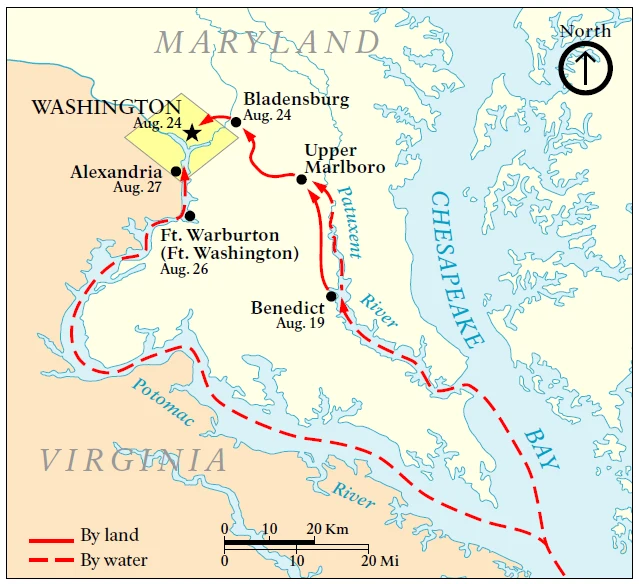
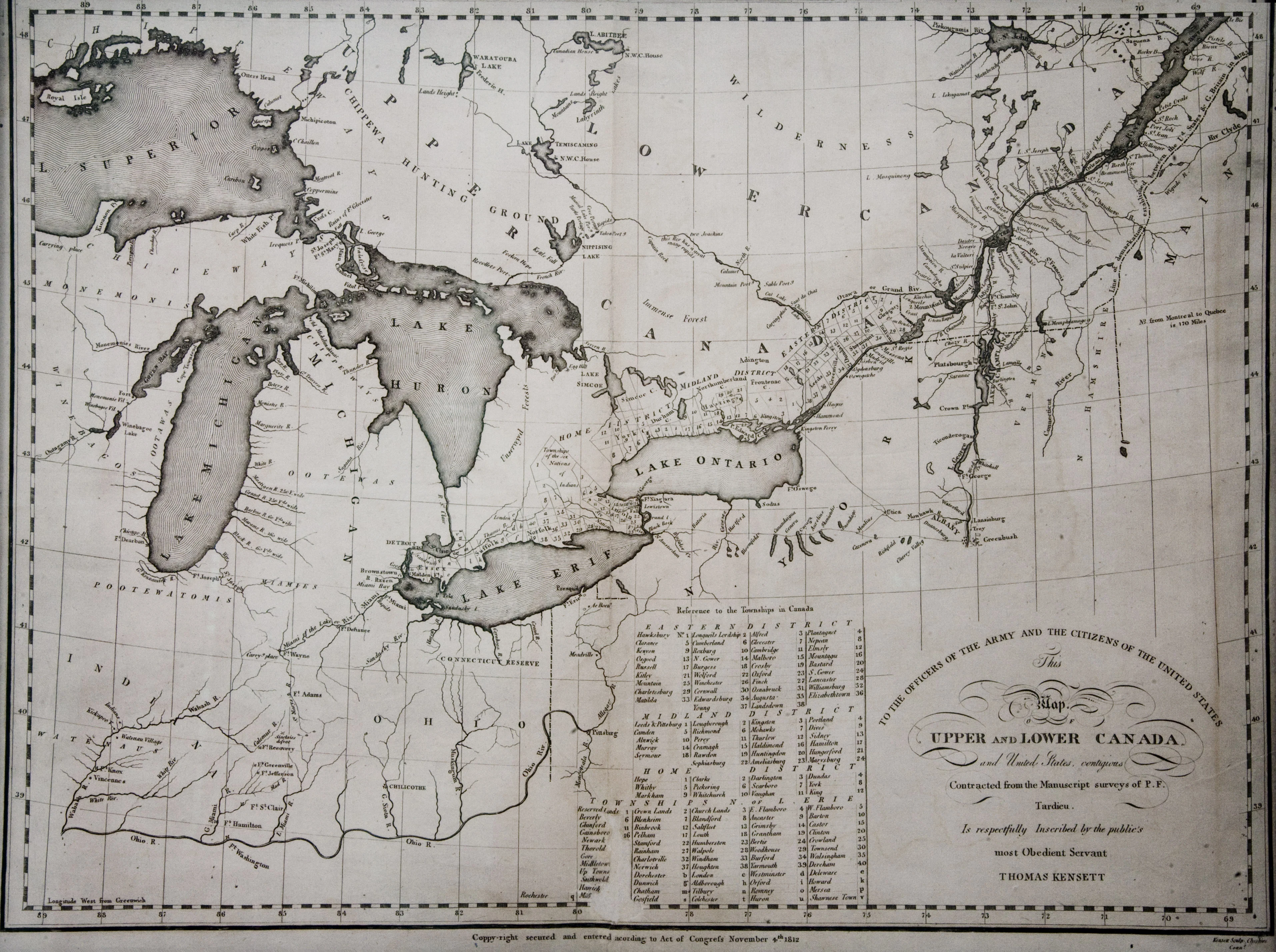
In 1812, American invasions of Canada collapsed — Detroit surrendered to a smaller British force, and Brock was killed at Queenston Heights — while the tiny U.S. Navy won headline-grabbing frigate duels. In 1813, the United States won control of Lake Erie and retook Detroit; at the Thames in October, Harrison's forces killed Tecumseh, collapsing his confederacy. American troops also burned York and Newark — retaliations that would come due. In 1814, Napoleon's abdication freed British veterans for America. A force sailed up the Chesapeake, routed the defenders at Bladensburg on 24 August, and burned the public buildings of Washington — the Capitol and the White House — in retaliation for American burnings in Canada, above all Newark in 1813. The National Park Service map at the top of this article traces that advance. But the shock did not break the American war effort: Baltimore (Fort McHenry) held two weeks later — Francis Scott Key wrote "The Star-Spangled Banner" watching the flag at dawn — and the American victory at Lake Champlain doomed a major British invasion from Canada. At Ghent, Wellington counselled against continuing the war, and the treaty was signed in December.
The coda came in January 1815 at New Orleans, where Jackson's forces crushed a British assault fought after the peace was signed. News of the victory reached Washington before news of Ghent, forging what Hickey calls "the myth of American victory." Jackson's victory over the Creek Red Sticks at Horseshoe Bend (March 1814) likewise led to the Treaty of Fort Jackson in August, ceding 23 million acres to the United States.
Casualties
Small beside the Napoleonic Wars — and disease killed far more than battle. Hickey's figures: about 20,000 American, 10,000 British and Canadian, and 7,500 Indigenous deaths. Disease and accidents, not combat, accounted for the great majority of military deaths on all sides — a typical pattern for the era. The proportional toll fell hardest on the First Nations, whose fighters died in far greater proportion to their population — and whose cause the war destroyed.
Economic effects
The war nearly erased American foreign trade — and accidentally incubated American industry. Between 1811 and 1814 exports dropped 90 percent ($108 million in 1807 to $7 million in 1813) and imports 80 percent; customs revenue collapsed and the national debt tripled between 1812 and 1816, with loans raised at ruinous terms — $34 million in specie for $80 million of face-value debt. Congress doubled import duties and quadrupled tonnage duties while the Royal Navy's blockade stretched from New England to New Orleans.
Yet the blockade acted as extreme protection. With British goods cut off, new American firms "sprang up with a mushroom growth" in textiles, iron, glass, and pottery, in economist Frank Taussig's phrase. A 2024 NBER study by Joseph Davis and Douglas Irwin nuances the story: the disruptions did not accelerate overall industrial growth, but reshaped it — infant industries boomed while trade-dependent ones like shipbuilding busted, leaving American industry 20–40 percent heavier in domestic manufacturing by the 1820s than pre-war trends would predict.
How it shaped the world
Three legacies: American nationalism, Canadian nationhood, and the ruin of the eastern Native nations.
The United States. The war's greatest product was the story Americans told themselves — the Canadian War Museum calls it a "nation-building experience." Four future presidents and three vice presidents owed their careers to it; the Federalists collapsed after 1816; "The Star-Spangled Banner" became the anthem in 1931; "Old Ironsides," West Point's grey uniforms, and "Uncle Sam" all date to the war. Congress kept a peacetime army of 10,000 plus 2,000 engineers — four times the pre-war establishment — and expanded the navy.
Canada. American failure to conquer Canada, plus the heroism ascribed to Brock, Tecumseh, and Laura Secord, hardened a separate Canadian identity — Canadians in a 2000 poll ranked the war the third most important event in their history. The flip side: Britain nearly shut American immigration into Canada and abandoned its First Nation allies — some 80 percent of whom lived south of the border.
Britain and the border. For Britain the war was a sideshow, forgotten amid Trafalgar and Waterloo. But London chose accommodation: the 1815 commercial treaty, the Rush-Bagot Agreement of 1817 demilitarizing the border, boundary settlements from 1818 to 1846, and the 1871 Treaty of Washington produced the world's longest undefended border. Hickey argues the road that began at Ghent leads to the twentieth century's Anglo-American alliance — Pax Britannica handing off to Pax Americana.
The Indigenous nations. They were, in Hickey's words, "the biggest losers in this war." Tecumseh's confederacy died with him at the Thames. Ghent's Article IX promised to restore Native nations to their 1811 status; the United States claimed wartime treaties superseded it, and Britain did not contest the claim. The 23 million acres at Fort Jackson opened the Old Southwest; further treaties opened the Old Northwest. Expansion after 1815 aimed south and west — never again north.
What historians debate
Was it a land grab or a war of honour? Many Canadians remain convinced the maritime causes were a pretext for annexing Canada; Hickey answers with Clay's own words — "Canada was not the end but the means" — and the treaty's silence on maritime rights: the war settled nothing it was fought over, and at best America "emerged from the war with a draw."
Pulitzer-winning historian Alan Taylor reframes it further in The Civil War of 1812 (Knopf, 2010): less a second war of independence than a civil war across a barely marked boundary between "kindred peoples, recently and incompletely divided by the revolution" — Loyalist refugees and recent American immigrants in Upper Canada, near-secessionist New England, republican Irish immigrants, and Native peoples caught between two expansionist cultures. Its real outcome, Taylor argues, was a hard boundary separating "the king's subject and the republic's citizen."