The Mexican-American War explained in one line: from April 1846 to February 1848 the United States and Mexico fought over Texas and the lands beyond it; U.S. forces won every major campaign, occupied Mexico City, and took some 525,000 square miles — California, New Mexico and the Southwest — in the Treaty of Guadalupe Hidalgo, a settlement that made the United States a Pacific power and reopened the slavery question that would lead to its Civil War.
Key takeaways
- A border dispute supplied the trigger, not the cause: the United States claimed Texas ended at the Rio Grande; Mexico held it ended at the Nueces River, some 150 miles farther north. The fighting began in the strip between the two rivers on 25 April 1846 (see Overview).
- Mexico lost 55 percent of its pre-war territory: the Treaty of Guadalupe Hidalgo (2 February 1848) ceded approximately 525,000 square miles for $15 million, on the U.S. Office of the Historian's reckoning (see How did it shape the world?).
- Disease, not battle, did most of the killing: the standard U.S. tabulation counts 13,283 American dead, of whom 11,550 died of other causes, mostly disease, against 1,733 in combat; historians estimate about 25,000 Mexican dead (see How many people died?).
- Gold was found nine days before California changed hands: James Wilson Marshall found gold on the American River on 24 January 1848; on 2 February the Treaty of Guadalupe Hidalgo ceded California to the United States, before either government knew of the discovery (see Economic effects).
- Peace was made by an envoy defying his own president: Nicholas Trist, recalled by Polk in October 1847, stayed, negotiated anyway, and signed the treaty — and Polk, judging that prolonging the war would be politically disastrous, sent it to the Senate (see How did the war unfold?).
- The victory was argued over at the time, not just later: Whigs censured President Polk, Congressman Abraham Lincoln demanded the exact "spot" of the first clash, and Ulysses S. Grant, who fought in the war, later called it one of the most unjust ever waged by a stronger nation against a weaker one (see What historians debate).
Contents
- Overview
- Why did the United States and Mexico go to war?
- How did the war unfold?
- How many people died?
- Economic effects
- How did it shape the world?
- What historians debate
Overview
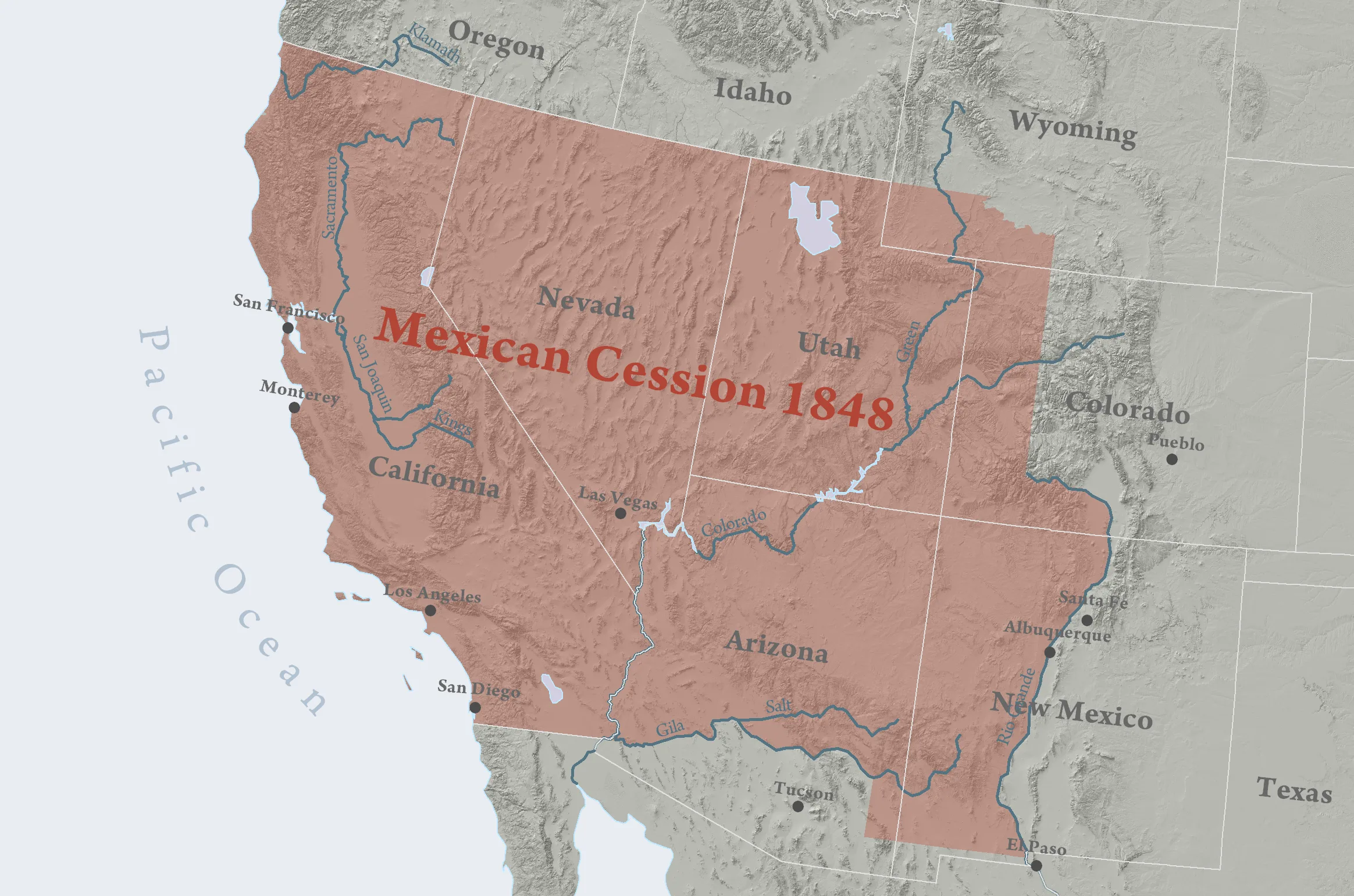
The Mexican-American War was a war between the United States and Mexico fought from April 1846 to February 1848. Britannica states its origins plainly: it stemmed from the United States' annexation of Texas in 1845 and from a dispute over whether Texas ended at the Nueces River (the Mexican claim) or the Rio Grande (the U.S. claim). The war, in which U.S. forces were consistently victorious, resulted in the United States' acquisition of more than 500,000 square miles (1,300,000 square km) of Mexican territory, known as the Mexican Cession, extending westward from the Rio Grande to the Pacific Ocean.
Texas had won de facto independence in the Texas Revolution of 1835–36, but Mexico never accepted it: the World History Encyclopedia records that the treaty Santa Anna signed after his capture at San Jacinto was signed under duress and was never ratified by the Mexican Congress, which refused to recognise Texan independence. Mexico severed relations with the United States in March 1845, shortly after the annexation, and Texas was admitted as the 28th state on 29 December 1845.
President James K. Polk, elected on a platform of expansionism, wanted more than Texas. In September 1845 he sent John Slidell on a secret mission to Mexico City to negotiate the disputed border, settle U.S. claims against Mexico, and purchase New Mexico and California for up to $30 million (Britannica's figure). Mexican President José Joaquín Herrera, aware in advance that Slidell's intention was the dismemberment of the country, refused to receive him. When Polk learned of the snub, he ordered troops under General Zachary Taylor to occupy the disputed area between the Nueces and the Rio Grande, in January 1846 on Britannica's dating.
Why did the United States and Mexico go to war?
The immediate cause was a clash in the disputed strip. On 25 April 1846 Mexican troops crossed the Rio Grande and attacked Taylor's troops, killing or injuring 16 of them, Britannica records. The World History Encyclopedia gives the patrol's own arithmetic: Captain Seth Thornton led 68 dragoons on reconnaissance on the evening of 24 April, and the next morning they were attacked by 2,000 Mexican cavalrymen, in what became known as the Thornton Affair; Smarthistory records 11 American soldiers killed, and the World History Encyclopedia records that the rest of the patrol was captured. Polk had begun preparing a war message on 9 May on other grounds — Mexico's refusal to pay U.S. claims and to negotiate with Slidell — but revised it that evening when news of the attack arrived. Delivered on 11 May, it claimed Mexico had "invaded our territory and shed American blood on American soil." Congress overwhelmingly approved a declaration of war on 13 May 1846.
Behind the trigger stood the idea contemporaries called Manifest Destiny: Britannica defines it as the concept that the United States had the providential right to expand to the Pacific Ocean. Mexico's position was the mirror image. Its historic border for Texas had ended at the Nueces River, 150 miles (240 km) north of the line Texas now claimed, and the Mexican presidency itself was unstable — in 1846 alone, the World History Encyclopedia notes, it exchanged hands four times. Neither government could concede the strip without damage at home, and only one of them, on Peter Guardino's analysis, could pay for a long war (see Economic effects).
How did the war unfold?
The war was won in three offensives — Taylor's in the north, Kearny's and the navy's seizure of New Mexico and California, and Scott's march from Veracruz to Mexico City, whose fall in September 1847 ended organised Mexican resistance and forced the peace. Taylor opened the fighting in the north. At Palo Alto (8 May 1846) American "flying artillery" held its ground, and at Resaca de la Palma (9 May) the Mexican army was forced back across the Rio Grande. Taylor then took Monterrey after hard street fighting from 21 to 24 September 1846. When Polk stripped Taylor of veteran troops for a second invasion, Santa Anna — returned from exile in Cuba after assuring the Americans he would make peace, then taking command of the Mexican army instead — put together an army of 20,000 men (the World History Encyclopedia's figure) and rushed to attack Taylor's weakened force. At Buena Vista (22–23 February 1847), Britannica's timeline gives Santa Anna at least 14,000 men against Taylor's force of about 5,000; the Americans, heavily outnumbered on either count, held excellent defensive ground and kept the battlefield, and Santa Anna withdrew.
Two other armies took the war's territorial prizes without a decisive northern battle. Brigadier General Stephen Watts Kearny marched the Army of the West from Fort Leavenworth and entered Santa Fe unopposed on 15 August 1846, the Mexican governor having disbanded his militia and fled. In California, American settlers seized Sonoma and raised the Bear Flag on 14 June, and Commodore John D. Sloat proclaimed the permanent annexation of California at San Francisco on 9 July. Californio resistance was beaten at the Battle of Río San Gabriel (8 January 1847), and a regional peace followed at Cahuenga days later.
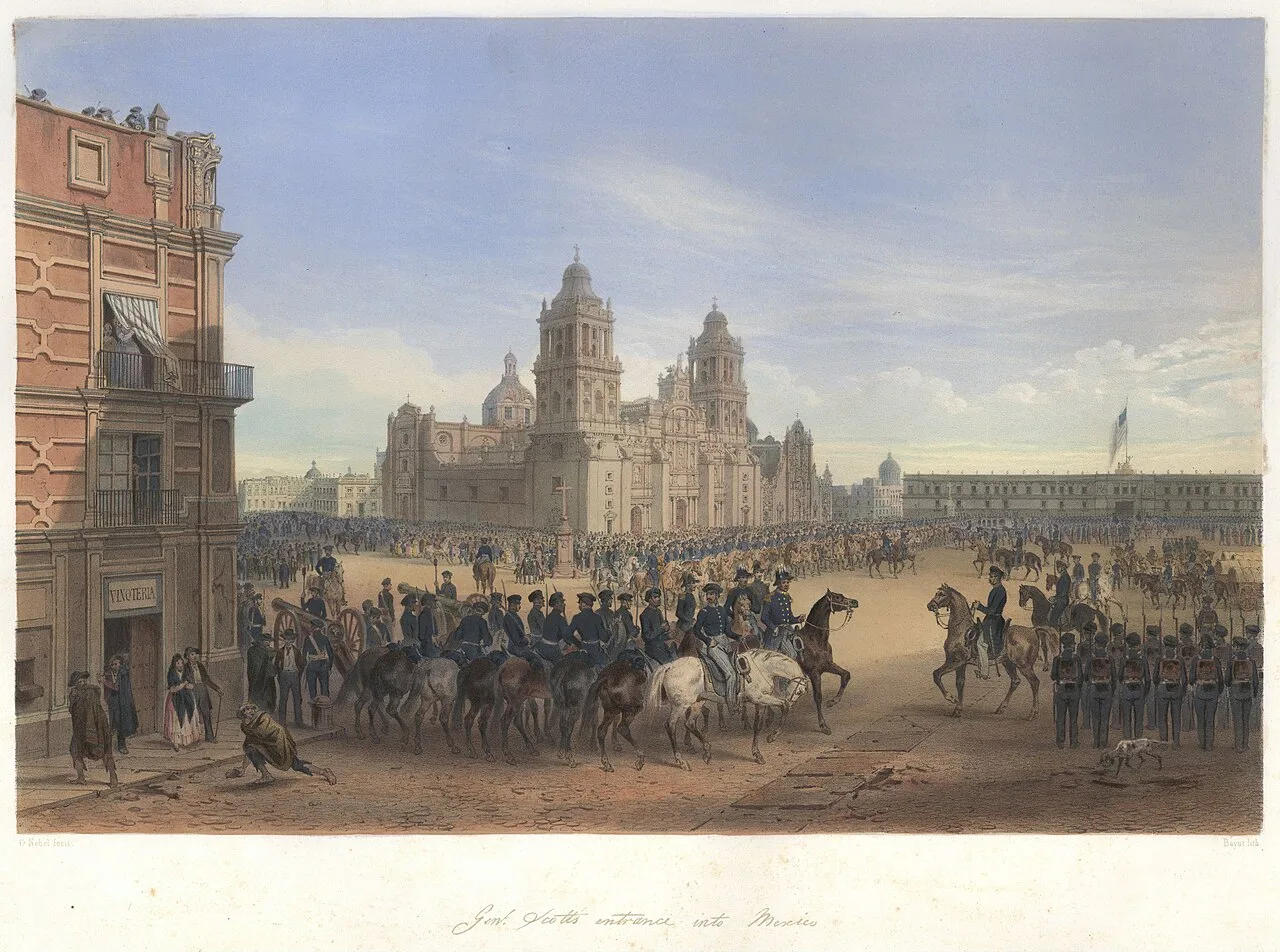
The decisive campaign was General Winfield Scott's. On 9 March 1847 a convoy of more than a hundred ships landed 10,000 soldiers south of Veracruz — the first successful amphibious landing in U.S. history, on Britannica's timeline — and the city fell on 26 March after an artillery bombardment. Scott then marched inland on the route Cortés had taken three centuries earlier: Cerro Gordo (18 April), Puebla, then Contreras and Churubusco (19–20 August), where the San Patricios — a battalion of largely Irish Catholic immigrants who had deserted the U.S. Army to fight for Mexico — made a last stand and, the World History Encyclopedia records, 50 of them were executed after capture. After the costly fight at Molina del Rey, U.S. forces stormed Chapultepec Castle on 13 September, and Scott entered Mexico City on 14 September 1847. Santa Anna resigned the presidency, the Mexican government re-established itself at Querétaro, and organised Mexican resistance ended, though guerrilla harassment of U.S. supply lines continued.
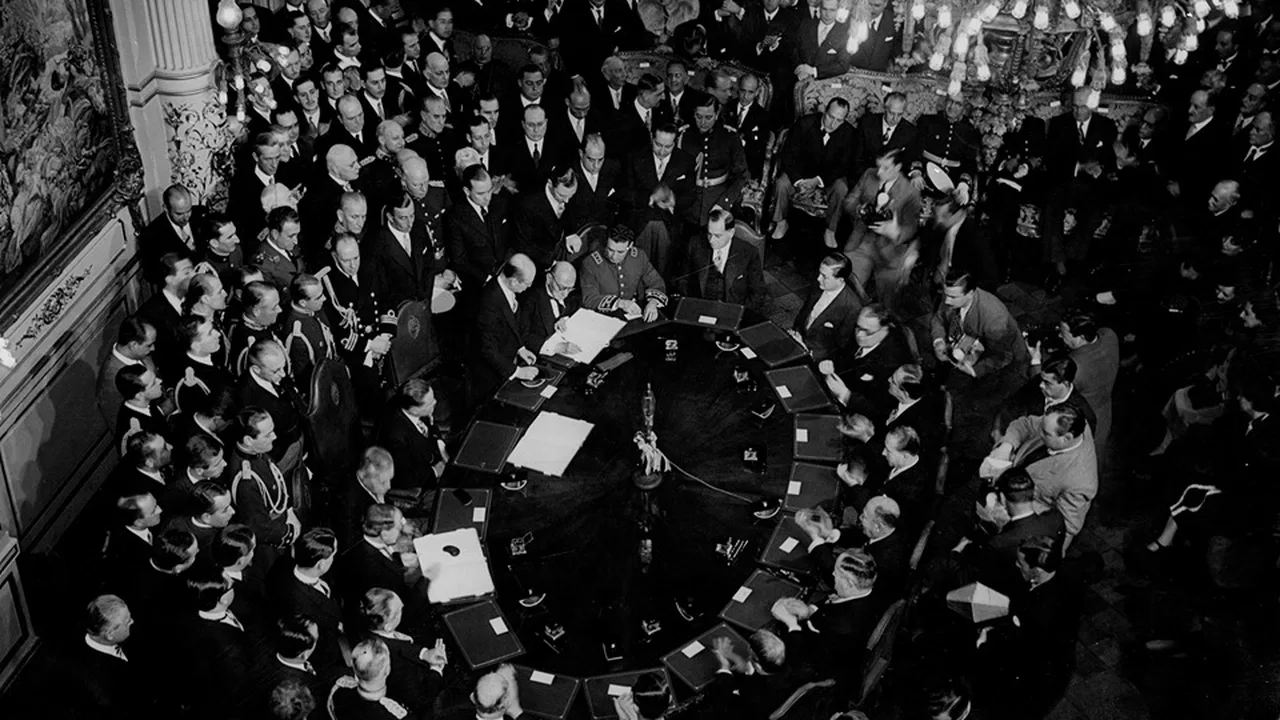
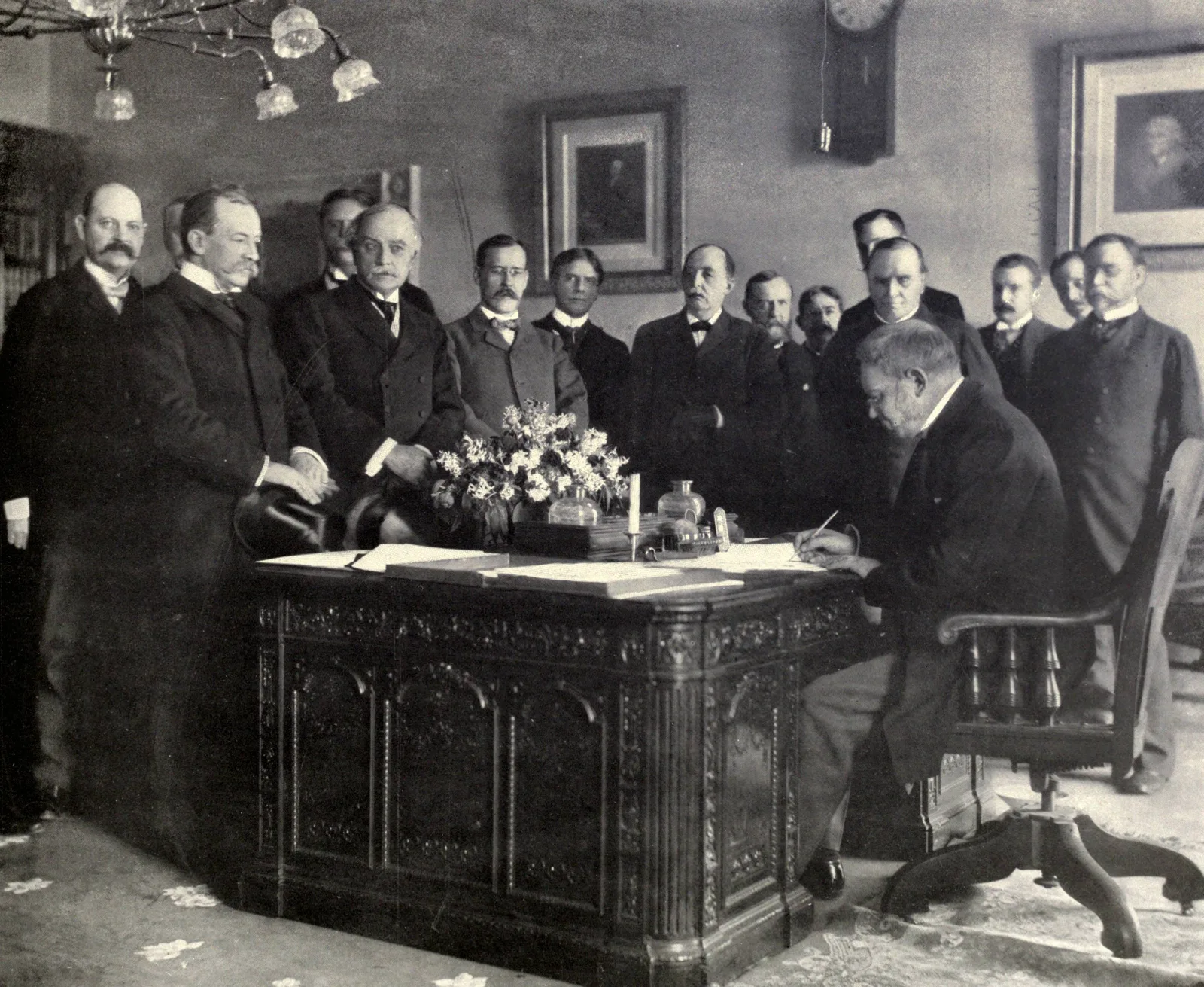
Peace required a negotiator willing to disobey his own president. Nicholas Trist, chief clerk of the State Department, had accompanied Scott as Polk's representative. Polk recalled him in October 1847, believing negotiations should move to Washington; the National Archives records that Trist judged Washington did not understand the situation in Mexico and negotiated in defiance of the president, writing to his wife on 4 December 1847 that the decision was altogether his own. On 2 February 1848 Trist and the Mexican commission of Don Bernardo Couto, Don Miguel Atristain and Don Luis Gonzaga Cuevas signed the Treaty of Guadalupe Hidalgo. Polk would have preferred a more extensive annexation, the Office of the Historian records, but he realised that prolonging the war would have disastrous political consequences, and he forwarded Trist's treaty to the Senate, which ratified it on 10 March 1848 — deleting, the Archives notes, Article X, which had guaranteed protection of Mexican land grants.
How many people died?
No exact count exists for either side, and the figures below are published strictly as the attributed totals their sources give. For the United States, the standard tabulation of U.S. military casualties counts 13,283 deaths: 1,733 in combat and 11,550 from other causes, overwhelmingly disease, with 4,152 wounded. Smithsonian Magazine's account rounds the same picture to almost 14,000 American dead, most from tropical diseases contracted during the fighting. The ratio is the war's central medical fact: disease killed roughly seven American soldiers for every one killed by Mexican fire, a pattern the World History Encyclopedia illustrates at Camargo in the summer of 1846, where dysentery carried off one in eight of Taylor's volunteers.
Mexican losses are less completely documented. Smarthistory, summarising historians' estimates, gives 25,000 Mexican soldiers dead, alongside 15,000 American soldiers — a higher American figure than the official tabulation, published here as the estimate it is. Smithsonian Magazine likewise puts Mexico's dead at more than 25,000. Peter Guardino, whose The Dead March (Harvard University Press, 2017) is built from Mexican as well as American sources, states the relationship rather than a total: the fighting claimed the lives of thousands of Americans and at least twice as many Mexicans, including many civilians. Greenberg, in Penn State's account of A Wicked War, notes the war had the highest mortality rate of any American war — a claim about the share of those who served who died, not about the largest absolute toll.
Economic effects
The United States could pay for a long foreign war and Mexico could not: that economic gap, more than any difference in unity or loyalty, is what Peter Guardino argues decided the war. Guardino's central argument is economic. The received view, he writes, holds that the United States won because its democratic system was more stable and its citizens more loyal; he invites skepticism about it. What differentiated the two countries in battle, on his account, was not American unity or loyalty to democracy but the United States' huge advantages in economic power and wealth — advantages its poorer neighbour could not overcome. Mexico's underlying weakness long predated the war: the World History Encyclopedia describes a post-independence economy in tatters, its silver mines of Zacatecas and Guanajuato devastated and farms deserted, and Smarthistory counts 50 different Mexican governments in the 30 years after independence.
The war's direct costs were asymmetric in the same direction. Smithsonian Magazine puts the cost of the war to the United States at more than $100 million. The peace then transferred wealth as well as land: Mexico received $15 million for the cession, and the United States assumed up to $3.25 million of debts Mexico owed U.S. citizens (Office of the Historian). What Mexico sold, neither side yet knew the value of. On 24 January 1848, James Wilson Marshall found flakes of gold in the American River near Coloma, California, while building a sawmill for John Sutter. Days later, HISTORY records, the Treaty of Guadalupe Hidalgo was signed, leaving California in U.S. hands — before either government knew gold had been found. The Gold Rush that followed sped California's admission as the 31st state, and gold mining peaked in 1852, when some $81 million was pulled from the ground in a single year — more than five times what the United States had paid Mexico for California and the entire cession combined.
How did it shape the world?
The treaty redrew North America. Mexico ceded approximately 525,000 square miles — 55 percent of its pre-war territory, on the Office of the Historian's reckoning — comprising nearly all the territory now in the states of New Mexico, Utah, Nevada, Arizona and California, Texas's claim to the Rio Grande, and western Colorado (Britannica). The National Archives adds that the agreement, with the 1853 Gadsden Purchase, created the southern border of the present-day United States, and that its provisions promised protection of the property and civil rights of the Mexican nationals who remained inside the new boundaries and became U.S. citizens. Smarthistory adds the cost borne inside the ceded land: residents of the territory were often left worse off than under Mexican rule, and settlers displaced and often killed Indigenous people whose land both nations had claimed.
For the United States, the cession detonated the settlement that had kept the Union together. The war reopened the slavery-extension issue, dormant since the Missouri Compromise: on 8 August 1846, Representative David Wilmot proposed that "neither slavery nor involuntary servitude shall ever exist" in any territory acquired from Mexico. The Wilmot Proviso was never passed, but Britannica records that it led to acrimonious debate and contributed greatly to rising sectional antagonism. The sequence ran on after the war: California applied to enter the Union in late 1849 with a constitution barring slavery, provoking a crisis settled only by the Compromise of 1850, and Smarthistory concludes that in 1861 the tensions over the expansion of slavery into the west led to the U.S. Civil War. The war also schooled the men who would fight that war — Ulysses S. Grant served in Mexico as a 24-year-old lieutenant (Smarthistory).
For Mexico, Smithsonian Magazine records, the defeat and the loss lingered in national memory: at the signing, commissioner Bernardo Couto told the American delegate, "This must be a proud moment for you; no less proud for you than humiliating for us." Smarthistory traces the domestic sequel: debates over the proper role of the army and the Catholic Church in Mexican politics led to the Reform War of 1857–1860, and later to the installation of a French emperor in Mexico.
What historians debate
- Was the war Polk's provocation or Mexico's attack? Polk's war message rested on the claim that Mexico had invaded U.S. territory. Whigs in both houses challenged the veracity of that assertion from the outset (Britannica): the clash happened in territory Mexico claimed as its own, between the Nueces and the Rio Grande. Lincoln's Spot Resolutions of December 1847 demanded to know whether the particular spot of soil on which American blood was shed "was, or was not, our own soil at that time." The Whig-controlled House voted 85 to 81 to censure Polk for having "unnecessarily and unconstitutionally" initiated the war. Amy S. Greenberg's A Wicked War: Polk, Clay, Lincoln, and the 1846 U.S. Invasion of Mexico (Alfred A. Knopf, 2012) argues the conflict produced the first truly national anti-war movement in the United States, and that dissent against war is deeply rooted in American history.
- Why did the United States win? K. Jack Bauer's The Mexican War, 1846–1848 remains the standard military history of the conflict, centred on operations and command. Guardino's The Dead March shifts the explanation from the battlefield to the two societies: Mexican patriotism was stronger, and American unity weaker, than the received view allows, and the decisive gap was economic — Mexico filled its ranks but could not feed, clothe or arm its soldiers as the United States could. The Kirk Center's review of Guardino adds the counterweights his own evidence supplies: the Mexican army was hampered throughout by chronic shortages of food, money and ordnance, its customs revenue choked off by the U.S. naval blockade, and at Churubusco its soldiers simply ran out of ammunition — while Santa Anna's miscalculations and open disobedience by his own generals weakened a defence that poverty had already strained.
- How should the war be judged — and why is it so little remembered? Grant's verdict, delivered in his memoirs and quoted by Smithsonian Magazine, was that he had been "bitterly opposed to the measure, and to this day regard the war, which resulted, as one of the most unjust ever waged by a stronger nation against a weaker nation." Greenberg takes her title from Grant's 1879 judgement that there was never "a more wicked war" than the one the United States waged on Mexico. In Mexico the conflict is named the War of the Northern Invasion (Smarthistory); in the United States it has, Smithsonian Magazine notes, no memorial in Washington, D.C., and only about 30 monuments nationwide — a forgetting that Timothy Henderson of Auburn University, quoted in the same magazine, summarises bluntly: most Americans do not know the war occurred, and are not even aware that the Southwest was once part of Mexico.
This explainer is drawn from the sources listed below, all opened or read during this run. Casualty and cost figures are published strictly as the attributed totals and estimates those sources give.