The Greco-Turkish War, explained in one line, was the three-year struggle in which Greece tried to hold a foothold in western Anatolia granted by the victors of the First World War, and the Turkish National Movement destroyed that foothold and the settlement behind it: from 15 May 1919 to 14 October 1922, Greek forces landed at Smyrna, advanced almost to Ankara, were stopped at the Sakarya River, and were routed in the Turkish Great Offensive of August 1922. The Treaty of Lausanne of 24 July 1923 and a compulsory population exchange then ended the Greek presence in Anatolia, created the borders of modern Turkey, and displaced well over a million and a half people. In Turkey the war is remembered as the western front of a war of independence; in Greece as the Asia Minor Catastrophe.
Key takeaways
- The turning point was Sakarya, not Smyrna: after winning at Kutahya-Eskisehir in July 1921, the Greek army marched on Ankara and was exhausted in the 21-day Battle of Sakarya (23 August – 13 September 1921). It never advanced again.
- The end came in three weeks: the Turkish Great Offensive opened on 26 August 1922, broke the Greek army at Dumlupinar on 30 August, and reached Smyrna on 9 September. Smyrna's Greek and Armenian quarters then burned; who set the fire, and how many died in it, remain disputed.
- Staying power decided the outcome: Greece, in the standard account, could not sustain long-term mobilisation on its poor economy and overextended supply lines, while the Turkish nationalists gained Soviet money and arms and separate French and Italian agreements that freed their other fronts.
- The peace exchanged peoples as well as territory: about 1,221,489 Greek Orthodox Christians were expelled from Turkey and 355,000 to 400,000 Muslims from Greece under the 1923 convention — the largest compulsory population exchange of its time.
Contents
- Overview
- Why did Greece land at Smyrna?
- How did the war unfold?
- Casualties
- Economic effects
- How it shaped the world
- What historians debate
Overview
The Greco-Turkish War was fought between the Kingdom of Greece and the Turkish National Movement — not, for most of its course, the Ottoman government in Constantinople, which the nationalists defied. It formed the western front of the wider Turkish War of Independence. Greece entered it encouraged by the Allies, above all by British Prime Minister David Lloyd George, who had promised Greece territorial gains at Ottoman expense; its governing idea was the Megali Idea, the Greek national programme of uniting territories with Greek populations — Constantinople, Thrace, the Aegean coastlands of Asia Minor and Pontus — in one state. By 1922 each side fielded roughly 200,000 to 215,000 men in the standard summary's strength table.
Michael Llewellyn-Smith's Ionian Vision: Greece in Asia Minor, 1919–1922 (first published 1973; Hurst, 1998), the standard English-language account of the Greek side, sets the Smyrna occupation against the Megali Idea and great-power rivalry and ends with the destruction of Smyrna and the execution of the Greek politicians held responsible. Erik J. Zurcher, in Turkey: A Modern History (I.B. Tauris, revised edition 2004), tells the same war from Ankara: a movement that requisitioned food, arms and recruits, invested Mustafa Kemal with the assembly's powers, and won the decisive battle on the Sakarya.
Why did Greece land at Smyrna?
Because the Allies authorised it, Greece's leaders believed Anatolia's Greeks needed a Greek state on both sides of the Aegean, and the Ottoman Empire appeared finished. On 15 May 1919 some 20,000 Greek soldiers landed at Smyrna (now Izmir) under Allied warships, on the basis of Article 7 of the Armistice of Mudros. The stated Greek justification, in the historiography summarised in the standard account, was protection of Greek populations amid continuing violence against Ottoman Greeks; the Turkish National Movement presented the conflict, by contrast, as a defensive struggle to preserve Turkish homelands against foreign occupation. Both framings are contemporary claims, kept attributed here.
Smyrna's demography was contested then and remains so. Cedric James Lowe and Michael L. Dockrill argued, as cited in the standard account, that Greeks formed perhaps a bare majority, more likely a large minority, in the Smyrna vilayet within an overwhelmingly Turkish Anatolia; contemporaneous British and American statistics cited in the same account put Greeks as the most numerous group in the Smyrna region itself, at 375,000 against 325,000 Muslims. Ottoman censuses counted by religion rather than language, one reason the figures do not reconcile.
The Treaty of Sevres, signed by the Ottoman government on 10 August 1920, assigned Eastern Thrace and the Smyrna district to Greece, with a possible League of Nations plebiscite on Smyrna after five years. It was never ratified, and Ankara declared it void. In Greece, the National Schism split the state: Eleftherios Venizelos lost the November 1920 elections, King Constantine returned, and many experienced Venizelist officers were replaced by monarchist appointees.
How did the war unfold?
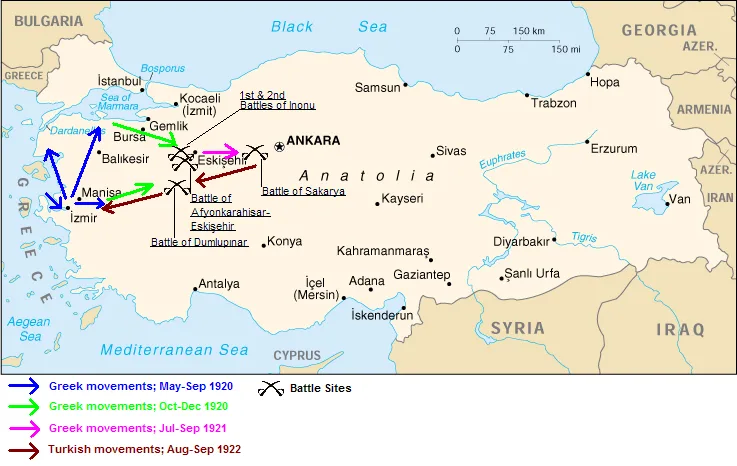
In three phases: Greek expansion to the summer of 1921, the check at Sakarya, and stalemate broken by the Great Offensive. In the summer offensive of 1920 the Greeks took Manisa, Balikesir, Aydin, Bursa and Usak. In early 1921 Turkish regulars halted them at the First and Second Battles of Inonu — small actions with large effect, since they established the Ankara army as a regular force. In July 1921 a reinforced Greek army of nine divisions won at Kutahya-Eskisehir; the Turks avoided encirclement and withdrew east of the Sakarya in good order.
At Kutahya the Greek leadership — King Constantine, Prime Minister Dimitrios Gounaris and General Anastasios Papoulas — chose to pursue and attack the last Turkish line before Ankara, against military caution and the dissent of Ioannis Metaxas, who favoured defence. The Greeks marched some 200 kilometres to their positions and fought the Battle of Sakarya from 23 August to 13 September 1921 (Britannica: 24 August – 16 September). The Turks held the heights west of Ankara — Zurcher calls Sakarya the decisive battle of the war — and the Greeks withdrew to their June lines.
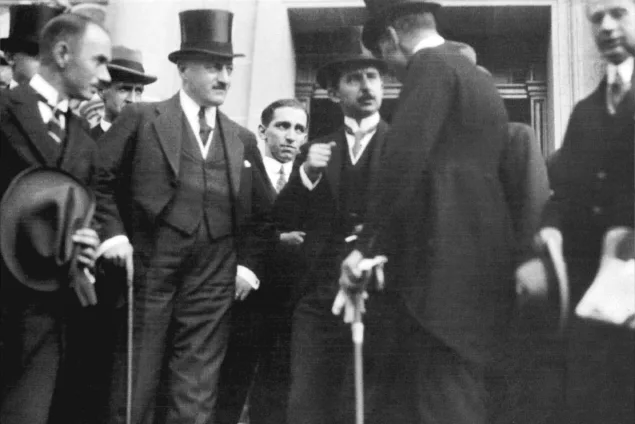
The year of stalemate decided the diplomacy. France signed the Treaty of Ankara in October 1921 and evacuated Cilicia; Italy likewise withdrew; Soviet Russia supplied money, rifles, cartridges and shells under the Treaty of Moscow of 1921. Britain, France and Italy concluded in early 1922 that Sevres could not be enforced; their March 1922 armistice proposal was declined by Mustafa Kemal while Greek troops remained in Anatolia. Historian Malcolm Yapp, quoted in the standard account, judged that withdrawal to defensible lines around Izmir was then the obvious Greek course, and that instead fantasy began to direct Greek policy.
On 26 August 1922 the Turks launched the Great Offensive. Afyon fell on 27 August, and on 30 August the Greek army was decisively defeated at Dumlupinar, losing much of its equipment and generals Nikolaos Trikoupis and Kimon Digenis, who were captured. Turkish cavalry entered Smyrna on 9 September; the Greek army's expulsion from Anatolia was complete by 18 September. From 13 September the Greek and Armenian quarters of Smyrna burned — the Muslim and Jewish quarters were largely unharmed — while refugees crowded the waterfront. The Armistice of Mudanya, concluded on 11 October 1922, required Greek evacuation of Eastern Thrace and came into force on 15 October.
Casualties
The military ledgers, from official histories, are comparatively precise; the civilian ledgers do not reconcile and are given as attributed ranges.
- Turkish military: 9,167 killed, 2,474 dead of wounds or non-combat causes, 31,097 wounded and 11,150 missing, citing the Turkish official history. Greece took 22,071 military and civilian prisoners; 6,330 of them, mostly civilians, were presumed to have died in Greek captivity and did not return in 1923.
- Greek military: 19,362 killed, 4,878 dead outside combat, 48,880 wounded and 18,095 missing, citing the Greek official history. Of 20,826 Greek prisoners taken by Turkey, about 13,740 returned in 1923 and about 7,000 were presumed to have died in Turkish captivity.
- Greek civilians: Rudolph J. Rummel estimated 264,000 Greek civilians killed by Turkish forces between 1919 and 1922, carried in the standard summary; his wider compilations for Anatolian Greeks in 1919–22 run from 213,000 to 368,000. These are demographic estimates, not counts, and Turkish historiography does not accept them.
- Turkish and Muslim civilians: the standard summary records disputed numbers of Turkish civilians killed, with no settled figure, and more than 30,000 buildings and 250 villages destroyed and burnt by the Hellenic Army. Arnold J. Toynbee, who toured the region as a correspondent, reported Greek villages burned by Turkish troops house by house; Ohio State University's Origins history summarises that violence against Muslim villagers and reprisals against Greek Orthodox villagers fed each other throughout the occupation.
- The burning of Smyrna: Norman M. Naimark, in Fires of Hatred: Ethnic Cleansing in Twentieth-Century Europe (Harvard University Press, 2001), gives 10,000 to 15,000 dead, with some 30,000 Greek and Armenian men additionally deported to the interior, where most died; Richard Clogg estimates 30,000, John Freely 50,000, Rummel 100,000, and Philip Mansel up to 180,000. Between 150,000 and 200,000 Greeks were expelled or evacuated after the fire. Responsibility is also disputed: most Western eyewitness reports and most modern scholars cited in the standard account attribute the ignition to Turkish troops, while Turkish and pro-Turkish sources hold that Greeks or Armenians started the fire. This article states the dispute rather than resolving it.
Economic effects
- Greece fought beyond its economy: the standard account states that Greece could not sustain long-term mobilisation, that its army was soon lacking in nearly everything except men, courage and enthusiasm, and that living off the land in Anatolia proved impossible as supply lines lengthened past Sakarya. Promised Allied finance also failed: Britain and France had promised 850 million gold francs, but after Athens changed government the French stopped supporting the Greeks.
- The exchange shocked both states: Ohio State's Origins history records that it put tremendous financial pressure on an already destabilised Greece, which had to care for its refugees, and created financial issues for Turkey as wealthy families were required to leave. The University of Michigan's Lausanne exhibit puts the scale: Greece's population rose from 4.5 million to 5.7 million, with arrivals who were often urban, artisan and bourgeois, while Turkey received around 400,000 primarily agrarian Muslims and lost population overall.
- Turkey lost its commercial class: Caglar Keyder, cited in the standard account of the exchange, noted that Turkey lost around 90 percent of its pre-war commercial class with the departure of the Greek Orthodox population, leaving the new Republic's bureaucracy unchallenged by an independent economic elite — a loss the Republic tried to answer with state-led creation of a national economy. Smyrna, one of the eastern Mediterranean's great port cities, was itself destroyed as a commercial centre: its Greek, Armenian and Western European quarters burned, and refugees in both countries, the Michigan exhibit records, faced housing shortages and lasting difficulty assimilating.
How it shaped the world
- It founded the Republic of Turkey: Lausanne recognised what Sevres had denied — full sovereignty, in the Michigan exhibit's contrast with the Ottoman Empire's partial sovereignty — over Anatolia, Istanbul and Eastern Thrace. The sultanate was abolished, and on 29 October 1923 the Republic of Turkey was proclaimed, with Mustafa Kemal as its first president. Its western border endures in its essentials.
- It ended the Megali Idea and remade Greece: defeat brought the 11 September 1922 revolution, the fall of the royalist government, and the Trial of the Six, after which former prime minister Dimitrios Gounaris and five others held responsible were executed — the ending Llewellyn-Smith's account closes on. The refugee influx reshaped Greece's cities, politics and culture for generations; 1922 remains, in Dimitris Pentzopoulos's phrase quoted in the standard account, the most calamitous year in modern Hellenic history.
- It brought down a British government: the Chanak Crisis, in which Turkish forces advanced on the Allied-held Straits zones, and the collapse of Britain's Greek policy contributed to the fall of David Lloyd George's government in October 1922.
- It normalised compulsory population exchange: the 1923 convention was, in Ohio State's summary, the largest compulsory population exchange in history up to that time. Naimark argued the Lausanne settlement was the last part of an ethnic cleansing campaign to create an ethnically pure homeland for the Turks, and Dinah Shelton wrote that the treaty completed the forcible transfer of the Greeks; other scholars cited in the standard account defend it as having, despite its costs, prevented further mass killing. Later peacemakers repeatedly cited the exchange as a precedent — its respectability in 1923 is itself one of the war's legacies.
What historians debate
- Invasion or defence? The national historiographies begin from opposite premises, and contemporary witnesses already disagreed. Toynbee held, in the judgement quoted in the standard account, that the war was a defensive war for the safeguarding of the Turkish homelands, provoked by Allied imperialism and an unwarranted Greek invasion, and that Greeks and Turks alike were in some degree victims of Venizelos's and Lloyd George's original miscalculations at Paris. Greek historiography, as Llewellyn-Smith presents it, begins from the Megali Idea and the Allied mandate at Smyrna. The demographic dispute over Smyrna sits underneath both.
- Could Greece have stopped in 1921? Yapp's judgement is that withdrawal after March 1922 was the obvious course and was not taken. The Kutahya decision of July 1921 — to march on Ankara over military caution and Metaxas's dissent — is the earlier candidate turning point in most accounts, Zurcher's included, since Sakarya consumed the army's remaining offensive power.
- Who burned Smyrna, and how many died there? Eyewitness and scholarly attribution in the sources opened runs mainly to Turkish troops; Turkish official historiography attributes the fire to Greek or Armenian arson; and the death estimates span an order of magnitude, from Naimark's 10,000–15,000 to Mansel's up to 180,000. What the sources agree on is the destruction of the Greek and Armenian quarters, the survival of the Muslim and Jewish quarters, and the end of the city's multi-communal life.
- Solution or ratified crime? The exchange's defenders argue it stabilised both states and prevented another round of massacres; its critics, Naimark and Shelton among them, classify it as legalised ethnic cleansing completing a process begun in war. The Michigan exhibit holds both descriptions at once: a transfer designed to reconcile cultural differences, and an instance of what is now called ethnic cleansing. That unresolved double character is why Lausanne is still argued about a century later.