The Winter War, explained in one line, was a 105-day war in which the Soviet Union invaded Finland and got far more than it bargained for: from 30 November 1939 to 13 March 1940, a Finnish army of some 300,000–340,000 men, with 32 tanks and 114 aircraft, held off a Soviet force of 425,000–760,000 men with thousands of tanks and aircraft, in temperatures down to −43 °C. The Soviet Union won the territory it had demanded — and more. Finland lost about 9 percent of its land, and 12 percent of its people were displaced. But Finland, alone among the states Moscow pressed in 1939, was not absorbed.
Key takeaways
- The mismatch was extreme, and at first it did not matter: the Red Army, its officer corps devastated by Stalin's Great Purge — 36,761 officers purged, including three of its five marshals — attacked in road-bound columns through deep snow, and Finnish ski troops cut those columns into isolated pockets called motti.
- Mass told in the end: under a new commander, Semyon Timoshenko, the Red Army fired 300,000 shells in the first 24 hours of its February 1940 offensive and broke the Mannerheim Line within about ten days.
- The casualty figures do not agree: Finland's 25,904 dead or missing are settled; Soviet dead were officially put at 48,475 in 1940, at 126,875 in the first post-Soviet archival accounting, and at up to 167,976 in a later named database.
- The peace cost more than the original demands: the treaty took the whole Karelian Isthmus and Viipuri — but Finland kept its sovereignty, and Moscow's puppet government was dropped before the talks. The Red Army's opening failure also encouraged Hitler to believe the Soviet Union could be beaten quickly, a judgement linked to Operation Barbarossa.
Contents
- Overview
- Why did the Soviet Union invade Finland?
- How did the war unfold?
- Casualties
- Economic effects
- How it shaped the world
- What historians debate
Overview
The Winter War — talvisota in Finnish, the Soviet–Finnish War of 1939–1940 in Russian historiography — began three months into the Second World War. Finland had been independent since December 1917, after a century as a grand duchy of the Russian Empire, and a civil war in 1918 won by the conservative Whites under Carl Gustaf Emil Mannerheim. The 1920 Treaty of Tartu fixed the border that left Leningrad only 32 kilometres (20 miles) from Finnish territory.
That geography is the war's premise. Moscow argued a hostile power in Finland could threaten Leningrad and the Baltic Fleet; Helsinki argued that conceding borderland, Gulf islands and a base at Hanko would leave it defenceless against the next demand. The 1939 negotiations failed because neither side could reduce its demands or trust the other's assurances.
Why did the Soviet Union invade Finland?
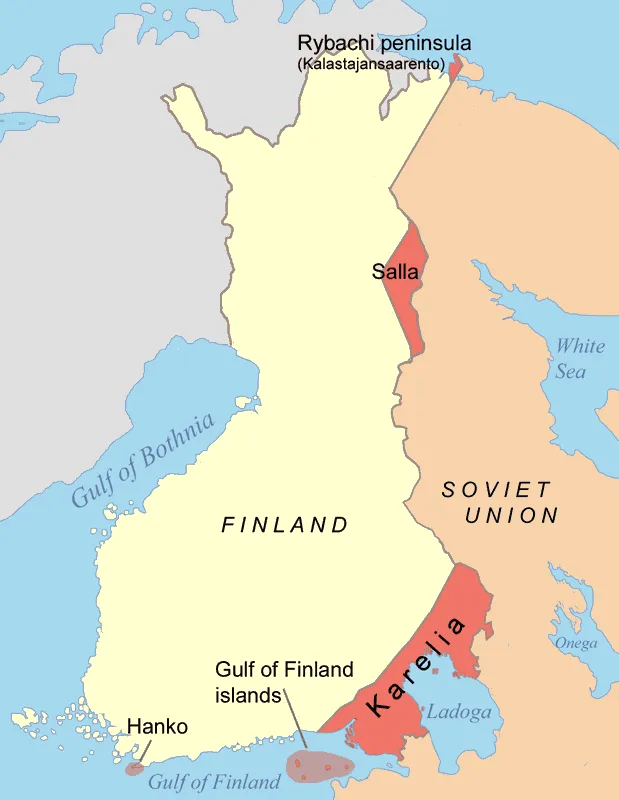
Because the August 1939 Molotov–Ribbentrop Pact had assigned Finland to the Soviet sphere, and Finland refused the territorial price Moscow set for Leningrad's security. Poland was partitioned in September, and Estonia, Latvia and Lithuania accepted treaties allowing Soviet bases. Finland, invited to Moscow on 5 October, was offered a trade: move the Karelian Isthmus border westward, demolish the isthmus fortifications, cede Gulf islands and the Rybachy Peninsula, and lease Hanko for 30 years — in exchange for Repola and Porajärvi in Soviet East Karelia, about twice the area demanded. Stalin attended six of the seven meetings and twice reduced his demands, a fact Stephen Kotkin emphasises in Stalin: Waiting for Hitler, 1929–1941 (2017). Helsinki counter-offered the Terijoki area and the Gulf islands, but no military lease, and on 9 November refused even the reduced terms.
The pretext followed on 26 November: Soviet reports said Finnish artillery had shelled the border village of Mainila, killing four guards. Finland denied it and proposed a joint commission. Research by Finnish and Russian historians later concluded it was a false-flag operation by an NKVD unit, and the question still divides Russian historiography. Moscow renounced the 1932 non-aggression pact on 28 November and invaded on 30 November. On 1 December it proclaimed a "Finnish Democratic Republic" under exiled communist Otto Wille Kuusinen.
How did the war unfold?
In two opposite phases: a Soviet disaster in December and January, then a methodical Soviet breakthrough in February that Finland could not survive.
The first phase failed for reasons the sources converge on. The purged Red Army advanced with troops drawn in part from the temperate Ukraine district, neither equipped nor trained for an Arctic winter, under commanders who expected the campaign to take two weeks. On the Karelian Isthmus, frontal assaults broke against the Mannerheim Line, Finland's chain of pillboxes, trenches and natural obstacles from the Gulf of Finland to Lake Ladoga. North of Ladoga, Finnish ski troops destroyed road-bound columns piecemeal: at Suomussalmi and on the Raate Road the Soviet 163rd and 44th Divisions were largely destroyed, and at Tolvajärvi the 139th and 75th suffered the same fate, in the National WWII Museum's account, which credits sniper Simo Häyhä with 505 Soviet soldiers — the "White Death" of its title. The League of Nations expelled the Soviet Union on 14 December. Some 12,000 foreign volunteers reached Finland, nearly 8,760 of them Swedes; the Franco-British expedition planned for March never sailed, because Norway and Sweden refused passage.
The second phase was a different army. Voroshilov was replaced by Timoshenko on 7 January 1940, Shaposhnikov was given authority, and the assault divisions rehearsed against life-size mock-ups of the Finnish fortifications. On 1 February the Red Army opened with 300,000 shells in 24 hours; by 11 February it had about 460,000 men, 3,350 artillery pieces, 3,000 tanks and 1,300 aircraft on the isthmus against some 150,000 Finns, and had broken through at Summa. Mannerheim authorised a general retreat on 15 February, and on 5 March Soviet forces were in the suburbs of Viipuri. With its artillery ammunition exhausted, Finland settled while it still had bargaining power. The Moscow Peace Treaty was signed on 12 March; the ceasefire took effect on 13 March.
Casualties
Casualty figures here are a case study in why this site reports ranges: Finland counted a small army carefully; the Soviet Union published a political figure in 1940 and opened its archives only half a century later.
- Finland: 25,904 dead or missing and 43,557 wounded, in the revised estimates published by Finnish historians in 2005. Between 800 and 1,100 Finns were taken prisoner; air raids killed 957 civilians.
- Soviet Union — the official 1940 figure: 48,475 dead and 158,863 sick and wounded, announced at the Supreme Soviet session of 26 March 1940. Soviet historiography relied on Molotov's speeches for the next fifty years.
- Soviet Union — the archival revisions: Grigoriy Krivosheyev's 1997 accounting gave 126,875 dead and missing and 391,783 total casualties. Yuri Kilin revised his estimate upward, to about 138,533 dead by 2012. In 2013 Pavel Petrov reported a Russian State Military Archive database confirming 167,976 killed or missing by name. The tables built from these works put Soviet wounded or sick at 188,671–207,538 (including at least 61,506 sick or frostbitten), and 5,572 captured.
- The outlier: Nikita Khrushchev wrote that more than one million Soviet soldiers were killed. The National WWII Museum judges that figure almost certainly inflated, written in part to discredit Stalin, while putting total Soviet casualties at 400,000–600,000 with 120,000–200,000 killed — above the archive-based tables, a reminder that totals change with what is counted.
- Materiel: Soviet tank losses are put at 1,200–3,543 and aircraft at 261–515 — against a Finnish starting strength of 32 tanks and 114 aircraft.
Economic effects
- Finland's territorial bill was an economic bill: the ceded 9 percent of territory included Viipuri — Finland's second-largest city by the population register — and much of its industrialised territory. The treaty area held 13 percent of Finland's economic assets on the measure in the current standard summary; older summaries put the loss at 30 percent of economic assets relative to March 1938. Both are reported because they measure different things.
- A resettlement of one citizen in eight: 422,000–450,000 Karelians — 12 percent of the population — were evacuated in days and lost their homes. Petsamo, captured during the war, was the one gain returned.
- The Soviet Union bought a border with men and machines: up to 3,543 tanks and 515 aircraft lost for a frontier adjustment — plus expulsion from the League of Nations and a reputation damaged in Berlin. Hanko was leased for 30 years as a Soviet naval base, the object Moscow had demanded first.
How it shaped the world
- It fed Hitler's fatal misjudgement. The Red Army's poor performance encouraged Hitler to believe an attack on the Soviet Union would succeed. The National WWII Museum adds that observers fixated on phase one's ski troops and paid too little attention to Timoshenko's rebound. Operation Barbarossa followed in June 1941.
- It reformed the Red Army — partly, and late. The Soviet General Staff reviewed the campaign in April 1940: commissars' frontline role was reduced, old ranks and discipline were reintroduced, and winter equipment and tactics improved. The reforms were incomplete when Germany invaded 14 months later.
- It set up the Continuation War. Finland rearmed and — without formally joining the Axis — cooperated with Germany and attacked on 25 June 1941, three days after Barbarossa began. It again preserved its independence in 1944, unlike the Baltic states, which the Soviet Union absorbed outright.
- It fixed a template for asymmetric war. Trotter's A Frozen Hell (Algonquin Books) remains the best-known English narrative: ski guerrillas, "Molotov cocktails", and motti encirclements became the standard illustration that terrain, morale and local knowledge can offset material superiority — for a time. They offset it for 105 days, not indefinitely.
What historians debate
- Did Stalin intend to conquer Finland outright? For a full-conquest aim: the Molotov–Ribbentrop secret protocol, and the Finnish Democratic Republic proclaimed on 1 December 1939. Hungarian historian István Ravasz argued the Central Committee had set out to restore the former Tsarist borders, and political scientist Dan Reiter concluded the Soviets "sought to impose a regime change". Russian historian Yuri Kilin holds the objective was to keep Finland from serving as a staging ground, by regime change if needed.
- The case against: Trotter argued the objective was Leningrad's flank, and that the strongest evidence is that annexation did not happen in 1940 or in 1944, when Stalin "could have done so with comparative ease". Bradley Lightbody wrote the entire aim was a more secure border. In 2002 Russian historian A. Chubaryan stated no documents supporting an annexation plan had been found in Russian archives. Kotkin adds that the fully Sovietised Baltic states were pressed into assistance pacts, while Finland was offered land for limited concessions.
- Was the peace a Finnish defeat or a Soviet failure? Some historians score it a Soviet victory — the line was broken and more was taken than demanded. Others score it a Soviet failure because absorbing Finland, if that was the aim, was not achieved. The verdicts measure against different war aims — which is why the intentions debate is the real argument.