The Peloponnesian War, explained in one line, was a 27-year fight for hegemony over Greece: from 431 to 404 BC, Athens and its Delian League fought Sparta and the Peloponnesian League, drawing in nearly every Greek city-state, destroying Athens' empire, and ending its golden age. Sparta won — but so weakened Greece that neither side could hold what followed.
Key takeaways
- Two systems, two kinds of power: democratic, naval, tribute-rich Athens against oligarchic, land-based Sparta. Athens was stronger at sea and richer; Sparta's hoplite army was, in Britannica's summary, the stronger land force.
- Thucydides is both source and argument: the Athenian historian who lived through the war argued its deepest cause was Athenian growth and Spartan fear. Almost everything later historians dispute starts from his account, which breaks off in 411 BC.
- Plague, not battle, was Athens' first catastrophe: the epidemic of 430–426 BC killed an estimated 75,000–100,000 people, around a quarter of the population, including Pericles.
- Sicily was the turning point Athens chose: the Sicilian Expedition (415–413 BC) destroyed a fleet and army Athens could replace only in hulls, not in experienced crews.
- Persian money finished the war: from 413 BC, Persian support let Sparta build the fleet that won at Aegospotami in 405 BC. Athens, blockaded, surrendered the next year.
Contents
- Overview
- Why did Athens and Sparta go to war?
- How did the war unfold?
- Casualties
- Economic effects
- How it shaped the world
- What historians debate
Overview
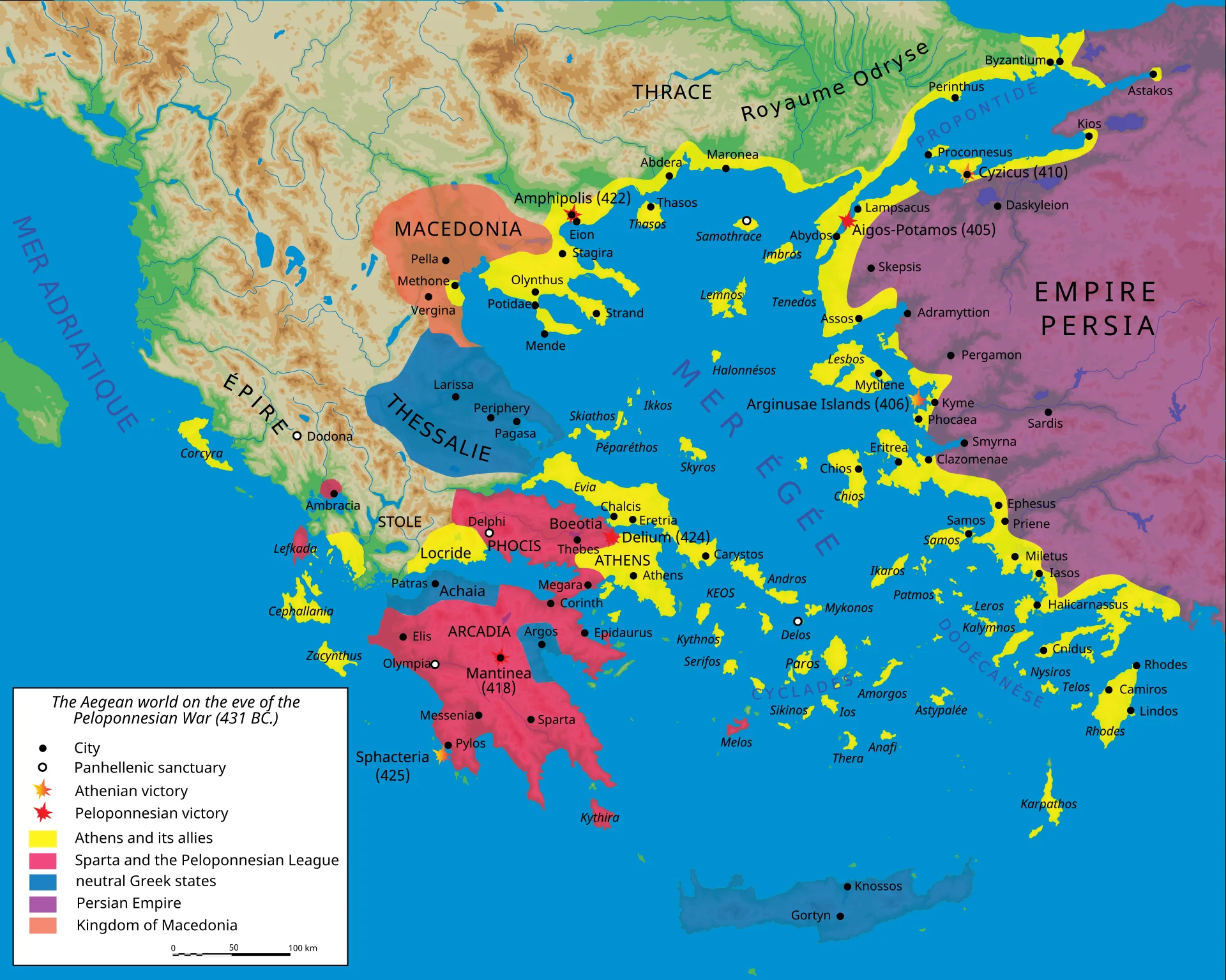
Before 431 BC, Athens stood at the height of its influence, Britannica notes. The Delian League, founded after the Greco-Persian Wars, had become in practice an Athenian empire: Aegean island and coastal states paid tribute that funded Athens' fleet and public building. Sparta led the rival Peloponnesian League of mostly land powers, including the sea power Corinth.
The blocs had already fought the First Peloponnesian War (460–446 BC), then settled for the Thirty Years' Peace in 445 BC. Disputes over Corcyra, Potidaea, and Megara in 433–432 BC broke it. Fighting fell, in Britannica's division, into two periods separated by the six-year Peace of Nicias: the Archidamian War (431–421 BC) and the renewed war (415–404 BC) dominated by Sicily and the Aegean.
Why did Athens and Sparta go to war?
Thucydides' answer is structural: Athens grew, Sparta feared that growth, and war followed. Modern historians treat that as a starting point, not a verdict — see the debate section below.
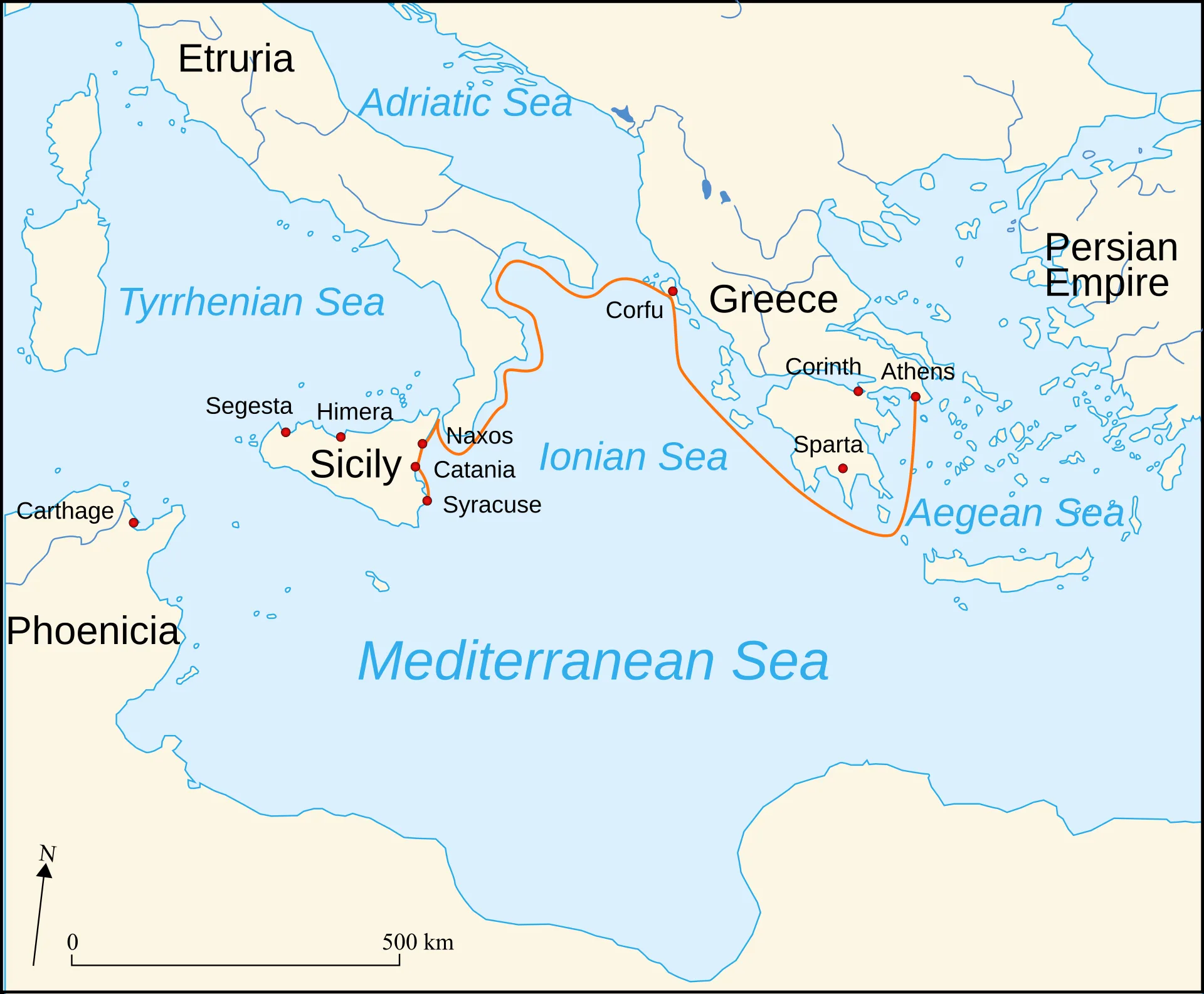
The immediate chain ran through Sparta's allies. In 433 BC Athens allied defensively with Corcyra (modern Corfu), a colony of Corinth, and Athenian ships helped avert a Corinthian victory at Sybota. Athens then ordered tributary Potidaea — also a Corinthian colony — to pull down its walls and expel Corinthian officials; Potidaea revolted with unofficial Corinthian help. Athens also imposed the Megarian Decree, barring Megara, a Spartan ally, from Athenian markets. Some modern economic historians regard the decree's effect as disastrous and a genuine cause; Thucydides gives it little weight.
At Sparta in 432 BC, Corinth pressed its grievances, Archidamus II argued against war, and the assembly still voted Athens had broken the peace. Pericles advised Athens not to yield. In spring 431 BC Thebes attacked Athenian ally Plataea, and open war began.
How did the war unfold?
Pericles' strategy was to refuse the battle Sparta wanted. As Thomas R. Martin (Perseus, Tufts) summarises it, Athens' walls — including the Long Walls to Piraeus, about seven kilometres away — made the city impregnable to contemporary siege methods. Athenians abandoned Attica's farms, imported food by sea paid for from tribute and silver, and raided the Peloponnesian coast. Pericles predicted superior money and manpower would win a war of attrition.
The strategy's cost arrived in 430 BC: plague (see Casualties). Pericles died in 429 BC. Sparta's invasions achieved little, while Athens suppressed Mytilene's revolt in 427 BC — rescinding, a day later, a vote to kill its adult men — and in 425 BC trapped a Spartan force on Sphacteria. Sparta's general Brasidas then campaigned in Thrace, encouraging subject cities to revolt. At Amphipolis in 422 BC both Brasidas and Cleon were killed, clearing the way for the Peace of Nicias in 421 BC. The peace lasted six years on paper, with proxy fighting throughout, notably Sparta's victory at Mantinea in 418 BC. Then Athens voted for Sicily.
What happened in Sicily?
Athens sent an expedition to conquer Syracuse that ended with the force effectively annihilated. It began as a proposal for 60 triremes. Its critic Nicias — appointed commander against his preference — tried to deter the assembly by demanding a much larger force; the assembly voted it: more than 100 triremes and 5,000 hoplites, plus reinforcements in 413 BC of 73 triremes and another 5,000 hoplites. Its advocate Alcibiades was recalled for trial before reaching Sicily and defected to Sparta.
Syracuse, aided by Corinth and a Spartan force under Gylippus, broke the siege. After naval defeats and a failed retreat, nearly the entire force was killed, captured, or sold into slavery, and some 200 ships were lost. Athens rebuilt hulls; experienced crews proved far harder to replace.
How did Sparta finally win?
Persia changed the naval balance. From 413 BC Sparta fortified Decelea in Attica — a permanent post, not a seasonal invasion — and allied with Persia, which sought to recover the Greek cities of Asia Minor. Persian funding under Tissaphernes (413–408 BC) and then Cyrus the Younger let Sparta sustain a fleet in the Aegean.
Athens resisted nine more years, surviving an oligarchic coup in 411 BC and winning naval victories that restored democracy in 410 BC, whose leaders rejected Spartan peace offers. In 405 BC Lysander destroyed the Athenian fleet at Aegospotami. Blockaded and starved, Athens surrendered in 404 BC. Its empire was dismantled, the Long Walls demolished, and Sparta installed the Thirty Tyrants.
Casualties
No reliable total exists. Ancient figures are incomplete or partisan, and modern references publish no single war-wide toll — a gap this article preserves rather than fills.
- The Plague of Athens (430–426 BC): an estimated 75,000 to 100,000 deaths, around 25% of the population, in the modern summaries of Thucydides' account. Thucydides says the population took about 15 years to recover, and the epidemic redistributed wealth and weakened Athens politically. The pathogen remains unidentified; around 30 candidates have been proposed, with typhoid fever among those most discussed.
- Military losses, attested minimum: the modern casualty table for the war lists at least 18,070 soldiers on the Athenian-allied side, with Spartan-allied losses and civilian casualties recorded as unknown. Treat that as a floor from named engagements, not a total.
- Sicily (415–413 BC): the expeditionary force — tens of thousands of troops and crews across the original force and its reinforcements — was, in the standard wording, killed, captured, or enslaved almost in its entirety. No agreed single figure for its dead survives.
- Commanders: Pericles (plague, 429 BC), Cleon and Brasidas (both at Amphipolis, 422 BC) are among the most consequential deaths — the latter two in a battle that removed both sides' leading war advocates and made the Peace of Nicias possible.
Economic effects
- Athens' war chest was imperial tribute. Britannica notes Athens was better prepared financially because of the large reserve amassed from regular tribute. The Perseus overview adds a second pillar: silver-mine income, used with league dues to buy imported food behind the walls.
- Decelea broke that model. The permanent Spartan post from 413 BC forced Athens to import all supplies by sea at greater expense and, in the standard account, totally disrupted the nearby silver mines, with as many as 20,000 slaves escaping or freed. As its reserve dwindled, Athens demanded more tribute from subject allies, fuelling revolts Persian-backed Sparta then supported.
- Persian subsidies were Sparta's economy of war. Sparta had the army but not the money for a sustained naval war. Persian payments supplied it, in exchange for influence in Asia Minor — a price that sat uneasily with Sparta's claim to be liberating Greeks.
- The peace was impoverishment. Whole cities were destroyed, countryside was ruined, poverty became widespread in the Peloponnese, and Athens was economically devastated and never regained its pre-war prosperity. Sparta's ascendancy proved temporary, declining after the Corinthian War (395–386 BC).
How it shaped the world
- It ended a golden age and a system. Britannica's verdict is that Athens' fall marked the end of the golden age of Greek civilisation, and that the fighting strained the city-state system itself — which collapsed the following century under Macedon under Philip II and Alexander the Great.
- It changed what Greek war was. Warfare once limited and formalised became, in the modern synthesis, total war between competing ideologies — democracy against oligarchy — in which civil war inside cities became common. That transformation is the war's institutional legacy.
- It produced a founding text of political realism. Thucydides' History, continued after its abrupt 411 BC break by Xenophon's Hellenica, remains a model of evidence-based history. Graham Allison built his "Thucydides Trap" on its causal claim, arguing in Destined for War (2017) that war followed in 12 of 16 rising-versus-ruling-power cases he traced — a risk to be managed, he presents it, not an inevitability.
What historians debate
- Was war inevitable? Thucydides says, in effect, yes. Donald Kagan challenged that across his four-volume history (Cornell University Press, 1969–1987). In The Outbreak of the Peloponnesian War (1969) he examined each decision point and concluded different choices by Corinthian, Spartan, and Athenian leaders could have averted war at several moments.
- Who was to blame for Sicily? Kagan, in The Peace of Nicias and the Sicilian Expedition (1981), argues Thucydides gives Nicias less blame than he deserved and instead faults the post-Periclean democracy. Other readings share responsibility among Alcibiades' advocacy, the assembly's expansion of the force, and Nicias' backfiring deterrent tactic.
- Can Thucydides be trusted? Scholars generally regard him as reliable, with a recognised exception: the speeches he reports, which he acknowledges are not verbatim records but reconstructions. His history ends in 411 BC, so the final phase depends on Xenophon — generally considered favourable to Sparta — and the later Diodorus Siculus. Every modern account is thus an argument built on incomplete, interested evidence.
---
Ancient casualty figures are routinely disputed. Every figure here is a range or attributed estimate from a source above, all opened and read during research.