The Punic Wars were three wars fought between the Roman Republic and the Carthaginian Empire from 264 to 146 BC — the First (264–241), the Second (218–201), and the Third (149–146). In 43 years of warfare across the western Mediterranean, Rome went from an Italian land power with no navy to the region's master: Carthage's city was razed, its people enslaved, and its territory became the Roman province of Africa. Nearly every figure about the wars comes from the winning side — no Carthaginian account survives.
Key takeaways
- Three wars, one rivalry: the First over Sicily and the sea (264–241 BC); the Second — Hannibal's war — across Italy, Spain, and Africa (218–201 BC); the Third, the siege and destruction of Carthage (149–146 BC).
- The trigger was a mercenary town: in 264 BC, mercenaries in Messana, Sicily, appealed to both Rome and Carthage; both sent troops, and the collision became a 23-year naval war.
- Rome learned war at sea from scratch: copying a wrecked Carthaginian quinquereme, Rome built fleets numbering in the hundreds and invented the corvus, a boarding bridge that turned naval battles into infantry fights.
- Cannae was Rome's worst day: on 2 August 216 BC, Hannibal annihilated an army of about 86,000 Romans and allies; ancient sources put Roman dead and captured at 67,500–80,000. Rome refused to negotiate and fought on for 14 more years.
- The settlement reshaped antiquity: indemnities in tens of tons of silver, Sicily as Rome's first overseas province, and the precedent that a rival could be destroyed outright.
Contents
- Overview
- Why did Rome and Carthage go to war?
- How did Hannibal's invasion nearly break Rome?
- Why did Rome destroy Carthage?
- Casualties
- Economic effects
- How it shaped the world
- What historians debate
Overview
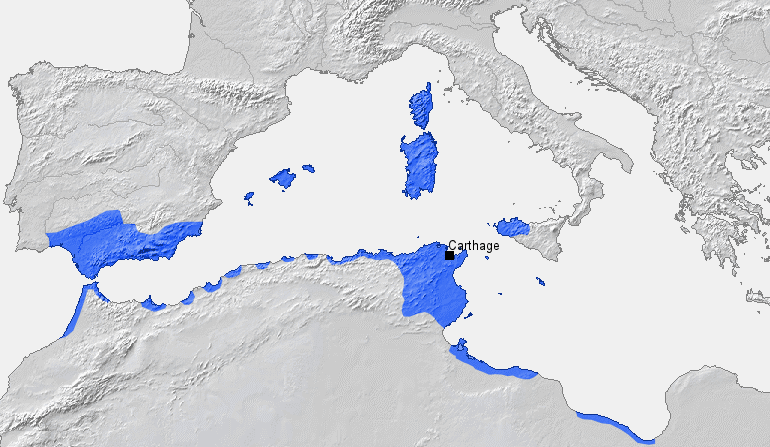
Before 264 BC, Carthage was the dominant power of the western Mediterranean — a maritime empire covering much of North Africa, southern Spain, the Balearics, Corsica, Sardinia, and western Sicily. Rome had just finished conquering peninsular Italy, with a formidable citizen army but effectively no navy. The two states had declared friendship in formal alliances in 509, 348, and about 279 BC; during the Pyrrhic War, Carthage had even ferried Roman troops with its fleet. Historian Richard Miles argues the two powers "stumbled into war more by accident than design" — neither expected the collision at Messana to become a 118-year struggle.
Why did Rome and Carthage go to war?
The immediate cause was the Mamertines of Messana. These Campanian mercenaries, who had seized the Sicilian city, appealed to both Rome and Carthage for help against Syracuse. Carthage garrisoned the city first; Rome's deadlocked Senate put the question to the popular assembly, which voted to intervene. Rome seized Messana — and Carthage declared war.
The First Punic War (264–241 BC) was fought mostly on and around Sicily: sieges and raids on land, and an enormous naval war. Rome built a fleet from a captured Carthaginian quinquereme as a blueprint and won at Mylae (260 BC) and Cape Ecnomus (256 BC), where Polybius puts the two fleets at a combined ~290,000 men. Rome invaded Africa, but the Carthaginians hired the Spartan mercenary Xanthippus, crushed the invaders at Tunis in 255 BC, and a storm then annihilated the Roman evacuation fleet: most of its ships and over 100,000 men were lost.
Rome kept rebuilding — roughly 1,000 war galleys were constructed during the war — and in 241 BC a new fleet destroyed the Carthaginian relief fleet at the Aegates Islands. Under the Treaty of Lutatius, Carthage evacuated Sicily, handed over prisoners, and paid 3,200 talents (about 82,000 kilograms of silver) over ten years. Sicily was annexed as Rome's first province. When Carthage's unpaid mercenaries then revolted, Rome seized Sardinia and Corsica in 238 BC and imposed a further 1,200 talents.
How did Hannibal's invasion nearly break Rome?
Humiliated, Carthage rebuilt in Iberia: Hamilcar Barca campaigned in Spain from 237 BC, building a Barcid state with silver mines, manpower, and shipyards — the material base for a rematch. After Hannibal besieged the pro-Roman city of Saguntum in 219 BC and Carthage refused to recall him, Rome declared war in spring 218 BC.
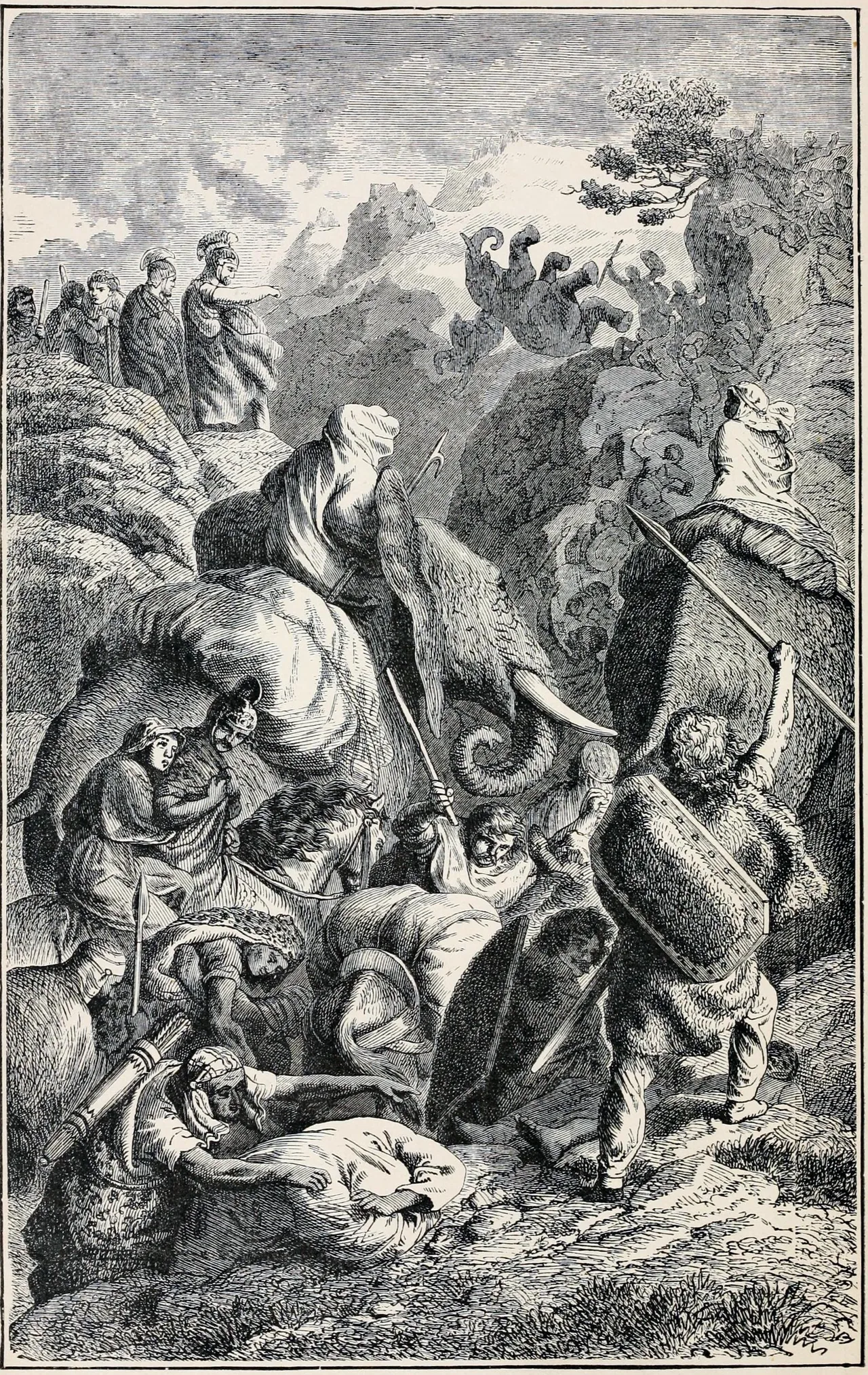
Hannibal's answer was to invade Italy itself. He marched an army with war elephants over the Alps, arriving in Cisalpine Gaul in late 218 BC with a force far smaller than the one that set out, but reinforced by Gallic allies. What followed were the most famous defeats in Roman history: the Trebia (218 BC), Lake Trasimene (217 BC, where an entire Roman army was ambushed), and Cannae on 2 August 216 BC, where Hannibal's double envelopment annihilated an army of about 86,000 Romans and allies. More than 120,000 Roman troops had died or been captured in less than three years, and cities including Capua defected.
Rome answered with Fabian attrition — Fabius Maximus "Cunctator" avoided pitched battle — and political ruthlessness: the draft age was lowered, criminals and debtors were enlisted, ransom offers were refused. Hannibal campaigned in southern Italy for 14 years without taking Rome, while Scipio Africanus took New Carthage in Iberia (209 BC), destroyed Hasdrubal's relief army at the Metaurus (207 BC), and in 204 BC invaded Africa itself. Recalled home, Hannibal was defeated at Zama in 202 BC. The 201 BC treaty stripped Carthage of all overseas territory and some African land, imposed 10,000 silver talents over 50 years, and forbade it to wage war without Rome's permission.
Why did Rome destroy Carthage?
The second century BC saw a disarmed but commercially reviving Carthage — Britannica notes its trade "expanded rapidly," exciting "the envy of Rome's growing mercantile community." Meanwhile Numidia, under Rome's ally Masinissa, kept seizing Carthaginian land. In 151 BC Carthage finally fought back; Rome used the treaty violation as a pretext and declared war in 149 BC.
The Third Punic War was essentially the siege of Carthage. After Carthage surrendered its weapons and 300 hostages, Rome demanded the population abandon the coastal city and move inland — impossible for a commercial port. Carthage resisted for two years until Scipio Aemilianus took command in 147 BC, sealed the blockade, and took the city house by house. Britannica records that of a population that may have exceeded a quarter of a million, only 50,000 remained at the surrender; the survivors were sold into slavery, the city was razed, and the territory became the Roman province of Africa.
Casualties
Ancient casualty figures are uncertain — the sources are Roman or pro-Roman, and ancient historians routinely inflated enemy numbers. With that caution, the attested ranges:
- First Punic War: the 255 BC storm alone drowned over 100,000 Romans; the naval battles involved fleets Polybius puts at a combined ~290,000 men; land operations on Sicily were sieges of attrition with heavy losses on both sides.
- Second Punic War: at Cannae, the ancient counts give 67,500–80,000 Roman-allied casualties — Polybius says 70,000 killed and 10,000 captured, Livy 48,200 killed and 19,300 captured — against 5,700–8,000 Carthaginian dead. Adrian Goldsworthy has compared Cannae's single-day toll to the British Army's losses on the first day of the Somme in 1916. Over 120,000 Roman troops died or were captured in the war's first three years.
- Third Punic War: Britannica puts the city's population at possibly over a quarter of a million, with only 50,000 alive at the surrender — the rest killed in the siege or street fighting, and the survivors sold into slavery.
No Carthaginian source survives to give their version of these losses; every number above comes from the Roman tradition.
Economic effects
The wars were catastrophically expensive, and the price was paid in silver — much of it Spanish silver from the Barcid mines that had funded Carthage's own rearmament.
- Indemnities: 3,200 talents (about 81 tons of silver) over 10 years after the First Punic War, plus 1,200 more with the Sardinia–Corsica seizure; 10,000 talents over 50 years after the Second — a debt that structured Carthage's economy for two generations.
- Sicily as prototype province: Rome's first overseas province became the template for imperial extraction — regular tribute, and increasingly Sicilian grain feeding Rome's growing urban population.
- The naval build-up: the roughly 1,000 war galleys Rome built in the First Punic War underwrote its maritime dominance for the next 600 years; the western Mediterranean's trade routes moved under Roman control and stayed there.
- Carthage's commercial revival — and its doom: in the second century BC a disarmed Carthage rebuilt its trade so successfully that it excited, in Britannica's phrase, "the envy of Rome's growing mercantile community" — a commercial motive alongside the strategic ones for the final destruction.
How it shaped the world
- Rome became an empire in practice before it was one in name. Before the wars, Rome was an Italian power; afterward it held Sicily, Sardinia, Corsica, most of Iberia, and North Africa — and the provincia system invented to hold them became the empire's administrative machinery.
- The "never surrender" doctrine. Per Goldsworthy's The Punic Wars (Cassell, 2000), Rome's decisive advantages were institutional: refusal to concede defeat, copying enemies' strengths, loyal allies, and manpower reserves that mercenary-dependent Carthage could never match.
- A precedent of annihilation, and a lesson for theory. The razing of Carthage in 146 BC (the same year Corinth was sacked) established that a rival could be erased from the map — the ancient world's clearest case of urbicide as policy. And Polybius read the conflict as a demonstration of his "mixed constitution" theory: Rome's blend of consuls, Senate, and assemblies absorbed shocks that would have broken a Carthaginian-style oligarchy — a framework that influenced political theory for two millennia.
What historians debate
- Did Rome stumble into the wars, or drive them? William V. Harris argued in War and Imperialism in Republican Rome (Oxford, 1979) that Republican Rome was an exceptionally aggressive, systematically war-making state. Against this, Richard Miles has argued the First Punic War was entered into "more by accident than design" by two powers whose spheres collided at Messana. The debate frames every account of who bears blame.
- Can we trust the sources? Polybius — a Greek hostage in Rome who befriended Scipio Aemilianus and accompanied him in the Third Punic War — is, as the classicist Craige Champion puts it, "a remarkably well-informed, industrious and insightful historian," and Adrian Goldsworthy holds that "Polybius' account is usually to be preferred." But Polybius favored the Scipio family, and no Punic text survives. Livy, the other major source, is openly pro-Roman; Goldsworthy says his "reliability is often suspect," and the historian Philip Sabin refers to his "military ignorance."
- Could Hannibal have won? Most modern scholarship holds that Hannibal could destroy Roman armies but never replace his own losses — he won every battle in Italy and still lost the war. The counter-argument is that Carthage's home government failed him; whether he should have marched on Rome after Cannae remains the most-debated counterfactual in ancient military history.
---
Ancient battle statistics are routinely disputed. Every claim in this article is attributed to a source in the list above, all of which were opened and read during research.