The Yom Kippur War, explained in one line, was a 19-day war that undid the verdict of 1967 without reversing it: from 6 to 25 October 1973, Egypt and Syria attacked Israel together, achieved complete surprise, and then watched Israel recover and end the war closer to Cairo and Damascus than to its own cities. Yet the side that finished militarily pressed still negotiated, because Egypt had won what it came for: proof that the post-1967 stalemate could not hold.
Key takeaways
- Surprise was a system, not an accident: years of exercises, a demobilisation announcement two days before the attack, and an Israeli intelligence doctrine — the "concept" — that filtered out the warnings left Israel's forward lines thinly held on the holiest day of its calendar.
- Limited aims beat total aims: Egypt planned to hold a strip east of the canal, not to destroy Israel. That modesty is why a war Egypt was losing by 20 October still ended as an Egyptian diplomatic success.
- The superpowers nearly collided: Soviet resupply, a US airlift to Israel, and a Soviet threat of unilateral intervention on 24 October brought a US worldwide nuclear alert — the closest approach to superpower confrontation since Cuba in 1962, on the State Department's own account.
- The economic war outlasted the shooting war: the Arab oil embargo and OPEC price rises quadrupled crude prices and reshaped Western energy policy for a generation.
- The war made the first peace: disengagement in 1974–75 led to Camp David in 1978 and the Egypt–Israel treaty of 1979.
Contents
- Overview · Why war came · How it unfolded · Casualties · Economic effects · How it shaped the world · What historians debate
Overview
The Yom Kippur War — the October War or Ramadan War in Arab usage — was the fourth Arab-Israeli war, after 1948–49, 1956 and 1967. Its name comes from its opening day, Yom Kippur, the Jewish Day of Atonement, which in 1973 fell on 6 October, during Ramadan. Fighting was confined to two fronts — the Suez Canal and Sinai, and the Golan Heights — with smaller expeditionary forces from Iraq, Jordan, Saudi Arabia, Morocco, Cuba and others joining the Arab side.
The balance of forces favoured the attackers in numbers: the standard tables put Egypt at 650,000–850,000 troops and Syria at 150,000–300,000, against Israel's 375,000–415,000 once mobilised — on 6 October Israel's reserves, the bulk of its army, were at home. What Israel had was interior lines, a stronger air force, and the ability to fight the two fronts in sequence.
Why did war come in October 1973?
Because diplomacy after 1967 produced a stalemate that Egypt's president concluded only a war could break — and because he designed that war to be winnable at a limited size. The sequence is documented in the US State Department's official history. Anwar Sadat, who succeeded Nasser in 1970, proposed in February 1971 that Egypt would end belligerency if Israel withdrew from the Sinai under Resolution 242; the initiative stalled. In July 1972 he expelled Soviet military advisers, and in February 1973 his envoy told Henry Kissinger Egypt could sign a separate peace, with normalisation still tied to full withdrawal. Nothing moved: Kissinger's position, as the State Department history records, was that no initiative should precede Israel's October 1973 elections.
Sadat's war plan matched his diplomacy. Egypt would cross the canal in Operation Badr, hold a bridgehead under its surface-to-air missile umbrella, and sit there — a position Israel would have to attack at heavy cost, and one that would force the superpowers to impose a settlement process. Syria's Hafez al-Assad attacked simultaneously so Israel could not concentrate. Deception did the rest: repeated exercises through 1973 taught Israeli intelligence to discount the real mobilisation, and a public demobilisation on 4 October reinforced the lesson.
Israel's failure to see it coming is the war's most studied episode. Military intelligence held a doctrine its inquiry later named the "concept": Egypt would not attack until it could strike Israel's airfields in depth, and Syria would not attack without Egypt. Brookings' retrospective summarises the mechanism — indicators contradicting the concept were explained away rather than allowed to revise it. The Agranat record, published by the Israel State Archives, shows the final warning reaching the leadership only in the early hours of 6 October, predicting an attack at 6 p.m. It came at 2 p.m.
How did the war unfold?
In three phases: an Arab breakthrough, an Israeli recovery on the northern front first, and a canal crossing in the south that decided the war's endgame — and its danger.
On 6 October Egyptian engineers breached the canal's sand ramparts with water cannon, infantry crossed in boats, and by the next day two Egyptian armies held bridgeheads on the east bank; Egyptian losses were a fraction of what Israeli planning had assumed, as Britannica records. In the north, Syrian armour broke into the southern Golan before Israeli reserve units, arriving piecemeal, held the line around 8–9 October. An Israeli counter-attack in Sinai on 8 October failed heavily against Egyptian anti-tank infantry — the war's clearest demonstration that 1967's methods no longer worked against prepared defences covered by missiles.
The superpowers then entered as quartermasters: the Soviet Union resupplied Egypt and Syria, and after Israel's 9 October request the United States answered with an emergency airlift whose first aircraft arrived on 14 October, on the State Department's chronology. With the Golan retaken by 10 October, Israel advanced into Syria, taking a salient of about 500 square kilometres and shelling the outskirts of Damascus. Egypt attacked out of its bridgeheads on 14 October, partly to relieve Syria, and lost heavily; Israel exploited the gap between Egypt's Second and Third Armies, crossed the canal near Deversoir on 15–16 October, and cut the Third Army's supply lines.
The endgame nearly escaped control. The Security Council adopted Resolution 338 on 22 October, calling for a ceasefire and negotiations on Resolution 242; fighting continued, and on 24 October Leonid Brezhnev warned Washington that Moscow might act unilaterally if the two powers did not jointly enforce the ceasefire. The United States put its nuclear forces on worldwide alert on 25 October — the State Department history calls it the closest approach to nuclear confrontation since the Cuban missile crisis. Resolution 340, with UN peacekeepers, held. At the ceasefire Egypt held about 1,200 square kilometres east of the canal and Israel about 1,600 square kilometres west of it, the Third Army encircled but supplied under negotiation. Formal agreements followed: Egypt on 11 November 1973, Syria on 31 May 1974.
Casualties
Arab governments never published complete official figures, so every total for Egypt and Syria is an estimate, and the standard tables give ranges rather than points.
- Israel: 2,521–2,800 killed, 7,250–8,800 wounded, 293 captured — for a population of about three and a quarter million, Israel's costliest war since 1948. The figure most often cited in Israeli sources is 2,656 killed.
- Egypt: an estimated 5,000–15,000 killed and 8,372 captured. The range's width — a factor of three — reflects the absence of an official Egyptian accounting.
- Syria: 3,000–3,500 killed and 392 captured, most in the Golan fighting and the subsequent Israeli advance.
- Expeditionary forces: Iraq 278 killed; Cuba 180; Jordan 23; Kuwait 18; Morocco 6 — small contingents whose presence shows the war's pan-Arab character.
- Totals and equipment: combined Arab dead are put at 8,000–18,500, with 18,000–35,000 wounded. Tank losses were on a Second World War scale for 19 days: roughly 2,250–2,300 Arab tanks destroyed against 400–800 Israeli; aircraft losses are given as 341–514 Arab and 102–387 Israeli — another range too wide to narrow honestly.
Economic effects
- The oil shock — the war's global bill: on 16–17 October the Arab exporters of OAPEC raised prices, cut production, and embargoed the United States and the Netherlands for supporting Israel. The IMF's history records crude prices rising some 300 percent within three months — from about $3 a barrel to nearly $12 by January 1974. The embargo ended in March 1974; the price level did not fall back.
- Stagflation in the West: the shock landed on economies already inflating. Queues and rationing in the United States that winter, a recession running from late 1973 to 1975, and a decade of inflation with stagnation followed — the IMF's retrospective distinguishes the embargo itself from the larger, lasting effect of OPEC's price increases. Energy security, fuel-economy rules, strategic stockpiles and the International Energy Agency, created in 1974, all date from this war.
- The belligerents: Israel's mobilisation stopped civilian life for weeks and its replacement bill drove a lasting rise in defence spending and US aid. Egypt regained the Suez Canal — cleared after disengagement and reopened in June 1975, restoring revenue lost since 1967 — and, after 1979, the Sinai oil fields. Syria paid to rebuild an army and air-defence network largely destroyed in three weeks.
How it shaped the world
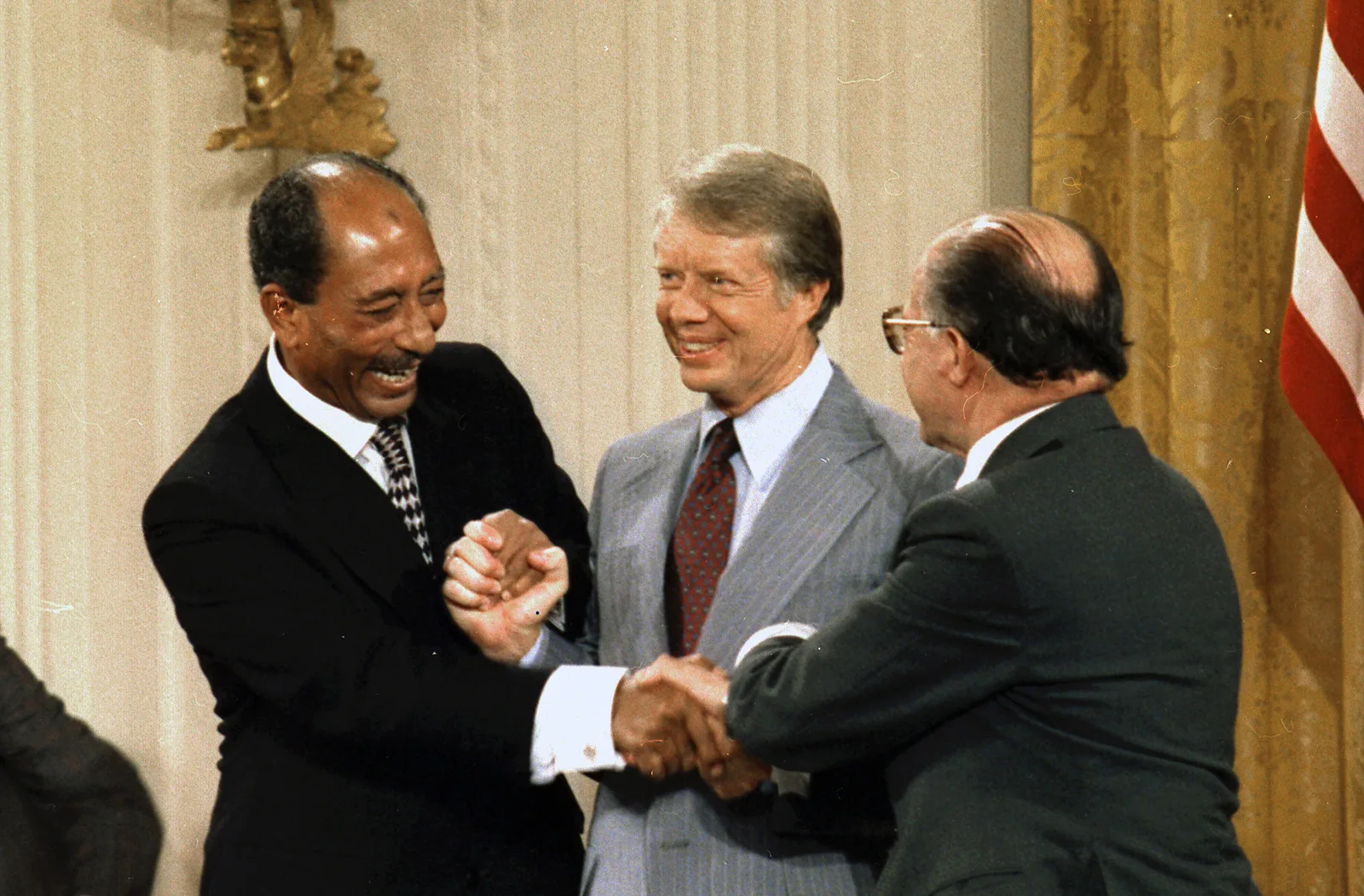
- It produced the first Arab-Israeli peace. Kissinger's shuttle diplomacy converted the ceasefire into disengagement agreements — Sinai in January 1974 and September 1975, the Golan in May 1974 — and the State Department history draws the line from those steps to the 1979 treaty. Sadat's Jerusalem visit in 1977, the Camp David Accords of 1978 and the treaty of 26 March 1979 followed; Israel returned the entire Sinai by 1982, and Egypt became the first Arab state to recognise Israel — and was suspended from the Arab League for it.
- It moved Egypt between camps. After the war Egypt completed a reorientation toward the United States that lasted for decades, while Syria remained Moscow's regional partner. The Cold War map drawn in 1973–79 proved durable.
- It ended Israeli invincibility as a political fact. The Agranat findings, the resignations of David Elazar and then of Golda Meir and Moshe Dayan in 1974, and the protest movement the war spawned reshaped Israeli politics; the long decline of the Labour alignment that had governed since 1948 is conventionally dated from here.
- It changed how armies fought. Prepared anti-tank and anti-aircraft missile defences had blunted the armour and air power that decided 1967. Western and Soviet armies alike studied 1973's loss rates; the US Army's post-Vietnam doctrinal rebuilding took the Golan and Sinai battles as a central case.
What historians debate
- Who won? Israeli operational histories, beginning with Chaim Herzog's The War of Atonement (1975), emphasise the recovery: both offensives defeated, the canal crossed, two capitals threatened. Egyptian accounts, including chief of staff Saad el-Shazly's memoir The Crossing of the Suez, emphasise 6 October itself and Egypt's retained bridgehead. Abraham Rabinovich's The Yom Kippur War (Schocken, 2004), built on declassified Israeli records and more than 130 interviews, is the most widely cited narrative in English and holds both truths at once: a battlefield recovery bought at a cost that made it function, politically, as a defeat.
- Was the surprise a failure of intelligence or of politics? The Agranat Commission blamed intelligence chief Eli Zeira, his research head, and the chief of staff, while finding no fault in Dayan and praising Meir's mobilisation decision — a distribution of blame the public rejected, forcing the politicians' resignations anyway. Uri Bar-Joseph, in The Watchman Fell Asleep (2005), put the weight on the intelligence chiefs' adherence to the concept; his later The Angel (2016) examined the Egyptian source whose warnings were discounted. Whether ministerial responsibility should have stopped where the commission stopped remains an open question in Israeli historiography.
- Did Sadat plan a limited war, or a larger one that failed? George Gawrych's Leavenworth study The 1973 Arab-Israeli War: The Albatross of Decisive Victory (1996) argues from Egyptian planning documents that Sadat's aims were deliberately bounded by what his missile umbrella could cover. Other readings treat the limited plan as partly a rationalisation after 14 October. The record supports the limited plan's existence; how far Sadat hoped to exceed it remains argued.
- How close did the superpowers come? Whether Brezhnev's 24 October message was a genuine intention to intervene or a bluff to freeze the Third Army's encirclement is still debated from the same declassified record; that the US alert was ordered, and stood down within a day as Resolution 340 took hold, is not disputed.