The Iran-Iraq War, explained: from 22 September 1980 to 20 August 1988, Iran and Iraq fought the 20th century's longest conventional war. Iraq invaded a weakened, post-revolutionary Iran expecting a quick victory; instead the war settled into years of trench warfare, human-wave assaults, chemical attacks, and a naval campaign against oil tankers in the Gulf. Total casualties are estimated at one to two million, and when it ended the borders were effectively unchanged.
Key takeaways
- Saddam Hussein's gamble: Iraq invaded in September 1980 believing Iran's purged army would collapse quickly. Iranian resistance stopped the offensive by December, only 50–75 miles inside Iran.
- An eight-year war of attrition: Iran recaptured its lost territory by mid-1982; when Iraq withdrew and offered peace, Iran invaded Iraq instead, and the front froze.
- The human cost is disputed but enormous: Britannica estimates one to two million total casualties, with perhaps 500,000 killed, most of them Iranian — and notes both sides manipulated their figures. Iraq's use of chemical weapons killed thousands of soldiers and, at Halabja in March 1988, as many as 5,000 Kurdish civilians.
- Both economies were devastated and both regimes survived: Iraq was bankrolled by Gulf states and left deeply indebted — the strain helped push it into Kuwait in 1990. In Iran, the war entrenched the hard-liners and the IRGC.
Contents
- Overview
- Why did Iraq invade Iran in 1980?
- How did the war unfold?
- What were the Tanker War and the War of the Cities?
- Casualties
- Economic effects
- How it shaped the world
- What historians debate
Overview
The Iran-Iraq War, also called the First Persian Gulf War, was fought between Iran and Iraq from 22 September 1980 to 20 August 1988. Iraq began the war with an air and ground invasion of western Iran; neither side achieved its war aims. The fighting produced large-scale trench warfare, the routine use of chemical weapons by Iraq, and a naval campaign against oil tankers in the Gulf. Iran accepted UN Security Council Resolution 598 (passed July 1987) on 17 July 1988; the ceasefire took effect on 20 August. Formal peace came on 16 August 1990, when Iraq — preoccupied with its invasion of Kuwait — agreed to Iranian terms: troop withdrawal, shared sovereignty over the Shatt al-Arab waterway, and a prisoner exchange.
Why did Iraq invade Iran in 1980?
A mix of territorial ambition, ideological fear, and perceived opportunity. Iraq and Iran had disputed their border — above all the Shatt al-Arab waterway — for decades. A 1937 treaty required Iranian ships to pay tolls; Iran broke it in 1969; and in the 1975 Algiers Agreement Saddam Hussein conceded the river's eastern bank in exchange for an end to Iranian meddling in Iraq. He considered those concessions lopsided and wanted them back.
The 1979 Iranian Revolution then made the situation urgent in Baghdad's eyes. Iran's new leaders spoke of exporting Islamic governance; Ayatollah Ruhollah Khomeini had built an audience in Iraq during his years of exile there; and in April 1980 an Iran-linked Iraqi Shi'a group tried to assassinate Iraq's deputy prime minister, Tariq Aziz — part of what Iraq cited as its casus belli. Iraq's leadership also feared Iran's theocracy would rally Iraq's Shi'a majority against the secular, Sunni-dominated Ba'athist government.
Crucially, Saddam saw weakness. Iran's regular armed forces had been gutted by revolutionary purges — officers removed, senior generals executed, spare-parts chains broken, a 60% desertion rate — and the country was diplomatically isolated after the seizure of the US embassy in Tehran. Iraqi military intelligence assessed in July 1980 that Iran had no capacity for large-scale offensive or defensive operations. Saddam demanded the Shatt al-Arab back, plus some form of Arab self-determination in Khuzestan, Iran's oil-rich, largely Arab border province, and the return of the Abu Musa and Tunb islands Iran had seized in 1971. He expected a fast, limited war.
How did the war unfold?
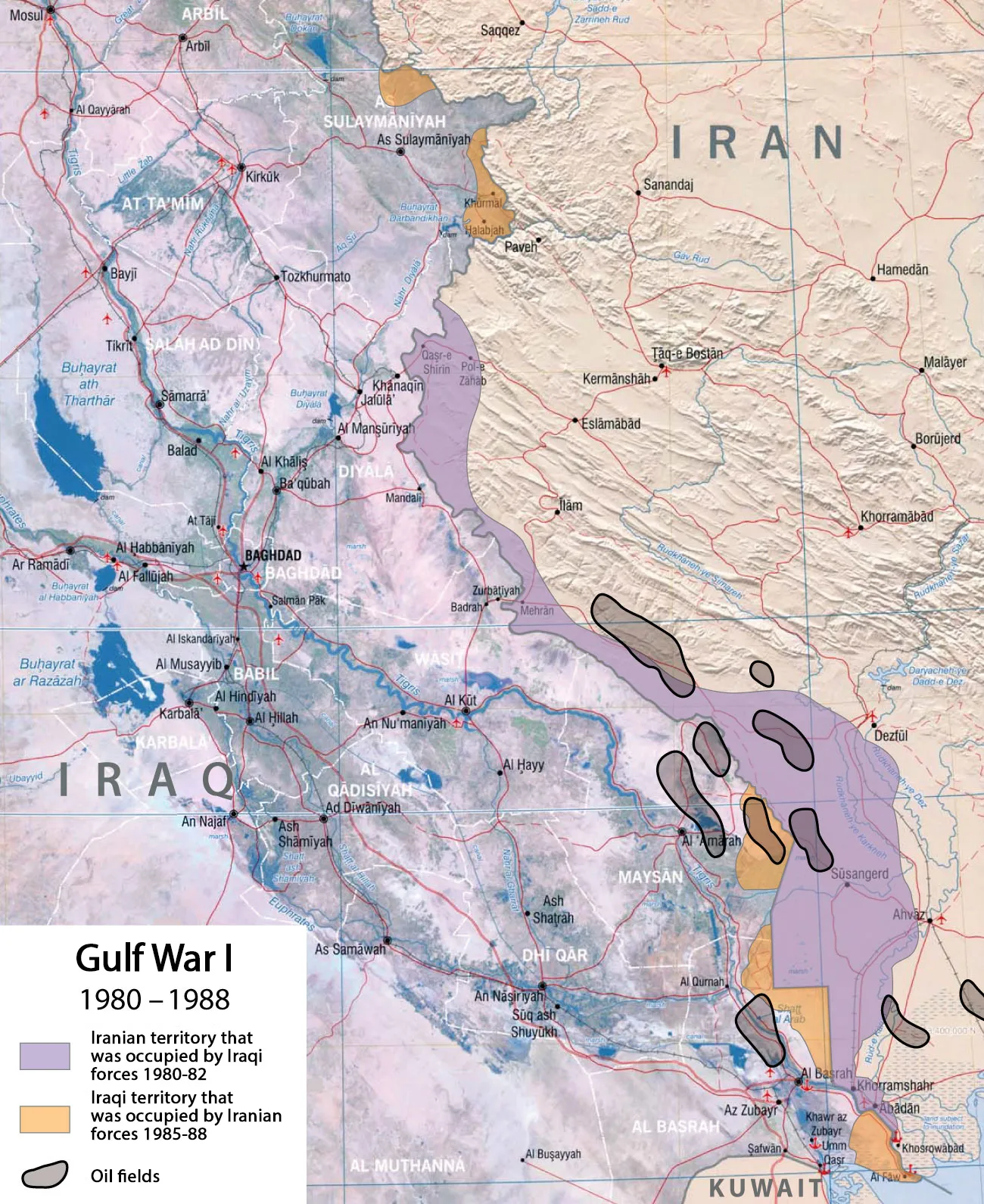
Iraq's offensive stalled fast; the war then dragged through two distinct phases. In September 1980 Iraqi armor advanced along a broad front into Khuzestan, capturing Khorramshahr but failing to take Abadan, Iran's great oil-refining city. By December the offensive had bogged down. An early Iranian militia victory in April 1981 persuaded Tehran to expand the IRGC's combat role, and in September 1981 Iranian forces pushed the Iraqis back across the Karun River. Iraq was the better-connected belligerent: its war effort was openly financed by Saudi Arabia, Kuwait, and other Arab states and tacitly supported by the United States and the Soviet Union, and by 1987 it fielded an army of about one million men with French and Soviet arms and substantial chemical weapons. Iran's only major allies were Syria and Libya; it fought largely isolated, under sanctions that starved it of heavy weapons.
In May 1982 Iran recaptured Khorramshahr. Iraq then voluntarily withdrew from all captured Iranian territory and began seeking a peace agreement — and Iran refused. Tehran carried the war into Iraq instead, invading Al-Basrah province in July 1982 in an effort to topple Saddam; the front then froze. Iran launched repeated fruitless infantry assaults — human waves, sometimes untrained and unarmed conscripts — repelled by superior Iraqi firepower, gaining only a few miles in the south (Majnun Islands 1984, Al-Faw peninsula 1986). The years 1982–87 were a war of attrition.
1988 broke the stalemate in Iraq's favor. In early 1988 Iraqi forces killed as many as 5,000 Kurdish civilians with chemical weapons at Halabja; in April, using chemical weapons against Iranian troops, Iraq recaptured the Al-Faw peninsula, then Salamcha and Majnun; in July Iraqi forces penetrated deep into Iran again. That same month the US missile cruiser Vincennes shot down Iran Air Flight 655, killing all 290 aboard. Iran accepted UN Resolution 598 on 17 July 1988, worn down by Iraq's chemical offensives, renewed missile strikes on its cities, and uncertainty about US intentions, in the Gale encyclopedia account.
What were the Tanker War and the War of the Cities?
Two parallel campaigns aimed at breaking the other side's will and wallet. From 1984, both countries attacked each other's oil-tanker shipping in the Persian Gulf. Iraq bombed Iranian oil shipments from the air; Iran retaliated against the shipping of neutral Gulf states it accused of bankrolling Iraq, notably Kuwait. The Tanker War struck more than 100 oil tankers and drew in the United States and several Western European nations, which stationed warships in the Gulf to keep oil flowing.
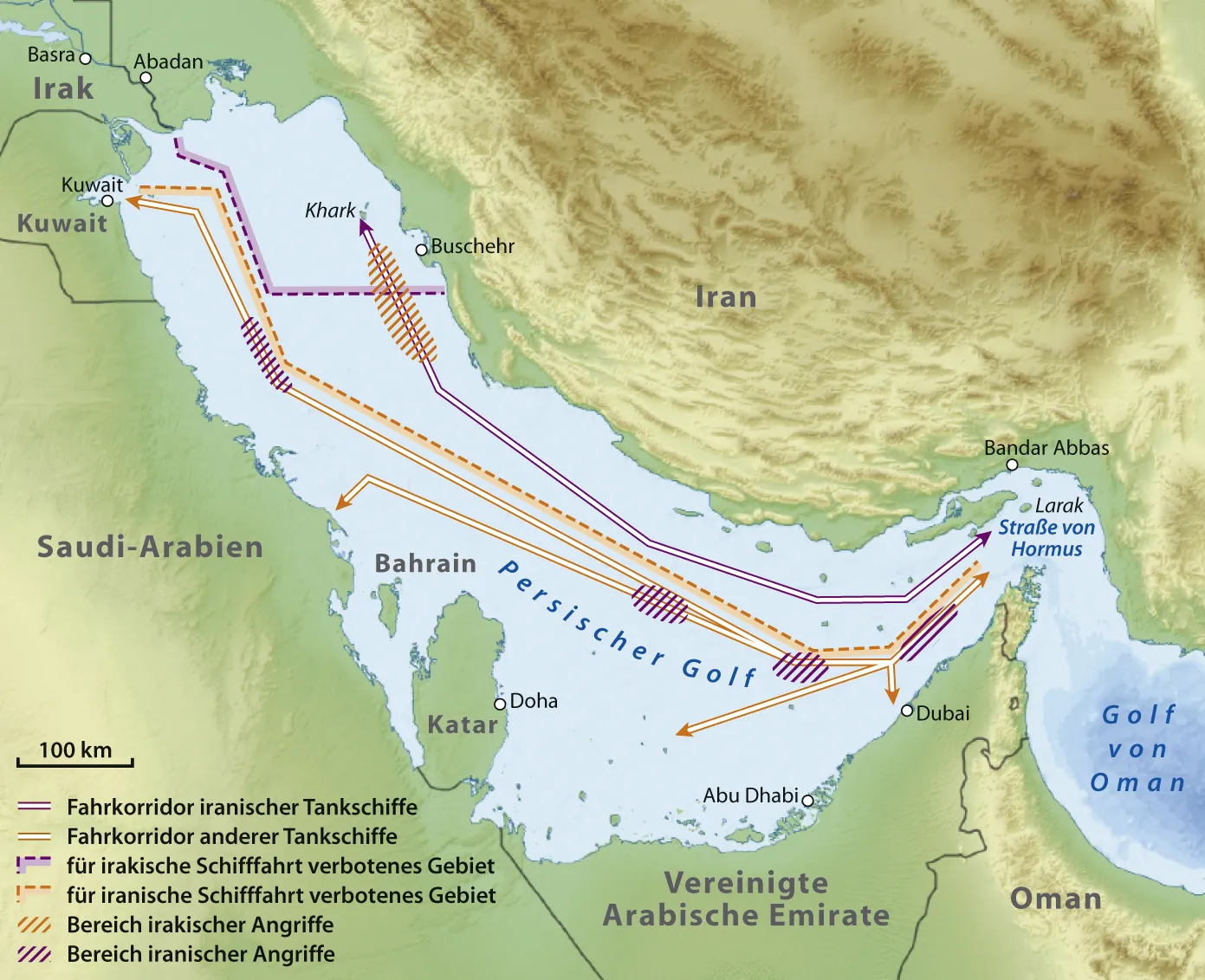
Alongside it ran the War of the Cities: sporadic air and missile attacks against each other's cities and military and oil installations, peaking in early 1988 with a renewed wave of Iraqi missile strikes on Iranian cities including Tehran. Thousands of civilians died in these strikes; the Gale encyclopedia's conservative count lists 2,000 Iranian civilians killed by bombs and missiles.
Casualties
The numbers are among the most disputed in 20th-century military history — and both governments manipulated them.
Britannica puts the widely cited figure at one to two million total casualties, with perhaps 500,000 killed on both sides, Iran suffering the greatest losses. Beyond that, the ranges diverge:
- Iranian military dead: compiled ranges run from 200,000 to 600,000. Iran officially claimed 200,000–220,000 deaths; conservative Western estimates go up to 262,000. Iraqi intelligence privately put Iranian dead at 228,000–258,000 in August 1986, while the Iraqi government publicly claimed 800,000 Iranians killed in action. A 2017 peer-reviewed study in International Security (Tabatabai & Samuel) gives 170,000–750,000 Iranian deaths.
- Iraqi military dead: compiled ranges run from 105,000 to 500,000. US Marine Corps analysts estimated by April 1988 that 150,000–340,000 Iraqis and 450,000–730,000 Iranians had died; the Gale encyclopedia gives a conservative figure of more than 60,000 Iraqi battle dead.
- Kurds: separate from the front-line toll, Iraq's 1988 Anfal campaigns killed an estimated 50,000–100,000 Kurds (Britannica); conservative counts put the chemical-weapons toll on Iraqi Kurdish civilians at 6,000 or more (Gale).
A caution: because both sides manipulated loss figures, USMC analysts warned at the time that the fighting on the ground did not substantiate the highest claims. Where figures clash, the honest answer is the range, not a number.
Economic effects
Both economies were devastated, and the war's financial consequences outlived the fighting. Oil-export capacity collapsed on both sides at various times under air strikes and pipeline shutoffs, and the loss of income brought each country's development programs to a near standstill. Compiled estimates put Iran's economic loss at roughly $627 billion and Iraq's at $561 billion. Iraq funded its war machine on borrowed money — openly financed by Saudi Arabia, Kuwait, and other Arab states — and emerged heavily indebted and labor-strapped, with a huge army and no war to fight. That financial pressure, Britannica notes, was one of the factors that precipitated Iraq's invasion of Kuwait in 1990, which triggered the Persian Gulf War.
How it shaped the world
The war left both regimes in power but transformed both countries — and much of the region. In Iran, the existential threat of the war elevated hard-line figures such as Ali Khamenei over moderate revolutionaries like Abolhasan Bani-Sadr, and the IRGC evolved from a limited state militia into Iran's most powerful armed force. Tabatabai and Samuel argue in International Security that the "imposed war" remains the pivotal event of Iran's modern strategic culture: it convinced Tehran it was isolated in an unjust international order, driving the self-reliance doctrine and the nuclear hedging that have defined Iranian policy ever since.
For Iraq, the conflict produced one of the 20th century's largest standing armies, a chemical-weapons program, and crushing debt — the combination that made the 1990 Kuwait invasion, and the war that followed it, thinkable. Military historian Pierre Razoux, whose 688-page The Iran-Iraq War (Harvard University Press, 2015) draws on Saddam's post-capture debrief transcripts and interviews with Iranian and Iraqi commanders, argues that almost nothing in the modern Middle East can be understood without this war.
What historians debate
How many died — and how to read Iraq's decision to invade. Casualty scholarship splits between official Iranian claims, Iraqi counter-claims, and independent estimates. On origins, the Gale encyclopedia account — drawing on Shahram Chubin and Charles Tripp's Iran and Iraq at War (1988) and the work of Efraim Karsh — stresses that Baghdad acted on intelligence from exiled Iranian officers about factional disarray, making the invasion as much a calculated gamble on a closing window of Iranian weakness as an ideological crusade.