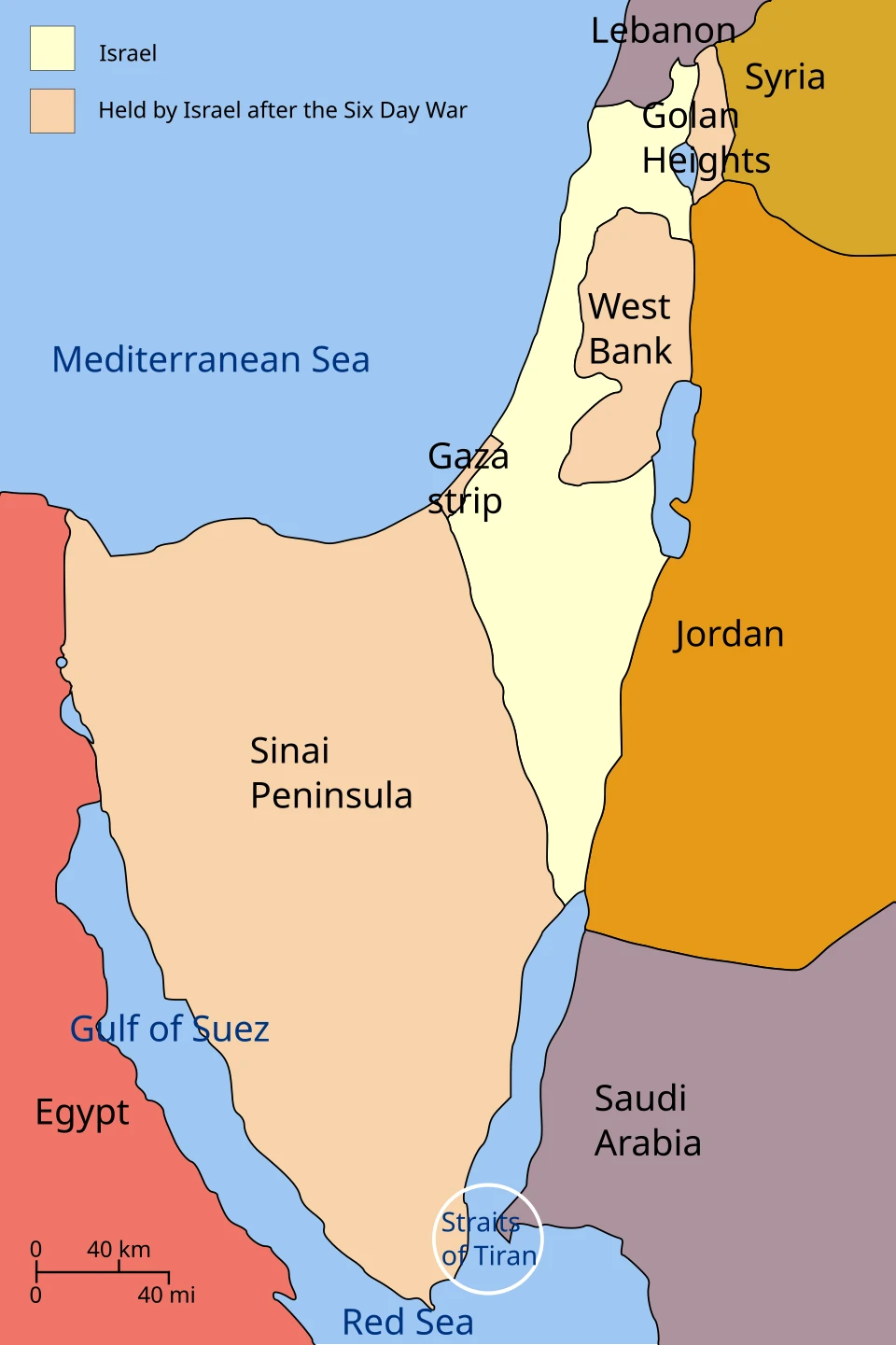
The Six-Day War, explained in one line, was a six-day Arab-Israeli war that redrew the map of the Middle East: from 5 to 10 June 1967, Israel fought Egypt, Jordan and Syria, destroyed the Egyptian air force in a surprise first strike, and captured the Sinai Peninsula and Gaza Strip from Egypt, the West Bank and East Jerusalem from Jordan, and the Golan Heights from Syria — about 70,000 square kilometres in all. Israel won on every front. Instead of a settlement, June 1967 created the questions — occupation, settlements, Jerusalem and refugees — that still structure the region.
Key takeaways
- The first morning decided the war in the air: Israel's opening strike on 5 June destroyed most of Egypt's air force on the ground; Britannica puts the loss at more than 90 percent of Egypt's air force. Ground forces fighting without air cover then lost on three fronts in turn.
- A crisis of signals, not a single plan: Egypt's May moves were read in Israel as preparation for attack and, on much of the historiography, in Cairo as deterrence that went further than Egypt's army could support.
- The numbers do not agree, and that matters: Israeli dead are put at 776–983; Egyptian dead or missing at 9,800–15,000. Jordanian figures diverge most sharply between sources. This article reports ranges, with attribution.
- Eight years of closed canal: the war's largest single economic fact was not battle damage but the Suez Canal, shut from 1967 to 1975, forcing world shipping around Africa and accelerating the move to very large tankers.
- Land for peace began here: Resolution 242 traded, in principle, withdrawal for recognition and peace. Only one front — Sinai, returned by 1982 — has ever been settled on those terms.
Contents
- Overview
- Why did war come in June 1967?
- How did the war unfold?
- Casualties
- Economic effects
- How it shaped the world
- What historians debate
Overview
The Six-Day War was the third Arab-Israeli war, after 1948–49 and 1956, fought inside a Cold War frame: Egypt and Syria were armed largely with Soviet equipment, Jordan mainly with American and British equipment, and Israel mainly with Western — especially French — aircraft and armour. On paper the Arab coalition was larger: the standard strength tables put Israel at about 264,000 personnel, against roughly 160,000 Egyptians, 75,000 Syrians and 55,000 Jordanians, with more Arab tanks and aircraft than Israel fielded. The result ran the other way, in six days.
That speed is the war's central puzzle. A state of some two and a half million people defeated three neighbours at once, tripled the territory under its control — the measure the Council on Foreign Relations' fiftieth-anniversary assessment also uses — and brought more than a million Palestinians, in Britannica's summary, under its rule. Egypt's president, Gamal Abdel Nasser, announced his resignation on 9 June and withdrew it after mass demonstrations.
Why did war come in June 1967?
Because a border crisis escalated, step by public step, past the point where either side could climb down. The sequence itself is not seriously disputed; what each step was meant to do is the historiographical argument (see below).
The background was a frontier that had never settled. Palestinian guerrilla groups based in Syria, Lebanon and Jordan had stepped up attacks inside Israel, and Israeli reprisals had grown heavier — notably the November 1966 raid on al-Samu in the Jordanian-ruled West Bank, which Britannica records as leaving 18 dead, and an April 1967 air battle in which Israel shot down six Syrian jets. A Soviet intelligence report in May, described by Britannica as inaccurate, said Israel was massing against Syria.
Nasser then moved in the open: forces into Sinai from 14 May, a formal request on 18 May to remove the UN Emergency Force that had patrolled the border since 1957, and on 22 May the closure of the Straits of Tiran to Israeli shipping, blockading Eilat — a step Israel had said since 1957 would be a cause for war. On 30 May King Hussein signed a mutual defence pact in Cairo placing Jordanian forces under Egyptian command; Iraq joined shortly after. Israel formed a national unity government on 1 June and decided to strike on 4 June.
How did the war unfold?
In three campaigns, fought in sequence rather than truly at once: Sinai first, then the West Bank, then the Golan.
Early on 5 June, Israeli aircraft struck Egyptian airfields in Operation Focus, catching aircraft on the ground; a parallel strike incapacitated Syria's air force. With the sky lost, Egypt's Sinai army — about 100,000 men deployed forward — was exposed, and a withdrawal ordered by Nasser became a rout through the Sinai passes. Within three days Israel held Gaza and the whole peninsula up to the east bank of the Suez Canal.
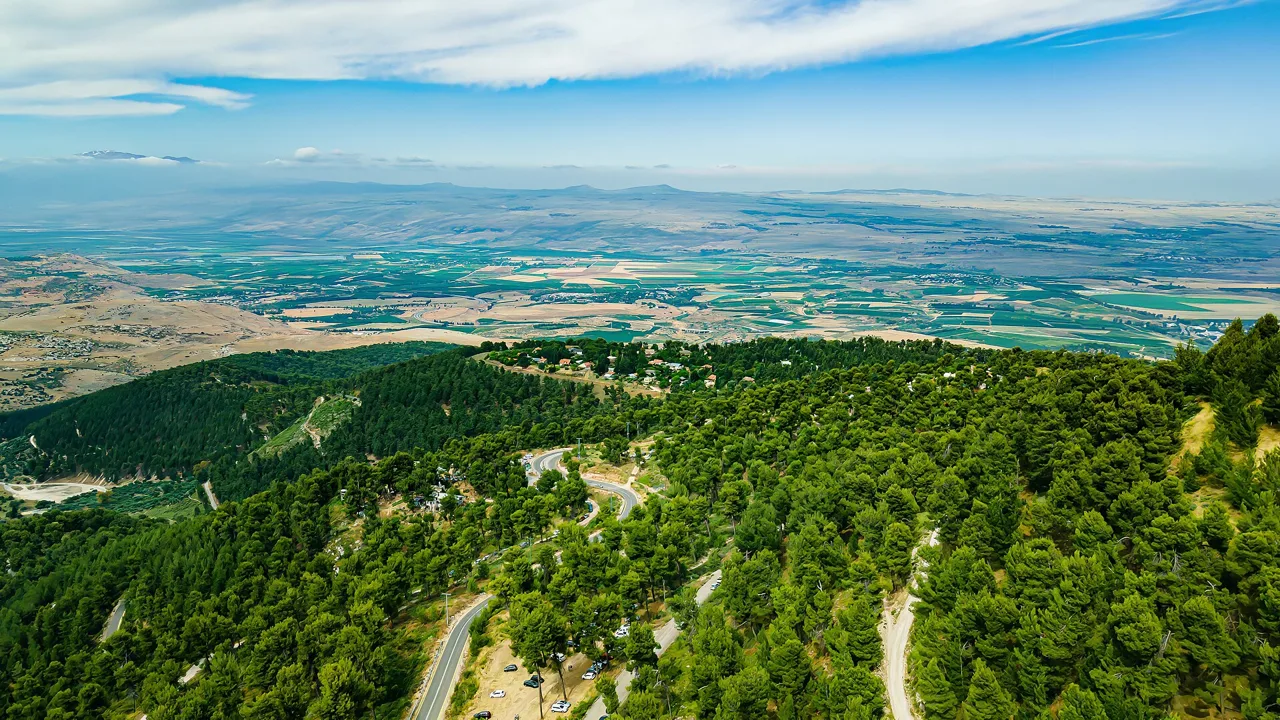
Jordan opened the eastern front on 5 June by shelling West Jerusalem, despite an Israeli message urging Hussein to stay out. By 7 June Jordanian forces had been driven from East Jerusalem — including the Old City — and most of the West Bank. The Security Council's ceasefire call of 7 June was accepted by Israel and Jordan that day and by Egypt on 8 June. Syria had shelled northern settlements but held back from a full offensive; on 9 June Israel assaulted the fortified Golan Heights and took the plateau after a day of heavy fighting, and Syria accepted the ceasefire on 10 June.
One incident remains separately contested. On 8 June Israeli aircraft and torpedo boats attacked USS Liberty, a US Navy intelligence ship in international waters off Sinai, killing 34 of her crew and wounding roughly 170 more, as Britannica records. Israel said the ship had been mistaken for an Egyptian vessel and apologised; a number of American officials and survivors have maintained the attack was deliberate. Both governments' inquiries concluded it was a mistake of identification — this article records the disagreement without resolving it.
Casualties
Casualty figures for 1967 still do not converge, because Egyptian records were never fully published and sources differ on whether the missing are counted with the killed. The ranges below are those in the standard reference tables; departures are stated.
- Israel: 776–983 killed and 4,517 wounded; 15 captured. Twenty Israeli civilians were also killed. Britannica's rounded summary gives about 700 Israeli dead, just below the range's floor.
- Egypt: 9,800–15,000 killed or missing, and 4,338 captured — by far the heaviest loss, concentrated in the Sinai air and ground collapse. Britannica gives more than 11,000 Egyptian dead, inside the range. Egyptian aircraft losses are put at roughly 280–350, and tank losses at more than 500.
- Jordan: about 700 killed and 2,500 wounded in the casualty tables most histories use, with 533 captured. Britannica, however, gives 6,000 Jordanian dead — a figure closer to those tables' older "killed or missing" estimates for Jordan. The discrepancy is flagged here rather than averaged away: Jordanian losses are the least settled number in the war.
- Syria: 1,000–2,500 killed, with 367–591 captured, most of them on the Golan in the war's last two days.
- Others: 15 UN Emergency Force peacekeepers were killed; 34 American personnel died aboard USS Liberty (above).
- Displacement: the standard accounts put Palestinian displacement in 1967 at roughly 280,000–325,000 people fleeing or expelled from the West Bank, with about 100,000 Syrians leaving the Golan; other counts give up to 413,000 Palestinians displaced. Palestinians call the 1967 displacement the Naksa (the setback), distinct from the Nakba of 1948, and many of those displaced were 1948 refugees displaced a second time.
Economic effects
- The Suez Canal — the war's biggest bill: Egypt closed the canal during the fighting, its banks became a front line, and it stayed shut for eight years, until June 1975. National Geographic, recounting the reopening, cites an estimated 12 billion dollars in added world shipping costs. Ships between the Gulf and Europe added some 6,000 miles around Africa, and the long closure accelerated the shift to supertankers too large for the canal in any case. Egypt lost eight years of canal tolls, and more than a million Egyptians left the canal cities.
- The 1967 oil embargo that failed: Arab producers cut supplies to the United States, Britain and West Germany, but spare capacity elsewhere covered the shortfall and the embargo was lifted by the autumn. The lesson — that oil leverage needed tighter coordination — belongs to the prehistory of 1973.
- Egypt, Jordan and Israel: Egypt lost the Sinai oil fields along with canal revenue, and paid to rebuild a shattered army and fight the War of Attrition of 1968–70. Jordan lost the West Bank — agricultural land and Jerusalem's tourism, a large share of its economy and population. Israel's reserve mobilisation halted much of civilian economic life in May–June 1967, defence spending rose sharply to hold the new lines, and the territories tied the economies together through Palestinian labour in Israel and Israeli goods in the territories.
How it shaped the world
- It created the modern territorial dispute. Of the four areas taken in 1967, only Sinai has changed hands since by agreement: returned to Egypt in stages under the 1979 peace treaty. Israel annexed East Jerusalem and, in 1981, the Golan Heights; neither annexation has been widely recognised internationally. The West Bank and Gaza remained under occupation, and the political status of each territory is still argued in the vocabulary of 1967.
- It produced the land-for-peace formula. Resolution 242 (22 November 1967) paired withdrawal from occupied territories with every state's right to live in peace within secure and recognised boundaries; Egypt and Jordan accepted it at the time, the CFR assessment notes. Its wording — withdrawal from "territories" in the English text — has supported two readings ever since, and Camp David and every later negotiation have cited it.
- It ended pan-Arabism's ascendancy and raised the Palestinian movement. The defeat discredited Nasser's claim to lead a united Arab world. Khartoum in September 1967 is famous for its formula of no peace, no recognition and no negotiations; the CFR's scholars note the same resolution committed the Arab states to recovering the lost land politically rather than militarily. For Palestinians, the lesson was that Arab states would not deliver a state: Fatah took control of the PLO in 1968–69 under Yasir Arafat.
- It made the United States the region's outside power. Before 1967 France was Israel's main arms supplier; after it, the United States progressively took that role, and with it the broker's role in every later negotiation.
- It changed Israeli politics from inside. Control of the Old City and the West Bank — the biblical Judea and Samaria — energised religious Zionism, as the CFR's contributors describe, and the settlement movement organised from the mid-1970s built the civilian presence later governments variously expanded, froze or, in Sinai and later Gaza, dismantled. The CFR assessment put the West Bank settler population at some 400,000 at its fiftieth-anniversary writing, excluding East Jerusalem.
- It set up the next war. Egypt and Syria attacked in October 1973 explicitly to recover what 1967 had taken — and the diplomacy that followed 1973 finally traded Sinai for peace.
What historians debate
- Did Nasser intend war? Michael B. Oren's Six Days of War (Oxford University Press, 2002) — the most detailed archival history of the crisis, winner of the Los Angeles Times Book Prize for History — presents a crisis neither side fully controlled. Egyptian historian Abd al-Azim Ramadan held that Nasser's decisions to expel the UN force and close the straits created a state of war despite Egypt's lack of preparation. Whether Nasser expected concessions without a war remains argued from the same record.
- Was Israel's strike pre-emption or aggression? Israel's position is that the blockade, the buffer force's removal, the defence pacts and troops on its borders constituted a casus belli. The Arab position, recorded in the standard controversies summaries, is that Egypt acted defensively and no attack was imminent, making the 5 June strike unjustified. Both governments initially claimed they had been attacked; Israel later acknowledged it struck first, as a pre-emptive act. The dispute is over justification, not over who struck first.
- Oren and the "new historians": Oren's book was praised across much of the spectrum — Avi Shlaim, himself a leading revisionist historian, called it in The Guardian the most detailed and best-documented history of the war then available — while Tony Judt, in The New Republic, praised its international scope but questioned its novelty and its treatment of long-term consequences. Shlaim's The Iron Wall: Israel and the Arab World (2000) argues that reliance on military superiority repeatedly substituted for a political settlement. Benny Morris, in Righteous Victims (1999), documented the escalation's contingency; his wider work concluded the Palestinian refugee problem was born of war rather than a master plan on either side, a conclusion Shlaim and others argue understates Morris's own evidence. The debate stays live partly because the archives are asymmetric: Israeli, American and British records are largely open; Egyptian, Syrian and Jordanian state archives for 1967 largely are not.
- Why did the Arab armies perform as they did? Egypt's own post-1973 review, summarised in the standard accounts, blamed bureaucratic leadership, promotion by loyalty over competence, poor intelligence, and a command culture in which subordinates feared telling Nasser the truth, alongside better Israeli training and organisation.