The Hundred Years' War was an intermittent 116-year struggle between England and France (24 May 1337 – 19 October 1453) over the French throne and England's lands in France. It began with devastating English victories at Crécy (1346) and Poitiers (1356), swung back to France under Charles V, reignited with Henry V's victory at Agincourt (1415), and ended — after Joan of Arc broke the siege of Orléans in 1429 — in a French victory: England lost every continental possession except Calais. Five generations of kings fought it; it changed how wars were financed, how armies were raised, and what it meant to be French or English.
Key takeaways
- Three phases, not one war: the Edwardian (1337–1360), Caroline (1369–1389), and Lancastrian (1415–1453) phases, separated by truces — hence "Hundred Years'" is approximate.
- A throne and a duchy at stake: Edward III of England claimed the French crown through his mother Isabella after the Capetian male line died out in 1328, while Philip VI confiscated Edward's French duchy of Guyenne in 1337.
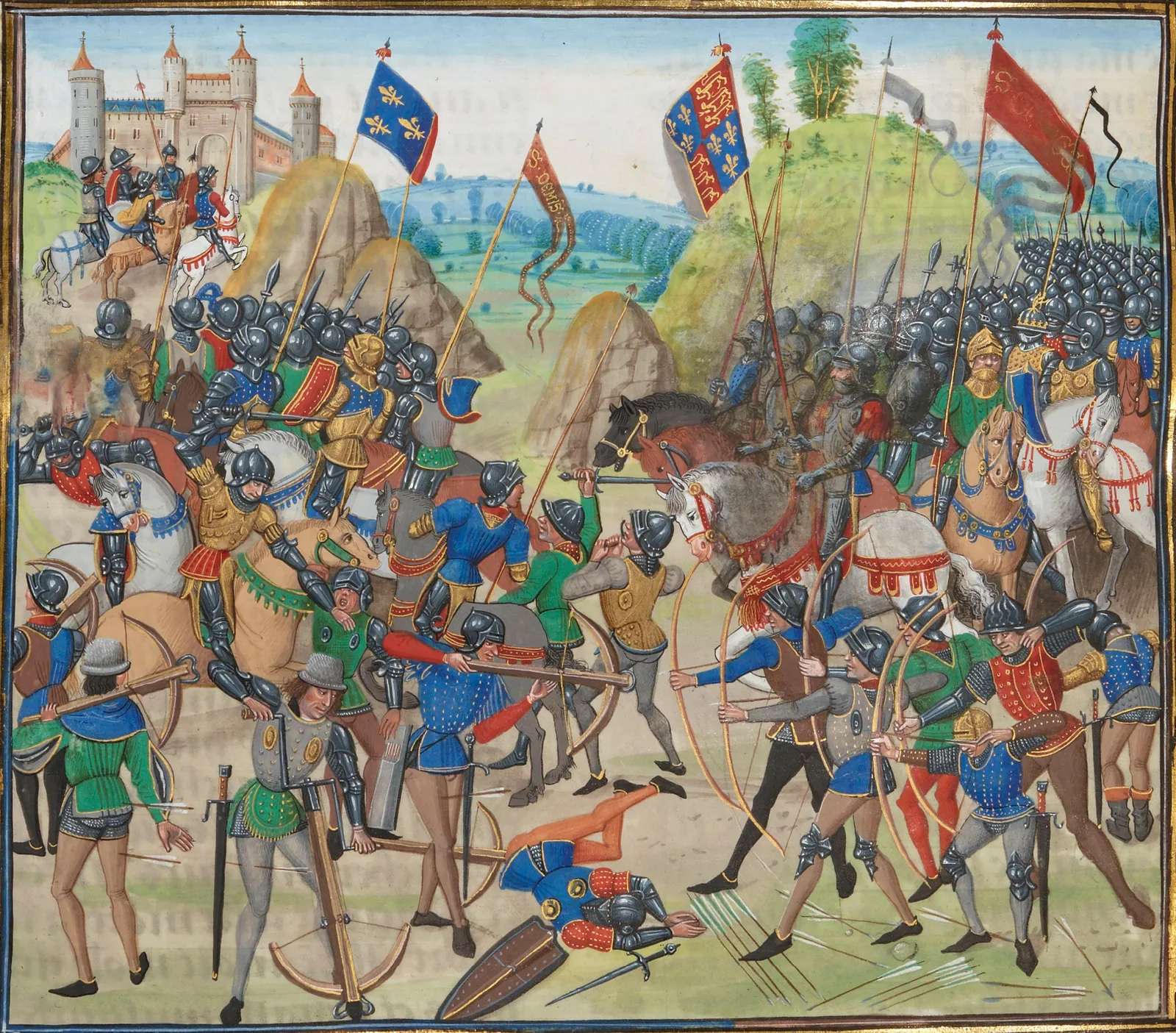
- The longbow era: English and Welsh archers broke French cavalry at Crécy, Poitiers, and Agincourt, ending the unquestioned supremacy of the mounted knight.
- Joan of Arc turned the tide: her 1429 victories at Orléans and Patay and the coronation of Charles VII at Reims broke the aura of English invincibility; she was burned in 1431, after her work was done.
- The aftermath: France emerged with a standing army and a centralized monarchy; England emerged insolvent, lost its continental lands, and slid toward the Wars of the Roses.
Contents
- Overview
- Why did the war start?
- How was the war fought? The three phases
- What happened at the great battles?
- Who was Joan of Arc and why did she change the war?
- Casualties
- Economic effects
- How it shaped the world
- What historians debate
Overview
In the early 14th century, France was the richest, largest, and most populous kingdom of western Europe — roughly 16 million people in 1328 against England's 5 million, per French historian Olivier Renaudeau — while England was the best organized state in the west. The war was fought mostly in France: French towns and farms bore the damage while English parliaments bore the taxes. By the end, feudal levies had given way to paid professional armies, and both kingdoms had forged stronger national identities.
Why did the war start?
Two disputes, one dynastic and one feudal, combined in 1328–1337.
The succession crisis. When Charles IV died on 1 February 1328 with no male heir, an assembly of magnates chose Philip of Valois (Philip VI) over Edward III of England, whose claim ran through his mother Isabella. The barons effectively barred inheritance through a woman — later called Salic law. Edward protested, then did homage for his French lands at Amiens in 1329.
The Guyenne problem. Since 1259, England's kings had held the duchy of Guyenne (reduced Aquitaine) as vassals of the French crown — making one king the vassal of another. When Edward's homage proved grudging and Gascon–French incidents multiplied, Philip VI declared Guyenne confiscated on 24 May 1337, the conventional start of the war. That October, Edward formally declared the French crown rightfully his.
How was the war fought? The three phases
The Edwardian War (1337–1360). England destroyed the French fleet at Sluis (24 June 1340), then campaigned through Brittany and Gascony, climaxing in the Crécy campaign of 1346 and the capture of Calais. The Treaty of Brétigny (8 May 1360): France ceded Aquitaine plus Calais and Guînes in full sovereignty, Edward renounced his claim to the French crown, and John II's ransom was set at 3,000,000 gold écus.
The Caroline War (1369–1389). Under Charles V and his constable Bertrand du Guesclin, France avoided pitched battles and nibbled back the ceded lands; by 1378 the French had reconquered most of what Brétigny had given away.
The Lancastrian War (1415–1453). Exploiting Charles VI's mental illness and a French civil war, Henry V invaded in 1415, won Agincourt, allied with Burgundy, and by the Treaty of Troyes (1420) married Catherine of Valois with his heirs designated to inherit the French throne. Both kings died in 1422; England ruled northern France for the infant Henry VI — until Joan of Arc, the loss of Burgundy (1435), and French victories at Patay (1429), Formigny (1450), and Castillon (1453) ended it.
What happened at the great battles?
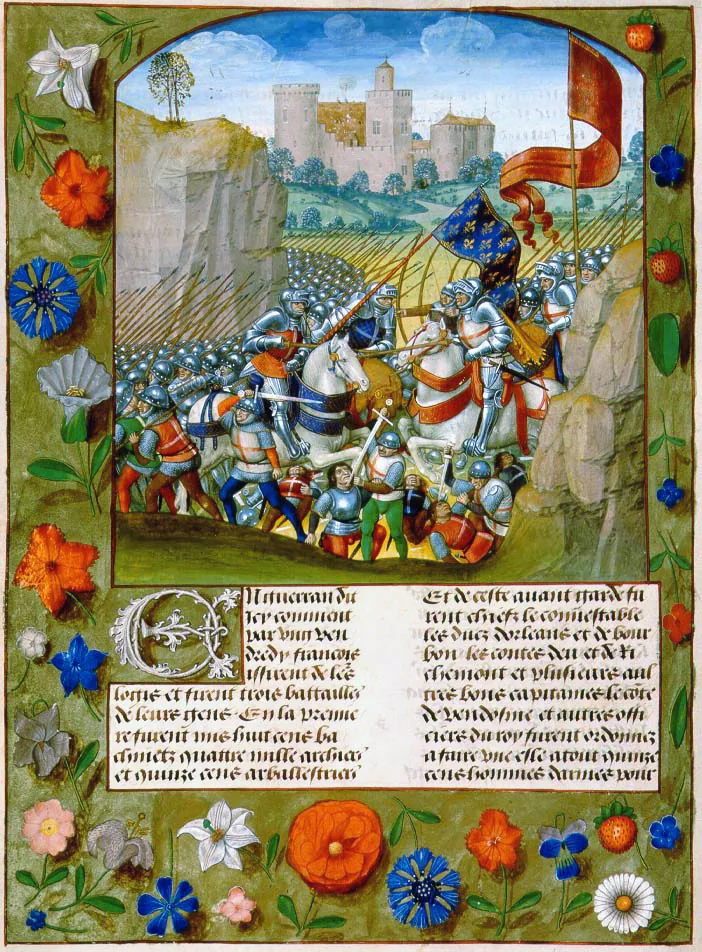
Crécy, 26 August 1346. Returning from a chevauchée — a destructive mounted raid that burned towns to within sight of Paris — Edward III took a defensive position near Crécy-en-Ponthieu. Modern historians put the English at 7,000–15,000 (Sumption argues 7,000–10,000; Ayton about 14,000; Rogers about 15,000) against 20,000–30,000 French. Genoese crossbowmen, their bowstrings rain-softened, broke first; French cavalry then foundered uphill through mud, pits, and arrow storms. Clifford Rogers calls it "a total victory for the English"; Sumption, "a political catastrophe for the French Crown." Crécy "established the effectiveness of the longbow as a dominant weapon on the Western European battlefield."
Poitiers, 19 September 1356. The Black Prince, with fewer than 7,000 men, caught John II's larger army near Poitiers; the French charged entrenched archers, and John II himself was taken prisoner with thousands of his knights — the captivity that produced the crushing Brétigny settlement.
Agincourt, 25 October 1415. Weakened by disease at Harfleur, Henry V was blocked by a larger French army: 6,000–8,100 English (nearly 80 percent archers) against 14,000–15,000 French. English dead: at most a few hundred (112 identified by name). French dead: around 6,000, mostly nobles, with 700–2,200 captured. The victory gave England 14 years of dominance — until Orléans.
Who was Joan of Arc and why did she change the war?
In 1429 the dauphin Charles's cause looked hopeless: uncrowned, Reims in enemy hands. Joan of Arc, a peasant girl from Domrémy (born c. 1412) who said saints' voices commanded her to expel the English, was given troops after examination by theologians. She entered Orléans on 29 April 1429; after the storming of Les Tourelles on 7 May, the English abandoned the siege the next day. At Patay (18 June), the English army was routed — with it, Britannica notes, "finally, its reputation for invincibility." Joan escorted Charles to Reims, where he was crowned Charles VII on 17 July 1429. Captured by Burgundian forces (then allied with England) in 1430, she was tried at Rouen and burned as a heretic on 30 May 1431, aged 19. Pope Calixtus III annulled the sentence in 1455–56; she was canonized in 1920 and remains France's national heroine.
Casualties
Medieval armies kept no reliable rolls of the dead, so every figure is an estimate.
- Whole war: a summary of French and English military deaths puts roughly 185,000 killed in combat and about 556,000 total military deaths across the 116 years.
- Crécy: English dead 100–300; French men-at-arms 1,542–4,000, infantry losses unknown but heavy. Froissart claimed 30,000 French killed or captured; Alfred Burne, in The Crécy War, guessed roughly 12,000 French dead.
- Agincourt: English dead at most 600 (112 identified); French dead around 6,000. Anne Curry's archival research argues the armies were closer in size than legend holds — roughly 8,500–9,000 English against about 12,000 French.
- Civilians and the plague: the war's chevauchées deliberately ravaged the countryside; the sack of Caen in 1346 alone killed over 5,000 soldiers and civilians. Far deadlier was the Black Death (1347–51): an estimated 6–12 million dead in France (30–60% of the population) and 2–3 million in England — plague deaths, not war deaths, but they hollowed out both kingdoms mid-war.
Economic effects
A sovereign default. Edward III borrowed heavily from Florence's banking houses against England's wool revenues. The chronicler Giovanni Villani blamed Edward's repudiation of war loans for the bankruptcy of the Bardi (1344) and Peruzzi companies, claiming debts of 900,000 and 600,000 gold florins respectively. Modern scholarship (notably Edwin Hunt's) is more cautious: the Peruzzi's records show they never had that much capital to lend, Edward repaid part in cash and wool grants, and Florence's own crises mattered. The defaults contributed to, but did not single-handedly cause, the collapses.
Ransoms as state finance. John II's 3,000,000-écu ransom was a national burden; decades later Henry V demanded 1.6 million crowns still outstanding from it as a precondition for peace talks, and in 1414 Parliament granted him a "double subsidy" — tax at twice the traditional rate — for the Agincourt campaign. By the war's end, England was left insolvent, and the shock of defeat helped push its nobility toward the Wars of the Roses.
How it shaped the world
- The professional army. Feudal levies gave way to paid, contracted troops — the first standing armies in Western Europe since Rome — and artillery, including small hand-held cannon, became central to siegecraft.
- The longbow's lesson. Three generations of French knights charged into arrow storms. The longbow — up to ten aimed shots a minute at 300+ metres, a skill archers trained in from boyhood, with tactics honed in the Scottish wars — proved disciplined missile troops could destroy the flower of chivalry. Chivalry peaked during the conflict, then declined.
- Nations, not just dynasties. The war accelerated French and English national feeling and the centralization of both states: a permanent English Parliament granting war taxes, an expanding French royal administration. Joan of Arc became the enduring symbol of French national consciousness.
- The map that followed. England kept only Calais (until 1558), though its kings styled themselves sovereigns of France for centuries — Renaudeau notes the royal arms kept the French fleurs-de-lis until 1801. Defeat discredited the regime and fed the Wars of the Roses (1455–1487).
What historians debate
How lopsided was Agincourt? The traditional picture — a tiny, exhausted English band against a vast French host — has been dismantled by Anne Curry (Agincourt: A New History, 2005), who worked from surviving muster rolls and financial records: about 8,500–9,000 English vs. about 12,000 French. A peer-reviewed H-France assessment calls her book "of fundamental importance" — though historians like Juliet Barker, Jonathan Sumption, and Clifford Rogers dispute how far the administrative records can be pushed, and the debate continues.
Was Agincourt decisive? Curry argues it was a moral rather than strategic victory — it did not force France to negotiate. The record agrees in effect: England's advantage lasted 14 years, until Orléans. The war was won by artillery, money, and transformed French morale, not by one afternoon in Picardy.
The big narrative. The modern standard history is Jonathan Sumption's five-volume The Hundred Years War (Faber & Faber: Trial by Battle, Trial by Fire, Divided Houses — 2009 Wolfson History Prize — Cursed Kings, Triumph and Illusion), treating the war as one long, savage, mercenary struggle rather than a chivalric romance. French scholars such as Philippe Contamine stress the other side of the Channel: how the defeat of chivalry fed national resistance.