The Suez Crisis, explained in one line: in October–November 1956 Britain, France and Israel secretly colluded to invade Egypt and retake the nationalised Suez Canal, won the fighting in nine days — and were forced out within weeks by the United States, the Soviet Union and the United Nations, in the crisis that ended Britain's career as an independent great power. The war itself ran from 29 October to 7 November 1956; the crisis around it ran from Nasser's nationalisation of the canal on 26 July 1956 to the last Israeli withdrawal in March 1957.
Key takeaways
- It was a military victory and a political defeat, simultaneously. The standard summary of the reference record is a coalition military victory and an Egyptian political victory: Egypt kept the canal, and the invaders left under orders from their own allies and creditors.
- The decisive weapon was financial, not military. The Bank of England lost $45 million in the invasion's first days; Washington blocked IMF help until Britain accepted withdrawal, and sterling was rescued by a $1.3 billion IMF package only after London capitulated.
- The death toll is a range with a long tail of prisoners. Egyptian military deaths are put at 1,650–3,000, plus some 1,000 civilians — while Egyptian prisoners are counted anywhere from 5,000 to more than 30,000, a spread that reflects the collapse in Sinai rather than a counting error.
- Its most durable invention was peacekeeping. The United Nations Emergency Force (UNEF), proposed by Canada's Lester B. Pearson, was the UN's first armed peacekeeping force; it supervised the withdrawals and then patrolled Sinai until 1967.
Contents
- Overview
- What caused the crisis?
- How was the war fought?
- Casualties
- Economic effects
- How it shaped the world
- What historians debate
Overview
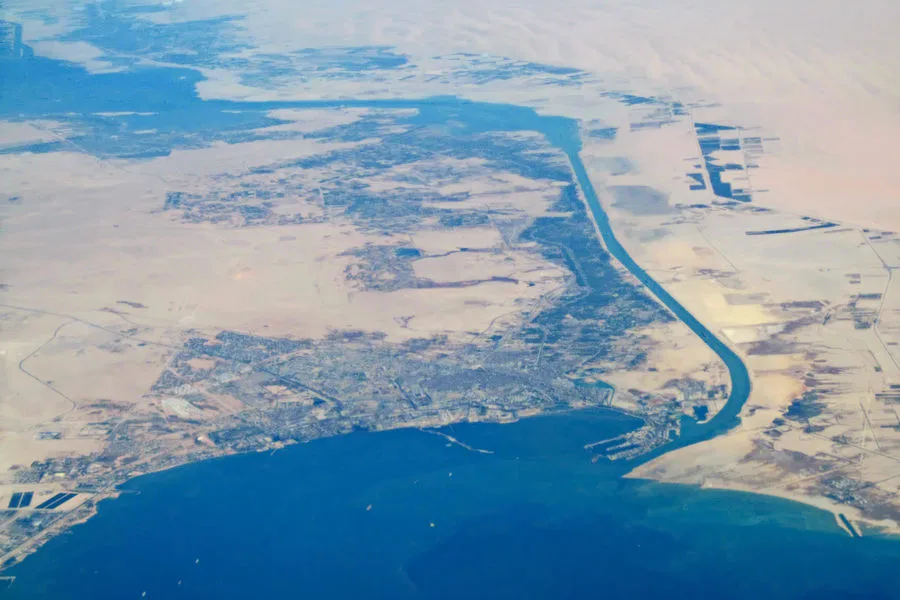
The Suez Crisis was a British-French-Israeli invasion of Egypt in 1956, known in the Arab world as the Tripartite Aggression and in Israel as the Sinai War. The canal at its centre had opened in 1869, operated by the Suez Canal Company, an Egyptian-chartered company controlled by French and British interests; Britain had bought a 44 percent share in 1875 and occupied Egypt in 1882, and the 1888 Convention of Constantinople had declared the canal a neutral zone under British protection. After the Second World War the waterway carried the bulk of western Europe's oil: of two million barrels a day imported from the Middle East, 1.2 million came by tanker through the canal. In October 1954 Britain had agreed to evacuate its Suez base within twenty months, with the canal company itself due to revert to Egypt in 1968. What turned a managed retreat into a war was the collision, over eighteen months, of Egyptian nationalism, Cold War arms politics and three governments' separate grievances against one man — Gamal Abdel Nasser.
What caused the crisis?
The immediate cause was a dam, a snub and a seizure: when the United States and Britain withdrew their promised financing for Egypt's Aswan High Dam, Nasser nationalised the canal to pay for it himself. Britannica traces the chain directly — Washington and London reneged in response to Egypt's growing ties with communist Czechoslovakia and the Soviet Union, above all the September 1955 Czech arms deal; Nasser answered on 26 July 1956 by seizing the Suez Canal Company, predicting that canal tolls would pay for the dam within five years. The U.S. Office of the Historian adds the legal point London and Paris preferred to skip: Nasser offered full economic compensation for the company. The outrage was not really about compensation. Britain feared Nasser might close the canal and cut the petroleum flowing from the Persian Gulf to western Europe, and Prime Minister Anthony Eden wanted him gone. France, fighting Algeria's independence war, blamed Nasser for supporting the Algerian rebels. Israel, blockaded by Egypt in the Straits of Tiran and hit by Egyptian-supported commando raids through 1955–56, wanted both ended. American mediation — Secretary of State John Foster Dulles's proposed Suez Canal Users' Association of 18 maritime nations, put forward on 9 September — won the full support of none of the parties. So the three aggrieved governments made their own arrangement, in secret.
How was the war fought?
Exactly as scripted at Sèvres — which is why the script's exposure destroyed it. Between 22 and 24 October 1956, at Sèvres outside Paris, the three governments signed a protocol, reconstructed by S. Ilan Troen in Israel Studies (1996): Israel would attack across Sinai on 29 October aiming to reach the canal within a day; on 30 October Britain and France would issue an ultimatum demanding both sides withdraw ten miles from the canal; on Egypt's anticipated rejection, Anglo-French forces would attack on 31 October and occupy the canal zone, while Israel seized the Tiran and Sanafir islands to reopen the Gulf of Aqaba. The protocol was signed by David Ben-Gurion, French foreign minister Christian Pineau and British official Patrick Dean. All three governments then denied it existed; Eden shredded the British copy, and surviving copies rest in Israeli archives.
The operation ran to the timetable. Ten Israeli brigades invaded on 29 October and routed Egypt's forces in Sinai, reaching within ten miles of the canal. Anglo-French aircraft opened their attack on 31 October, and on 5–6 November British and French forces landed at Port Said and Port Fuad — including the first helicopter assault in British service — taking the northern canal zone against fierce street fighting in which much of Port Said burned. The invaders had, on the military assessment recorded in the reference histories, the canal within a day's reach when the ceasefire stopped them.
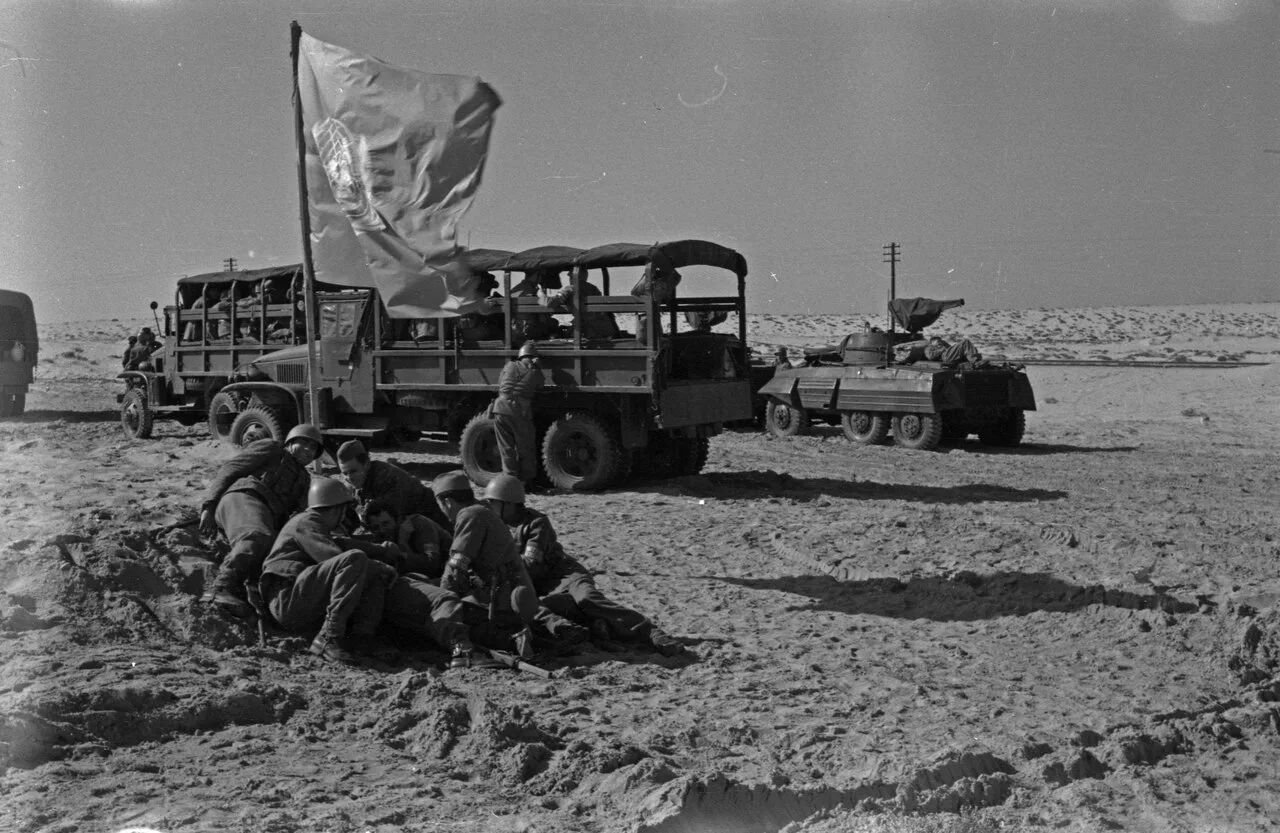
What stopped them was not Egypt. Britain and France vetoed ceasefire drafts in the Security Council on 30 October, so the General Assembly met in its first emergency special session from 1 November and adopted the American Resolution 997 in the early hours of 2 November by 64 votes to five. Soviet premier Nikolai Bulganin's letters of 5 November threatened rocket attacks on London, Paris and Tel Aviv. And Washington applied the pressure that counted: the Eisenhower administration, determined — in the Office of the Historian's summary — to dissociate the United States from European colonialism in the same week it was condemning the Soviet intervention in Hungary, condemned its own allies, voted for the UN resolutions, and squeezed sterling (see Economic effects). Eden announced a ceasefire on 6 November without warning France or Israel beforehand. Anglo-French troops completed their withdrawal by 22 December, replaced by UNEF; Israel, refusing any UN force on territory it held, withdrew from Sinai and Gaza in March 1957.
Casualties
Egypt paid almost the whole human cost, and even its bill is a range, because the Egyptian army in Sinai did not so much lose a battle as dissolve. The reference record puts Egyptian military deaths at 1,650 to 3,000 killed, with 4,900 wounded — and prisoners at anywhere from 5,000 to more than 30,000, the enormous spread reflecting mass surrenders and captures as Israeli forces overran Sinai in days. Egyptian equipment losses were correspondingly heavy: more than 215 aircraft and 125 tanks destroyed. Some 1,000 Egyptian civilians were killed, many of them at Port Said, where street fighting and fires destroyed much of the city; Nasser had proclaimed a "people's war," arming civilians and ordering soldiers into civilian clothes, a tactic the histories note was designed to make the invaders choose between civilian deaths and sniper fire.
The coalition's losses were small but are themselves a small lesson in sourcing: Israeli dead are given as 172 in the standard infobox tally and 189 in Derek Varble's count; British dead as 22 in the former and 16 in the latter; French dead are consistently 10. British wounded were 96, French 33, Israeli 817, with one Israeli captured. No figure in this section should be quoted without its range: for a nine-day war documented by four governments, the surviving counts still do not agree.
Economic effects
Suez was the first modern crisis in which a currency, not an army, decided a war. Egypt blocked the canal by sinking ships in it, and it stayed closed from October 1956 to March 1957 — fully reopened to shipping only on 24 April 1957. For the six months of closure, the IMF's own retrospective records, higher transport costs, delays and diverted trade weakened all four combatants' current accounts. Syria blew up the Kirkuk–Baniyas pipeline that carried Iraqi oil to the Mediterranean, and Saudi Arabia embargoed oil to Britain and France; the United States refused to fill the gap until London and Paris agreed to a rapid withdrawal.
Britain's exposure was sterling. The pound's parity had been fixed at $2.80 since 1949, and the Bank of England treated $2 billion as the reserve floor below which devaluation or a float would be forced. Speculation became a run once the invasion began: the Bank lost $45 million between 30 October and 2 November alone, and through November the losses pushed reserves below the floor. Chancellor of the Exchequer Harold Macmillan warned the cabinet that after American action the country would within weeks be unable to import sufficient food and energy. Washington's lever was precise — Britain's immediate IMF assistance was blocked by the United States, and Treasury Secretary George Humphrey was ordered to prepare sales of the US government's sterling bond holdings. James Boughton, the IMF's historian, shows how the rescue was priced: only after the cabinet set 22 December as the deadline for full withdrawal did Humphrey propose, on 3 December, a package of a $561 million immediate drawing plus a $739 million stand-by — $1.3 billion, 100 percent of Britain's IMF quota. In nine months the Fund lent $858 million to the four combatants and committed a further $738 million on stand-by, and Boughton argues the operation made the IMF, until then almost untested, into an international crisis manager.
How it shaped the world
Suez is the conventional date for the end of the European empires' independence — the last war Britain and France started as great powers and could not finish as them. Egypt kept the canal, and Nasser emerged, in Britannica's words, "a victor and a hero for the cause of Arab and Egyptian nationalism"; within fifteen months he had merged Egypt and Syria into the United Arab Republic. Eden, accused of misleading Parliament, resigned on 9 January 1957. The Office of the Historian records that American worry about the viability of British power in the Middle East produced the Eisenhower Doctrine of January 1957 — $200 million of aid and a promise of force, the United States formally filling the vacuum its allies had vacated.
Israel gained the concrete things it had fought for: the Straits of Tiran, closed since 1950, reopened to its shipping, UNEF stood between it and Egypt, and its southern border stayed quiet for eleven years — though the absence of any peace settlement also laid, as the histories note, the groundwork for the Six-Day War of 1967. The Soviet Union gained prestige it had not earned on the battlefield: Bulganin's rocket threats were widely believed at the time to have forced the ceasefire, and Nasser publicly thanked Khrushchev as Egypt's saviour while admitting in private that American economic pressure had saved him. The threats also covered Moscow's simultaneous crushing of the Hungarian uprising, which the crisis pushed off the world's front pages.
Two longer consequences ran through Paris and through the UN. France concluded it could not rely on allies: it accelerated its own nuclear weapons programme — a new Sahara test centre was authorised in 1957 and the first French device, Gerboise Bleue, was tested in 1960 — and historians such as Thomas Risse-Kappen trace a line from Suez to de Gaulle's 1966 withdrawal from NATO's military integration. And at the UN, Pearson's proposal created the template of armed, consent-based peacekeeping: UNEF's first units landed at Ismailia within ten days of the General Assembly's decision, the withdrawals were completed on schedule, and Pearson received the 1957 Nobel Peace Prize for it.
What historians debate
- Was there collusion, and who proved it? All three governments denied Sèvres for years, and Eden destroyed the British copy of the protocol. Keith Kyle's Suez: Britain's End of Empire in the Middle East (1991; revised edition with a foreword by Wm. Roger Louis) is treated by its publisher and reviewers as the seminal account: Kyle, who had covered the crisis from Washington for The Economist, worked the British archives as they opened from 1987 and the French, American and Israeli records besides, and established the collusion on documents rather than suspicion. Troen's 1996 publication of the protocol's text itself, from the Israeli copies, closed the factual question; what remains debated is how far Eden personally misled Parliament about foreknowledge of Israel's attack.
- Which pressure actually stopped the invasion — Soviet rockets or American money? Contemporary opinion credited Bulganin; the Soviet Union did not in fact possess the intercontinental missiles the threats implied, as was learned later. Diane Kunz's The Economic Diplomacy of the Suez Crisis made the financial case the standard one, and Nasser's private admission supports it. Economic historians have since refined rather than reversed it: a Queen's University study of the Bank of England's intervention concludes that recent historians have been right to downplay the run on the pound in the invasion's first week, but wrong to deny there was a financial crisis — by late November, reserve losses and collapsing credibility coincided, and reserves fell below $2 billion. A separate cabinet-level suspicion, recorded in the reference histories, is that Macmillan overstated the Treasury's position to force Eden's hand — what officials had told him was less serious than what he told his colleagues.
- Did Suez end British power, or merely announce it? Kyle's subtitle states the strong thesis — Britain's end of empire in the Middle East. The counter-evidence is in the aftermath itself: the Anglo-American relationship recovered within months, producing the 1958 US–UK Mutual Defence Agreement and, six years after the crisis, the sale of Polaris missile technology; British forces stayed east of Suez until 1971, withdrawn then mainly for economic reasons. The narrower claim commands the widest agreement, and it is the reference record's own: after 1956 Britain and France could no longer conduct an independent foreign policy without American consent.
This explainer is drawn from the sources listed below, all opened or read during this run. Casualty and cost figures are published strictly as the attributed ranges and estimates those sources give.
---