The Afghanistan War, explained in one line: the United States invaded Afghanistan on 7 October 2001 to destroy al-Qaeda's sanctuary and remove its Taliban hosts, succeeded in both within two months — and then spent twenty years, some $2.3 trillion and at least 176,000 lives trying to build an Afghan state that collapsed in eleven days in August 2021, returning the Taliban to power. It remains the longest war in American history.
Key takeaways
- The first war was won in two months; the second lasted nineteen years. Britannica divides the conflict into three phases — toppling the Taliban, rebuilding the state (2002–08), and a counterinsurgency turn from 2008 — of which only the first achieved its stated aim on schedule.
- The death toll is a range, not a number. Direct deaths are put at 176,206 by Brown University's Costs of War project and 212,191 by the Uppsala Conflict Data Program. The difference is method and coverage, and neither count includes indirect deaths.
- The Afghan state was built to need its builders. SIGAR found the Afghan forces were designed as a mirror image of US forces, dependent on American airpower, contractors and money — a dependency the 2020 Doha Agreement and the 2021 withdrawal exposed within weeks.
- The bill and the verdict arrived together. Costs of War puts the US cost at $2.26–2.31 trillion; SIGAR, after auditing $148 billion of reconstruction spending, concluded the mission "promised to bring stability and democracy to Afghanistan, yet ultimately delivered neither."
Contents
- Overview
- What caused the war?
- How was the war fought?
- Casualties
- Economic effects
- How it shaped the world
- What historians debate
Overview
The Afghanistan War was fought from 7 October 2001 to 30 August 2021. Britannica structures it in three phases. The first — toppling the Taliban, the ultraconservative movement that ruled Afghanistan and provided sanctuary to al-Qaeda, the perpetrators of the September 11 attacks — lasted just two months. The second, from 2002 to 2008, was a US strategy of defeating the Taliban militarily while rebuilding the core institutions of an Afghan state. The third, from 2008, was a turn to classic counterinsurgency — protecting the population and reintegrating insurgents — accelerated by President Barack Obama's 2009 decision to surge US troops, and coupled from the start with a timetable for handing security to Afghan forces. That approach, Britannica records, largely failed: insurgent attacks and civilian casualties stayed stubbornly high, and the Afghan units taking over appeared ill-prepared to hold off the Taliban. NATO's combat mission formally ended in December 2014, by which point the war had already become the longest the United States had ever fought. A US–Taliban agreement in February 2020 set the exit; the last American aircraft left on 30 August 2021, fifteen days after Kabul fell.
What caused the war?
The cause was sanctuary: al-Qaeda planned and trained for September 11 under Taliban protection, and the Taliban would not surrender its leaders. The Council on Foreign Relations' timeline records that three days after the attacks, on 18 September 2001, Congress passed the Authorization for Use of Military Force against those who had planned the attacks and those who had harboured them — the legal basis for the invasion. When the Taliban failed to hand over al-Qaeda's leaders, including Osama bin Laden, the United States invaded on 7 October in support of the Northern Alliance, the Afghan coalition still fighting the Taliban in the country's northeast. The stated aims were bounded — overthrow the Taliban, dislodge al-Qaeda — and both were met by December. What turned a two-month campaign into a twenty-year war was the decision that followed: to remain, and to construct a centralised Afghan republic that could guarantee the sanctuary never returned.
How was the war fought?
A light-footprint victory, a neglected reconstruction, a resurgent insurgency, a surge that bought time but not a settlement, and a negotiated exit that the Afghan government was not party to negotiating. US airpower, special forces and Northern Alliance ground troops took Kabul in November 2001 and Kandahar, the Taliban's spiritual home, in December. An interim administration under Hamid Karzai followed, and in 2004 the US-backed Islamic Republic was established — by which time, the record notes, the Taliban under Mullah Omar had already reorganised and begun an insurgency. American attention and resources had shifted to Iraq from 2003; Carter Malkasian's history calls these the years of the "light American footprint." By 2006 the Taliban had returned in force in the south and east, waging guerrilla war from the countryside, suicide attacks in the cities, and reprisals against Afghans who worked with the government.
Obama's answer, announced in February and again in December 2009, was a surge. By 2010 some 150,000 NATO troops were on the ground (Britannica), and roughly 140,000 foreign troops served under ISAF at the 2011 peak — yet the situation remained what Britannica calls a virtual stalemate, with higher casualties than before. In May 2011 US forces killed bin Laden in Abbottabad, Pakistan, and Obama announced the war's primary objectives had been achieved. On 28 December 2014 NATO's combat mission ended, leaving some 13,000 troops to train and support Afghan forces. The Taliban, undefeated, controlled or contested growing territory through the late 2010s, and the Islamic State's Khorasan affiliate added a further front from 2015.
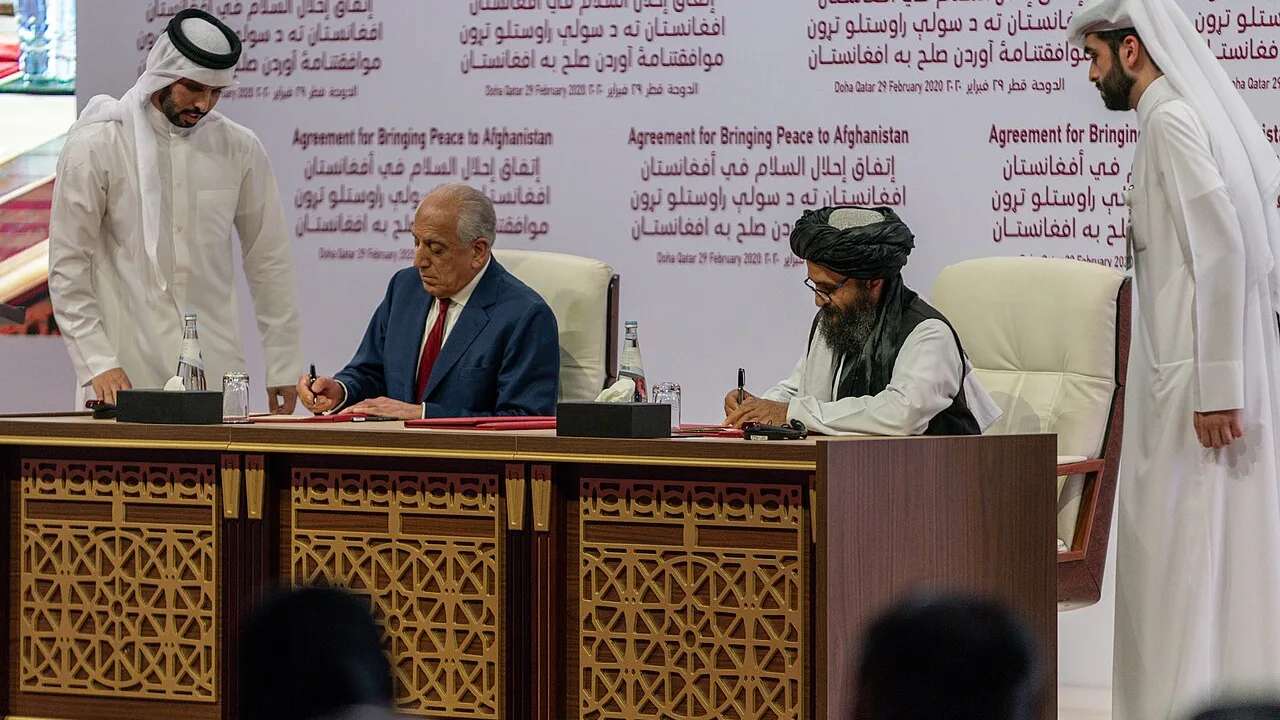
The endgame was diplomatic, then abrupt. On 29 February 2020 the United States and the Taliban signed an agreement in Doha providing for a full US withdrawal over 14 months, conditional on the Taliban entering peace negotiations with the Afghan government and preventing al-Qaeda and Islamic State affiliates from operating in Afghanistan. Critically, Britannica notes, the agreement did not require the Taliban to reach a settlement with Kabul — and the Afghan government had not negotiated it. The US drew down from 13,000 troops to 8,600 by late June 2020 and 3,500 by January 2021 anyway. President Biden, after a review, kept the withdrawal and moved the deadline to 31 August 2021. From May the Taliban overran district after district; the Afghan security forces, built around US air support and contractors that were now leaving, dissolved faster than any public assessment had predicted. Kabul fell on 15 August and President Ashraf Ghani fled. The evacuation that followed was punctuated on 26 August by an Islamic State Khorasan suicide bombing at the airport that killed at least 170 Afghan civilians and 13 US service personnel (Britannica), and on 29 August by a US drone strike that killed 10 civilians, including seven children, against a target later found not to have been a threat. The last US aircraft departed on the night of 30 August 2021.
Casualties
No total commands agreement, because the projects counting the dead count different wars: one counts documented direct deaths, another models a wider conflict, and the UN's systematic record begins only in 2009. Coalition military deaths are enumerated by comparison: about 2,400 US service members killed and 20,700 wounded in Britannica's accounting; the Defense Casualty Analysis System count compiled by the A-Mark Foundation gives 2,456 US military deaths and 20,770 wounded, plus 3,923 US contractor and Defence Department civilian deaths — contractors outnumbering soldiers among the American dead. Some 832,000 US troops served in Afghanistan over twenty years.
For the war as a whole, two totals frame the range. The Costs of War project (Neta Crawford and Catherine Lutz, Brown University) puts direct war deaths in Afghanistan at 176,206, composed in its September 2021 update of 46,319 civilians, 69,095 Afghan military and police, and at least 52,893 opposition fighters, plus allied troops, journalists and aid workers. Its April 2021 paper, using a slightly different cut-off, gives 47,245 civilians and 51,191 opposition fighters — a reminder that even one project's figures move with its accounting date. The Uppsala Conflict Data Program, the standard conflict dataset, counts 212,191 deaths — some 36,000 more, reflecting its broader event coverage. Both projects warn their figures are floors: Costs of War states plainly that deaths from "disease, loss of access to food, water, infrastructure, and/or other indirect consequences of the war" are unaccounted, and its earlier work suggested indirect deaths in modern wars can exceed direct ones several times over. No figure of that kind is published here as a total, because none is a count.
The civilian record has its own dedicated source. UNAMA began systematically recording civilian casualties only in 2009, and its September 2026 retrospective records more than 40,000 civilians killed and more than 77,000 wounded between January 2009 and 15 August 2021 — the war's second half alone. UNAMA attributed the majority of civilian casualties each year to anti-government elements, the share ranging from 61 to 80 percent depending on the year; in the first quarter of 2021, its final full reporting period, anti-government elements caused 61 percent and pro-government forces about 27 percent, with the Taliban alone responsible for 43.5 percent. Displacement matched death in scale: more than 5.7 million former refugees returned to Afghanistan after 2001, yet by the fall of Kabul 2.6 million Afghans remained refugees abroad and another 4 million were internally displaced (UNHCR figures carried in the war's reference record).
Economic effects
The United States spent more on this war than on any comparable enterprise since 1945, and the auditors' argument is about scope, not arithmetic. Costs of War estimates $2.261 trillion for 2001–2021: $933 billion of Defence Department war-budget spending, $59 billion of State Department war spending, $443 billion of war-related base-budget increases, $296 billion of veterans' care to date, and $530 billion of interest on the borrowing that financed the war — a total that rises to $2.313 trillion in the project's accounting through fiscal 2022, and which still excludes future lifetime veterans' care and future interest. SIGAR's count — $899.8 billion — looks like a contradiction until its scope is stated: it covers Defence Department spending and reconstruction only. SIGAR itself notes that the three categories it excludes (base-budget increases, veterans' care and interest) total $1.259 trillion, and that adding them brings its figure broadly into line with Costs of War. The honest summary is the range: roughly $0.9 trillion of direct departmental spending, roughly $2.3 trillion all-in.
Within that, reconstruction is the audited core. Congress appropriated more than $148 billion to rebuild Afghanistan — more, SIGAR notes, than the United States sent to Europe under the Marshall Plan — of which about 60 percent went to security, including 427,300 weapons, 96,000 ground vehicles and at least 162 aircraft for the Afghan forces. SIGAR's final forensic audit identified $26–29 billion lost to waste, fraud and abuse, and acting inspector general Gene Aloise named corruption as the single largest factor undermining the effort: it "turned the population against the government that we were trying to build," he said, and "weakened everything we tried to do." Some $7.1 billion of equipment supplied to the Afghan forces was left behind in August 2021 and, in the final report's words, now forms "the core of the Taliban security apparatus." SIGAR's sector lessons explain the mechanism behind the waste: strategies that were never coherent, timelines that rewarded spending quickly, institutions built beyond Afghanistan's capacity to sustain them, and monitoring too weak to correct course.
How it shaped the world
The war began the post-9/11 era and ended by discrediting its central method: that a superpower can remove a regime in weeks and then build a replacement state under fire. Its first legacy is doctrinal. The AUMF written for Afghanistan in September 2001 became the standing legal basis for two decades of US counterterrorism operations far beyond it, and the war's trajectory — rapid regime removal, mission expansion, stalemate, negotiated exit, collapse — became the reference case in every subsequent Western debate about intervention, from Iraq and Libya to the present.
Its second legacy is Afghan. The republic built between 2001 and 2021 ceased to exist as a functioning state within days of the foreign withdrawal, and the Islamic Emirate overthrown in 2001 was restored. UNAMA's victim reporting gives that legacy a human register: among survivors it interviewed, 95 percent described emotional or psychological harm and 84 percent financial losses, harm for which, it found, redress has barely begun.
Its third legacy is institutional candour, purchased late. SIGAR spent seventeen years documenting the failure in real time and closed with a warning future policymakers ignore at their risk: any mission "similar in context, scale, and ambition must confront the real possibility of failure."
What historians debate
- Was the war lost in 2002, 2009, or 2020? Each date has a school. The early-diversion case holds that the light footprint of the Iraq years let the Taliban regenerate in Pakistani sanctuary while reconstruction was starved. The surge case asks whether Obama's 2009 escalation — time-limited by its own announced drawdown — could ever have produced a settlement. The endgame case is now SIGAR's own record: officials told its investigators the Doha Agreement "ultimately sealed Afghanistan's fate" by legitimising the Taliban, excluding the Afghan government, and destroying Afghan forces' morale once US support was visibly ending. The sources opened do not choose among these; they establish that informed participants were making each argument while the war was still being fought.
- Identity or incompetence? Carter Malkasian, in The American War in Afghanistan: A History (Oxford University Press, 2021; Lionel Gelber Prize, 2022), argues from Pashto-language sources and district-level service that the Taliban's strength was rooted in its connection to Afghan religious and social identity — and that any government aligned with a foreign occupier was imperilled by that alignment, however well it governed. On this reading, better execution would have changed the war's costs more than its outcome. SIGAR's lessons-learned work reaches the complementary institutional verdict: the United States "failed to understand Afghanistan's complex social, economic, and political dynamics and tailor its efforts accordingly." The two accounts differ in emphasis — culture versus administration — and agree on the underlying point.
- Could the Afghan state have survived a slower exit? Defenders of a residual presence argue the republic held for six years after the combat mission ended, and collapsed only when air support, contractors and the Doha timetable converged in one summer. Critics answer that a state which falls in eleven days when its sponsor leaves was never, in the relevant sense, standing — and that SIGAR had documented the dependency for a decade. The speed of the collapse is the one fact neither side disputes.
This explainer is drawn from the sources listed below, all opened or read during this run. Casualty and cost figures are published strictly as the attributed ranges and estimates those sources give.
---