The Gaza ceasefire's status one year on is stalled: the agreement that took effect in October 2025 halted major military operations, freed all remaining hostages and increased humanitarian access, but it has not delivered the disarmament of Hamas, a new Palestinian administration, an international stabilisation force or an Israeli withdrawal — and almost nothing has been rebuilt. That is the shared assessment of the Associated Press's anniversary review, Human Rights Watch, and a joint statement issued on October 9 by more than 100 humanitarian, human rights and civil society organisations, which said the ceasefire exists in name only. The figures and positions below are attributed to those sources throughout.
What did the ceasefire achieve in its first phase?
The ceasefire achieved the end of major military operations, the return of the hostages and a rise in aid. The 20-point agreement, brokered by US President Donald Trump and Arab allies after months of negotiations, led to the return of all the remaining hostages taken in Hamas's October 7, 2023 attack, in which Hamas fighters killed some 1,200 people and abducted 251, the AP reported. Israel's response — massive bombardment and a ground invasion — has killed more than 74,000 Palestinians, according to the Gaza Health Ministry. The AP noted that the ministry, part of the Hamas-run government, maintains detailed records and is seen as generally reliable by UN agencies and independent experts, and that it does not distinguish between civilians and militants in its toll while saying women and children make up around half of the dead.
What has not happened since?
The agreement's later phases have not happened. Hamas was to hand over power to a committee of Palestinian administrators vetted by a new Board of Peace chaired by Trump. Hamas officially dissolved its government in July but left the civil service intact and remains the dominant power in the roughly 40 per cent of Gaza not controlled by the Israeli military; Israel has meanwhile barred the new Palestinian administration from entering Gaza via Egypt, the AP reported. An International Stabilization Force was announced in February but has yet to materialise; Indonesia, which pledged the largest contingent at 8,000 soldiers, put its plans on hold last spring as attention shifted to the Iran war.
The disarmament question is the core deadlock. Israel has tied any progress on the other issues to Hamas's complete disarmament, while Hamas and the Trump administration say the steps should happen simultaneously, the AP reported. In July, Trump announced a deal under which Hamas would disarm in a gradual, time-bound manner linked to a phased Israeli withdrawal, and Hamas confirmed for the first time that it had agreed to disarm on those terms. Days later, Prime Minister Benjamin Netanyahu announced that Israel would not withdraw from any part of Gaza until Hamas had been completely disarmed, explicitly rejecting the agreement Trump had announced — a hardening the AP linked to Netanyahu's position ahead of Israeli elections on October 27.
How much violence has there been under the ceasefire?
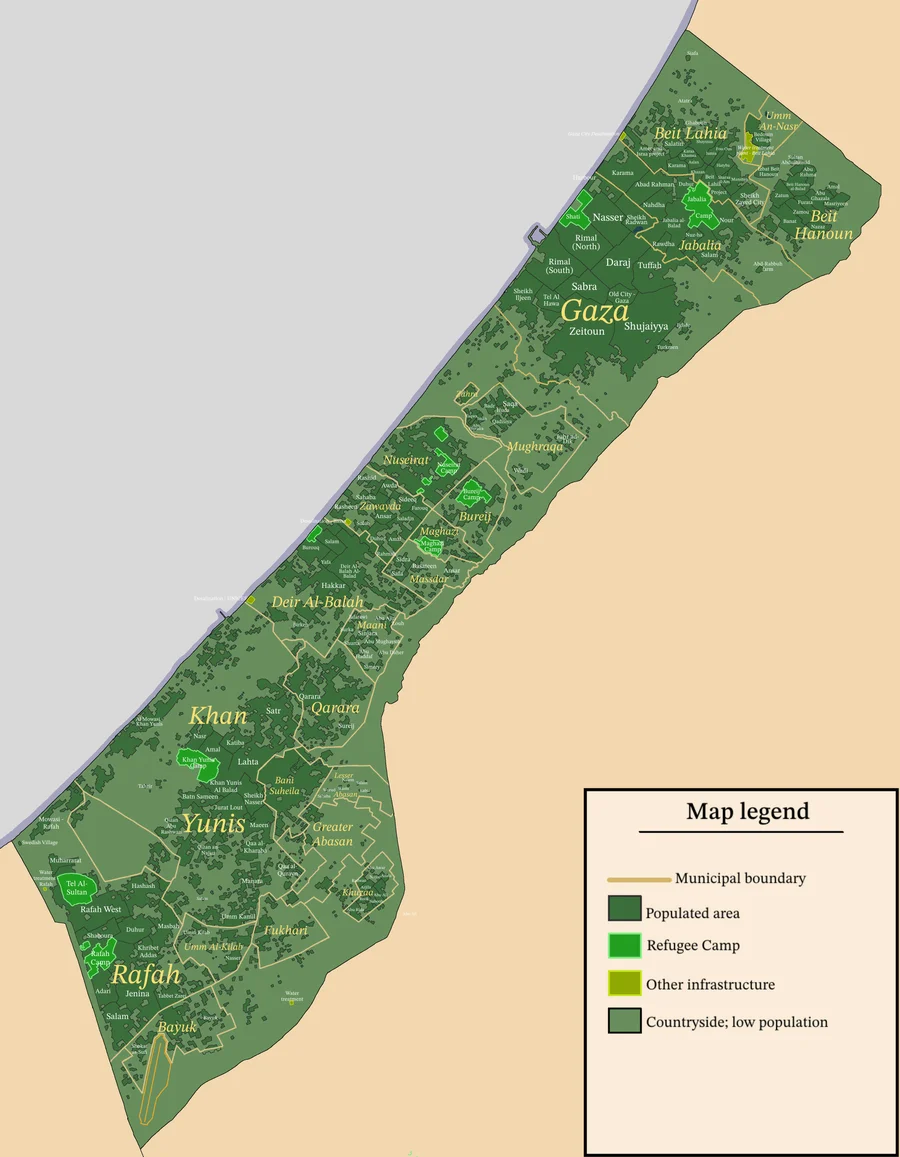
Strikes have continued throughout the year. Israeli strikes have killed over 1,400 Palestinians since the ceasefire took effect, according to the Gaza Health Ministry figures reported by the AP; sporadic attacks have killed five Israeli soldiers in Gaza in the same period. The joint statement by more than 100 organisations put the Palestinian toll at more than 1,400, including at least 327 children, and Human Rights Watch, also citing the Gaza Health Ministry, put the wounded at 4,881. The AP reported that Israel has carried out regular strikes on individuals it accused of violating the ceasefire, approaching the withdrawal line or having taken part in the October 7 attack, and that those strikes have often killed civilians. Israel was supposed to withdraw under the agreement but has instead seized more territory, pushing the so-called Yellow Line westward toward the Mediterranean; Human Rights Watch said the area inside the line now amounts to about 64 per cent of the Gaza Strip, and the organisations' statement said the line had been moved beyond the withdrawal line set out in the agreement.
What are living conditions like a year on?
Living conditions remain at crisis level on every measure the three sources cite. Nearly two million people still need shelter, the organisations said; the Palestine Shelter Cluster survey cited by Human Rights Watch found 94 per cent of the population lacks adequate shelter, nearly two-thirds of housing units have been destroyed, and more than half of surveyed households are living in tents, with winter approaching. Not one of Gaza's hospitals is fully functioning — Human Rights Watch, citing the World Health Organization, said 35 of 57 hospitals and field hospitals were partially functional — and the organisations said more than 18,500 patients, including at least 4,000 children, still need medical evacuation. On food, 1.4 million people face crisis-level hunger or worse: the IPC assessment cited by Human Rights Watch expected 67 per cent of the population to face crisis or worse levels of acute food insecurity in July–December 2026. The organisations also said more than 80 per cent of structures across Gaza have been damaged, including around two-thirds destroyed. Human Rights Watch said recovery and reconstruction needs are estimated by the EU and UN at $71.4 billion over the next decade, that the Board of Peace presented a six-month recovery programme on September 23, and that no recovery efforts have begun.
What happens next?
What happens next depends on the disarmament deadlock, which neither side has moved on since July. Human Rights Watch and the 100-plus organisations both called on governments that backed the agreement to use their influence to halt the attacks and ease restrictions on aid, equipment and rebuilding materials; Human Rights Watch and Amnesty International also stated their own legal characterisations of Israel's conduct and called for accountability — those characterisations are the organisations' positions, reported here as such, and Israel disputes them. On the facts all three sources agree on, the position is simpler: a ceasefire that ended the largest operations and freed the hostages, a population of some two million still in tents and damaged buildings, and a political process that has not advanced since the summer.
This explainer is drawn strictly from the AP anniversary review, the October 9 joint statement published by Amnesty International, and Human Rights Watch's October 10 assessment — all opened and read for this article. Casualty figures are Gaza Health Ministry figures as reported by those sources, with the AP's note on the ministry's records stated in the text. The FAQ answers are drawn only from the article's own text.