The First Opium War explained in one line: from 1839 to 1842 Britain and Qing China fought over a trade paid for first in silver and then in Indian opium; when Qing enforcement destroyed the drug at Canton, a small British expedition defeated far larger Qing forces along the coast and up the Yangtze, and the Treaty of Nanking ceded Hong Kong, opened five ports and imposed $21 million — without settling the opium question that had started the war.
Key takeaways
- Tea was paid for in silver, then in opium: Britain bought increasing quantities of Chinese tea but had few products China wanted, so silver drained east — until India's opium and cotton exports to China paid for the tea instead (see Overview).
- Enforcement supplied the trigger: Commissioner Lin Zexu, appointed in late 1838, forced foreign merchants to surrender their opium and destroyed more than 20,000 chests in 1839 (see Why did Britain and China go to war?).
- A small expedition beat a large establishment: the compiled strength figures put at least 19,000 British and Indian troops with 37 ships against a Qing establishment of 222,212 — and the Qing banner and Green Standard forces were, on Britannica's account, ill-equipped and poorly led against modern British forces (see How did the war unfold?).
- The peace billed China for the drug but never settled it: the Treaty of Nanking (29 August 1842) ceded Hong Kong Island in perpetuity, opened five treaty ports and imposed $21 million — including $6 million for the destroyed opium — but contained no provision legalising or prohibiting the opium trade itself (see How did it shape the world?).
- The dead are still counted three different ways: recorded battle losses, an 1847 British estimate, and modern totals citing Julia Lovell differ by an order of magnitude, because they count different things (see How many people died?).
Contents
- Overview
- Why did Britain and China go to war?
- How did the war unfold?
- How many people died?
- What were the economic effects?
- How did it shape the world?
- What do historians debate?
Overview
The First Opium War was a war between Britain — fighting with the East India Company — and Qing China fought from 1839 to 1842, which Britain won: the Treaty of Nanking (29 August 1842) ceded Hong Kong Island to Britain in perpetuity, opened five treaty ports to British trade and imposed a $21 million indemnity. The immediate issue, as the compiled record puts it, was the Chinese enforcement of their ban on the opium trade by seizing private opium stocks from mainly British merchants at Guangzhou — Canton, in the English of the time — and threatening to impose the death penalty for future offenders. Despite the ban, the British government supported the merchants' demand for compensation for the seized goods and insisted on the principles of free trade and equal diplomatic recognition with China.
The trade underneath the dispute ran one way. Britannica's account of western colonialism states the mechanism plainly: Great Britain had been buying increasing quantities of tea from China, but it had few products that China was interested in buying by way of exchange, and a resulting steady drain of British silver to pay for the tea was eventually stopped by Britain's ascendancy in India. A three-way exchange developed — the tea Britain bought in China was paid for by India's exports of opium and cotton to China. Foreign trade, meanwhile, was confined to a single port. Under the Canton System, Western ships traded only at Guangzhou, and only through licensed Chinese merchants, the Cohong; a translated Chinese memorial of 1836, reproduced by the UK National Archives, complained that the barbarian merchants had formerly brought foreign silver to China but had latterly sold opium clandestinely, so that silver had been going out of the country while none returned.
Why did Britain and China go to war?
The war started because stringent Qing enforcement in 1839 destroyed British-owned opium that the British government then treated as a claim for compensation, on top of older British grievances over the single-port system and diplomatic inequality. An increasing Chinese addiction to opium had fed a boom in imports and an unfavourable balance paid for by a steady loss of China's silver reserves; in light of that economic effect and the physical and mental deterioration of users, Chinese authorities banned the trade. At first smuggling blunted the ban. Toward the end of the 1830s enforcement became stringent: stores of opium were confiscated and warehouses were closed down.
The Daoguang Emperor rejected proposals to legalise and tax the trade — a proposal Xu Naiji had made in 1836, arguing, in James Polachek's account as summarised by Yale's China Hands Magazine, that legalisation would let the government regulate the flow and prevent the outflow of silver. Instead the emperor appointed Lin Zexu imperial commissioner in late 1838. Britannica records that Lin had submitted a memorial condemning legalisation, citing his own suppression of the traffic as governor general, and that the emperor — alarmed both on moral grounds and by the practical fact that even illegal imports had to be paid for with exported Chinese silver — gave him extraordinary powers after 19 personal audiences. In Guangzhou, Lin forced foreign merchants to surrender their stocks for destruction: the compiled record gives 1,420 tonnes of opium handed over in March 1839 and destroyed publicly at Humen on 3 June 1839, and Britannica's summary puts the surrender at over 20,000 chests. Lin also wrote to Queen Victoria asking whether she would allow a substance as poisonous as opium to be imported into her own country; Britannica notes he still believed the British depended on China — that they would perish without Chinese tea and rhubarb — and did not comprehend the British demands for free trade and international equality. In February 1840 the British government decided to launch a military expedition, and in June 16 British warships arrived and sailed north from Hong Kong to the mouth of the Bei River to press the demands.
How did the war unfold?
The war was decided at sea and on the rivers, not in a single land battle: British forces took coastal positions the Qing could not relieve, then in 1842 sailed up the Yangtze, cut toward Nanjing, and forced a negotiation. Britannica's China history records that the Qing had no effective tactics against the powerful British navy — they retaliated by setting burning rafts against the fleet and offering prizes for enemies' heads — and that the imperial banner troops, though they sometimes fought fiercely, were ill-equipped and lacked training for warfare against the more modern British forces, while the Green Standard battalions were in decay, without much motivation or good leadership, and hastily recruited local militias were useless.
Chronology shows the method. An agreement reached in January 1841 was acceptable to neither government; the compiled record adds that after the Second Battle of Chuenpi on 7 January 1841 British forces occupied Hong Kong, formally raising the flag on 26 January 1841. In May 1841 the British attacked the walled city of Guangzhou and received a ransom of $6 million, which provoked a Cantonese counterattack. Henry Pottinger, who succeeded Charles Elliot, arrived at Macau in August 1841 and campaigned northward, seizing Xiamen (Amoy), Dinghai and Ningbo. Reinforced from India, he resumed in May 1842 and took Wusong, Shanghai and Zhenjiang. Nanjing yielded in August, and peace followed.
One ship illustrates the technical gap. The iron steamship Nemesis, described by Peter Ward Fay in The Opium War 1840–1842 (University of North Carolina Press, 1975), was built almost entirely of iron, 184 feet long against a beam of 29, with a flat bottom that held her draught to a maximum of six feet — shallow enough for river mouths impassable to ships of the line. Launched on the Mersey late in 1839 by John Laird for the Secret Committee of the East India Company, she first saw action on 7 January 1841, landing 600 sepoys near the Chuenpi forts while she bombarded the watchtower; the Victorian Web summary of Fay records that Chinese gunnery proved inaccurate while every round from Nemesis found its mark. Her shallow draught, steam power and pivot-mounted 32-pounders made her, in that account, admirably suited to the river war the Qing had no answer to.
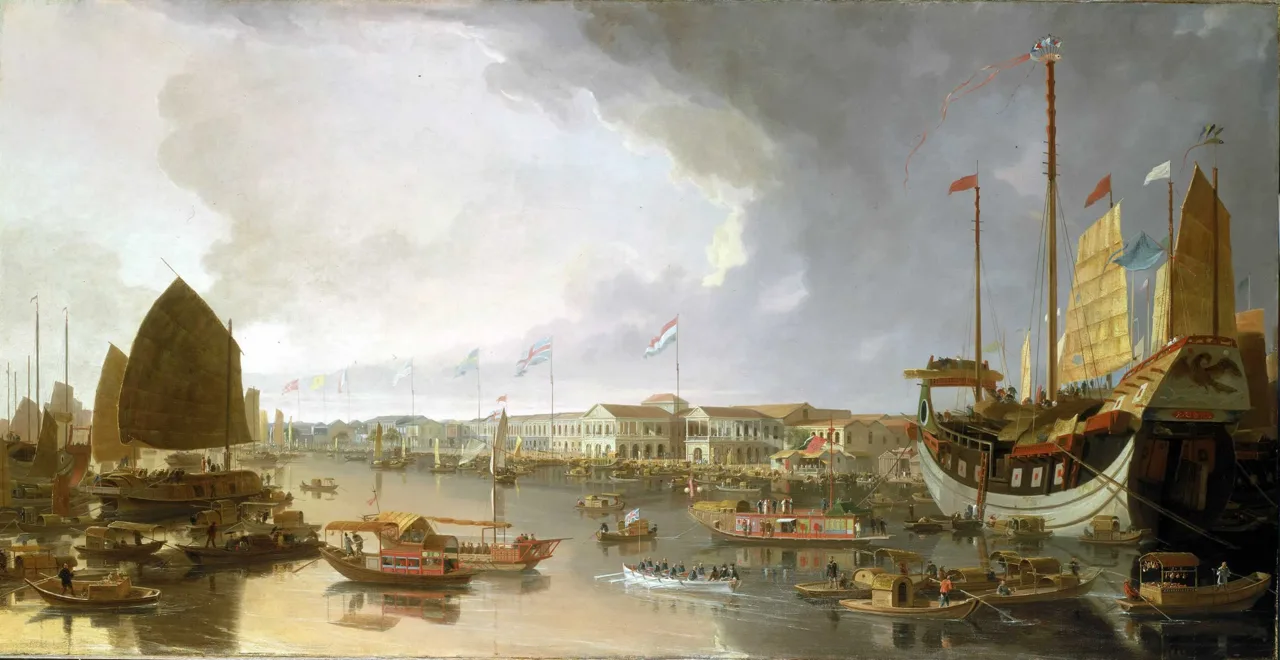
How many people died?
No agreed total exists, and the three published figures below do not measure the same thing — which is precisely why they must be published as a range with attribution rather than as one number. The compiled tabulation of the war gives British losses of 87 killed and 455 wounded, with 284 Indian shipwrecked sailors recorded as executed or dead in captivity, and Qing losses estimated at 3,100 killed and 4,536 wounded. That is a count of recorded military losses in the engagements its compilers could tabulate.
Broader estimates are far higher. A British report submitted to the government in 1847, quoted in a published survey of the war's contemporary battle art, put total British combat casualties at 69 killed and 451 wounded — close to the tabulation — while estimating Chinese casualties including deaths at 18,000 to 20,000. Madison Butchko's Yale China Hands Magazine survey, citing Julia Lovell's The Opium War (Picador, 2012), gives an estimated 20,000 to 25,000 Chinese deaths and around 500 British casualties. The gap between about 3,100 recorded Qing battle deaths and totals near 20,000–25,000 reflects what is being counted: tabulated engagement losses on one side, and wider deaths — including disease, which the battle-art survey notes was the far more common cause of British fatalities, with 5,329 hospital admissions and 448 deaths recorded in the second half of 1840 alone — on the other. This article publishes all three, attributed, and adopts none as the total.
What were the economic effects?
The war's economic core was payment for tea: Britain paid for Chinese tea first in silver and then, through a three-way trade, with India's opium and cotton exports — and the peace billed China $21 million, including $6 million for the destroyed opium. The war was, at bottom, a war about how tea would be paid for. Britannica's three-way account is the economic core: tea bought in China was paid for by India's exports of opium and cotton to China, financing centred in London, and because demand for tea in England was rapidly increasing, British merchants actively fostered the profitable exports from India. By 1839, on the figure the Yale survey cites from Lovell, British merchants were exporting an estimated 40,000 chests of opium annually to China. For China the flow ran in reverse: the 1836 memorial in the National Archives describes silver going out of the country with none returning, and Britannica records that the Daoguang Emperor's alarm was practical as well as moral — illegal imports still had to be paid for in exported silver.
The peace then billed China for the war and the drug together. The Academy of Chinese Studies breaks down the $21 million indemnity in the Treaty of Nanking exactly: $6 million for the confiscated opium, $3 million for unpaid debts, and $12 million for the cost of the war, with tariffs to be negotiated rather than set by China alone. Britannica adds that the treaty abolished the Cohong system that had channelled all Canton trade through licensed merchants. What the treaty did not do was settle opium: trade in the drug dropped after 1846, to British dissatisfaction, Britannica's China history notes, and the question of opium remained unsettled in the postwar arrangements — the trade that had caused the war continued outside the settlement that ended it.
How did it shape the world?
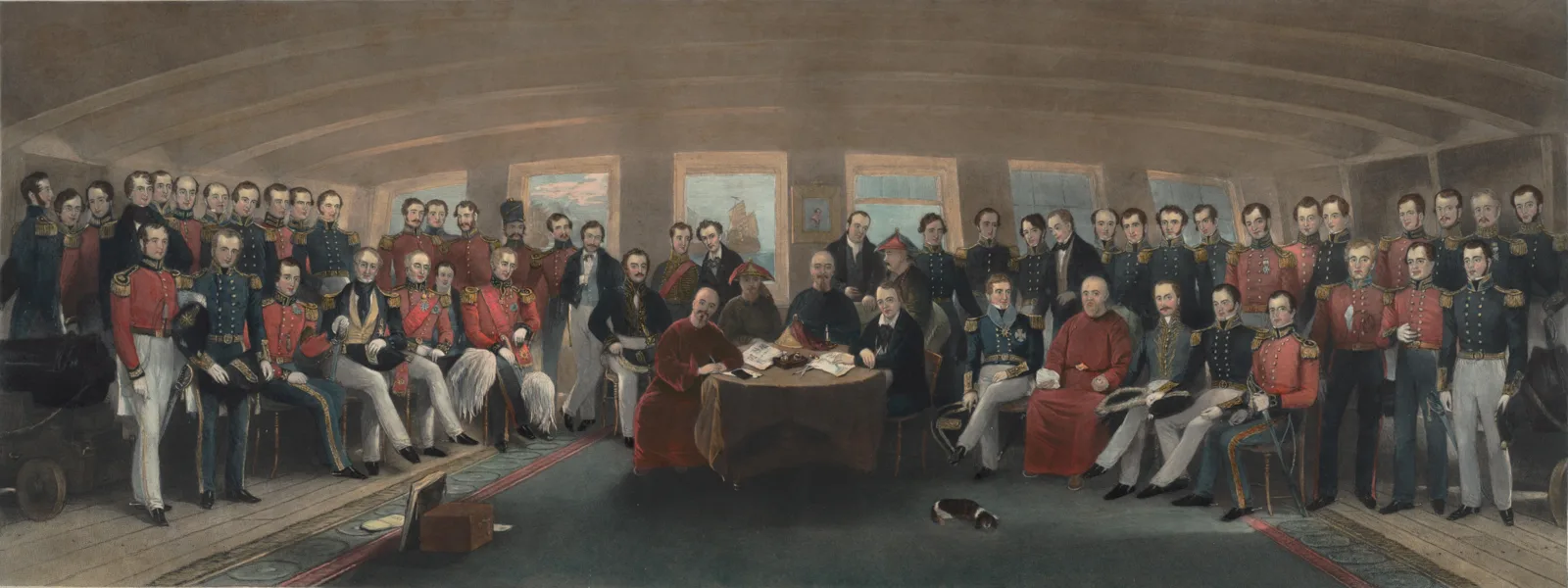
The Treaty of Nanking, signed on 29 August 1842 aboard HMS Cornwallis on the Yangtze by Qiying and Yilibu for the Qing and Sir Henry Pottinger for Britain, redrew China's relations with the outside world. Its main provisions, on Britannica's summary, were that China ceded Hong Kong to Britain, opened five ports to British trade, abolished the Cohong system, agreed to equal official recognition, and paid the $21 million indemnity. The National Archives reproduces the cession in the treaty's own words: the Emperor of China ceded the Island of Hong Kong "to be possessed in perpetuity by Her Britannic Majesty, Her Heirs and Successors." The five ports — Guangzhou, Xiamen, Fuzhou, Ningbo and Shanghai — were opened to British trade and residence, ending the single-port Canton System.
The settlement widened within two years. The Treaty of Nanjing was followed by two supplementary arrangements with the British in 1843, and in July 1844 China signed the Treaty of Wanghia with the United States and in October the Treaty of Whampoa with France. Together, Britannica records, these arrangements made up a complex of foreign privileges by virtue of most-favoured-nation clauses conceded to every signatory, and provided a basis for later inroads such as the loss of tariff autonomy and extraterritoriality — exemption from local law and tribunals. The compiled record states the longer framing directly: the Treaty of Nanking would be the first of what the Chinese later called the unequal treaties, twentieth-century nationalists considered 1839 the start of a century of humiliation, and many historians consider it the beginning of modern Chinese history. Britannica's China history closes its account with the clash of premises the war exposed: China had regarded foreign trade as a favour given by the heavenly empire to impoverished foreign powers, while to the British trade and commerce had become "the true herald of civilization."
What do historians debate?
Historians debate whether the war was caused by opium itself, by Britain's need to uphold honour and free trade, or by miscalculation on both sides — and whether any war between the two systems could have been avoided at all.
- Was the war about opium, or about honour and free trade? John K. Fairbank, quoted in the compiled historiography, held that Britain in demanding diplomatic equality and commercial opportunity represented all the Western states, and that it was an accident of history that British commercial interests centred not only on tea but also on opium — without a Chinese market for opium there would have been no "opium war," yet probably some kind of Sino-foreign war would have come anyway. Glenn Melancon argues, in the same summary, that the issue was not opium but Britain's need to uphold its reputation, its honour and its commitment to global free trade, under simultaneous pressures in the Near East, on the Indian frontier and in Latin America. Former U.S. President John Quincy Adams, quoted there, called opium "a mere incident to the dispute" and the cause the kowtow and China's pretensions to hold commerce on lord-and-vassal terms.
- Was the war inevitable, or a product of miscalculation? Stephen R. Platt's Imperial Twilight: The Opium War and the End of China's Last Golden Age (Alfred A. Knopf, 2018) argues, in its reviewers' summary, against inevitability: through economic transformation, internal politics, imperial arrogance, cultural ignorance, individual incompetence and the slowness of global communication, the conflict appears as something messier, almost accidental — a case for the power of miscalculation, delay and personality. The Yale survey makes the paired-individuals version of that argument: Lin Zexu's rigid enforcement and Charles Elliot's failed diplomacy escalated tensions, while Elliot's promise to compensate the smugglers forced his government's hand. Against both, the inevitability school cited there points to Britain's free-trade turn and the East India Company's opium interest as forces that made a clash over trade likely regardless of individuals.
- Whose failure inside China opened the door? James Polachek, in The Inner Opium War (Harvard University Press, 1992) as summarised in the compiled historiography, argues that the drive to suppress the trade arose from internal court factionalism — a purification-oriented group of literary scholars who paid no attention to the risk of intervention by much more powerful military forces — and that growing court awareness that addiction in the Guangdong garrisons, fed by collusion between British smugglers, Chinese smugglers and Chinese officials, had impaired military effectiveness mattered more than economics. Julia Lovell's The Opium War: Drugs, Dreams and the Making of Modern China (Picador, 2011; cited in the Yale survey as the 2012 edition) treats the war as the founding myth of modern Chinese nationalism as well as an event: her publisher's summary, opened via search in this run, describes a conflict rich in bureaucratic fumbling, military missteps and compromise that over 175 years became the start of China's heroic struggle against a Western conspiracy to destroy the country with opium and gunboat diplomacy, and the Yale survey relies on her for both its casualty estimate and its 1839 opium-export figure. Harry G. Gelber, quoted in the compiled historiography, dissents from the guilt framing altogether, arguing the British went to war because of Chinese military threats to defenceless civilians, refusal to negotiate on terms of diplomatic equality, and refusal to open more ports than Guangzhou — and that the belief about British "guilt" came later, as part of China's catalogue of Western exploitation.
This explainer is drawn from the sources listed below, all opened or read during this run. Casualty and cost figures are published strictly as the attributed totals and estimates those sources give.