Israeli strikes killed at least three more Palestinians in Gaza on Monday — two of them in Khan Younis, where six others were wounded, and a third in the town of Al-Mussadar — taking the number killed since the ceasefire that was supposed to end this war to at least 1,580, according to the territory's health officials. The Monday strikes came a day after Israeli attacks killed at least eight Palestinians, including five police officers. A year into the US-brokered ceasefire, Israel still controls about two-thirds of Gaza, nearly all of its more than 2 million residents are crowded into the remaining third among the ruins, and the killing has not stopped — it has only slowed. Amnesty International and the UN Commission of Inquiry have concluded that Israel's campaign in Gaza amounts to genocide; this site reports the ceasefire-period toll in that light, as the documented record of a population still being killed under an agreement meant to protect it.
Who was killed in Monday's strikes?
At least three people, in two places, according to the medics and health officials Reuters cited. Medics said two people were killed and six others wounded in two separate airstrikes in Khan Younis, in the south of the enclave, while a third person was killed in an Israeli airstrike in the town of Al-Mussadar. The Israeli military said it carried out two strikes in the enclave, targeting Palestinian militants, without giving further information — a claim published here as the military made it; it named no one it said it had targeted, and the people the medics described were reported as killed in Khan Younis and Al-Mussadar without any militant affiliation stated in the reporting opened. The pattern is now a daily one: on Sunday, medics said three people were killed in an Israeli airstrike in Gaza City, and the Hamas-run interior ministry said five police officers were killed in another strike in western Khan Younis. The Israeli military said it struck several militants in Khan Younis, without giving further information, and did not immediately comment on the Gaza City strike.
What is the toll since the ceasefire began?
At least 1,580 Palestinians killed, on the health officials' count as Reuters reported it on Monday — up from the at least 1,500 the same count gave in Reuters' Sunday report. Both figures are stated floors ("at least"), not a day-by-day tally: the deaths itemised across the two reports are Sunday's eight and Monday's three, and the gap between the two floors reflects the health officials' running count, which Reuters did not break down further in the reporting opened. Israel says four of its soldiers have been killed in the same period. Behind the ceasefire-period figure stands the full toll of the assault Israel launched after Hamas-led fighters killed about 1,200 people in southern Israel on October 7, 2023: Palestinian authorities say more than 74,000 people have been killed in Gaza. The ceasefire was meant to be the line under that number. Instead the number keeps moving — eight on Sunday, three on Monday — while the terms that were supposed to follow the truce remain unmet. Israel, which says the Hamas militant group has been rearming and launching attacks in violation of the year-old ceasefire, has stepped up strikes on the group in recent weeks, Reuters reported. Hamas has denied trying to carry out attacks or rebuild its arsenal and accuses Israel of undermining the Gaza peace deal. Those are the two official accounts; the documented fact between them is the toll itself, recorded by the territory's health officials and carried here as they report it.
What does the ceasefire look like on the ground?
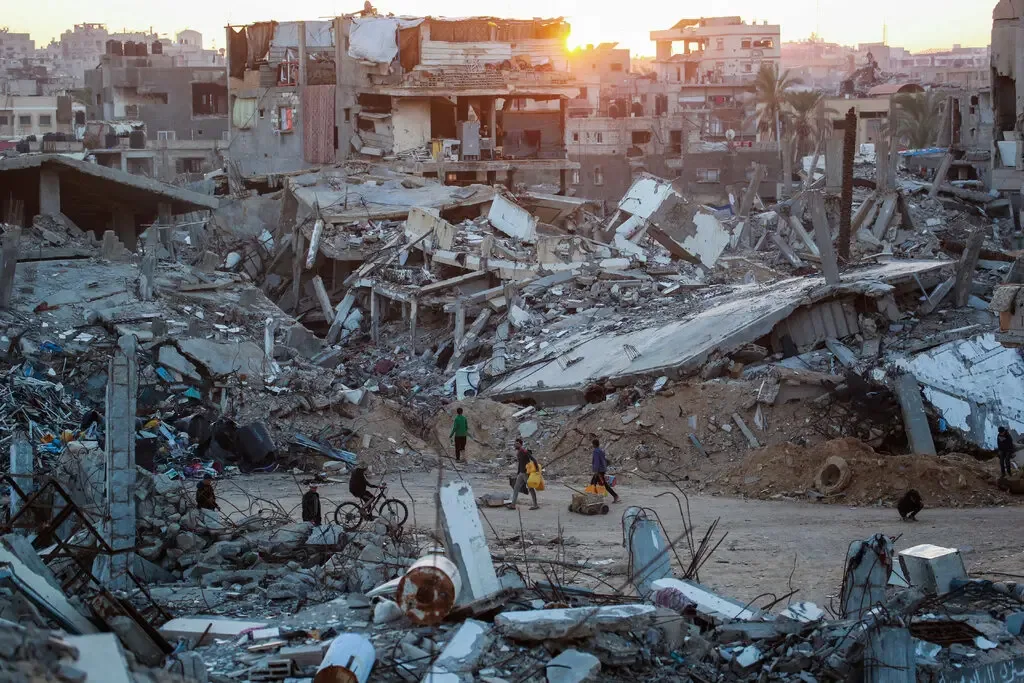
A territory divided, with the population compressed into the smaller part. Israeli troops control about two-thirds of Gaza, where they have ordered residents out. Nearly all of the more than 2 million residents live in the remaining third of the enclave among war ruins, mostly in makeshift tents and damaged buildings, still under the effective control of Hamas. Last year's US-brokered ceasefire calls for the eventual reconstruction of the territory. But little progress has been made, because negotiators have failed to agree on terms for Hamas to disarm or Israel to withdraw its troops. Until one of those two questions moves, the structure that produces the daily toll stays in place: an occupying army holding most of the land, a population sheltering in the rest, and strikes that each side justifies by pointing at the other.

What happens next?
On the record opened, nothing that changes the pattern. The ceasefire's next stage — disarmament terms, an Israeli withdrawal, reconstruction — has been stalled on the same disagreement for a year, and neither side's Monday statements pointed to movement: Israel's military described two strikes on militants and said no more; Hamas's position, as Reuters reported it, is denial of rearmament and an accusation that Israel is undermining the deal. What continues is measurable: a toll the health officials put at at least 1,500 on Sunday and at least 1,580 on Monday, counted in a territory whose people live, in their overwhelming majority, in tents and damaged buildings in the third of their land they are still permitted to occupy.
This report is drawn from Reuters' November 2, 2026 report, opened and read in full on reuters.com and in its updated form via a verbatim carrier, and Reuters' November 1, 2026 report, opened and read in full on reuters.com. Casualty figures are those of Gaza's health officials and medics as reported by Reuters, attributed as such throughout; the Israeli military's account of its strikes is published as the military stated it. Per this site's standing editorial directive for Gaza coverage, the framing sides with the victims, and the genocide characterization is that concluded by Amnesty International and the UN Commission of Inquiry.