The Chinese Civil War explained in one line: between 1927 and 1949 Chiang Kai-shek's Nationalists and Mao Zedong's Communists fought two wars with a truce in between — and the side that was nearly annihilated in 1935 won in 1949, because the war against Japan exhausted the government, land reform mobilised the countryside for its enemies, and hyperinflation destroyed the government's own soldiers' pay and its cities' loyalty before the decisive campaigns were ever fought.
Key takeaways
- The war had two phases and an interlude: a first phase from 1927 to 1937, a Second United Front against Japan from 1937 to 1945 in which the Communists grew from some 40,000 troops to over a million, and a second phase from 1945 to 1949 that the Communists won outright (see Overview).
- The Long March saved the party it nearly killed: of 90,000–100,000 who began the retreat from Jiangxi in October 1934, only some 7,000–8,000 reached Shaanxi — but the survivors carried Mao Zedong to the party's leadership (see Why did the war start?).
- The decision came in five months, not twenty-two years: the Liaoshen, Huaihai and Pingjin campaigns of September 1948 to January 1949 destroyed 1.54 million veteran Nationalist troops (see How did the war unfold?).
- The death toll is a set of attributed ranges, not a number: estimates run from 2.5 million to up to 6 million for the second phase alone, with Britannica putting civilian deaths at approximately 5 million (see How many people died?).
- The war never formally ended: no armistice or peace treaty was ever signed, and the division between the People's Republic on the mainland and the Republic of China on Taiwan is its surviving settlement (see How did it shape the world?).
Contents
- Overview
- Why did the war start?
- How did the war unfold?
- How many people died?
- What were the economic effects?
- How did it shape the world?
- What do historians debate?
Overview
The Chinese Civil War was fought between the government of the Republic of China (ROC), led by the Kuomintang (KMT) under Chiang Kai-shek, and the Chinese Communist Party (CCP) under Mao Zedong, intermittently from 1 August 1927 until the Kuomintang's retreat to Taiwan on 7 December 1949 — and the Communists won it: they gained control of mainland China, proclaimed the People's Republic of China (PRC) on 1 October 1949, and left the Republic of China government holding Taiwan (compiled record; Britannica). The war is generally divided into two phases with an interlude. In the first phase (1927–1937) the Nationalists controlled most of China and repeatedly tried to exterminate the Communist base areas; from 1937 to 1945 hostilities were mostly put on hold as the Second United Front fought Japan's invasion; and in the second phase (1945–1949) — the Chinese Communist Revolution, in the CCP's own naming — the Communists moved from guerrilla enclaves to conventional armies and conquered the country in under four years (compiled record).
The reversal at the war's heart is statistical before it is anything else. In 1935 the Communists were a remnant: some 7,000–8,000 survivors of the Long March in a poor corner of Shaanxi. By autumn 1945 their forces numbered 1.27 million regulars with 2.68 million militia, governing 19 base areas in which 95 million people lived (compiled record). The Nationalists, by contrast, entered the postwar contest holding the cities, the coast, international recognition and American support — and lost all of it in four years. Explaining that reversal, without pretending it was inevitable, is the central problem this article takes up, and it is why the war was won in the countryside and in the treasury as much as on the battlefield.
Why did the war start?
The war started when an alliance of convenience broke. After the Qing dynasty's collapse, the Kuomintang under Sun Yat-sen, ignored by the Western powers, accepted Soviet help: the Sun–Joffe Manifesto of 1923 pledged cooperation between the Comintern, the KMT and the small CCP, Soviet adviser Mikhail Borodin reorganised both parties, and Communists joined the KMT as individuals (compiled record). Together, in the First United Front, they launched the Northern Expedition of 1926–27 against the warlords — a very successful campaign that carried Nationalist arms across central China (compiled record). But the alliance contained the war's cause inside it: Chiang Kai-shek, who had studied in Moscow and commanded the Soviet-equipped Whampoa Military Academy, moved against Communist influence as his own power grew, and on 12 April 1927 Communists in Shanghai were purged through hundreds of arrests and executions on General Bai Chongxi's orders (compiled record). The CCP calls this the 12 April Incident; it is known in the West as the Shanghai massacre, and it opened the White Terror (compiled record).
The Communists answered in arms. On 1 August 1927 they launched the Nanchang uprising, which created the Chinese Red Army; Mao's Autumn Harvest Uprising followed in September, and the party retreated to rural base areas — soviets — in the south (compiled record). Chiang, his government recognised internationally at Nanjing after Beijing fell in June 1928, tried to finish the matter in five encirclement campaigns. The first four failed or were aborted; the fifth used a blockhouse strategy — fortified posts built about eight kilometres apart to strangle the Jiangxi Soviet's supplies (compiled record). It worked, and it produced the war's most famous episode: in October 1934 the Communists broke out of the blockhouse ring and began the Long March, a fighting retreat of over 9,000 kilometres in 370 days to Shaanxi (compiled record). Of the 90,000–100,000 who began it, only around 7,000–8,000 arrived; along the way, at the Zunyi Conference of January 1935, Mao rose toward command, and the compiled record's verdict is that the great retreat made Mao the undisputed leader of the Chinese Communist Party (compiled record). The first phase then closed diplomatically, not militarily: on 12 December 1936 Generals Zhang Xueliang and Yang Hucheng kidnapped Chiang at Xi'an and forced him into a truce — the Second United Front against Japan, whose full-scale invasion came in 1937 (compiled record).
How did the war unfold?
The war unfolded as a contest the interlude decided. During the eight years against Japan, the Nationalists, as China's legal government, bore the brunt of the conventional fighting, and Japan's last great offensive, Operation Ichi-Go in 1944, severely weakened Chiang's forces (compiled record). The Communists, nominally integrated as the Eighth Route Army and New Fourth Army, shunned conventional battle, waged guerrilla war behind Japanese lines, and used the occupied zones to build bases, reduce rents, return land to poor peasants and arm the people (compiled record). The alliance was in name only — the New Fourth Army incident of 1941, in which Nationalist forces ambushed a Communist army on the move and killed several thousand, ended the United Front in practice (compiled record) — and by spring 1945 the Communists governed areas holding 95 million people (compiled record).
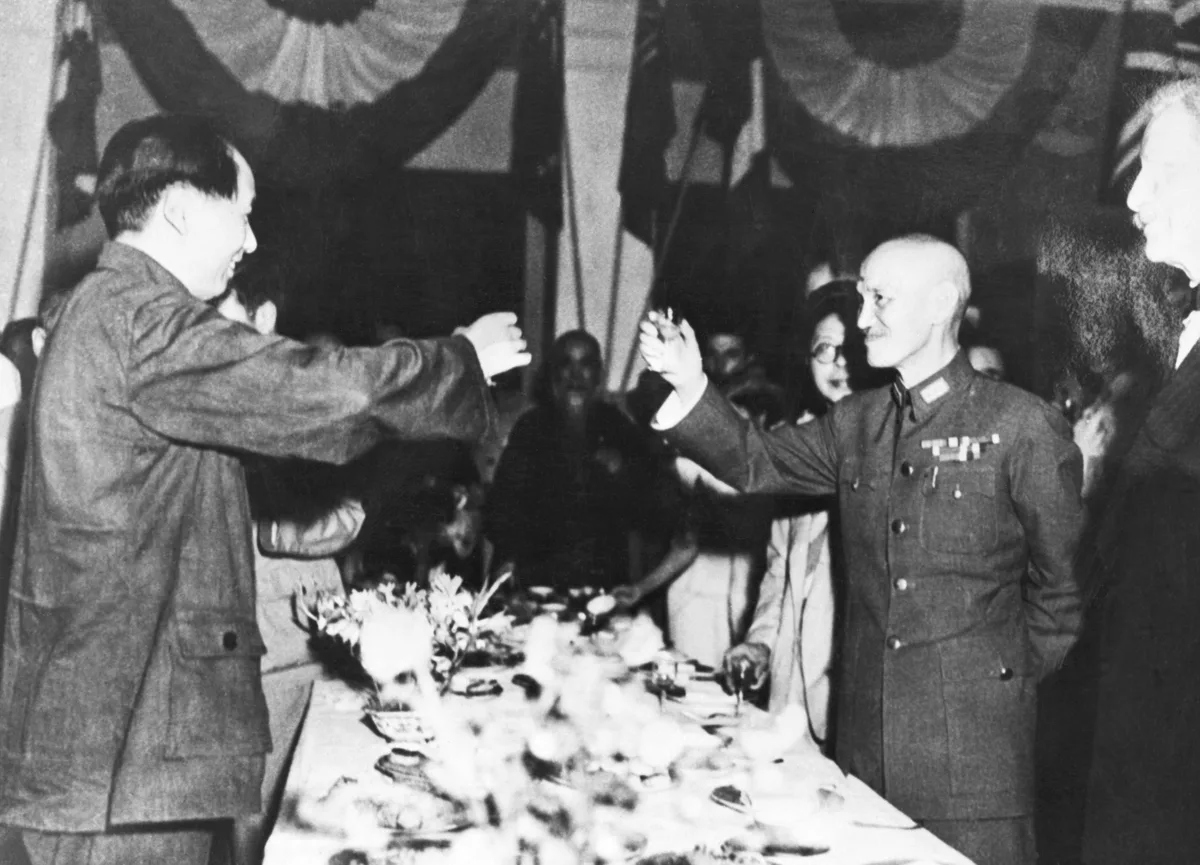
The second phase opened with a race for the surrender. In Manchuria, where the Nationalists had no forces, Soviet troops held the territory; the Soviet Union turned over captured Japanese weapons to the Communists and delayed its withdrawal while dismantling Manchurian industry, while the United States airlifted Nationalist troops north and landed forces to guard strategic sites (compiled record). Peace was attempted and failed: Chiang and Mao met at Chongqing from August to October 1945 and signed the Double Tenth Agreement, and General George Marshall's mission sought a unified government from December 1945 — but fighting continued throughout, and on 26 June 1946 full-scale war resumed (compiled record). Chiang attacked with 113 brigades, 1.6 million troops, on 20 July 1946; the Communists answered with a passive defence, abandoning territory to preserve their forces, and after a year they had wiped out 1.12 million Nationalist troops while growing to about two million men — the Nationalists' capture of the Communist capital, Yan'an, in March 1947 was, in the compiled record's word, symbolic (compiled record). American help was large but interrupted: arms sales were suspended from July 1946 to May 1947, and the compiled record, citing William Blum's account, puts US aid to the KMT at $4.43 billion within two years of the Sino-Japanese War, with a further $275 million economic and $120 million military package agreed in 1948 (compiled record).
The end came in three overlapping campaigns. In Liaoshen (12 September–2 November 1948), Lin Biao took Jinzhou in October, Changchun's garrison surrendered, and Shenyang fell, costing the Nationalists over 470,000 men and the whole northeast, with its industry and its captured heavy weapons (compiled record; Academy of Chinese Studies). In Huaihai (6 November 1948–10 January 1949), the war's largest operation, Communist forces under a front committee including Deng Xiaoping, Chen Yi and Liu Bocheng destroyed the Nationalists' elite armies in east-central China, supplied by a mobilisation the compiled record puts at 5,430,000 peasants in transport and support roles (compiled record; Academy of Chinese Studies). In Pingjin (29 November 1948–31 January 1949), 890,000 Communist troops faced Nationalist forces the compiled record puts at some 600,000 — the Academy of Chinese Studies puts Fu Zuoyi's encircled command at 500,000 men, and the two counts are published here as each source gives them: Tianjin was stormed on 15 January 1949, and General Fu Zuoyi then surrendered Beiping — Beijing — which the PLA entered unopposed on 31 January, sparing the ancient capital (compiled record; Academy of Chinese Studies; Britannica). Together the three campaigns destroyed 144 regular and 29 irregular Nationalist divisions, including 1.54 million veteran troops (compiled record). What remained was pursuit: Chiang resigned the presidency on 21 January 1949, peace talks in April collapsed over the demand that Communist armies cross the Yangtze, the crossing followed, and Nanjing fell on 24 April (Britannica). Shanghai followed, the south and northwest fell through the summer and autumn, Mao proclaimed the PRC on 1 October, the Nationalist capital moved to Taipei on 8 December, and Chiang left the mainland on 10 December 1949 (Britannica).
How many people died?
No agreed total exists, and the components disagree by source in ways this article reports rather than resolves. For the military dead of the second phase, the compiled record's tabulation gives 370,000 Nationalists killed and 1.5–1.7 million total Nationalist casualties, against 263,800 Communists killed, 190,000 missing and 850,000 wounded — over 1.3 million in all (compiled record). Britannica's accounting is different in kind: official Communist figures of some 1.5 million PLA dead and wounded; some 600,000 Nationalist troops killed in combat — against the compiled record's 370,000 — with roughly three times that number defecting to the Communists and nearly 7 million Nationalist troops captured during four years of combat (Britannica). The gap between the two military counts is partly definitional: the PRC's own postwar recording of Nationalist casualties, as the compiled record gives it, totals 5,452,700 regulars and 2,258,800 irregulars — a figure that can only embrace the killed, wounded, captured and defected together (compiled record).
The civilian-inclusive estimates are wider still. The compiled record estimates about 7 million dead, including civilians, in the first phase (1928–1937), and for the second phase gives estimates of 2.5 million and up to 6 million (compiled record). Britannica puts approximately 5 million civilians dead as a result of combat, famine and disease in the 1945–49 phase alone (Britannica). The war's sieges show where such numbers come from: at Changchun in 1948 the PLA's blockade prevented civilians leaving the city, and the compiled record puts the starvation toll at tens of thousands to 150,000 civilians (compiled record). Diana Lary's China's Civil War: A Social History, 1945–1949 (Cambridge University Press, 2015) — the first social history of the war in English, in its Pacific Affairs review's account — deliberately works below the level of these totals, reconstructing from memoirs and oral histories the separations, exiles and losses through which the aggregate figures were lived (Pacific Affairs review). On the evidence opened for this article, the honest summary is a range: millions of soldiers and, on the largest attributions, some five million civilians in the final phase, within whole-war estimates that begin at about 7 million for the first phase alone — with no source opened supporting a single combined total, and none printed here.
What were the economic effects?
The war's decisive economic weapon was inflation, and the best witness is the losing side's own correspondence. The US ambassador's dispatch of 4 January 1949, preserved in Foreign Relations of the United States, records that on 1 January 1948 the Chinese National Currency stood at about 140,000 to the US dollar on Shanghai's black market; by year's end it took the equivalent of over 400 million to buy one dollar (FRUS). The government's answer, on 19 August 1948, was the Gold Yuan: the old currency converted at 3,000,000 to 1, the new unit set at 4 to the dollar and backed 40 per cent by gold, silver and hard currencies, all private gold, silver and foreign currency called in, and prices and wages frozen (FRUS). The dispatch is unsparing about why it failed: the budget was hopelessly unbalanced and could not be balanced while the civil war continued, none of the three conditions the reform needed — a reduced deficit, a major military victory, exemplary punishment of corrupt senior officers — was met, and by mid-October the Gold Yuan had lost 80 per cent of its dollar value (FRUS). When controls were abandoned on 1 November, citizens who had obeyed and surrendered their gold were allowed to buy it back at ten times the redemption price — a stroke the dispatch says rid the government of any vestige of support from the fledgling middle class (FRUS). The compiled hyperinflation record gives the same collapse in prices: Shanghai wholesale prices rose fivefold from September 1945 to February 1946 and thirtyfold the following year (compiled record).
The military consequence ran through soldiers' pockets. The compiled record notes that hyperinflation destroyed the purchasing power of Nationalist soldiers' pay, that supplies disappeared into the barter economy through corruption and embezzlement, and that ordinary soldiers were often malnourished and desertion common (compiled record). Suzanne Pepper's Civil War in China: The Political Struggle 1945–1949 (1978; new edition 1999) made this the centre of the first comprehensive account of the defeat: in the publisher's summary, the Nationalists lost not just militarily but by alienating the civilian population through corruption and incompetence, with a whole chapter given to the political costs of economic mismanagement (Bloomsbury). The Communists, by contrast, paid for their war substantially in kind and in labour — the 5.43 million peasants mobilised for Huaihai were a logistics system no treasury had to fund (compiled record) — and their land reform turned the countryside's surplus and manpower toward the PLA (compiled record). The Nationalist state's remaining treasure left with it: Britannica records that the air force's assets began relocating to Taiwan as early as August 1948, followed by the navy and the government's gold reserves (Britannica) — the reserves on which, the hyperinflation record notes, the Nationalists eventually restored financial stability on Taiwan with American support (compiled record).
How did it shape the world?
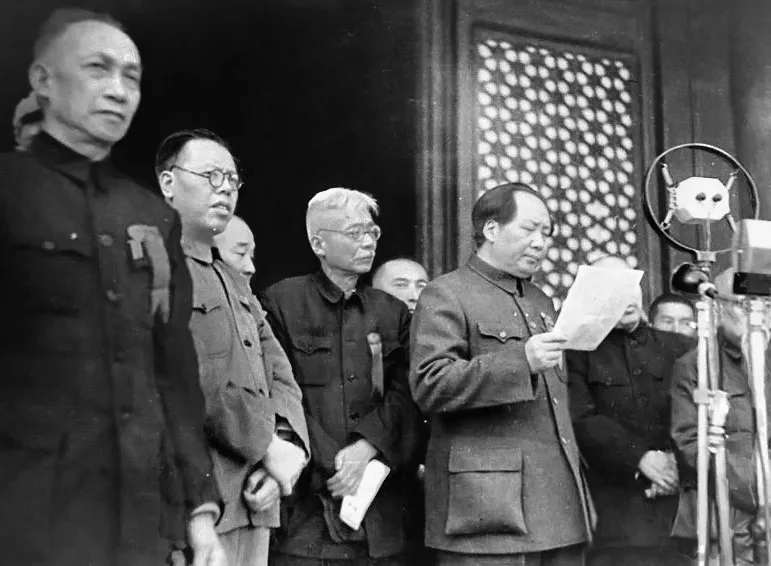
The war shaped the world first by deciding who governed a quarter of humanity. On 1 October 1949 Mao proclaimed the People's Republic of China from Tiananmen; the Soviet Union and the communist bloc recognised it at once, and by the end of 1949 virtually all of mainland China was under Communist control (Britannica). The Republic of China did not fall — it relocated: its capital moved to Taipei on 8 December 1949, and the two governments settled into the standoff across the Taiwan Strait that has lasted since the 1950s, each long claiming to be the legitimate government of all China (Britannica; compiled record). Because no armistice or peace treaty has ever been signed, historians such as Lary describe the war as technically ongoing — a legal open end that still frames cross-strait relations (compiled record; Pacific Affairs review).
Second, it redrew the Cold War. A communist China ended any prospect of the postwar settlement the United States had sought through the Marshall Mission, aligned the world's most populous state with the Soviet Union at the Cold War's outset, and led within a year to the new state's armed profile being established through the PLA's intervention in the Korean War — the subject of the closing chapter, "To the Yalu", of Westad's history, as its H-Net review describes (H-Net review). The exodus was institutional as well as territorial: by December 1949 the remaining pockets of Nationalist control were eroding as provincial governors switched allegiance, while people, goods and institutions completed their transfer to Taiwan (Britannica).
Third, it reset China's own state. The victors inherited the machinery the war had built — a party-army that had learned to govern base areas, run land reform and mobilise millions — and the losers, on Taiwan, rebuilt theirs around the gold reserves and the lesson of the mainland's loss. The division the war left was therefore not only between two governments but between two answers to the question the civil war had posed since 1927: how China should be unified, modernised and ruled.
What do historians debate?
Historians debate, first, whether the outcome was inevitable. Odd Arne Westad's Decisive Encounters: The Chinese Civil War, 1946–1950 (Stanford University Press, 2003) argues the opposite of the hindsight view: in the H-Net review's summary, the war was not a tale of terminal Nationalist decline and irresistible Communist rise — the Nationalist leaders, by their decisions, squandered most of the relative advantages they had in 1945, Mao's side gained only the minimum support needed first to survive and then to strike, and final political defeat came only with Huaihai in late 1948 (H-Net review). On Westad's reading the war's conduct, not its preconditions, decided it: Nationalist errors in alliance-building, in relations with local and urban elites and in military strategy, against Communist cohesion and the unglamorous work of fitting party practice to local needs (H-Net review).
Second, they debate the weight of the countryside. Pepper's account gives the political struggle primacy — the takeover from the Japanese, the student anti-war movement, economic mismanagement and the intelligentsia's indictment of the Kuomintang, set against the Communist alternative (Bloomsbury). The Pacific Affairs review of Lary registers a caution from newer local scholarship: Chen Yung-fa's work on local archives shows the Communists overcoming peasant resistance to taxation, conscription and corvée by organisation and countermeasures, not by patriotic appeal alone — mobilisation was built, not simply awakened (Pacific Affairs review). The two readings are compatible in sequence — a government that lost the cities on prices and corruption, and a movement that organised the countryside village by village — but they differ on where the war was truly lost and won.
Third, they debate how the war should be written at all. Lary's social history — the first in English, built from biographies, memoirs and oral histories — reads 1945–49 through trauma: the separations, divisions and exiles that aggregate casualty tables conceal, and the war's reverberations through the 1950s in both Chinas (Pacific Affairs review). Against the campaign histories, her question is not which army manoeuvred better but what twenty-two years of intermittent civil war did to the society that endured it. The sources opened for this article support holding all three frames at once: a war undecided until it was fought (Westad), lost politically before it was lost militarily (Pepper), and remembered socially long after its battles ended (Lary).