The First Indochina War explained in one line: from 1946 to 1954 France fought to restore an empire it had already lost on paper in 1945, against a Viet Minh that began as scattered guerrilla islands and — once Communist China's victory in 1949 gave it a border with a supplier — built itself into a state with a conventional army, which surrounded France's chosen fortress at Dien Bien Phu, broke it with artillery in the siege of 13 March–7 May 1954, and ended French Indochina at Geneva.
Key takeaways
- The war began over a broken compromise: the March 1946 agreement recognising Vietnam as a free state inside the French Union failed because the two sides' goals — restored colonial rule against total independence — could not both be met (see Why did the war start?).
- 1949 changed the war's kind, not just its scale: China's communist victory turned a rural insurgency into a conventional war between two supplied armies — China and the USSR behind the Viet Minh, the United States financing France (see How did the war unfold?).
- Dien Bien Phu was a logistics defeat before it was a battle: France picked a roadless valley suppliable only by air, expecting the Viet Minh to have no artillery; Giap hauled guns through the mountains and closed the airfield (see How did the war unfold?).
- The death toll is a range, not a number: total deaths are put at 400,000–842,707 in the compiled record, with civilian deaths at 125,000–400,000, and the component counts disagree between Western, French and Vietnamese sources (see How many people died?).
- Geneva divided Vietnam "provisionally" — and the provisional became permanent: the 17th parallel was expressly not a border, and the July 1956 reunification elections written into the settlement were never held (see How did it shape the world?).
Contents
- Overview
- Why did the war start?
- How did the war unfold?
- How many people died?
- What were the economic effects?
- How did it shape the world?
- What do historians debate?
Overview
The First Indochina War was fought in French Indochina between the French Union and the Viet Minh and their respective allies from 19 December 1946 until the final ceasefire of 11 August 1954, and it ended when Giap's forces overran the French garrison at Dien Bien Phu on 7 May 1954 — the defeat that ended French Indochina — followed by the dissolution of the Indochinese federation and the partition of Vietnam at the 17th parallel under the Geneva Accords. Most of the fighting took place in Vietnam — above all in Tonkin, in the north — but the war engulfed the whole country and extended into the neighbouring protectorates of Laos and Cambodia (compiled record). On one side stood France's Far East Expeditionary Corps, supported from 1949 by the State of Vietnam of the former Emperor Bao Dai; on the other, the Democratic Republic of Vietnam (DRV) proclaimed by Ho Chi Minh on 2 September 1945, its Viet Minh front, and its army commanded by Vo Nguyen Giap (compiled record; Britannica).
The war's shape changed halfway through. Its first years were a low-level rural insurgency in which the French held the cities and the Viet Minh much of the countryside; the Chinese Communist victory of 1949 then gave the DRV a friendly border, Chinese and Soviet materiel, and the means to build regular divisions, while the United States — which recognised the State of Vietnam in 1950 as China and the USSR recognised the DRV — financed a rising share of the French effort (compiled record). By 1953 the French commander, General Henri Navarre, reported to Paris that there was no possibility of winning the war and that a stalemate was the best available outcome (compiled record). France nevertheless sought a decisive battle on its own terms at Dien Bien Phu, and lost it: the garrison was overrun on 7 May 1954 (Britannica). Pierre Mendès France became prime minister on 17 June on a promise to achieve a ceasefire, and the Geneva Accords were signed on 20 July 1954, with staggered ceasefires taking effect across Indochina through 11 August (compiled record).
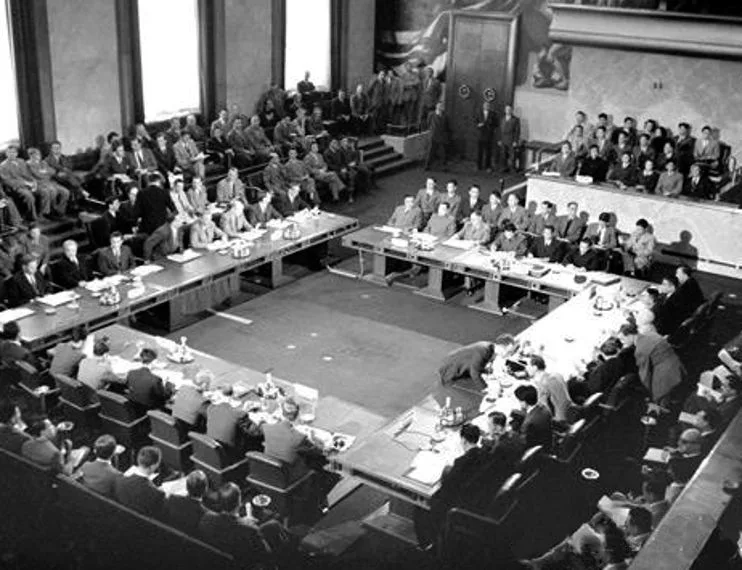
The settlement's own text is the clearest statement of what Geneva did and did not do. The Final Declaration, whose text the US Office of the Historian preserves, welcomed the end of hostilities in Cambodia, Laos and Vietnam and the prospect of all three playing their part "in full independence and sovereignty"; for Vietnam it recognised a military demarcation line that "should not in any way be interpreted as constituting a political or territorial boundary", and it provided for general elections in July 1956, under international supervision, to settle the country's political future (FRUS text). Neither the elections nor reunification followed — a failure whose consequences structure the rest of this article.
Why did the war start?
The war started because Vietnam's status had been settled twice in eighteen months, in incompatible ways. Vietnam had been absorbed into French Indochina in stages between 1858 and 1887 (compiled record). Japan's March 1945 coup ousted the Vichy French administration; when Japan surrendered, the Potsdam decisions assigned the disarmament of Japanese forces south of the 16th parallel to Britain's South East Asia Command and north of it to China (compiled record). On 25 August 1945 Bao Dai abdicated in favour of the Viet Minh, and on 2 September Ho Chi Minh proclaimed the DRV in Hanoi (compiled record). In the south, however, French forces overthrew the Viet Minh administration in Saigon on 23 September 1945 and declared French authority restored, and guerrilla fighting began around the city at once (compiled record).
A compromise was attempted and failed. Under the agreement of 6 March 1946 negotiated by Jean Sainteny, France recognised Vietnam as a free state within the French Union — EBSCO's account specifies an independent state in a union with Laos and Cambodia — and Ho agreed to 25,000 French troops remaining for five years (Britannica; EBSCO). EBSCO records that the high commissioner, Admiral Georges Thierry d'Argenlieu, then breached the agreement's spirit by proclaiming a separate Republic of Cochinchina in the south, discrediting Ho, who had staked his position on negotiation; the follow-up Fontainebleau talks produced only a vague draft whose unstated lines of authority over policing and customs EBSCO treats as a direct cause of the war. Britannica summarises the underlying problem without choosing a side: the goals were irreconcilable — French re-establishment of colonial rule against Vietnamese total independence.
The spark came at Haiphong. Fighting broke out in the port on 20 November 1946 over the French seizure of a Chinese smuggling boat and the arrest of its crew, and France answered with a full assault using infantry, tanks, artillery, air strikes and naval bombardment; official French reports at the time stated that 6,000 civilians had been killed, figures later reduced to no more than several hundred (EBSCO) — the first of this war's contested tolls, published here as EBSCO gives both versions. Fighting spread to Hanoi, and on 19 December 1946 Giap declared war and Ho called on the Vietnamese people to rise in defence of independence (EBSCO; Britannica dates the war's beginning to the Haiphong bombardment and the Viet Minh's subsequent attack on French troops in Hanoi).
How did the war unfold?
The war unfolded in three phases: an insurgency France could contain but not finish (1946–49), a conventional war between two externally supplied armies (1950–53), and a French search for a negotiated exit that ended in a set-piece defeat (1953–54). In the first phase the pattern EBSCO describes was set early: the countryside was the prize, villagers were caught between French recruiters by day and Viet Minh cadres by night, and a succession of French commanders could not overcome guerrilla forces with peasant support. France's political answer, in June 1949, was to reunite Cochinchina with the protectorates of Annam and Tonkin as a State of Vietnam within the French Union under Bao Dai — a rival Vietnamese state to set against the DRV (compiled record).
The second phase began with the Cold War's arrival at Vietnam's border. In 1950 China and the Soviet Union recognised the DRV and the United States recognised the State of Vietnam, and the conflict came to resemble a conventional war between two armies equipped with modern weapons, although guerrilla warfare continued (compiled record). Two constraints shaped the French effort throughout: metropolitan conscripts were forbidden by the government, to keep the war from becoming more unpopular at home — in France the left called it la sale guerre, the dirty war — so the Expeditionary Corps drew on professional French troops, the Foreign Legion and colonial troops from across the empire, alongside the State of Vietnam's own army, formally established in December 1950 (compiled record). Total French Union service across the war is put by the compiled record at 496,560 Expeditionary Corps troops, including 296,000 Europeans and 183,000 Africans, with a peak strength of 190,000 plus 55,000 local auxiliaries, against Viet Minh forces tabulated at 125,000 regulars, 75,000 regional troops and 250,000 irregulars.
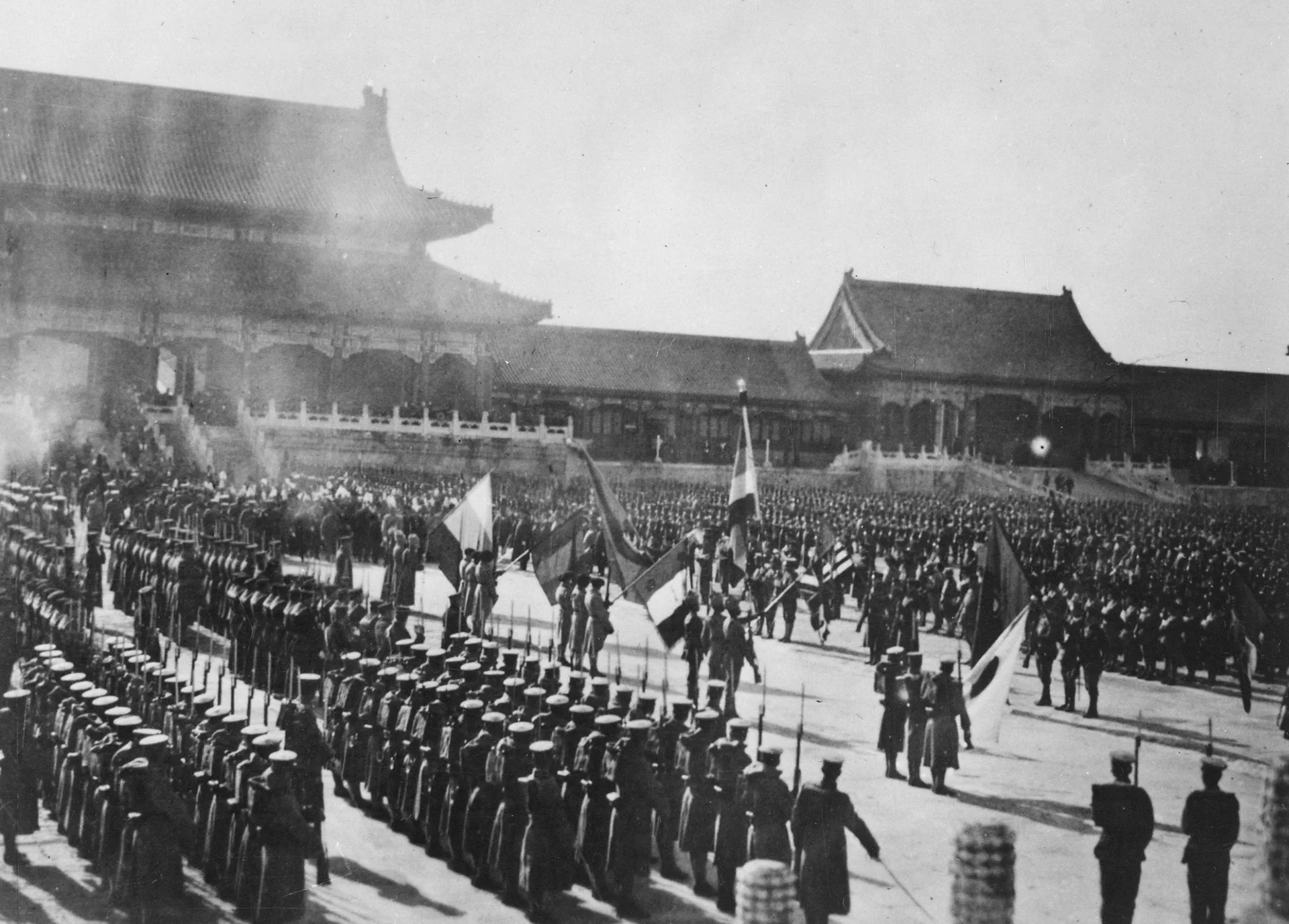
France's chosen tactic in the third phase was the air-land base: a well-defended outpost planted at the end of the Viet Minh's supply lines to force them into a conventional battle French firepower would win. It worked at Na San in 1952 (compiled record). At Dien Bien Phu it destroyed the army that tried it. Navarre occupied the valley in Operation Castor on 20 November 1953 to cut the nationalist supply lines into Laos and maintain a base for forays against the Viet Minh (Britannica; compiled record). The valley was roadless — EBSCO puts Navarre's force at 16,000 soldiers who could be protected and supplied by air, on the assumption that the surrounding mountains would prevent the Viet Minh from amassing artillery; the compiled record puts the French force at 15,000, and the two counts are published here as each source gives them. Giap instead concentrated more than 40,000 troops around the position (compiled record; Britannica gives 40,000), hauling disassembled artillery through the mountains — EBSCO's battle account puts his assembling force at some 60,000 from November 1953 — and opened the siege on 13 March 1954. Viet Minh artillery wrecked the airfields, the monsoon hampered parachute resupply, and by late April the French held only three strong points (compiled record). The last offensive, on 4 May, failed; the final assault began on 6 May, and on 7 May 1954 the base was overrun (Britannica; compiled record). Whether Navarre's mandate had even included the defence of Laos that Dien Bien Phu was meant to serve remains, EBSCO notes, a debated question.
How many people died?
No agreed total exists, and the honest answer is again a set of attributed ranges. The compiled record puts total deaths in the war at 400,000–842,707, and civilian deaths at 125,000–400,000. Its component figures show why no single number can be stated: for the Viet Minh, Western historians estimate 175,000–300,000 dead or missing, while the Vietnamese government's figure is 191,605 dead or missing — inside the Western range, but a different kind of number, an official count rather than an estimate. For France the same record gives 74,220 dead, of whom 20,685 were Frenchmen, with 64,127 wounded — and gives 75,581 French Union dead elsewhere in its own tabulation, a discrepancy this article reports rather than resolves. The State of Vietnam's dead or missing are given at 58,877 (compiled record). These war-wide totals and the State of Vietnam figure rest on the compiled record's tabulation alone — no second independent war-wide tabulation was opened in this run — so they are published as that source's attributed figures under the two-source rule's attributed-single-source exception, with the limitation stated here; the component figures that the opened sources do corroborate independently, above all for Dien Bien Phu, are set out below.
The decisive battle's toll is likewise published in two versions. For Dien Bien Phu the compiled record gives at least 2,200 French dead, 1,729 missing and 11,721 captured — the prisoners being one-third of all those the Viet Minh captured in the entire war — and about 25,000 Viet Minh casualties, with as many as 10,000 killed. EBSCO's two accounts differ in detail: its battle entry gives nearly 2,300 French dead and approximately 5,200 wounded, while its narrative history gives more than 2,200 French dead, nearly 5,200 wounded and 11,800 captured, against 7,950 Viet Minh dead and 15,000 wounded. The French figures converge; the Viet Minh figures do not — 7,950 dead (EBSCO) against as many as 10,000 killed within a larger casualty total (compiled record) — and both are printed here with their sources. EBSCO adds the grimmest component of the French loss: most of the captured, in its account, died on the 250-mile march to the prison camps or of disease and treatment in them. The war's first contested toll, at Haiphong in November 1946 — 6,000 civilians in the French reports of the time, later reduced to several hundred (EBSCO) — belongs in this section too: from its first month, this war's numbers were arguments, and they remain so.
What were the economic effects?
The war's largest economic fact is that by its end France was no longer paying for most of it. The UQAM dictionary of the war, edited from Université du Québec à Montréal scholarship, traces the escalation precisely: France's foreign minister Robert Schuman asked Washington for financial help on 15 September 1949; a provisional military convention followed on 30 December 1949 and the Accords of Principles in February 1950 established that American assistance would be financial and material; the first American ships unloaded war materiel at Saigon in August 1950; and between September 1950 and May 1953 the United States supplied 286,000 tons of materiel to the Expeditionary Corps. In 1952 the Americans had assumed around 40 per cent of the war's financial burden; by 1954 the figure had reached almost 80 per cent, before aid ended in July (UQAM). The compiled record puts the same dependence in daily terms: $3,000,000 a day in 1952, with France increasingly unable to afford the conflict. French historian Hugues Tertrais has put the point provocatively, in the UQAM entry's quotation: the Americans were in effect "buying the war from the French" — a characterisation the entry balances with Mark Lawrence's formulation that they were "assuming the burden".
The strain was political as well as fiscal. The compiled record notes that France had 17 different governments during the war, and that the rapid turnover left it unable to prosecute the war with any consistent policy; the prohibition on sending metropolitan conscripts was itself an economic-political choice, shifting the manpower cost onto professionals, legionnaires and colonial troops. In Vietnam, EBSCO's assessment is that thirty years of war — the French war running into the American one — prevented industrialisation and devastated the agricultural base, leaving the country at times unable to feed its citizens adequately; that judgement covers 1946–76 as a whole, and this article attributes it as such rather than assigning the whole damage to the first war alone. What the first war itself indisputably did was consume the country's surplus for eight years, militarise both rival Vietnamese states, and end with a partition that split the Red River Delta's food-producing north from the Mekong Delta's rice-exporting south into separate economies — a division the Geneva text itself treated as temporary, providing in its eighth paragraph that everyone in Vietnam must be allowed to decide freely in which zone to live (FRUS text), the provision under which the compiled record's Operation Passage to Freedom moved civilians from north to south from August 1954.
How did it shape the world?
The war shaped the world first by ending an empire and dividing a country. The Geneva Accords dissolved French Indochina: Laos and Cambodia, whose independence France had already recognised in late 1953, emerged as sovereign kingdoms, and Vietnam was divided at the 17th parallel into a Viet Minh north and a State of Vietnam south, pending the July 1956 elections (compiled record; FRUS text). The settlement's fragility was built in. The Vietnam agreement was signed only by France and the Viet Minh; the State of Vietnam declared its opposition and asserted its freedom of action, and the United States merely took note of it (compiled record). After partition the United States replaced France as the State of Vietnam's patron while China and the Soviet Union backed the North; in July 1955 Prime Minister Ngo Dinh Diem announced his opposition to the reunification election, and in October 1955 he replaced Bao Dai and proclaimed the Republic of Vietnam (compiled record). The insurgency that followed escalated into the Second Indochina War — the Vietnam War — which ended only in 1975 (compiled record).
Second, Dien Bien Phu became the decolonisation era's proof of concept. British historian Martin Windrow's verdict, quoted by EBSCO, is that the victory represented "the first time that a non-European colonial independence movement had evolved… to defeat a modern Western occupier in a pitched battle." The compiled record documents the fastest transmission of that lesson: the Viet Minh victory had an inspirational effect on independence movements across the French colonies, most notably the FLN in Algeria, where war broke out on 1 November 1954 — months after Geneva — and where Benyoucef Benkhedda, later head of the Algerian provisional government, praised Dien Bien Phu as "a powerful incentive to all who thought immediate insurrection the only possible strategy". For France itself, Britannica records that the sense of national humiliation after the battle, particularly acute within the army, had lasting repercussions on French public opinion and contributed — along with later events in Algeria — to the downfall of the Fourth Republic in 1958.
Third, Geneva set the template, and the warning, for Cold War partition settlements: a demarcation line declared temporary by its own text, an international supervisory commission, a promised election as the mechanism of reunification — and, when the election was refused, a frozen division that hardened into two states and a second, larger war. The settlement was also negotiated as much between the nine delegations listed in the Final Declaration — Cambodia, the DRV, France, Laos, China, the State of Vietnam, the USSR, the United Kingdom and the United States — as between the armies in Vietnam (FRUS text).
What do historians debate?
Historians debate, first, what kind of war this was. Christopher Goscha's The Road to Dien Bien Phu: A History of the First War for Vietnam (Princeton University Press, 2022) argues — in the summary of its Pacific Affairs review — that for most of the war neither the DRV nor the French-aligned State of Vietnam controlled continuous territory: both were "archipelagic states" of discontinuous islands of control, with sovereignty switching between contested spaces sometimes by day and night. Goscha's second argument is that the DRV's transformation, from 1950, into a single-party state through "Vietnamese War Communism" was what won the war: it built the bureaucratic and logistical infrastructure to absorb massive Chinese aid, draft very large numbers of soldiers and civilian porters, and field the conventional army that won at Dien Bien Phu — the military build-up and the formation of the communist state being, in his account, co-constitutive processes. On that reading, the decisive development of the war is not the siege in the valley but the state built in the years before them.
Second, they debate who the war's paymaster was, and what that made it. Tertrais's "buying the war" against Lawrence's "assuming the burden" (both via UQAM) is a debate about agency: whether American money made the late French war an American war conducted by proxy — by 1954 the United States was financing almost 80 per cent of it — or whether France retained a policy of its own that Washington merely underwrote. The documentary spine of the debate is not in dispute: the 1949 Schuman request, the 1950 agreements, 286,000 tons of materiel by May 1953, and the 40-to-80-per-cent climb (UQAM). What the money bought is.
Third, they debate the battle itself: whether Navarre's mandate included the defence of Laos (still debated, per EBSCO), whether the Na San "hedgehog" was a model or a trap misread as one, and whether the garrison's numbers — 15,000 in the compiled record, 16,000 in EBSCO — and Giap's — 40,000 in Britannica and the compiled concentration figure, some 60,000 assembling in EBSCO — can be reconciled, or whether the discrepancies simply record that both armies counted differently. The older classics frame the argument's poles and are named in the opened bibliographies: Bernard B. Fall's Hell in a Very Small Place: The Siege of Dien Bien Phu (Lippincott, 1967); Jules Roy's The Battle of Dienbienphu (1965); Stanley Karnow's Vietnam, a History (1983), which EBSCO calls possibly the definitive history of both the French and American involvements; and Martin Windrow's The Last Valley (2004), which EBSCO credits with examining how the Dien Bien Phu strategy was based on the one that had succeeded at Na San — and failed to take the differences into account. The sources opened for this article support the composite: a guerrilla war that became a state-building war, financed into a Cold War war, and settled — provisionally, as its own text insisted — at Geneva.