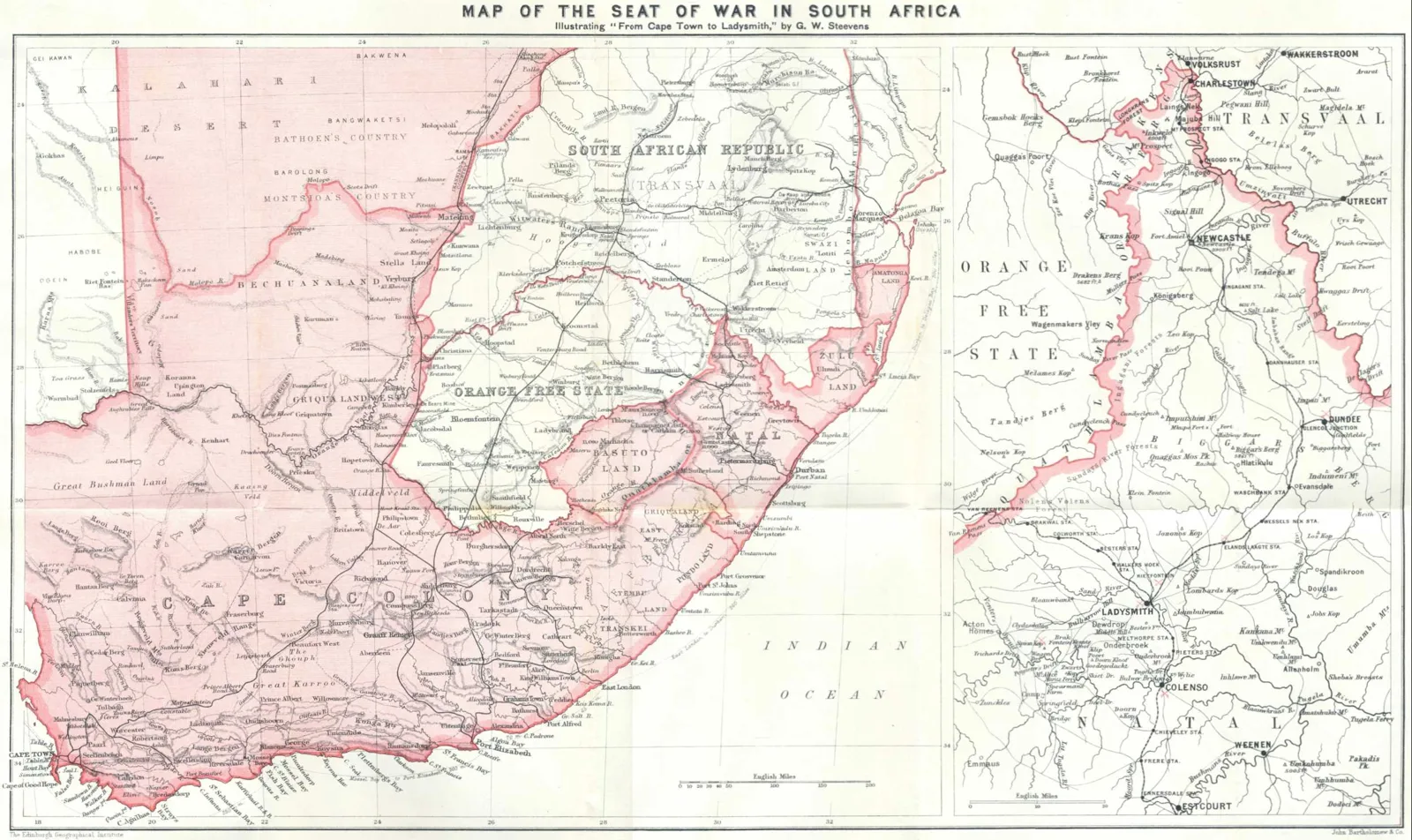
The Second Boer War, explained: between 11 October 1899 and 31 May 1902, Great Britain fought the two Boer (Afrikaner) republics — the South African Republic (Transvaal) and the Orange Free State — for supremacy in southern Africa, in a war whose underlying prize, many historians argue, was the Witwatersrand gold-mining complex, then the largest in the world. Britain eventually deployed nearly 500,000 men against a Boer strength of no more than about 88,000, spent more than £200 million, and still needed two years of guerrilla war, farm-burning and concentration camps to win. Around 75,000 people died, most of them civilians and most of those from disease.
Key takeaways
- Gold made a local rivalry a great-power prize: after gold was discovered on the Witwatersrand in 1886, the South African Republic could fund modernisation and rival Britain in southern Africa — and the mostly British Uitlanders who worked the mines became the stated cause of war when the republic denied them political rights.
- The weaker side dictated how the war was fought: outnumbered roughly five to one, Boer commandos used modern rifle fire, mobility and then guerrilla tactics so effectively that Britannica calls the conflict a foretaste of the defensive warfare of the First World War.
- The camps, not the battles, killed most people: about 22,000 imperial soldiers died, two-thirds of them from disease — but the largest single category of death was Boer women and children in concentration camps, recorded at 26,370, alongside an estimated 20,000 Black African deaths that historians note rest on far poorer records.
- The losers won the peace: the Treaty of Vereeniging abolished the republics, yet promised self-government and paid £3 million in reconstruction aid. Former Boer generals Louis Botha and Jan Smuts went on to lead the Union of South Africa created in 1910 — while the treaty deferred Black voting rights until after that self-government, entrenching white minority rule.
Contents
- Overview
- What caused the war?
- How was the war fought?
- Casualties
- Economic effects
- How it shaped the world
- What historians debate
Overview
The Second Boer War — also called the South African War or Anglo-Boer War — was the largest and most costly war Britain fought between the Napoleonic Wars and the First World War, in Britannica's assessment. The name itself is contested ground: Afrikaner tradition calls it the Second Freedom War, while many modern scholars prefer "South African War" precisely because Black South Africans were participants and victims, not bystanders — a point Bill Nasson, professor of history at the University of Stellenbosch, builds into The Boer War: The Struggle for South Africa and his later The War for South Africa (2010).
The imbalance was stark. British strength reached nearly 500,000 men from across the empire, including large Canadian and Australian contingents and at least 100,000 Black Africans employed as labourers, transport drivers and, increasingly, armed scouts. Against this the republics could muster about 88,000 burghers in citizen commandos, with few artillery pieces but outstanding generals such as Louis Botha, Jan Smuts and Christiaan de Wet.
What caused the war?
Britain said suzerainty; many historians say gold — and the two claims are not mutually exclusive. British politicians claimed they were defending their "suzerainty" over the South African Republic enshrined in the Pretoria and London conventions of 1881 and 1884. Britannica records that many historians stress instead that the contest was for control of the Witwatersrand complex, at a time when the world's monetary systems, Britain's pre-eminently, were increasingly dependent on gold.
The background was a century of friction. The Boers had trekked away from British rule in the 1830s, founded their republics in 1852 and 1854, and had already defeated Britain once, in the First Boer War of 1880–81. Diamonds (1867) and then gold (1886) transformed the stakes: the gold rush drew tens of thousands of Uitlanders to Johannesburg, whom the republic required to wait 14 years for the vote while taxing their industry. The failed Jameson Raid of 1895–96, an attempt to spark an Uitlander uprising, humiliated Britain and hardened Boer opinion, returning Paul Kruger to the presidency in 1898.
From 1897 the British high commissioner Alfred Milner pressed for franchise reform that would, in Britannica's words, give the Uitlanders a dominant role in the republic's policy. President Marthinus Steyn of the Orange Free State hosted the Bloemfontein Conference in May–June 1899; Kruger's concessions were judged insufficient, Britain began landing reinforcements in August and September, and on 9 October 1899 the republics issued an ultimatum demanding the troops' withdrawal. It expired on 11 October, and the Boers struck first.
How was the war fought?
In three phases: Boer victories, British occupation, and a guerrilla war Britain answered with scorched earth. In the first phase the unprepared British were besieged at Ladysmith, Mafeking and Kimberley and beaten at Stormberg, Magersfontein and Colenso during "Black Week" (10–15 December 1899) — defeats the National Army Museum attributes to frontal attacks on concealed positions against an enemy using modern rifles and smokeless powder.
In the second phase, Lords Roberts and Kitchener replaced the failed command, relieved the besieged towns, and advanced up the railway lines: Bloemfontein fell in February 1900, Johannesburg and Pretoria in May and June, and Britain annexed both republics. Kruger fled to Europe and found sympathy but no intervention.
The third phase lasted some fifteen months. Commandos under de Wet, de la Rey, Botha and Smuts — who raided to within 50 miles of Cape Town — harried British communications across territory Britain nominally held. Kitchener answered with blockhouses and barbed wire, then a scorched-earth policy: farms of Boers and Africans alike were destroyed, and the rural population was rounded up into segregated concentration camps, often under horrific conditions. Emily Hobhouse's June 1901 report caused an international outcry; the government's Fawcett Commission confirmed her findings and camp administration improved. But Kitchener's methods wore the commandos down, splitting bittereinders ("bitter-enders") from hensoppers who surrendered, until the remaining leaders accepted terms at Vereeniging.
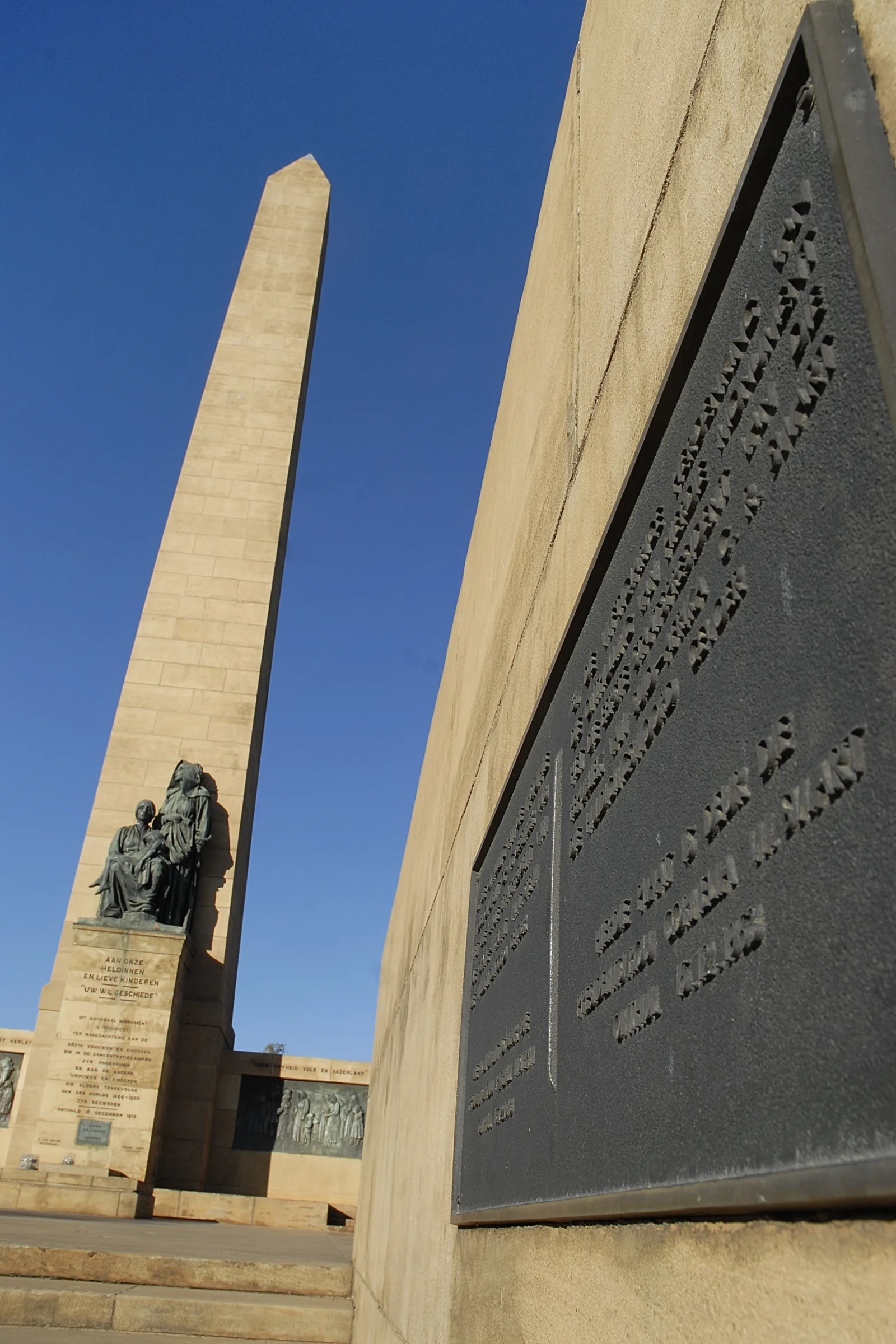
Casualties
Around 75,000 people died — and disease, not combat, did most of the killing on every side. The figures below are the commonly cited accounting, published here as ranges because the sources opened do not fully agree, above all on African deaths:
- British and imperial soldiers: about 22,000 dead (the detailed table gives 22,092, with 75,430 more returned home sick or wounded). Only 7,792 were battle casualties; the rest died largely of disease. The National Army Museum puts it as two-thirds of deaths caused by disease and inadequate medical provision, out of more than 120,000 British and imperial casualties in total.
- Boer commandos: 6,000 to 7,000 dead (6,189 in the detailed table), with some 24,000 captured and sent to prisoner-of-war camps overseas, including St Helena, Bermuda, Ceylon and India.
- Boer civilians: 20,000 to 28,000 dead, overwhelmingly in the concentration camps — the recorded camp figure is 26,370 Boer women and children, and Britannica's summary likewise gives over 26,000. Total civilian fatalities in the detailed table are 46,370.
- Black Africans: an estimated 20,000 dead, of some 115,000 interned in separate camps — but Britannica gives a lower range of 13,000 to 20,000. These are the war's least certain figures: the African camps were recorded far less completely, a gap Nasson and other South African historians stress in restoring Black South Africans to a war long mislabelled a "white man's war."
Economic effects
The war cost Britain more than £200 million — and temporarily shut down the industry it was fought over. The detailed cost table totals £211,156,000 including interest; the National Army Museum gives £210 million, which it equates to over £25 billion today. Thomas Pakenham, in The Boer War (1979), calls it the costliest and most humiliating war Britain fought between 1815 and 1914.
On the Rand, gold production collapsed: output worth £15,141,376 in 1898 fell to £2,024,278 across November 1899 to April 1901, recovering only as mines reopened under occupation. Scorched earth destroyed the farm economy the commandos lived off, so the peace carried a reconstruction price tag — the £3 million grant and further loans written into the treaty.
How it shaped the world
It created modern South Africa — on terms that excluded its majority. The Treaty of Vereeniging, signed at Pretoria on 31 May 1902 after approval at Vereeniging, ended the republics' independence, declared a general amnesty, protected the use of Dutch in schools and courts, and promised eventual self-government. That promise was fulfilled in 1906–07, and on 31 May 1910 the former republics were merged with the Cape and Natal as the Union of South Africa. Pakenham's famous verdict is that the Boers, in political terms, lost the war but won the peace: Botha became the Union's first prime minister, with Smuts beside him.
Clause VIII was the price: it deferred "the question of granting the franchise to natives" until after self-government, meaning the white minority would decide it. Black Africans were left without the vote except in the Cape Colony — a settlement Britannica links to the protests and organisation, including the founding generation of the African National Congress, that followed. Afrikaner nationalism, seared by the camp deaths, likewise became a defining force in the new state.
For warfare, the war was a preview: Britannica judges that it provided "a foretaste of warfare fought with breach-loading rifles and machine guns, with the advantage to the defenders, that was to characterize World War I." The British Army, the National Army Museum concludes, learned from its defeats, and the reforms that followed shaped the force that marched in 1914.
What historians debate
- Was it a war for gold? J. A. Hobson, who reported from South Africa for the Manchester Guardian, argued in Imperialism: A Study (1902) that the war was fought to secure the gold resources for mining interests — an argument that shaped a century of anti-imperial thought. Britannica's cautious formulation is that the causes "have provoked intense debates among historians and remain as unresolved today as during the war itself."
- Whose war was it? Most scholars have abandoned the label "white man's war": Nasson's work, using Afrikaans as well as English sources, treats it as a struggle involving all South Africa's peoples, which is why "South African War" is now the official and increasingly the scholarly name.
- Were the camps a crime or a catastrophe of administration? Hobhouse and the Fawcett Commission established the facts of hunger and disease at the time; the argument since — over intent, negligence and why the African camps were worse recorded and worse supplied — remains a live dispute, and is why the civilian figures above are ranges, not single numbers.
This explainer is drawn from the reference sources listed above, all opened or read during this run. Casualty and cost figures are published as the ranges those sources give; where sources disagree — above all on Black African deaths — the disagreement is stated rather than resolved.