The Russo-Turkish War, explained in one line: between April 1877 and March 1878, a Russian-led coalition defeated the Ottoman Empire in the Balkans and the Caucasus, ended almost five centuries of Ottoman domination in Bulgaria, and redrew the map of south-eastern Europe — twice, because the great powers rewrote the first peace treaty within four months. It was the last and most consequential of the Russo-Turkish wars, and the settlement it produced is a standard case study in how a victory on the battlefield can be trimmed at the conference table, and how the trimming stores up the next wars.
What caused the war?
The deep causes were Russian ambition and Balkan nationalism. Russia wanted to recover the territorial losses and prestige it had surrendered in the Crimean War of 1853–56, to re-establish itself in the Black Sea, and to support the political movement attempting to free Balkan nations from the Ottoman Empire. The triggers came in 1875–76. An uprising by Serbs in Herzegovina began in July 1875 and spread into Bosnia; Serbia and Montenegro went to war with the Ottomans; and in the spring of 1876 Bulgarian revolutionaries launched the April Uprising in the south-central Bulgarian lands. Ottoman regulars and irregulars suppressed it, massacring up to 30,000 people in the process — among them some 5,000 of the 7,000 villagers of Batak. Reports of the atrocities outraged opinion across Europe and destroyed what remained of the Ottomans' diplomatic protection. Russia declared war on 24 April 1877, leading a coalition that included Romania, Serbia, Montenegro and Bulgarian volunteers, against an Ottoman Empire fielding some 281,000 troops in total across both fronts.
How was the war fought?
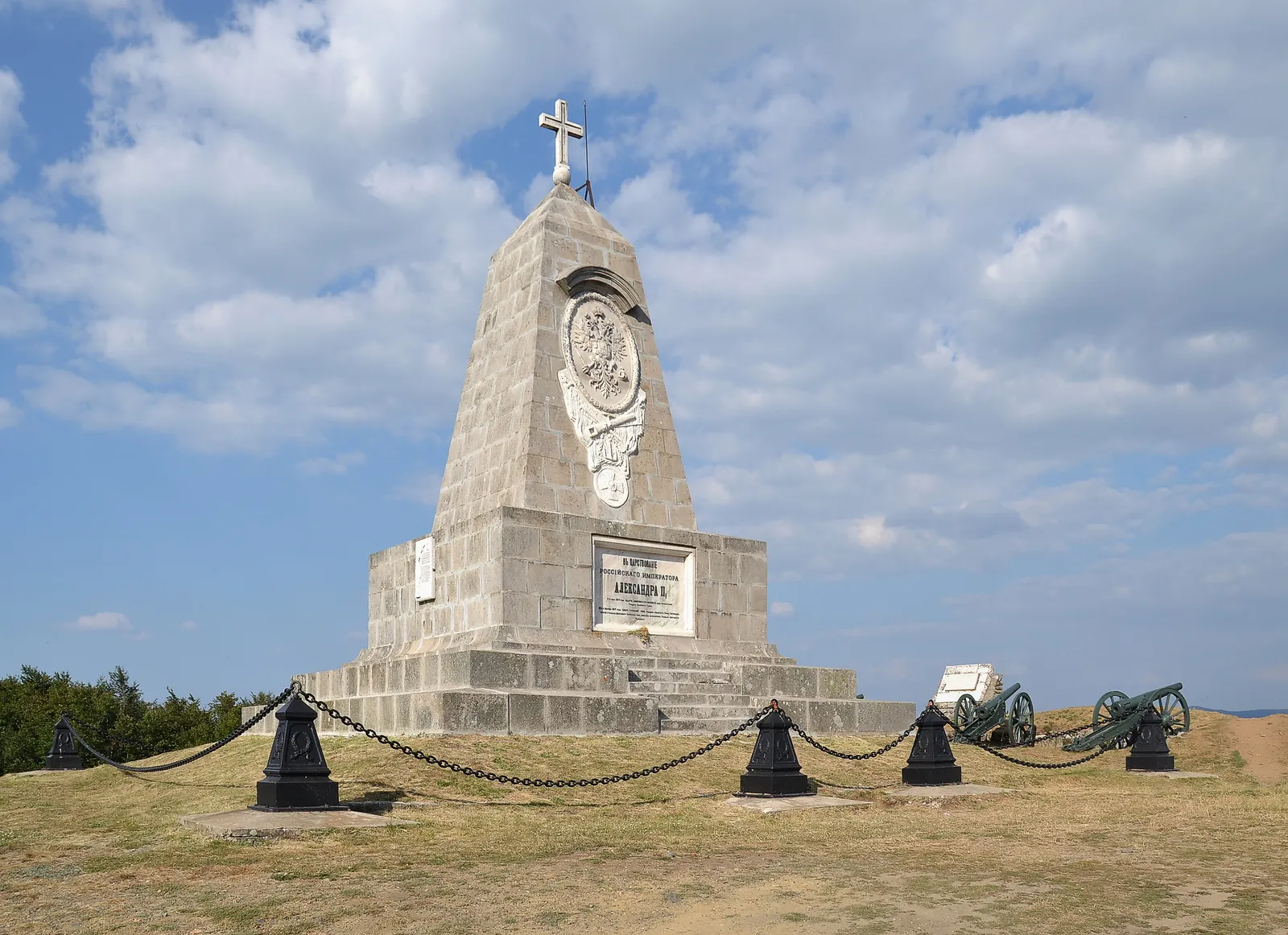
In three phases. Russian troops entered Romania in April 1877 and crossed the Danube into Bulgarian territory in late June, capturing Svishtov and Nikopol in July. Then the advance stalled at Plevna (Pleven), where Turkish forces under Osman Pasha dug in before the Russians could take the strategic town. Ottoman defences withstood Russian attacks in late July, August and September; the Russians settled into a siege instead, with Tsar Alexander II staying with the attacking forces, until the Turkish garrison of 43,000 surrendered in December 1877. Russia suffered approximately 38,000 casualties during the Plevna operations. In parallel, General Iosif Gurko's command took Shipka Pass in mid-July 1877, and Russian and Bulgarian forces held it through four battles against Ottoman attempts to retake it, until the conclusion of the fourth battle in January 1878, when 32,000 Turkish troops surrendered. In the Caucasus, Russian forces took the fortresses of Kars and Batum. With Plevna fallen and the pass forced, the Russian advance rolled south to the gates of Constantinople itself, and the fighting ended with the Treaty of San Stefano on 3 March 1878.
What did the peace settlements do?
Two settlements, four months apart, with opposite logics. The Treaty of San Stefano, signed on 3 March 1878 in a village west of Constantinople, was Russia's dictated peace: it created a large autonomous Bulgaria, re-establishing the Bulgarian state after almost five centuries of Ottoman domination (1396–1878), and recognised the full independence of Romania, Serbia and Montenegro; Russia claimed Kars and Batum in the Caucasus and annexed the Budjak region. The scale of the Bulgarian state — a presumed Russian client reaching toward the Aegean — alarmed Britain and Austria-Hungary, and the western great powers intervened. At the Congress of Berlin, from 13 June to 13 July 1878, with German Chancellor Otto von Bismarck as host and self-styled "honest broker," the Treaty of Berlin dismantled the San Stefano Bulgaria: it was divided into three parts — an autonomous Principality of Bulgaria north of the Balkan Mountains; Eastern Rumelia, south of the mountains and more closely tied to the Sultan; and Macedonia, returned to direct Turkish rule — and reduced by two-thirds, completely cut off from the Aegean Sea. Austria-Hungary was allowed to occupy Bosnia and Herzegovina, Britain took the occupation of Cyprus, and Russia kept Bessarabia and its Caucasus gains.
What did the war cost, and why does it still matter?
Disease killed more soldiers than combat did. Military deaths are estimated at roughly 96,700 to 111,200 for the coalition — Russia losing 15,567 to 30,000 killed, about 81,000 dead from disease and 56,652 wounded — and 90,000 to 120,000 for the Ottoman Empire, including 30,000 killed and some 110,000 captured. An estimated 500,000 to 1.5 million Muslim and Jewish civilians were displaced. The war's political legacy outlasted its butcher's bill. Bulgaria emerged as a state but a truncated one, and the grievance of the lost San Stefano borders shaped Bulgarian policy for decades; Bosnia's transfer to Austro-Hungarian administration planted the dispute that detonated in 1914; and the Berlin settlement, while it averted an immediate great-power war, exacerbated nationalist grievances across the Balkans and deepened the Anglo-Russian rivalry — a direct line, as the standard histories draw it, to the Balkan Wars of 1912–13 and the First World War.
This explainer is drawn from the reference sources listed above, all read during this run. Casualty and displacement figures are published as the ranges those sources give; 19th-century counts, particularly of disease deaths and civilian displacement, are estimates and differ between sources.