The Bosnian War, explained in one line: between April 1992 and November 1995, the republic of Bosnia and Herzegovina tore itself apart along ethnic lines as Yugoslavia collapsed — Bosniak, Serb and Croat forces, each backed from outside, fought over whether the new state would exist at all and who would hold its land — and the war ended with about 100,000 dead, more than 2.2 million people driven from their homes, and a peace settlement at Dayton, Ohio, that divided the country 51 percent to 49 percent and still structures it today. It was, at the time, the most violent conflict in Europe since the end of the Second World War.
What caused the Bosnian War?
The Bosnian War was a product of the breakup of Yugoslavia. As the federation weakened at the end of the Cold War and ethnic nationalism revived in the 1980s, its republics began to leave: Slovenia and Croatia seceded in 1991, and war in Croatia followed. Bosnia and Herzegovina was the federation's most mixed republic — in the 1991 census Muslims (the group that from the mid-1990s has called itself Bosniak) made up more than two-fifths of the population, Serbs slightly less than one-third and Croats about one-sixth; the standard reference figures are 44 percent Bosniak, 32.5 percent Serb and 17 percent Croat. Every partition proposal therefore meant drawing lines through mixed towns and villages.
The sequence into war was fast. Bosnian Serb leaders proclaimed "Serb Autonomous Regions" during 1991, boycotted the Bosnian presidency from August, and on 9 January 1992 proclaimed a Serb republic inside Bosnia. A referendum on independence was held on 29 February–1 March 1992; Bosnian Serb parties obstructed voting in most Serb-populated areas and almost no Bosnian Serbs voted, while of the nearly two-thirds of the electorate that did vote, almost all chose independence. President Alija Izetbegovic proclaimed independence on 3 March. European Community negotiators' attempts to divide the republic into ethnic cantons failed — each of the three parties rejected a different version. When the United States and the EC recognised independence on 6–7 April 1992, Bosnian Serb paramilitary forces were already firing on Sarajevo.
How was the war fought?
Bosnian Serb forces held the decisive early advantage: the weapons and resources of the Yugoslav People's Army (JNA). In April 1992, towns in eastern Bosnia with large Bosniak populations — Zvornik, Foca, Visegrad — were attacked by paramilitaries and army units together, and most of the local Bosniak population was expelled: the first victims of a process described as ethnic cleansing. Within six weeks a coordinated offensive brought roughly two-thirds of Bosnian territory under Serb control, and in May the army units in Bosnia were placed under a Bosnian Serb general, Ratko Mladic. Britannica's summary of responsibility is careful and is followed here: Bosniaks were the primary victims of ethnic cleansing and Serbs the primary perpetrators, while Croats were also among both victims and perpetrators.
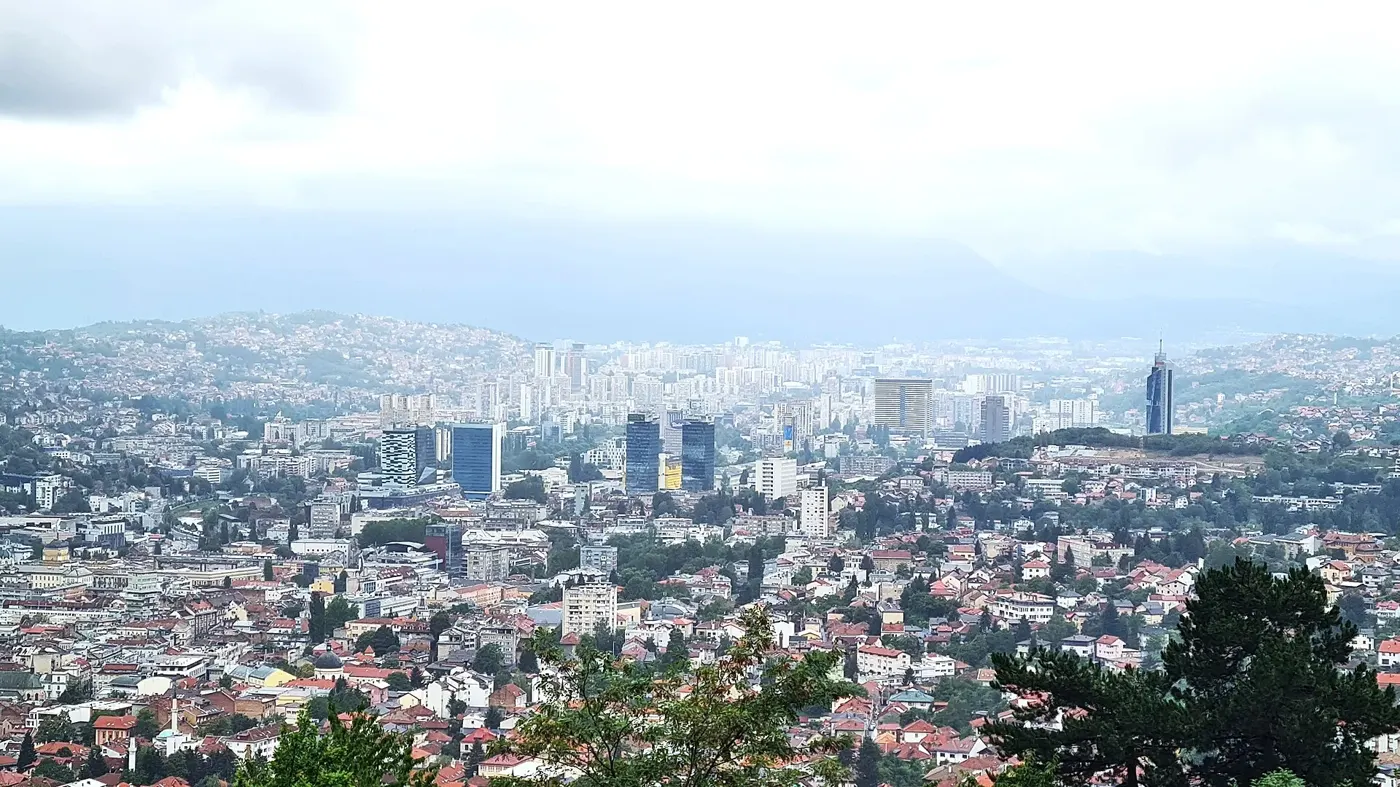
From the summer of 1992 the front lines were fairly static, but the war's character was set by sieges and campaigns against civilians rather than by manoeuvre. Sarajevo, the capital, was encircled and bombarded for the duration — the siege ran beyond the war's formal end, into 1996. A second war opened inside the first: tensions between Croat and Bosniak forces escalated into the Croat–Bosniak War in early 1993, weakening the government side until, in 1994, the Washington Agreement joined Bosniaks and Croats in a single federation against Republika Srpska. The United Nations declined to fight the war but ran humanitarian aid through its Protection Force (UNPROFOR) and declared a number of "safe areas" — a protection that failed at the decisive point. The war was also marked by systematic mass rape, mainly perpetrated by Serb forces and to a lesser extent by Croat and Bosniak forces; the published estimate range is 12,000 to 50,000 women raped, most of the victims Bosniak women.
What happened at Srebrenica?
In July 1995, Bosnian Serb forces overran the UN-declared safe area of Srebrenica in eastern Bosnia and murdered more than 8,000 Bosniak men and boys. Britannica, using a more conservative count, puts the massacre at more than 7,000 Bosniak men; the figure of over 8,000 is the one carried by the standard war reference and by the memorial record. The killings at Srebrenica are the only incident in Europe to have been recognised as a genocide since the Second World War. Together with a further Bosnian Serb attack on a Sarajevo marketplace, Srebrenica changed the international calculation: NATO, which had first used force in February 1994 when its fighters shot down four Bosnian Serb aircraft violating the no-fly zone, now undertook concentrated air strikes — Operation Deliberate Force — against Bosnian Serb positions, combined with a large-scale Bosniak-Croat land offensive. Peace proposals had failed for years largely because the Bosnian Serbs, who controlled about 70 percent of the land by 1994, refused to concede territory; under air attack and losing ground, they agreed to talks.
How did the war end — and what did Dayton settle?
The talks were held at Dayton, Ohio, in November 1995, under US sponsorship, with Serbian President Slobodan Milosevic representing the Bosnian Serbs. The Dayton Accords were initialed on 21 November 1995 — the date the war is conventionally said to have ended — and formally signed in Paris on 14 December. They kept Bosnia and Herzegovina as a single, federalised state: 51 percent of its land constitutes the Croat-Bosniak Federation and 49 percent the Serb republic, Republika Srpska. A 60,000-member international force was deployed to enforce the agreement, and an Office of the High Representative was established to oversee its civilian implementation. The accounting continued in court: by early 2008 the International Criminal Tribunal for the former Yugoslavia had convicted 45 Serbs, 12 Croats and four Bosniaks of war crimes in connection with the war in Bosnia; Milosevic died in prison before his trial ended, while Radovan Karadzic, Ratko Mladic and Slobodan Praljak were convicted, Britannica records.
The human totals were revised as the research improved. It was originally estimated that at least 200,000 people were killed and more than 2,000,000 displaced during the 1992–95 war; subsequent name-by-name studies concluded the death toll was actually about 100,000, with displacement put at over 2.2 million. The documented breakdown by side — some 62,000 dead on the Bosnian government side, soldiers and civilians together; about 8,400 on the Croat side; about 25,000 on the Serb side; and 5,100 more whose ethnicity and status are unstated — sums to just over 101,000, largely Bosniaks. Those are the figures used throughout this explainer: attributed, revised, and still the most complete count the record supports.
This explainer is drawn from Encyclopaedia Britannica's 'Bosnian War' entry, opened and read in full, and the 'Bosnian War' reference article, opened and read, including its casualty boxes and chronology. Where the two differ — the Srebrenica count, more than 7,000 in Britannica against over 8,000 in the reference total — both figures are stated with their sources rather than silently merged.