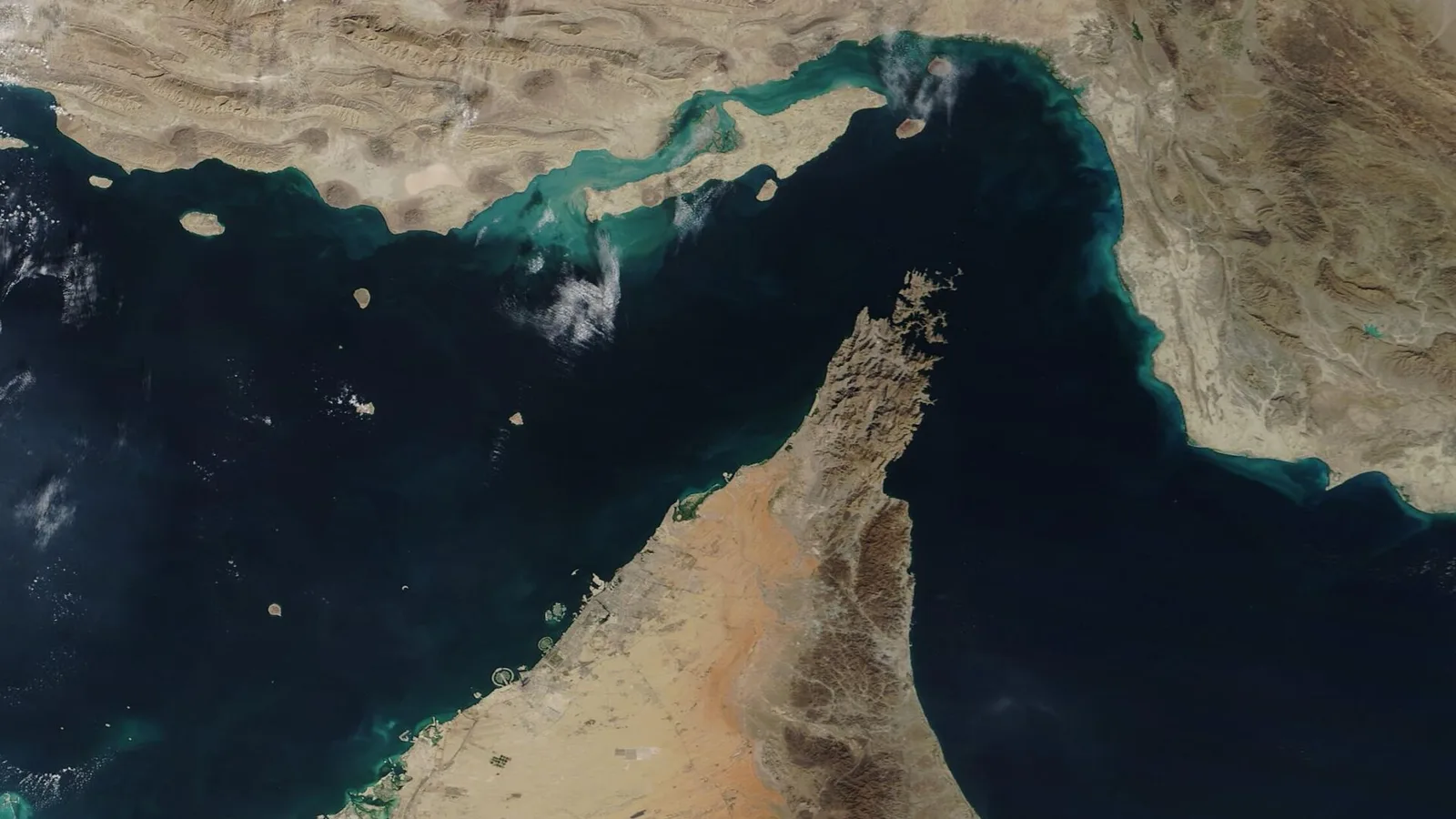
The Strait of Hormuz is the world's most important energy chokepoint — the narrow waterway through which roughly a fifth to a quarter of the world's seaborne oil passed before the 2026 Iran conflict, according to the International Energy Agency and the U.S. Energy Information Administration. It lies between Iran and Oman, connecting the Persian Gulf with the Gulf of Oman and the Arabian Sea, and at its narrowest point it is only about 21 nautical miles wide. Months of disruption during the Iran conflict have turned this geography into the center of the global energy crisis — and driven the U.S. to push Gulf producers to build permanent alternatives.
Where is the Strait of Hormuz and why does it matter?
The strait is the only sea passage from the Persian Gulf to the open ocean, meaning nearly every barrel of oil exported by Saudi Arabia, Iran, Iraq, Kuwait, Qatar, and the UAE must pass through it. The IEA says an average of about 20 million barrels of crude oil and oil products a day moved through Hormuz in 2025, representing roughly a quarter of global seaborne oil trade; the EIA put the figure at 20.9–21.0 million barrels per day in the first half of 2025. The strait also carried more than 20% of global LNG trade — much of it Qatar's gas, bound for Asia.
More than 80% of the oil and liquefied natural gas moving through the chokepoint heads to China, India, Japan, and South Korea. Any prolonged disruption affects crude supplies, shipping costs, insurance premiums, and ultimately fuel prices far beyond the Middle East.
How has the 2026 conflict disrupted Hormuz traffic?
The Iran war has severely disrupted traffic through Hormuz, CNN reported in October 2026, which has pushed Gulf oil exporters toward the Red Sea as an alternative export corridor. The U.S. military maintains a blockade while Tehran continues to launch attacks on passing energy shipments, the Wall Street Journal reported; one October 7 attack in the strait wounded 12 mariners aboard the Panama-flagged commercial vessel MT On Peace, India's Ministry of External Affairs said, per the WSJ.
Kpler data cited by the WSJ put crude flows through Hormuz at 74% of prewar levels after a series of tanker attacks in early October. Iran's state news agency reported a blast heard from the sea at Qeshm Island, raising concerns of another flare-up, ANZ Research analysts said, per the WSJ. Iran also intensified attacks on tankers in recent days, driving oil prices higher — Brent rose to about $101.20 a barrel on October 7 (see the market snapshot box).
Attribution: the MT On Peace casualty figures come from India's Ministry of External Affairs via the WSJ; the Qeshm blast report comes from Iran's state news agency via ANZ Research. These claims have not been independently verified.
Can pipelines replace the Strait of Hormuz?
Not completely, at least in the short term. Saudi Arabia's East-West Pipeline carries crude from the kingdom's eastern oil fields to Yanbu on the Red Sea. The UAE's Habshan-Fujairah pipeline moves oil from Abu Dhabi to Fujairah on the Gulf of Oman, bypassing the strait entirely. Iraq is exploring a Basra-Aqaba corridor, and Washington is pushing Gulf producers to build more alternatives, with Saudi Arabia and the UAE identified as key partners.
But the EIA says existing pipelines in Saudi Arabia and the UAE provide alternative capacity of only about 4.7 million barrels per day — substantial, but far below the ~21 million barrels per day that historically moved through Hormuz. Kuwait, Qatar, Bahrain, and Iran have almost no bypass options, the IEA notes. And pipelines are themselves fixed targets: Houthi missile and drone strikes on Saudi infrastructure in October 2026 showed that even export infrastructure outside the strait can come under attack.
What would a full closure mean?
The IEA notes that a major disruption would have significant consequences for global oil markets — and the strait is uniquely vulnerable because the navigable shipping lanes are just two miles wide in each direction and pass through both Iranian and Omani territorial waters. As Iran's leverage over the strait weakens through bypass routes, analysts quoted by energy outlets warn of the risk that Tehran escalates attacks on shipping instead. For now, markets are watching each tanker attack: oil's rise above $101 on October 7 was attributed by ING analysts to the tug-of-war between improving regional supply and lingering threats to it.
Attribution notes: flow figures in this article are from the IEA and EIA as reported by NewsNation, whose article was opened and read; October 2026 flow and price data are from the Wall Street Journal (opened and read). The MT On Peace and Qeshm Island items are single-source reports noted with attribution.