World War II, the conflict that involved virtually every part of the world during the years 1939–45, was in many respects a continuation — after an uneasy 20-year hiatus — of the disputes left unsettled by World War I. The principal belligerents were the Axis powers, Germany, Italy, and Japan, and the Allies: France, Great Britain, the United States, the Soviet Union, and China. It was a "total" war in which civilian populations not only contributed to the war effort but became direct targets of aerial attack, and it ended with an estimated 40–50 million deaths, making it the bloodiest conflict, as well as the largest war, in history. The war's aftermath redrew borders, created the United Nations, divided Europe, and shifted global power decisively toward the United States and the Soviet Union.
Key takeaways
- World War II was the deadliest conflict in human history. Estimates of the total killed range from 35 million to 60 million; Britannica uses a figure of 40–50 million deaths, the wide span reflecting the inexactness of wartime statistics.
- The war began in Europe in 1939 and became truly global in 1941. Germany invaded Poland on September 1, 1939; the Soviet–German war began with Operation Barbarossa in June 1941, and the Pacific war began with Japan's attack on Pearl Harbor in December 1941.
- Civilians were targets as well as victims. The Nazi regime's war of extermination murdered some six million Jews, and strategic bombing killed hundreds of thousands of civilians on all sides.
- Its institutions still shape the world. The United Nations, founded in 1945; the U.S.-financed Marshall Plan, which rebuilt Western Europe; and the U.S.–Soviet rivalry known as the Cold War all grew directly out of the war's aftermath.
Contents
- Key takeaways
- Contents
- Overview
- Casualties in World War II
- Economic effects
- How World War II shaped the world
Overview
The road to World War II ran through the unresolved consequences of World War I — a point Britannica makes central to its account of the conflict. By early 1939, the German dictator Adolf Hitler was determined to invade Poland. Poland held guarantees of French and British military support, but Hitler first moved to neutralize the Soviet Union: secret negotiations produced the German-Soviet Nonaggression Pact, signed on August 23–24, 1939, whose secret protocol divided Poland between Germany and the U.S.S.R. Hitler ordered the invasion to begin on the morning of September 1, 1939; in response, Great Britain and France declared war on Germany on September 3. World War II had begun.
The war became truly global in 1941. On June 22, 1941, Germany invaded the Soviet Union in Operation Barbarossa, opening the Eastern Front — the largest theater of the war. On December 7/8, 1941, Japan attacked the American naval base at Pearl Harbor and other American, Dutch, and British installations across Asia, bringing the United States into the war against both Japan and, days later, Germany and Italy.
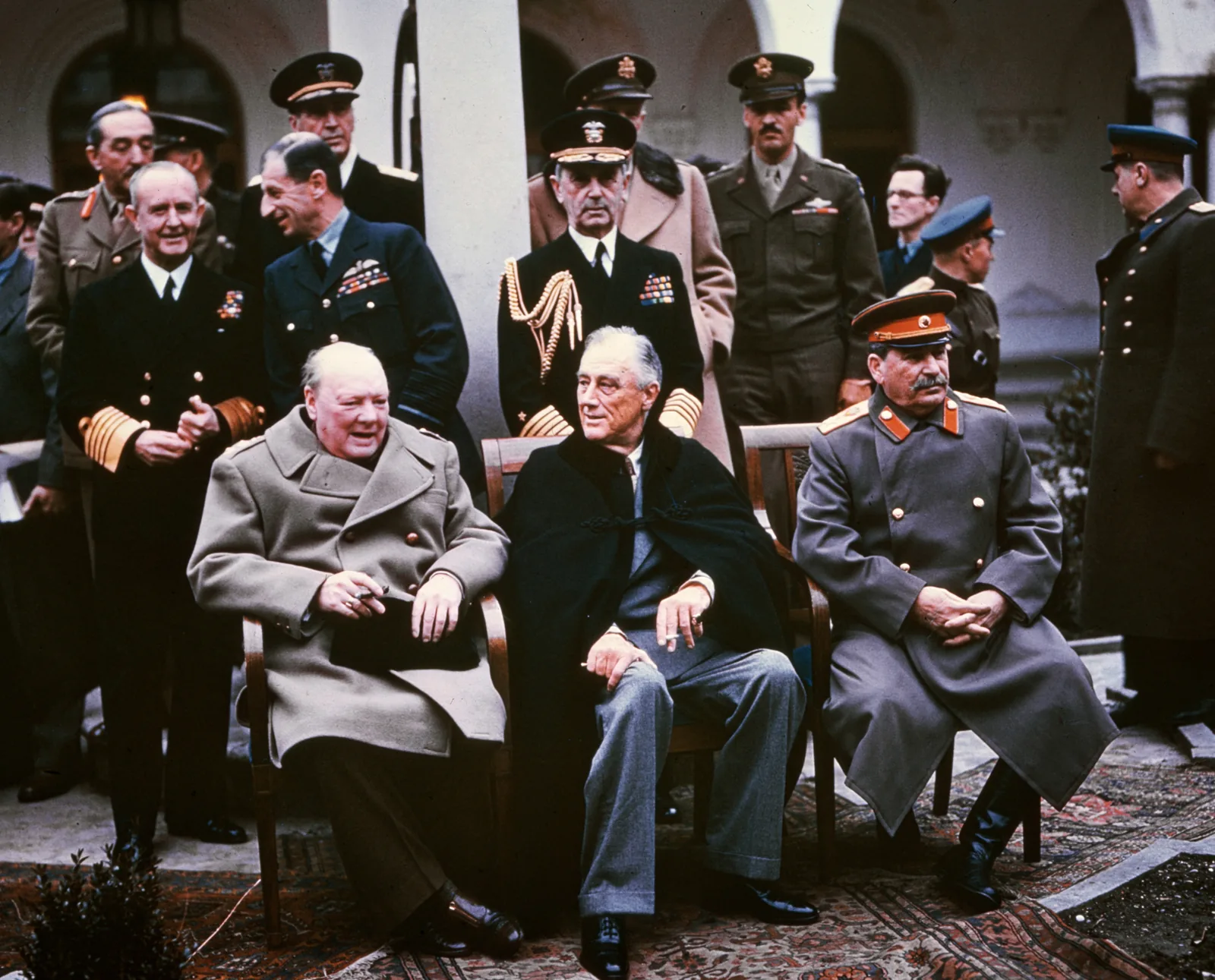
The principal Allied leaders were Winston Churchill (United Kingdom), Joseph Stalin (Soviet Union), Charles de Gaulle (France), and Franklin D. Roosevelt and then Harry S. Truman (United States); the Axis was led by Adolf Hitler (Germany), Benito Mussolini (Italy), and Hideki Tojo (Japan). The war's turning points came in 1942–43: the American victory at the Battle of Midway (June 1942) destroyed the Japanese first-line carrier force and ended Japan's ability to wage offensive war in the Pacific, while the Soviet victory at Stalingrad (February 1943) destroyed two entire German armies and marked, in Britannica's phrase, "the beginning of the end of the Third Reich."
The war ended in stages. The Allied landings at Normandy on June 6, 1944 opened a second front in Europe; Hitler committed suicide on April 30, 1945, and the war in Europe ended on May 8. In the Pacific, the firebombing of Japanese cities and the atomic bombings of Hiroshima and Nagasaki in August 1945 knocked Japan out of the war.
Casualties in World War II
The death toll of World War II is given as a range because, as Britannica notes, "statistics about the war's casualties are inexact." Estimates of the total number killed have ranged from 35 million to 60 million; Britannica's main account uses 40–50 million deaths, making the war "the bloodiest conflict, as well as the largest war, in history." The Soviet Union and China are believed to have suffered the most total casualties.
Country-level estimates compiled by Britannica illustrate the distribution. An estimated 5.8 million Poles died — about 20 percent of Poland's prewar population, the highest proportional loss of any nation. About 4.2 million Germans died, and about 1.972 million Japanese died. On the Allied side, Britannica's table records roughly 18 million Soviet dead (11 million military and about 7 million civilian), though historians' estimates for Soviet losses vary; the Britannica figures are conservative compared with some Russian historiography, which places the total higher.
A distinctive feature of World War II casualties was the deliberate targeting of civilians. The Nazi regime's war of extermination murdered Jews, Slavs, and others deemed inferior by Nazi ideology. The United States Holocaust Memorial Museum records that six million Jews were murdered in the Holocaust; almost a third of them were killed in mass shootings, with as many as 2 million Jews murdered in mass shootings and gas vans in territory seized from Soviet forces — what the museum calls the "Holocaust by bullets."
Strategic bombing also killed civilians on a vast scale. Hundreds of thousands died in the firebombings of Japanese cities and in the Allied bombing campaign over Germany, and the atomic bombings of Hiroshima and Nagasaki in August 1945 added tens of thousands more civilian deaths in a single stroke.
Economic effects
World War II devastated the economies of Europe and East Asia. Cities, factories, transport networks, and farmland were destroyed on a scale that dwarfed the damage of World War I, and millions of displaced people and refugees strained every relief system. But the war also accelerated a transformation already underway since 1918: the decisive shift of economic power toward the United States.
The American response to Europe's ruin was the Marshall Plan — formally the European Recovery Program — a U.S.-sponsored program that ran from April 1948 to December 1951 and was designed, in Britannica's words, "to rehabilitate the economies of 17 western and southern European countries in order to create stable conditions in which democratic institutions could survive." The United States had feared that postwar poverty, unemployment, and dislocation were reinforcing the appeal of communist parties to voters in western Europe.
Secretary of State George C. Marshall laid out the case in a June 5, 1947 address at Harvard University:
"The truth of the matter is that Europe's requirements for the next three or four years of foreign food and other essential products — principally from America — are so much greater than her present ability to pay that she must have substantial additional help or face economic, social, and political deterioration of a very grave character." — George C. Marshall, June 5, 1947
Congress authorized the program, and President Harry S. Truman signed it into law on April 3, 1948. Over the next four years, a specially created bureau, the Economic Cooperation Administration, distributed some $13 billion in economic aid — the vast majority as direct grants rather than loans — helping to restore industrial and agricultural production, establish financial stability, and expand trade. Aid had originally been offered to almost all European countries, including those under Soviet occupation, but the Soviets withdrew early and the other eastern European nations under their influence followed, leaving 17 western and southern European participants.
Britannica judges the plan "very successful": the western European countries involved saw their gross national products rise by 15 to 25 percent during the period, and the plan contributed greatly to the rapid renewal of the western European chemical, engineering, and steel industries. To coordinate the effort, the participants created the Organisation for European Economic Co-operation — an early step toward the economic integration of Europe.
How World War II shaped the world
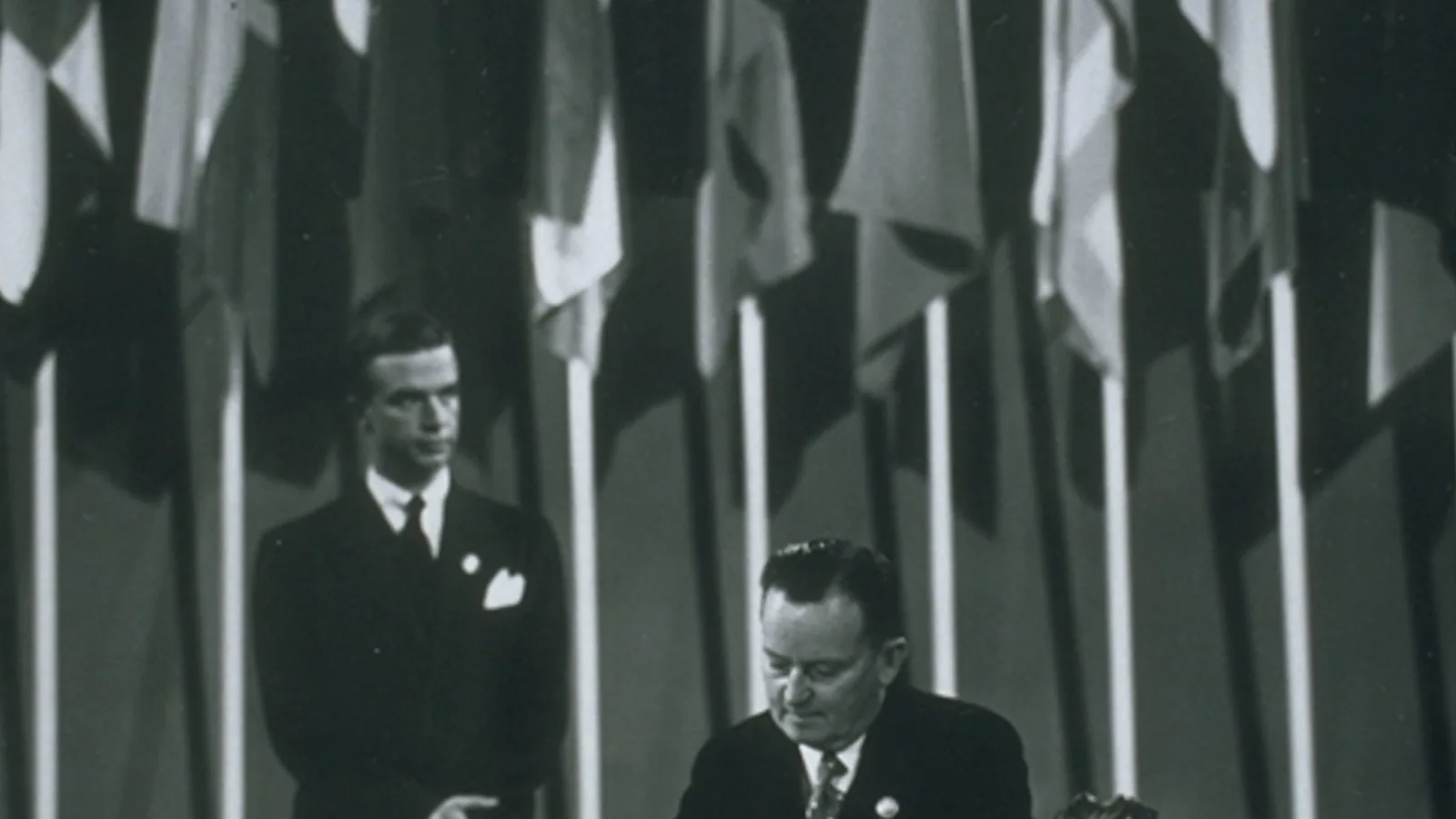
No war reshaped the international order more thoroughly. Its most visible institutional legacy was the United Nations. Delegates of fifty nations met in San Francisco from April 25 to June 26, 1945, at the United Nations Conference on International Organization, and agreed upon the UN Charter and the Statute of the new International Court of Justice. The Charter was signed on June 26, 1945, and the United Nations came into existence on October 24, 1945 — now observed as United Nations Day — once the five great powers (China, France, Great Britain, the Soviet Union, and the United States) and a majority of the other signatories had ratified it.
The organization was explicitly born from the war. As UN News put it on the Charter's 80th anniversary, representatives convened in San Francisco committed to the idea of "never again" — never again would a war of this magnitude devastate the world. The Charter paved the way for the 1948 Universal Declaration of Human Rights, and, in the words of UN General Assembly President Philémon Yang, "has shaped decades of progress — guided international action on decolonisation, protected human rights and promoted justice and sustainable development."
Geopolitically, Britannica summarizes the outcome in three strokes: the war "resulted in the extension of the Soviet Union's power to nations of eastern Europe, enabled a communist movement to eventually achieve power in China, and marked the decisive shift of power in the world away from the states of western Europe and toward the United States and the Soviet Union." The rivalry between those two superpowers became the Cold War — Britannica's own timeline of Cold War events opens with the Truman Doctrine and the Marshall Plan — and the division hardened as the Marshall Plan's offer of aid split Europe: the western participants rebuilt with American help while the Soviet Union blocked its satellites from taking part.
The war also ushered in the atomic age. The atomic bombings of Hiroshima and Nagasaki demonstrated a weapon of previously unimaginable destructive power, and the subsequent nuclear arms race between the superpowers defined the security politics of the second half of the 20th century. Together with decolonization — the breakup of the European colonial empires accelerated by the war — these changes form the world as it still exists: a United Nations system, a nuclear-armed great-power rivalry's long shadow, and a global economy whose center of gravity the war moved permanently across the Atlantic.