World War I, fought from 1914 to 1918, was the first conflict to draw most of the nations of Europe — along with Russia, the United States, the Middle East, and other regions — into full-scale industrialized warfare. It pitted the Central Powers, mainly Germany, Austria-Hungary, and Turkey, against the Allies, mainly France, Great Britain, Russia, Italy, Japan, and, from 1917, the United States, and ended with the defeat of the Central Powers. As Britannica puts it, the war was "virtually unprecedented in the slaughter, carnage, and destruction it caused," and it proved to be one of the great watersheds of 20th-century history: four empires collapsed, the map of Europe was redrawn, the United States emerged as a world power, and the settlement that ended the war planted the seeds of the next one.
Key takeaways
- A regional crisis became a world war in weeks. The assassination of Archduke Franz Ferdinand on June 28, 1914 triggered a chain of ultimatums and mobilizations that drew the continent's alliance blocs into war within about five weeks.
- The death toll was staggering and remains disputed. Britannica estimates about 8.5 million soldiers died, with "perhaps as many as 13,000,000 civilians" also dead — putting commonly cited total deaths in the 15–22 million range, with the civilian count the main source of disagreement.
- The war broke the prewar economic order. Combatants abandoned the gold standard and printed money to pay for the war, producing high inflation; the peace settlement then imposed reparations of 132 billion gold marks on Germany — almost twice its prewar national income.
- Its settlement redrew Europe and reshaped global power. The German, Russian, Austro-Hungarian, and Ottoman dynasties fell, the Treaty of Versailles created the League of Nations, and the United States emerged as a world power.
Contents
- Key takeaways
- Contents
- Overview
- Casualties in World War I
- Economic effects
- How World War I shaped the world
Overview
World War I grew out of a crisis in the Balkans. On June 28, 1914, in Sarajevo — then part of Austria-Hungary — the Bosnian Serb Gavrilo Princip shot and killed Archduke Franz Ferdinand, heir presumptive to the Austrian emperor Franz Joseph, and his wife Sophie. The plot had been hatched by Colonel Dragutin Dimitrijević, head of Serbia's military intelligence and of the secret society Union or Death, as part of a pan-Serbian campaign to "liberate" South Slavs living under Habsburg rule.
What followed was the so-called July Crisis. Austria-Hungary, assured of Germany's support, presented Serbia with an ultimatum designed to be unacceptable and declared war on July 28. Russia mobilized in Serbia's defense; Germany, doubting that Britain would intervene, sent ultimatums to Russia and France, then declared war on Russia on August 1 and on France on August 3. When German forces invaded neutral Belgium on the night of August 3–4, Britain — committed to defend Belgium — declared war on Germany on August 4. Within weeks, most of Europe was at war, and on September 5, 1914, Russia, France, and Great Britain signed the Treaty of London, pledging not to make a separate peace; they could now be called the Allied, or Entente, powers.
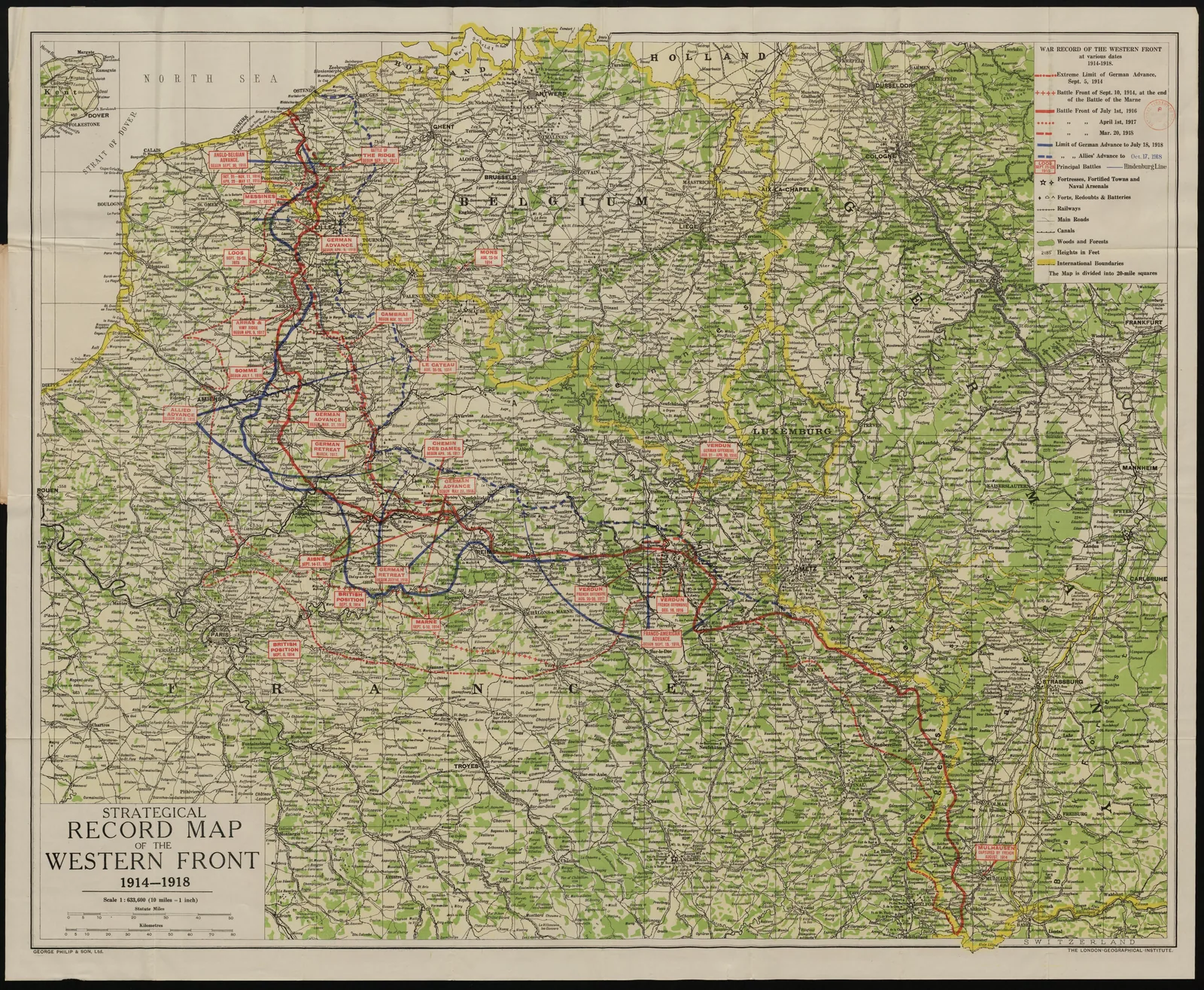
The war that Europeans expected to be over in months instead settled into years of attritional warfare on multiple fronts, with new weapons — machine guns, heavy artillery, poison gas, tanks, and aircraft — making it deadlier than any previous conflict.
The United States entered the war in 1917 after two shocks: the revelation of the Zimmermann Telegram, in which Germany proposed a military alliance with Mexico against the United States, promising the return of Texas, Arizona, and New Mexico; and Germany's resumption of unrestricted submarine warfare, which sank American merchant ships. On April 2, 1917, President Woodrow Wilson asked Congress for war, declaring that "the world must be made safe for democracy," and Congress declared war on Germany on April 6. The fighting ended in 1918 after more than four years of combat and the deaths of some 8.5 million soldiers; the formal peace settlement, the Treaty of Versailles, was signed on June 28, 1919.
Casualties in World War I
No figure from World War I is stated with complete confidence — record-keeping varied widely between belligerents, and the line between war deaths and deaths from wartime disease and famine is hard to draw. The figures below are therefore given as ranges, with disagreements noted.
Britannica estimates that some 8.5 million soldiers died as a result of wounds or disease during the war, and that "perhaps as many as 13,000,000 civilians also died." Combining these estimates, historians commonly place total deaths in the range of roughly 15–22 million. The military component is the better-documented side: the Allies won the war, but at the cost of millions of dead on both sides.
The civilian figure is where the largest uncertainty lies — Britannica's "perhaps as many as" phrasing reflects genuine disagreement among historians about how many civilian deaths to attribute to the war rather than to overlapping catastrophes. Where estimates diverge, they do so mainly over the counting of civilian deaths, not the military toll.
What is not disputed is the scale. Britannica notes that the immense number of deaths "dwarfed that of any previous war, largely because of the new technologies and styles of warfare used in World War I." For comparison, the deadliest war the world had previously seen — the Napoleonic Wars of the early 19th century — killed a fraction of that number.
Economic effects
World War I marked, in the words of an IMF historical exhibit, "the end of an economic era." Faced with an urgent need for liquidity to pay for the fighting, the combatant countries took their currencies off the stabilizing gold standard and printed more money. The result was high inflation, which persisted after the war.
The war was financed overwhelmingly through borrowing and money creation, because tax revenue was nowhere near enough to meet the demands of total war. By 1918, European states were weighed down by immense public debt, and the inflationary financing had weakened their currencies.
The peace settlement compounded the damage. The IMF exhibit states that the Treaty of Versailles "exacerbated tensions and economic instability rather than fostering growth and cooperation":
The European allies, especially France and the United Kingdom, felt that the losers should compensate them for the cost of the war by paying reparations. In 1921, Germany's reparations alone were fixed at 132 billion gold marks — almost twice its prewar national income.
A vicious circle followed, documented in the IMF's account of the postwar years. The defeated countries had no gold with which to pay reparations, and without that reparations money the Allies could not repay their war loans from the United States — which refused to cancel them, insisting the loans were commercial transactions. The strain broke several currencies entirely: the IMF notes that the German, Austrian, Hungarian, Polish, and Bulgarian monetary systems collapsed under runaway hyperinflation. The United States loaned money to Germany through the Dawes Plan, which — along with private investment — enabled scaled-down reparations payments, but the victors ultimately collected only a small fraction of what was assessed, and the United States eventually had to cancel the remaining debts of its allies.
The economic map of the world shifted with the war. Europe's economies were exhausted and indebted; the United States, which had financed much of the Allied war effort, emerged as the world's leading creditor nation — a position Britannica captures in its summary of the war's significance: "The United States emerged as a world power."
How World War I shaped the world
The political consequences of World War I were as profound as the military and economic ones. Four imperial dynasties — the Habsburgs of Austria-Hungary, the Hohenzollerns of Germany, the sultanate of the Ottoman Empire, and the Romanovs of Russia — collapsed as a direct result of the war. In Russia, the strain of the war produced the Bolshevik Revolution, which took Russia out of the war and reshaped its politics for the rest of the century.
"The war was virtually unprecedented in the slaughter, carnage, and destruction it caused." — Encyclopædia Britannica, World War I
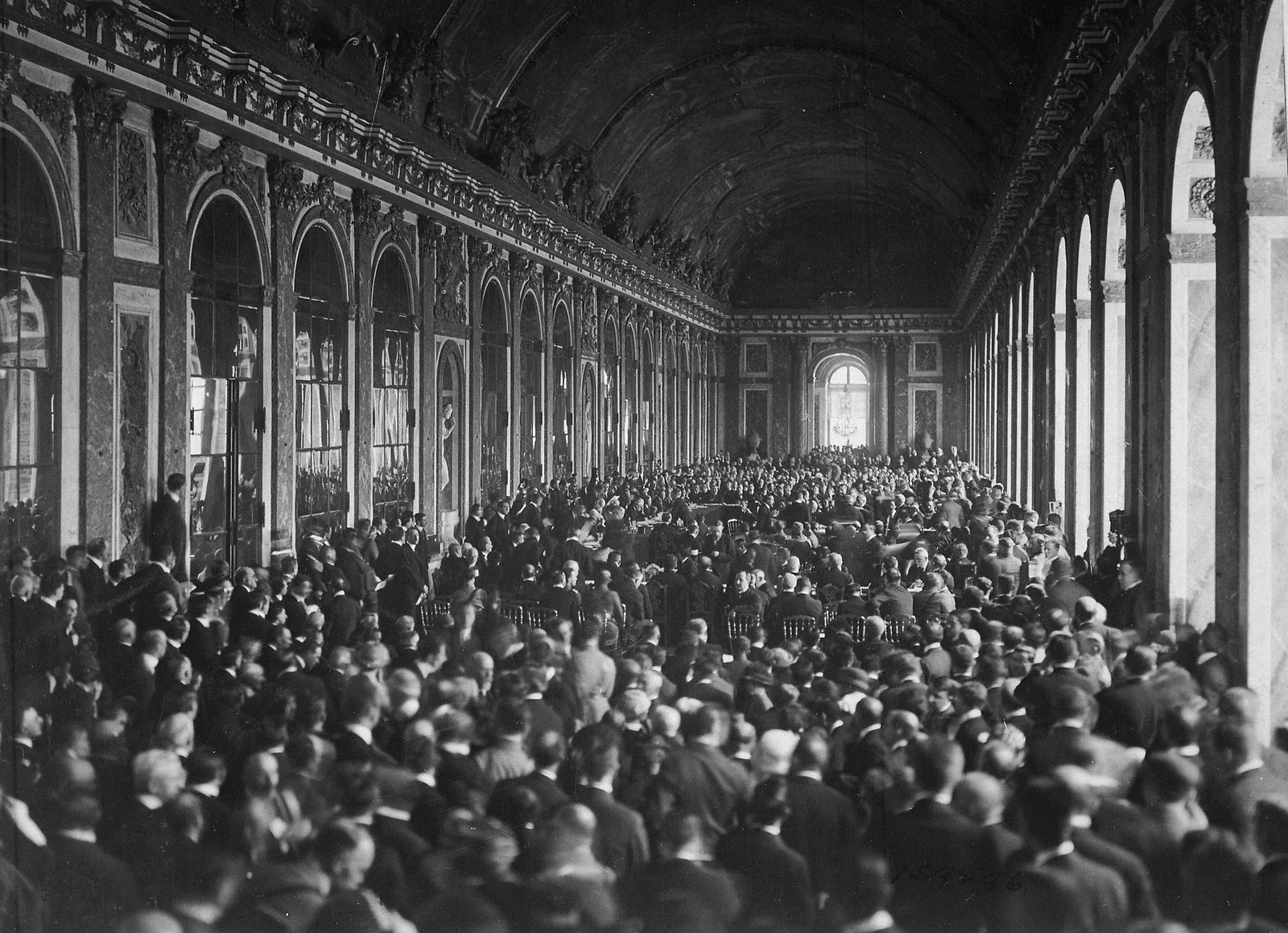
The peace settlement redrew the map. The Treaty of Versailles, signed on June 28, 1919, required Germany to pay financial reparations, disarm, lose territory, and give up all of its overseas colonies, according to the Library of Congress. It also called for the creation of the League of Nations, the international organization President Woodrow Wilson had championed in his Fourteen Points. The League was the first attempt at a global body dedicated to collective security — but it was weakened from the start: the U.S. Senate rejected the treaty twice, in 1919 and 1920, and the United States never joined the League, signing a separate peace with Germany in 1921 instead.
The broader reshaping was economic and strategic as well as territorial. New states emerged from the collapsed empires, the financial center of gravity shifted from London toward New York, and warfare itself had changed: new technology had made it, in Britannica's words, "deadlier than ever before," with the industrial slaughter of the trenches becoming the defining image of the conflict. Most consequentially, Britannica argues, the war "in its destabilization of European society, laid the groundwork for World War II" — a judgment historians continue to debate, but one that explains why the 1914–1918 conflict is still called the war that made the modern world.