The Thirty Years' War, explained: between 1618 and 1648, a Bohemian revolt mutated into a continent-wide struggle drawing in half of Europe. It began as a fight over religion inside the Holy Roman Empire and ended as a war of pure power politics — Catholic France bankrolled Protestant armies against Catholic Austria. An estimated 4.5 to 8 million died, most from famine and disease, and the Peace of Westphalia that ended it is still taught as the founding moment of the modern state system.
Key takeaways
- Religion lit the fuse, power politics kept the war burning: the war began in 1618 with Protestant Bohemia's rebellion against the future emperor Ferdinand II, but by 1635 Catholic France was fighting alongside Protestant Sweden against the Catholic Habsburgs. Historian Peter H. Wilson argues religion was "one element in a lethal stew of political, social, and dynastic forces" — not the catalyst.
- The human cost was staggering and mostly indirect: an estimated 4.5–8 million dead; only about 3% of civilian deaths came from military action, against 64% from plague and 12% from starvation. The German lands lost roughly 40% of their population.
- The settlement remade Europe: Dutch independence recognized, Sweden a Baltic great power, France the preeminent Western power, Habsburg power permanently diminished — and the Peace of Westphalia became the cornerstone of the modern state system, though scholars now debate whether that "Westphalian myth" is even true.
Contents
Overview
The Thirty Years' War was fought primarily in Central Europe between 23 May 1618 and 24 October 1648 — what Britannica calls a series of wars fought for "religious, dynastic, territorial, and commercial rivalries," ending with a map "irrevocably changed."
The standard narrative: in 1618 Ferdinand II, as king of Bohemia, attempted to impose Catholic absolutism on his domains; Protestant nobles led by Count Thurn answered with the Defenestration of Prague, throwing two of Ferdinand's Catholic representatives out of the castle windows (all three survived). The rebels deposed Ferdinand and elected the Calvinist Frederick V of the Palatinate as Bohemia's king; imperial forces crushed the revolt at White Mountain (November 1620). Then Denmark (1625), Sweden (1630), and France (1635) intervened in succession — each re-lighting a war that kept threatening to burn out — until the treaties of Münster and Osnabrück (24 October 1648) ended the fighting.
The structural origins lie in the unresolved settlement of the Reformation: the Peace of Augsburg (1555) fixed religious boundaries under cuius regio, eius religio but recognized only Catholics and Lutherans — Calvinism was excluded. By 1608 the Empire had armed itself politically (Protestant Union vs. Catholic League). Two external drivers made an internal dispute a European war: the Spanish Habsburgs needed the "Spanish Road" through the Electoral Palatinate linking their Italian possessions to Flanders, and the candidacy of the fervently Catholic Ferdinand for the Bohemian crown convinced Bohemia's Protestant nobility that a Counter-Reformation crackdown was coming.
The conventional telling frames this as the last great war of religion. Historian Peter H. Wilson's revision — the standard view in modern scholarship — holds that religion was the war's language and pretext, but that dynastic ambition, fiscal desperation, and the Franco-Habsburg rivalry were its engines. The clinching evidence: Catholic France, Europe's most devoutly Catholic great power, subsidized Protestant Sweden and entered the war in 1635 against Catholic Spain and Austria.
The four phases
Bohemian (1618–25). The Bohemian revolt, Frederick V's brief kingship, and the Catholic victory at White Mountain. Because the Palatinate sat astride the Spanish Road, Spain and the Dutch Republic were drawn into the German conflict.
Danish (1625–29). King Christian IV of Denmark intervened to gain ground in northern Germany and was defeated by the Catholic armies of the imperial general Albrecht von Wallenstein. The Peace of Lübeck (1629) ended the intervention; as Britannica notes, it "finished Denmark as a European power."
Swedish (1630–35). Gustavus Adolphus of Sweden landed in Pomerania in 1630, bankrolled in part by French subsidies. His new-model army smashed the imperial army of Count Tilly at Breitenfeld (September 1631). The sack of Magdeburg (May 1631), the war's most notorious atrocity, came during this phase. Gustavus was killed at Lützen (1632); Sweden's defeat at Nördlingen (1634) broke the Protestant advance; the Peace of Prague (1635) largely ended the war's civil-war phase inside the Empire.
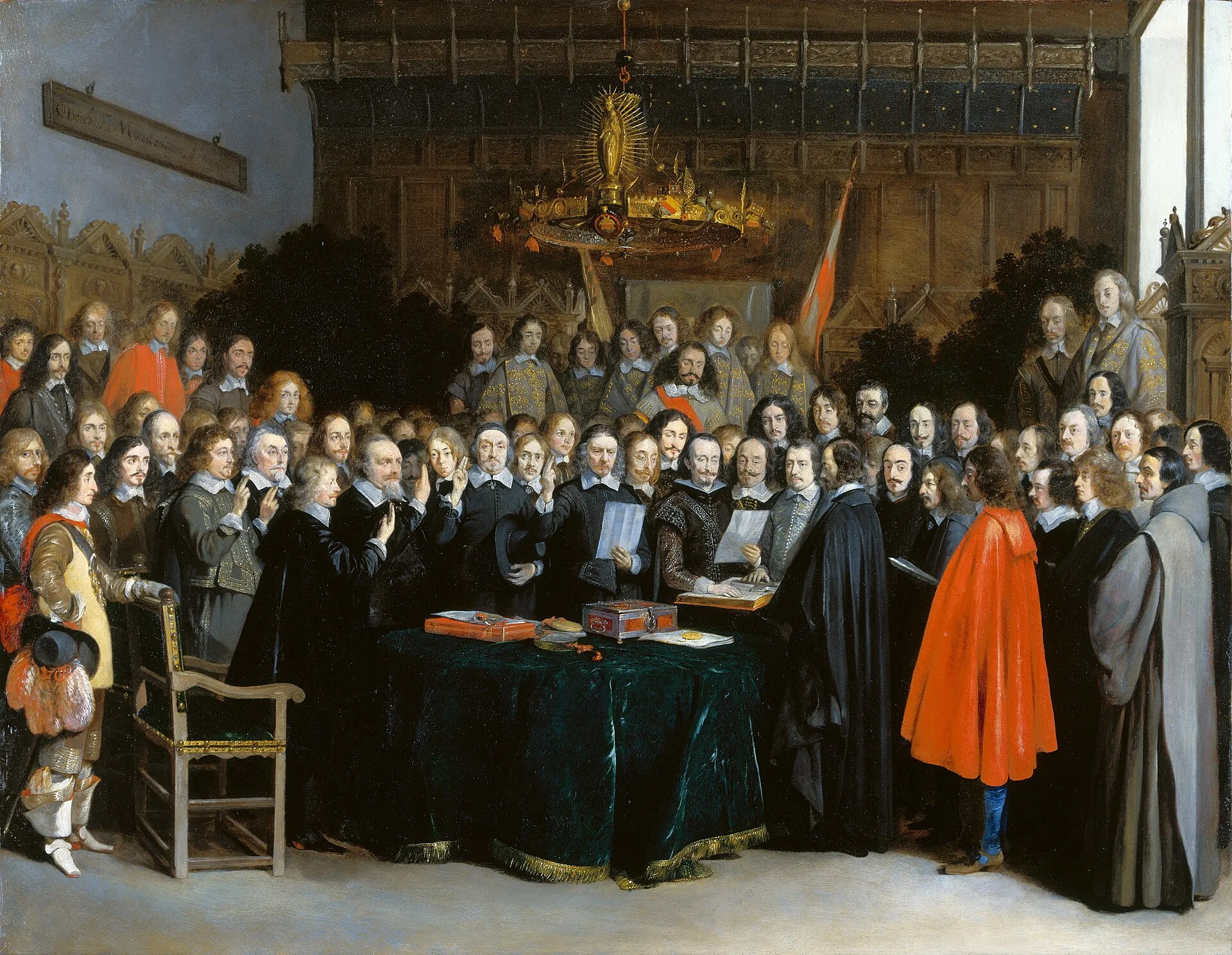
French (1635–48). France declared war on Spain in 1635, converting the conflict into one theatre of a Franco-Habsburg war. The fighting grew increasingly aimless — historian Jeremy Black argues most later campaigns were "inconclusive," armies being preoccupied with extracting supplies and pay. At Rocroi (1643) the Duke of Enghien destroyed the legendary Spanish tercios. Negotiations from 1643 produced the Peace of Münster (Spain–Dutch Republic, January 1648) and, on 24 October 1648, the paired treaties of Münster (Empire–France) and Osnabrück (Empire–Sweden) — the Peace of Westphalia. Over 109 delegations took part, and no plenary session ever met; the last Swedish garrison left Germany in 1654.
Casualties
The widely cited figure is 4.5 to 8 million dead — "from the effects of battle, famine, or disease," mostly after 1630 and mostly civilians:
- Military dead: Wilson puts those killed or wounded in action at around 450,000; disease is estimated to have multiplied the toll two to three times, suggesting 1.3 to 1.8 million total military casualties.
- How civilians died: local records suggest only 3% of civilian deaths were due to military action; the leading causes were bubonic plague (64%), starvation (12%), dysentery (5%), and typhus (4%). Poor harvests, repeated plundering, and displacement into crowded cities spread disease — soldiers moving from Germany are alleged to have sparked the 1629–31 Italian plague that killed some 280,000.
- Population decline: historians broadly agree the German lands lost roughly 40% of their population — from 18–20 million around 1600 to 11–13 million by 1650 — and did not recover until about 1750. The Czech lands lost about 27%. But the losses were wildly uneven: northwest Germany suffered minimal decline, while Mecklenburg, Pomerania, and Württemberg fell by nearly 50%. The German historian Günther Franz (1940) estimated about 40% of the rural and 33% of the urban civilian population were lost — a measure of total demographic loss, not deaths alone.
- Treat single big numbers with skepticism: claims of up to 12 million deaths are no longer considered realistic, and 19th-century German nationalists are recorded as having exaggerated the war's impact.
Economic effects
The war's armies were overwhelmingly mercenary and frequently unpaid, which turned logistics into plunder. Britannica describes the resulting "wolf-strategy": armies of both sides "plundered as they marched, leaving cities, towns, villages, and farms ravaged." Most 17th-century states could not finance armies of this size for long, so troops lived off "contributions" extorted from whatever territory they passed through. Black's judgment is blunt: the war's later armies were "increasingly devoid of intelligible political objectives," degenerating into "travelling armed mobs."
The macroeconomic picture is more nuanced: the war caused sharp short-term dislocation (especially 1618–23), but appears to have accelerated existing changes in trading patterns — price differentials between regional markets kept narrowing. The death toll may even have improved living standards for survivors: one study finds real wages in Germany rose by about 40% between 1603 and 1652.
The war also bankrupted an empire: Spain poured subsidies into its Austrian Habsburg cousins, and the loss of those subsidies after 1640 — as Spain buckled under its own global war's costs — substantially weakened the imperial position. Sweden extracted a five-million-thaler indemnity; the Dutch, whose trade boomed while German lands starved, emerged with independence recognized.
How it shaped the world
The map was redrawn. Sweden took Wismar, Western Pomerania, and Bremen-Verden, plus a seat in the Imperial Diet. Brandenburg-Prussia took Farther Pomerania, Magdeburg, and Halberstadt. France formally gained Metz, Toul, Verdun, and the Alsatian Décapole (except Strasbourg and Mulhouse). Dutch independence was recognized by Spain. Inside the Empire, the member states gained full sovereignty over domestic affairs, the 1624 "Normaljahr" fixed each state's official religion, Calvinism was legally recognized for the first time, and the old ius reformandi was removed. (The terms did not apply to the Habsburgs' hereditary lands.)
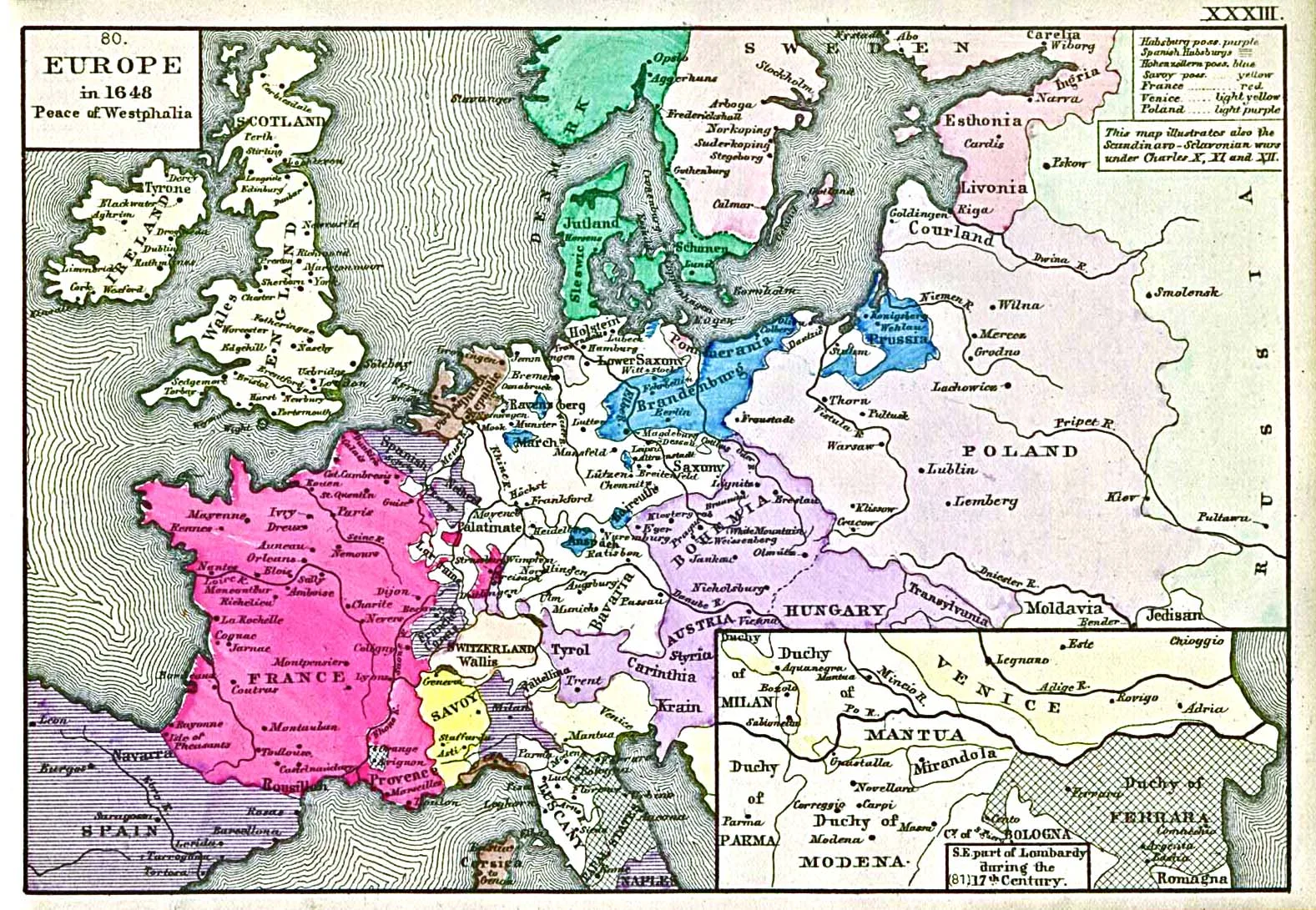
It founded — or didn't found — the modern state system. Westphalia is traditionally taught as the birth of sovereignty and non-intervention — the moment Europe became a community of sovereign states, as Britannica summarizes. But political scientist Andreas Osiander ("Sovereignty, International Relations, and the Westphalian Myth," International Organization, vol. 55, no. 2, 2001) argues that "the treaties confirm neither [France's or Sweden's] 'sovereignty' nor anybody else's; least of all do they contain anything about sovereignty as a principle" — the grant of alliance-making rights to the imperial estates was not even new. The "Westphalian system" survives mainly as shorthand: a founding myth of international relations that the war's own documents do not clearly support.
Power shifted permanently. France emerged as the preeminent Western power until the Napoleonic era; Spain lost its dominant position (fighting on against France until the 1659 Treaty of the Pyrenees); Sweden became a Baltic great power. The Habsburg dream of a Catholic-imperial order in Central Europe was finished; the Empire survived — Wilson stresses the war did not destroy it — but as a fragmented federation of estates.
Warfare itself changed. Gustavus Adolphus's combined-arms tactics at Breitenfeld are a milestone of the "Military Revolution," but the deeper legacy was institutional: states built the machinery to fund, supply, and direct permanent armies — transferring organized violence from "contractor" generals like Wallenstein to nation-states.
What historians debate
- Was it a religious war at all? C.V. Wedgwood's classic The Thirty Years War (1938, still in print via NYRB Classics) tells it as the great tragedy of a religiously riven Europe. Wilson's The Thirty Years War: Europe's Tragedy (Harvard University Press, 2009; Society of Military History Distinguished Book Award) dismantles that frame: religion was one element in a lethal mix of dynastic, political, and social forces. Modern scholarship largely sides with Wilson.
- What did Westphalia actually create? The conventional sovereignty story (Britannica, HISTORY) versus Osiander's "myth" thesis — one of the sharpest divides between how the war is taught and how specialists read the treaties.
- How many died? The 4.5–8 million range rests on demographic reconstruction, not counted bodies; the old nationalist-inflated figures are out, but the true toll remains an estimate with wide error bars — and regional variation so extreme that some areas barely noticed a war that halved the population of others.