The Spanish Civil War, fought from 17 July 1936 to 1 April 1939, was a military revolt against the democratically elected government of Spain's Second Republic that failed as a coup and succeeded as a civil war. On one side stood the Republicans — the left-leaning Popular Front government backed by urban workers, agricultural labourers, much of the educated middle class, the Soviet Union, and tens of thousands of international volunteers. On the other stood the Nationalists — rebels led from October 1936 by General Francisco Franco, drawing on conservative Catholics, large landowners, much of the officer corps, the fascist Falange, and supplied by Nazi Germany and Fascist Italy. What began as a Spanish crisis became a proxy war watched around the world — and a rehearsal for the global war to come.
Key takeaways
- A failed coup became a three-year war: the July 1936 uprising seized Spanish Morocco and the conservative heartland, but the Republic held about two-thirds of Spain.
- The world intervened: Germany and Italy armed Franco of troops, tanks, and planes to Franco; the USSR supplied the Republic; roughly 35,000–40,000 foreigners fought in the International Brigades. The September 1936 non-intervention agreement was ignored by all three major interveners.
- Terror as policy: roughly 150,000–200,000 killings are attributed to the Nationalists and 35,000–55,000 to the Republicans — the Nationalists' campaign the more systematic of the two.
- A preview of total war: Guernica's destruction by German and Italian bombers made aerial terror bombing a global shock, and Spain became a testing ground for the tank and air warfare Germany would deploy in 1939.
- The aftermath: Franco ruled Spain as a dictator from 1939 until his death in 1975. Both sides financed the war largely by printing money, and postwar autarky brought the "Years of Hunger."
Contents
- Overview
- The road to war
- How the war was fought
- Guernica
- Casualties
- Economic effects
- How it shaped the world
- What historians debate
Overview
Spain spent much of the 1920s under the dictatorship of Miguel Primo de Rivera, and the Great Depression deepened polarization. The Second Republic, proclaimed in 1931 after King Alfonso XIII went into exile, attempted land reform, military reform, and secularization — alienating landowners, the officer corps, and the Catholic Church, while disappointing a radicalized left. The elections of 16 February 1936 brought a leftist Popular Front government to power.
Rebel officers planned an 18 July uprising in Spanish Morocco and a general uprising a day later. But the plan was discovered on the afternoon of 17 July in Melilla, forcing premature action — and the coup failed in Madrid, Barcelona, Valencia, and Bilbao. Franco ferried his Army of Africa from Morocco with planes and boats from Mussolini and Hitler, and marched north toward Madrid, besieged from November 1936.
The road to war
The coup's failure created two Spains, each of which immediately began repressing suspected opponents. Britannica notes a difference in pattern: Republican violence occurred mainly in the early stages before the rule of law was restored, while Nationalist violence was a conscious policy of terror.
Franco's path to sole command was helped by the deaths of his rivals: General José Sanjurjo, the rebels' first choice for head of state, died in a plane crash days after the uprising began, and General Emilio Mola, the coup's mastermind, died in a plane crash in June 1937. On 1 October 1936 Franco was named head of state in Burgos.
The Republic was compromised by infighting. Anarchists and militant socialists saw the war as a revolution and spearheaded collectivization; moderates wanted to preserve the Republic. The split exploded into street fighting in Barcelona in May 1937 — a "civil war within the civil war" — after which Soviet-backed communists tightened control and suppressed anarchist and anti-Stalin Marxist organizations.
How the war was fought
The Nationalists reached the outskirts of Madrid by November 1936 but stalled at the University City. They took the northern provinces in 1937, holding the whole northern coast by October. In April 1938 a salient through Teruel reached the Mediterranean and split the Republic in two. A final Republican offensive stalled at the Ebro in November 1938; a Catalan offensive that December drove the Republic's armies into France — some 250,000 soldiers and as many civilians fled. Barcelona fell on 26 January 1939, Nationalists entered Madrid on 28 March, and a 5 March coup by Republican officer Segismundo Casado, meant to negotiate a peace, was rejected by Franco — who declared the war over on 1 April 1939.
Foreign intervention tilted the balance. Historian Miguel Alonso Ibarra (Autonomous University of Barcelona) puts foreign combatants on the Nationalist side at about 115,000. For the Republic, HISTORY puts the International Brigades at roughly 35,000 foreign volunteers, whose most significant contribution was the defense of Madrid — alongside Soviet technicians, pilots and equipment.
Guernica
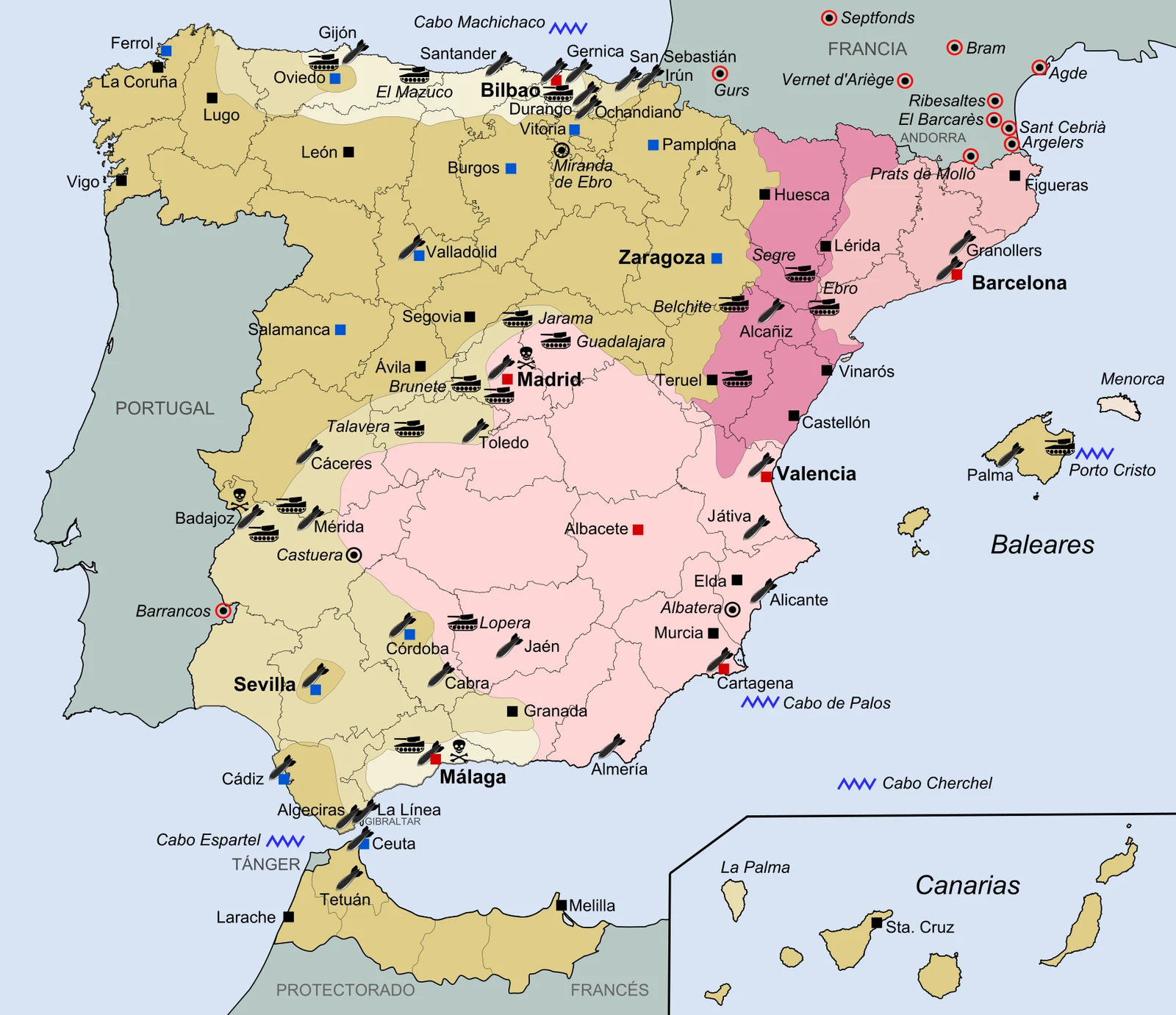
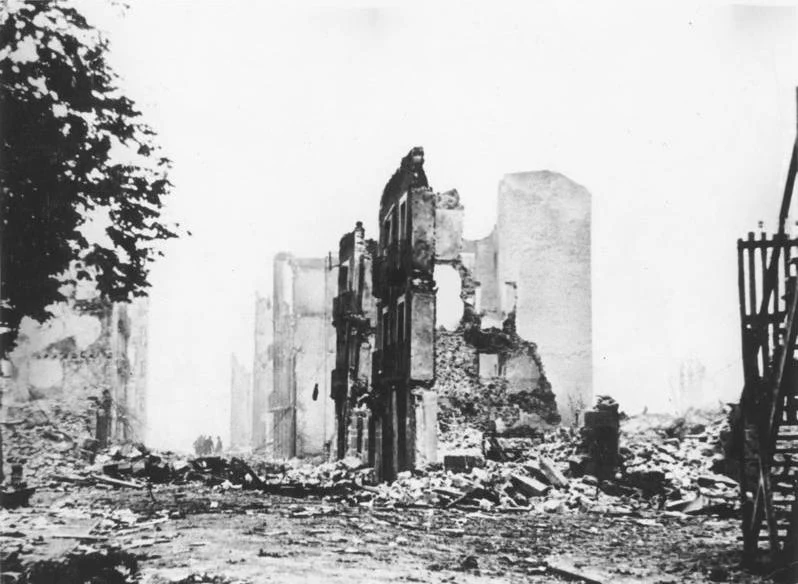
On 26 April 1937, the Basque town of Guernica was bombed at the behest of Franco's Nationalists by the Nazi German Condor Legion and the Fascist Italian Aviazione Legionaria, under the code name Operation Rügen. Ordered by Condor Legion chief of staff Wolfram von Richthofen, the raid dropped some 22 tonnes of ordnance — his stated goal was to block roads and a bridge to trap Republican forces retreating toward Bilbao. Some 22 tonnes of ordnance fell over roughly three hours, destroying three-quarters of the town's buildings.
The regime initially claimed retreating Republicans had destroyed the town — contradicted by The Times correspondent George L. Steer, reporting on the scene. The Basque government reported 1,654 killed; a Soviet source cited 800; a British source used by the USAF Air War College claims 400. Modern research has revised the toll sharply downward: historians now generally agree deaths were under 300 — roughly 170–300 — with the wartime figure of over 1,700 now regarded as exaggerated.
Casualties
Nationalist authorities put the total death toll at 1,000,000; more recent estimates are closer to 500,000 or less, excluding deaths from malnutrition, starvation, and disease. Hugh Thomas, in the 2012 edition of his classic The Spanish Civil War (1961), put war deaths at about 500,000, with some 100,000 more executed after the war.
- Nationalist killings: roughly 150,000–200,000 — Beevor (The Battle for Spain) 200,000; Preston (The Spanish Holocaust) 180,000; the Juliá-edited Víctimas de la guerra civil (1999) about 150,000. Some compendia are lower — Stanley Payne at about 70,000.
- Republican killings: roughly 35,000–55,000 — Preston 55,000, Beevor 35,000, the Juliá volume about 50,000 — including the anticlerical killings of the early months.
The oft-cited 150-to-50 ratio includes the postwar Francoist terror; wartime-only estimates, such as Julián Casanova's 2013 compendium (~100,000 vs ~55,000), run closer to 2-to-1. Treat every figure as an estimate — but the direction of the imbalance, Nationalist terror on a larger and more systematic scale, is broadly accepted.
Economic effects
Both sides financed the war mainly by printing money. The economic historians Martín-Aceña, Martínez Ruiz, and Pons show that — contrary to the Franco-era narrative of Republican "squandering" — both sides consumed similar amounts of resources, and the Republic did not lose for lack of means. What mattered were the non-intervention agreement and the Republic's early military setbacks.
The Republic began with most of the advantages: about 60 percent of the population, the main industrial base, the principal cities, and the Bank of Spain's reserves. But Soviet aid had to be paid in cash: the Republic shipped some 510 tonnes of gold — 72.6% of the Bank of Spain's reserves — to the USSR's Gossbank. Franco financed his war on credit: long-term German and Italian weapons credits, plus private donations and financiers in Portugal and Switzerland. The balance tilted when the Nationalists captured the developed northern provinces in mid-1937, taking the north's coal, iron, steel, and shipyards.
The postwar economy was shaped by Franco's choice of autarky. Franco's choice of autarky produced the "Years of Hunger" (1939–52) "Years of Hunger" (1939–52): the edited volume Franco's Famine (Bloomsbury Academic, 2021/2023) — a single but scholarly source — puts the toll at at least 200,000 dead from hunger or malnutrition-related diseases in the 1940s, arguing the famine was political: autarky's price controls and black market, with wages plunging to 50% below 1936 levels.
How it shaped the world
- A rehearsal for World War II. For Germany and Italy, Spain was a testing ground for new tank and air warfare. Göring's Luftwaffe previewed the air power of the blitzkrieg; within five months of the war's end, the same pilots were flying refined versions of the same aircraft over Poland. Franco kept Spain officially non-belligerent — meeting Hitler at Hendaye in October 1940 without joining the Axis — but sent the Blue Division, some 45,000 Spanish volunteers serving in rotation with the German Army on the Eastern Front (1941–43), where they fought in the siege of Leningrad (about 4,954 killed, 8,700 wounded).
- Guernica as symbol. The bombing's global shock made aerial terror bombing a byword for modern war's inhumanity. It inspired Picasso's Guernica (1937), painted for the Spanish Republic's pavilion at the Paris Exposition.
- A war of writers and photographers. Hemingway covered the war as a journalist from 1937. Orwell fought with the POUM militia, was shot in the throat in Barcelona, and wrote Homage to Catalonia (1938). The poet Federico García Lorca was assassinated by a Nationalist death squad in 1936 at age 38. Robert Capa's Death of a Loyalist Soldier became an iconic war photograph.
What historians debate
Casualty numbers remain the most contested ground: whether the Nationalist terror claimed 150,000 or 200,000 lives, and whether the Republican terror claimed 35,000 or 55,000, depends on which historian's archival count is used. The Juliá-edited volume (1999) fixed a rough 3-to-1 ratio in much of the scholarship; Paul Preston (The Spanish Holocaust, HarperPress, 2012) and Antony Beevor (The Battle for Spain, Weidenfeld & Nicolson, 2006) worked at the higher end; Hugh Thomas's pioneering The Spanish Civil War (1961) set the baseline a generation earlier.
Historians also debate causation: was the Republic's defeat chiefly a matter of Franco's superior foreign backing and the democracies' non-intervention — the economic emphasis of Martín-Aceña, Martínez Ruiz, and Pons? How decisive was the Republic's internal fracturing versus its material disadvantage? And on Guernica: tactical bridge-bombing that went catastrophically wide, or deliberate terror attack?