The Austro-Prussian War, explained: fought from mid-June to 23 August 1866, it was the second of Bismarck's three wars of German unification — deliberately staged by Prussia to expel Austria from German affairs. Prussia crushed the Austrian army at Königgrätz on 3 July 1866, dissolved the German Confederation, and created the Prussian-led North German Confederation in its place. Austria lost no territory but paid a 40-million-thaler indemnity; Italy, Prussia's ally, gained Venetia.
Key takeaways
- A planned showdown, not an accident: Britannica describes the 1866 campaign as a carefully planned stage in Prussia's unification project, with Bismarck as its principal agent — revenge for the humiliation of Olmütz in 1850, when a failed Prussian mobilization forced Berlin to accept Austrian terms.
- Decided at Königgrätz: on 3 July 1866, Moltke's three Prussian armies converged on Benedek's Austrian-Saxon force in Bohemia. Austrian-Saxon losses were about 44,000 men against roughly 9,000 Prussian, with some 22,000 Austrians taken prisoner.
- Austria won the southern war and lost the peace: at Custoza (24 June) and Lissa (20 July), Austrian forces beat the Italians on land and sea. None of it mattered — the Italian front merely pinned down Austrian troops while the north decided everything.
- A lenient peace by design: the Treaty of Prague took no Austrian territory. Bismarck wanted Austria neutralized, not vengeful — a possible future ally, and an example that might attract the southern German states later.
- The map changed without Austria shrinking: Prussia annexed Hanover, Hesse-Kassel, Nassau, Frankfurt, and Schleswig-Holstein, gaining the territory that connected its eastern and western halves; the German Confederation gave way to the North German Confederation.
Contents
- Overview
- Why did Prussia and Austria go to war in 1866?
- How did the war unfold?
- What did the war cost?
- Economic effects
- How did it shape the world?
- What historians debate
Overview
The Austro-Prussian War — known in Germany as the Deutscher Krieg and in English as the Seven Weeks' War — was fought between the Kingdom of Prussia and the Austrian Empire (with their German allies) from mid-June to 23 August 1866. At stake was the leadership of the German Confederation, the loose federation of 39 German states that had organized Central Europe since 1815. Prussia won, and the prize was political rather than territorial: the Confederation was dissolved, Austria was excluded from German affairs, and the Prussian-dominated North German Confederation took its place — the kleindeutsch settlement that would become the German Empire after the Franco-Prussian War of 1870–71. The same war doubled as Italy's Third War of Independence: Italy fought alongside Prussia and gained Venetia.
Why did Prussia and Austria go to war in 1866?
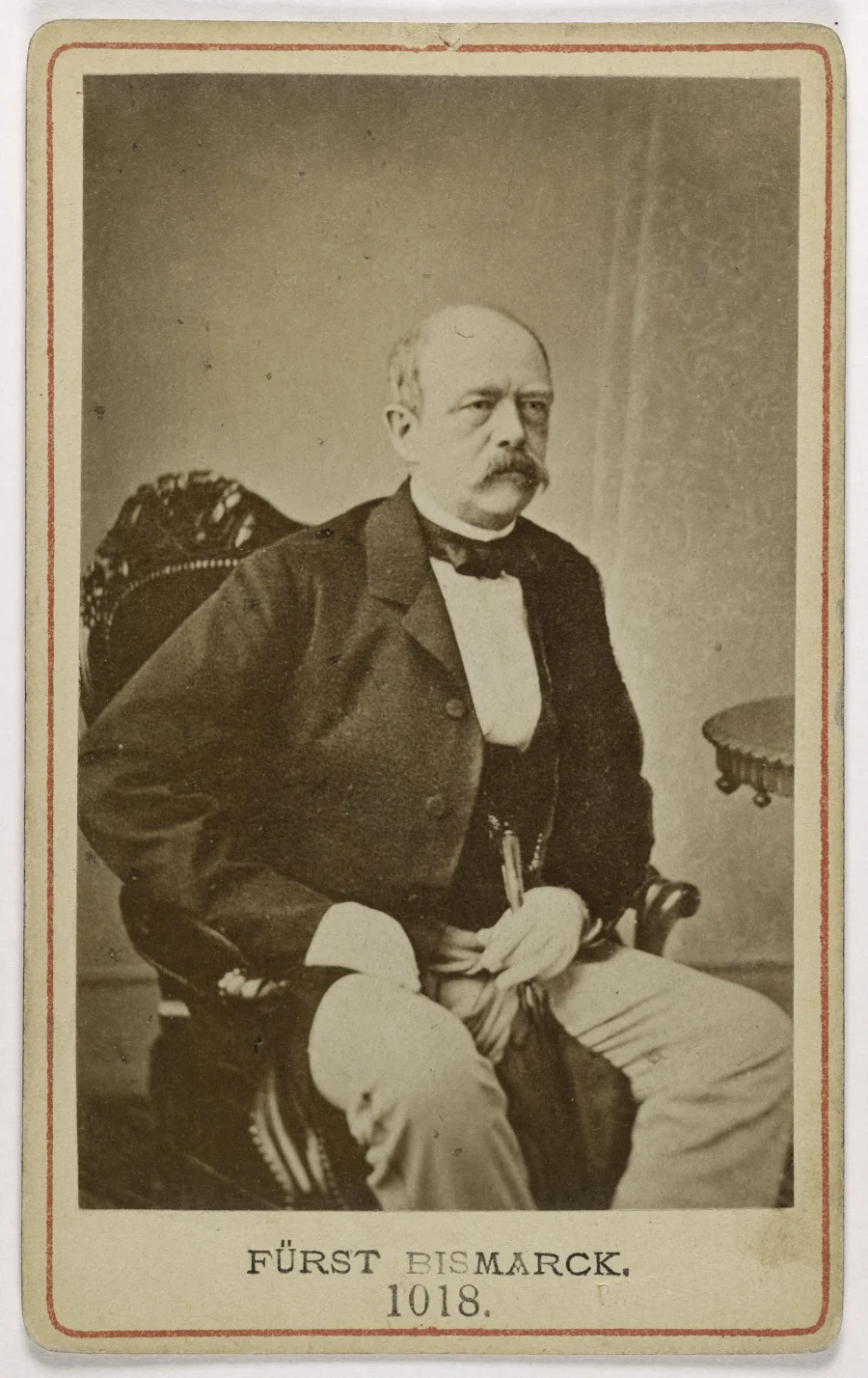
Because Prussia deliberately challenged Austria for the leadership of Germany — and found a pretext. The German Historical Institute treats the war as the installment of unification that "resolved the German Question by excluding the Habsburg Empire from the future nation-state," and Britannica calls 1866 a carefully planned stage in Prussia's unification project, with Bismarck as its principal agent.
The rivalry was decades old. Prussia had challenged Austria in 1850, but its mobilization collapsed so completely that Berlin had to accept the humiliating terms of Olmütz, which reasserted Vienna's presidency of the Confederation. Since then, as Britannica notes, Prussia had prepared methodically for a rematch: Bismarck as statesman, Count Helmuth von Moltke as strategist, and Count Albrecht von Roon as army organizer rebuilt the instrument of revenge.
The pretext was the administration of Schleswig and Holstein, duchies Austria and Prussia had seized from Denmark in 1864 and held jointly since. When Austria brought the dispute before the German Diet, Prussia declared the arrangement void, invaded Holstein, and — after the Diet voted for mobilization against Prussia — declared the Confederation itself at an end. War followed in mid-June.
Diplomacy was as much a weapon as artillery. Prussia's secret alliance with Italy (8 April 1866) forced Austria to divide its forces between the German and Italian fronts. Neither France nor Russia intervened — an isolation Bismarck had carefully arranged, leaving Austria to fight alone despite being the power most European observers expected to win. Historian Geoffrey Wawro's archival study, The Austro-Prussian War: Austria's War with Prussia and Italy in 1866 (Cambridge University Press, 1996), opens with that striking fact: the conflict most pundits expected Austria to win ended in what the publisher calls the "wretched collapse of the Austrian army in July 1866."
How did the war unfold?
Prussia struck first, on three fronts, and the main campaign in Bohemia was decided in a single day. After overrunning the Austrian-allied states of Hanover, Hesse, and Saxony in June, Moltke drove three Prussian armies into Bohemia along converging lines — a staff operation built on rail-borne mobilization and the telegraph. The Austrians, under Field Marshal Ludwig von Benedek, concentrated around Olmütz and moved into Bohemia to meet them.
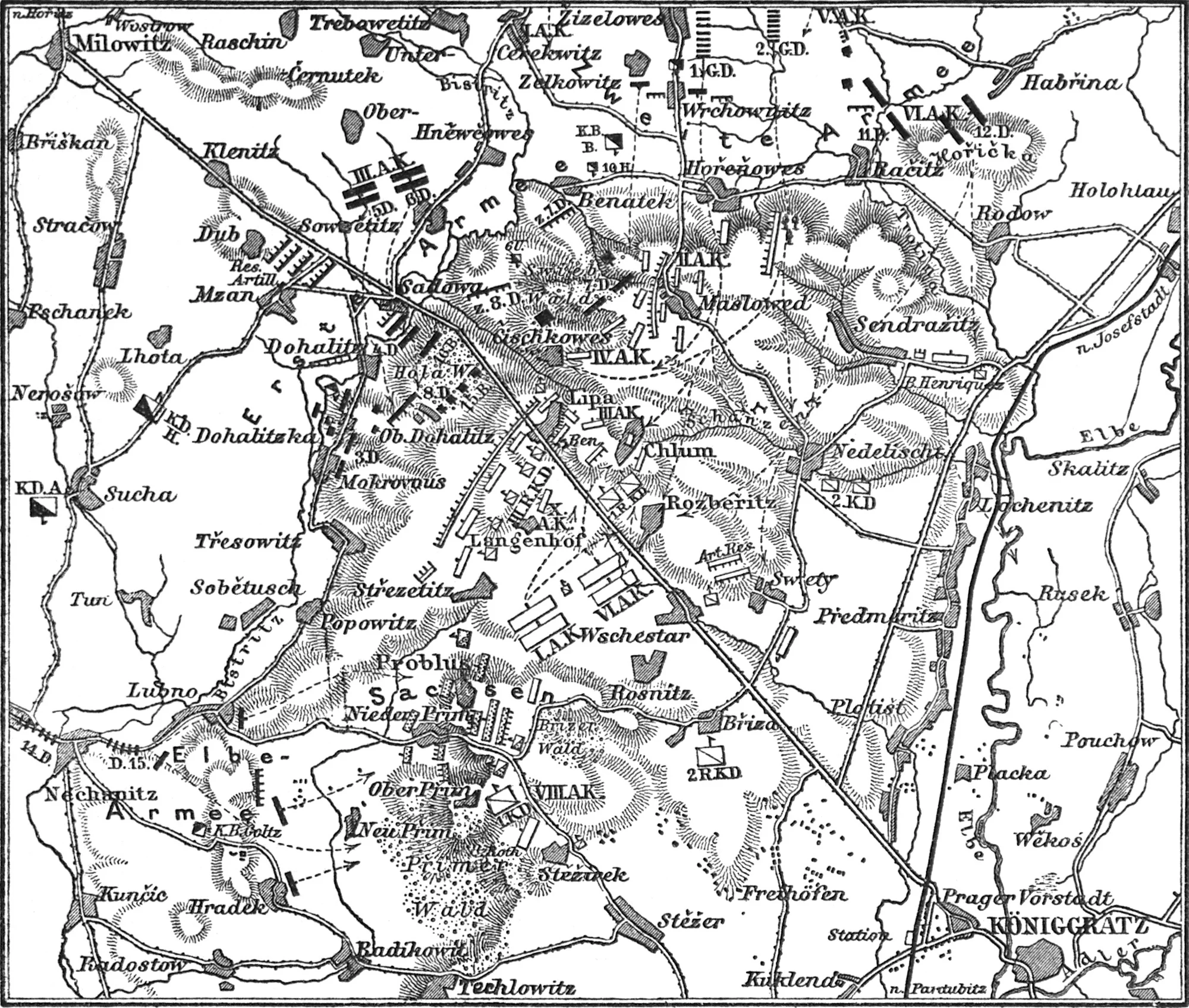
The campaign was a string of Prussian encounter-battle victories — Nachod, Trautenau, Gitschin — culminating in the Battle of Königgrätz (Sadová) on 3 July 1866, one of the largest battles of the 19th century. Roughly 220,000 Prussians under King Wilhelm I and Moltke faced about 215,000 Austrians and Saxons under Benedek. The Prussian First Army and the Army of the Elbe attacked frontally while the Second Army, arriving from the northeast under Crown Prince Friedrich Wilhelm, fell on the Austrian flank and rear. By late afternoon the Austrian line collapsed. Prussian losses were about 9,000 men; Austrian-Saxon losses were about 44,000, including some 22,000 prisoners, and nearly 120 guns. The defeat broke Austrian resistance in Bohemia, and the Prussians advanced toward Vienna. The last land engagement of the northern campaign came at Lamač, outside Bratislava, on 22 July — the day the armistice took effect.
The southern front is the war's great irony. Italy declared war on 20 June 1866, and Austria beat the Italians on both land and sea: at Custoza on 24 June, Archduke Albrecht's 80,000 Austrians defeated Victor Emmanuel II's disorganized 120,000-man Italian army (Italian losses about 8,000; Austrian about 5,600, per Britannica), and at Lissa on 20 July, Admiral Wilhelm von Tegetthoff's Austrian squadron defeated a larger Italian fleet, sinking two Italian ironclads. Yet Italy ended the war on the winning side: with the Austrian northern army shattered, Vienna sued for peace, and Italy gained Venetia anyway — the classic example of tactics without strategy.
What did the war cost?
Roughly 115,000–120,000 military losses across both theatres — but every total is an estimate, and disease killed on top of battle. A detailed Czech campaign compilation, drawing on Wawro's 1996 study and other archival work, puts the northern campaign's losses at approximately 96,000 Austrian and Saxon soldiers (about 21,000 killed, 32,000 wounded, 43,000 missing or captured) against 19,000 Prussians (about 5,000 killed, 13,000 wounded, 1,000 missing or captured). The southern theatre added about 8,000 Austrian and 10,100 Italian land-force losses. Two caveats: the compilers note the Austrian totals exclude the tens of thousands of soldiers who died in the summer's cholera epidemic, and 19th-century loss accounting differs sharply between the Austrian and Prussian general-staff histories. What is not in dispute is the asymmetry: Prussia's losses were a fraction of Austria's — the reason the war could be so short and so cheap for the winner.
Economic effects
The war's economic footprint was political first, fiscal second. The headline figure comes from the peace documents: the Preliminary Peace of Nikolsburg, whose text the German Historical Institute publishes in full, set Austria's war indemnity at 40 million thalers (with 15 million plus 5 million in deductions allowed) — deliberately moderate, Bismarck's restraint rather than Prussia's need. The war was over too fast to bankrupt anyone: seven weeks of campaigning, funded out of mobilization credits.
The real economic prize was territorial and institutional. Prussia annexed Hanover, Hesse-Kassel, Nassau, Frankfurt, and Schleswig-Holstein — contiguous territory that joined its long-separated eastern and western halves, and, as Britannica notes, acquired "the territory that had separated the eastern and the western parts of the Prussian state." The annexed states were among the most commercially developed in northern Germany; their absorption extended the Prussian-led customs and railway space that would become the economic foundation of the German Empire. The North German Confederation gave northern Germany a single military and commercial framework for the first time — the institutional precondition for the Gründerzeit industrial boom.
How did it shape the world?
It settled the "German question" and demonstrated a new grammar of war. The settlement was kleindeutsch: a Germany led by Prussia, without Austria. The Austrian-led German Confederation, the central institution of Central Europe since 1815, ceased to exist; the Prussian-led North German Confederation replaced it. Four years later, the Franco-Prussian War completed what 1866 had begun, and the German Empire was proclaimed at Versailles in January 1871.
The war also previewed, a generation before 1914, industrial-age warfare: Moltke's general staff directing three armies by rail and telegraph toward a single battlefield; the breech-loading Dreyse needle gun letting Prussian infantry fire prone and fast against Austrian muzzle-loaders; a decisive battle that destroyed an army in an afternoon. Christopher Clark's Iron Kingdom: The Rise and Downfall of Prussia, 1600–1947 (Penguin, 2007) treats 1866 as a hinge in the longer rise of the Prussian military state — the moment Bismarck's army proved it could remake Europe's map in seven weeks.
What historians debate
Was 1866 won by Prussian technology or lost by Austrian incompetence? Older accounts emphasize the Dreyse needle gun — the breech-loader that let Prussian infantry fire far faster than Austrian muzzle-loaders, and reload lying down. Wawro's archival study shifts the weight toward the Austrian side: his publisher's summary describes "the terror and panic that overtook Austria's regiments of the line in each clash with the Prussians" and "the unconscionable blundering of the Austrian commandant and his chief deputies." In this account, the Austrians did not so much lose a fair fight as collapse — a command failure layered over institutional rot.
A second debate concerns Bismarck's peace. Was the leniency of Nikolsburg and Prague — no Austrian territory taken, Saxony's integrity preserved — strategic genius or a missed chance? The German Historical Institute's commentary on the Nikolsburg documents sides with Bismarck's defenders: by keeping his claims modest, he hoped to keep Austria available as a future partner and to draw the southern German states toward a larger union later. What is agreed is that the leniency worked as intended in the short term: Austria stayed neutral in 1870, and the road to the German Empire stayed open.