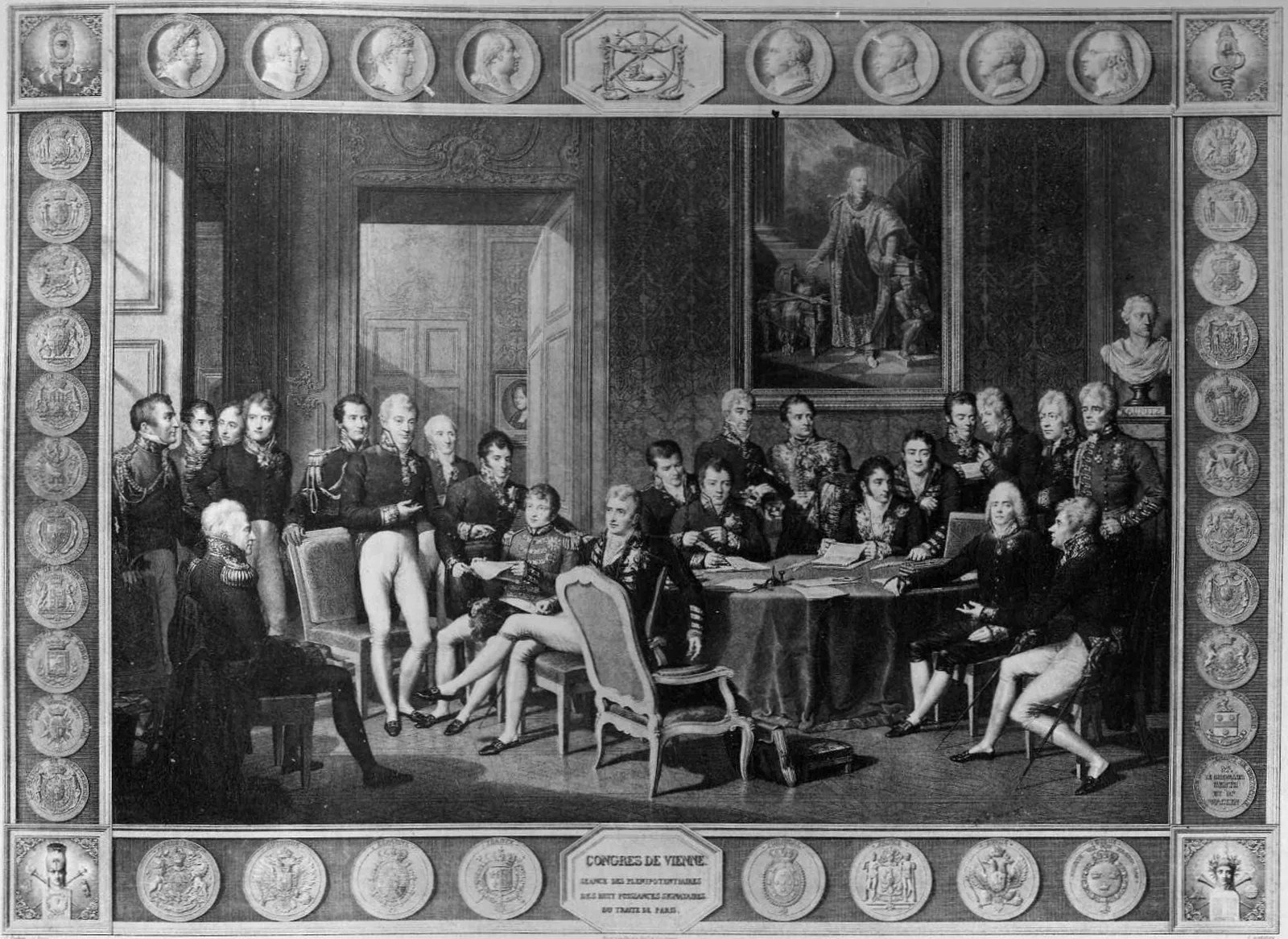
The Napoleonic Wars — the series of conflicts between Napoleonic France and shifting alliances of European powers, fought from about 1800 to 1815 — briefly brought most of Europe under French hegemony and ended at Waterloo with Napoleon's second abdication on June 22, 1815. As Britannica describes them, they form the second half of a 23-year stretch of almost unbroken conflict that began with the French Revolutionary wars, and they closed with the Congress of Vienna remaking the map of Europe.
Key takeaways
- A continent-spanning conflict: From about 1800 to 1815, Napoleonic France fought a shifting cast of European alliances. The Allies entered Paris in March 1814 and exiled Napoleon to Elba; after his return during the Hundred Days, they defeated him for good at Waterloo on June 18, 1815.
- A heavy and uncertain human cost: An academic study of French army losses estimates 400,000–1 million dead between 1800 and 1815. Historians disagree on overall totals, so no single reliable figure exists — the toll is best stated as a wide range.
- An economic war as well as a military one: Napoleon's Continental System (1806–1812) tried to strangle British trade, while the cost of the fighting saddled Britain with a national debt of £854 million — 2.7 times its national income in 1819.
- A redrawn map: The Congress of Vienna remade Europe's borders and set the stage for the eventual unification of Germany and Italy; pressures from the Napoleonic era also helped prompt the sale of Louisiana to the United States.
Contents
Overview of the Napoleonic Wars
Britannica defines the Napoleonic Wars as the series of wars between Napoleonic France and shifting alliances of other European powers that produced a brief French hegemony over most of Europe. Dated from about 1800 to 1815, they were the culmination of a 23-year period of conflict that included the French Revolutionary wars — meaning much of Europe was at war, with brief intermissions, for a full generation.
The endgame came quickly once the alliance against Napoleon held together. The Allies entered Paris in March 1814, Napoleon abdicated and was exiled to Elba, and the victorious powers began redrawing the map at the Congress of Vienna. Napoleon's escape in March 1815 triggered the Hundred Days — a final campaign that ended on June 18, 1815 at Waterloo, where the forces of the Duke of Wellington and the Prussian field marshal Gebhard Leberecht von Blücher defeated the French army. Napoleon abdicated a second time on June 22, 1815.
French historiography often treats the Napoleonic era as a vehicle for spreading the legal and administrative reforms of the Revolution, while historians in the lands that fought against France — in German, Spanish, and Russian traditions — generally emphasize the wars as a foreign occupation and a spur to national resistance. Both perspectives describe the same fact: for roughly fifteen years, the continent's politics were organized around war with France.
Casualties
Counting the dead of the Napoleonic Wars is notoriously difficult. Records are incomplete, armies crossed and recrossed the continent, and disease killed far more men than battle — a pattern that makes historians wary of precise totals. What exists in the academic literature are ranges, and they vary widely.
The most detailed work concerns the French army. A study by historian Michel Roucaud in the Fondation Napoléon's journal examines what happened to the more than 2 million French conscripts raised between 1800 and 1815. It estimates 200,000–400,000 died on the battlefield, and another 200,000–600,000 died of wounds or in captivity — a total French army loss of roughly 400,000 to 1 million men. Roucaud stresses that exact tolls are hard to ascertain, noting the "subjectivity shown by historians" in assembling them.
For the wars as a whole — including the Austrian, Prussian, Russian, British, Spanish, and other armies, plus civilian deaths from occupation, siege, famine, and epidemic disease — no consensus figure exists in the sources consulted for this article. Some popular estimates run into the millions, but without a solid, verifiable source they cannot be responsibly quoted here. The honest answer is that estimates vary widely, and the French army's 400,000–1 million dead represents only one belligerent's losses.
Economic effects
The Napoleonic Wars were fought with money as well as men. Napoleon's most ambitious economic weapon was the Continental System (1806–1812), a program of economic warfare against Britain described in the Columbia Encyclopedia. The Berlin Decree of 1806, followed by the Warsaw and Milan decrees of 1807 and the Fontainebleau Decree of 1810, forbade trade with Britain across the territories France controlled. The stated aims were sweeping: to destroy British credit, break the Bank of England, and ruin British industry.
Britain retaliated with its Orders in Council, and the economic war produced collateral damage across Europe. The British bombardment of Copenhagen in 1807 and seizure of the Danish fleet grew out of the trade struggle; Amsterdam, cut off from maritime commerce, declined permanently as a trading center. On the sea itself, the blockade leaked: with Britain controlling the oceans, smuggling thrived, and Napoleon himself was eventually reduced to issuing special licenses for trade with England. The Russian campaign of 1812 was, according to the encyclopedia account, brought on by Russia's refusal to conform to the decrees — and the Anglo-American War of 1812 was, at least in part, a product of the same economic warfare. Historians also debate whether the Continental System delayed the Industrial Revolution in France, while noting that it inadvertently fostered domestic industries such as beet-sugar manufacture and the machine spinning of textiles.
The fiscal burden of victory was enormous for Britain. Economic historian Patrick O'Brien's LSE research records that Britain's national debt grew to the "astronomical sum of £854 million," or 2.7 times the national income for 1819. The share of taxes devoted to servicing the debt jumped from a modal 2–3% before the Glorious Revolution to 60% after the Napoleonic War. Britain had funded not just its own armies but subsidies to the European allies willing to field troops against France — a strategy that bought victory at the price of a generation of debt service.
How it shaped the world
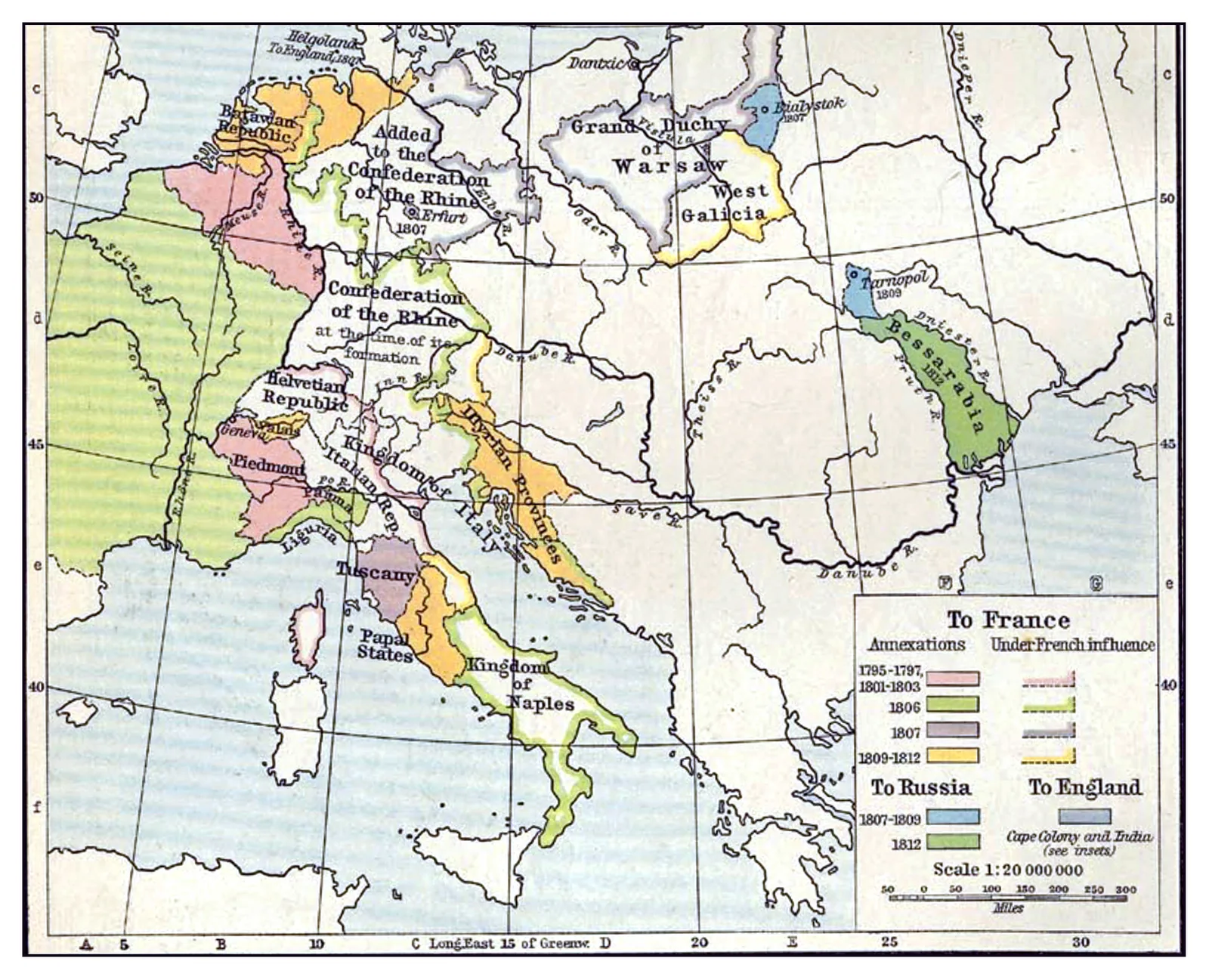
The most visible legacy of the Napoleonic Wars is the map. The Congress of Vienna, which met as the wars ended, remade the map of Europe — and Britannica notes that the Vienna settlement set the stage for the eventual emergence of Germany and Italy as unified states. The diplomatic order built at Vienna, the so-called Concert of Europe, would govern great-power relations for decades.
The wars' shockwaves reached beyond Europe. Britannica notes that Napoleonic pressures "likely prompted" the sale of Louisiana to the United States — an American acquisition made possible, at least in part, by France's wartime need for money and its inability to defend distant possessions.
Institutionally, the Napoleonic era left a double legacy that historians still argue over. In France, the Napoleonic Code and the administrative machinery built during the wars endured long after the empire fell. In the territories France occupied, the experience of French administration — and of resistance to it — helped forge the national movements that would reshape the continent in the 19th century. The 23-year period of war that ended at Waterloo closed the age of the French Revolution and opened the age of nationalism.