The Franco-Prussian War, fought from 19 July 1870 to 10 May 1871 between the Second French Empire (and then the French Third Republic) and a coalition of German states led by Prussia, was the shortest of the great nineteenth-century wars and among the most consequential. In less than ten months it destroyed the regime of Napoleon III, killed on the order of 180,000–200,000 soldiers, transferred Alsace-Lorraine to Germany, imposed a five-billion-franc indemnity on France, and created a unified German Empire in the Hall of Mirrors at Versailles. The settlement's humiliations hardened into a forty-year Franco-German enmity that Britannica calls the driving force behind the slaughter of the First World War's Western Front.
Key takeaways
- A manufactured crisis: The immediate trigger was a Hohenzollern prince's candidacy for the Spanish throne — withdrawn under French pressure — followed by Bismarck's edited publication of the Ems telegram, which goaded France into declaring war on 19 July 1870.
- Decided in six weeks: German railways, the Prussian general staff, and Krupp breech-loading artillery overwhelmed French mobilization and leadership. Napoleon III surrendered with his army at Sedan on 2 September; Paris fell to siege on 28 January 1871.
- A lopsided butcher's bill: Official histories report roughly 44,000 German dead against about 139,000 French dead — with 143,000 French wounded and over 470,000 captured or interned. Estimates vary with how disease deaths are counted.
- An economy reshaped: France paid five billion francs — about a quarter of its GDP and two and a half times its annual budget — in full by September 1873, while Germany absorbed Alsace-Lorraine's coal and iron.
- The world it made: German unification ended French continental hegemony, completed Italian unification, entrenched the Prussian general-staff model in every great power's army, and left a revanchist France and a militarized Germany locked in the rivalry that detonated in 1914.
Contents
Overview
The road to war
The war's deeper roots lie in Prussia's rise. Its victory over Austria in the Seven Weeks' War of 1866 had confirmed Prussian leadership of the German states and, as Britannica puts it, "threatened France's position as the dominant power in Europe." France had already tried to extract compensation — Napoleon III demanded a return to the borders of 1814 plus Luxembourg, the Saar, and the Bavarian Palatinate — and Bismarck contemptuously refused, circulating the French demands to the southern German states, which promptly concluded defensive alliances with Prussia.
The spark was dynastic. Prince Leopold of Hohenzollern-Sigmaringen, a relative of the Prussian king, had been persuaded by Bismarck and Spain's leader Juan Prim to accept the vacant Spanish throne. France, fearing encirclement by a Prussian–Spanish combination, forced Leopold's withdrawal — then demanded that King Wilhelm I guarantee no Hohenzollern would ever again seek the crown. Wilhelm politely declined; Bismarck edited the king's telegraphed account of the meeting into the provocative Ems telegram and published it on 14 July. War fever consumed Paris, and on 19 July 1870 France declared war on Prussia.
What historians debate
Whether anyone in Berlin or Paris wanted the war is contested. Some historians hold that Bismarck deliberately provoked the French declaration of war to draw the four independent southern German states into the North German Confederation; others contend he exploited the crisis as it unfolded. On the French side, François Roth and Pierre Milza argue that Napoleon III was himself pressed toward war by a bellicose press and public opinion. In English-language scholarship, Sir Michael Howard's The Franco-Prussian War (1961) long stood as the classic account, later joined by Geoffrey Wawro's archival study (Cambridge University Press, 2003) and David Wetzel's A Duel of Giants (2001) on the Bismarck–Napoleon III duel behind the war's origins.
Sedan and the fall of the Empire
France entered the war confident: its army carried the breech-loading Chassepot rifle and the mitrailleuse, an early machine gun. But German mobilization was ruthlessly efficient — Britannica records 380,000 German troops at the front within 18 days — while French units reached the front late and under-supplied. Under Chief of the General Staff Helmuth von Moltke, German armies repeatedly outflanked the French in August 1870, then trapped Marshal Bazaine's army in Metz.
The decisive stroke came at Sedan. Mac-Mahon's army tried to relieve Metz and was encircled against the Belgian frontier. On 1 September 1870 German artillery on the surrounding heights pounded the French into surrender; the next day Napoleon III capitulated with some 104,000 officers and men. Paris erupted: the emperor was deposed, and on 4 September a Government of National Defense proclaimed the Third Republic. France fought on for five more months — Metz capitulated in late October with 140,000 men, and after a four-month siege marked by starvation and bombardment, Paris surrendered on 28 January 1871.
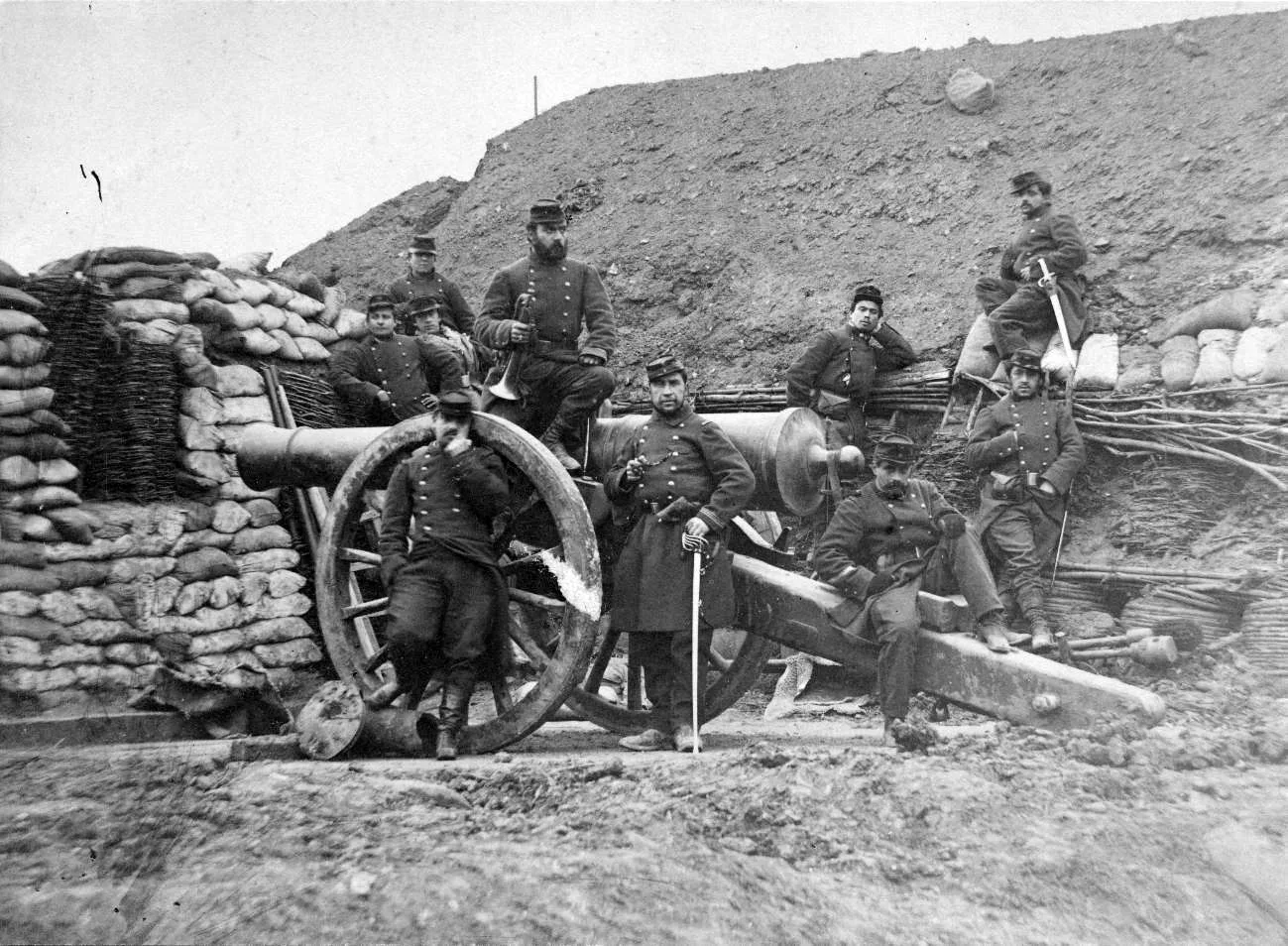
The peace of Frankfurt
The Treaty of Frankfurt (10 May 1871; preliminaries ratified 1 March) annexed Alsace (except Belfort) and half of Lorraine, with Metz to Germany — including the fortresses of Strasbourg and Metz and, as historian Jeffrey Zalar notes, a third of Lorraine with its rich coal and iron deposits. France paid an indemnity of five billion francs and covered the cost of a German occupation of its northern departments until the indemnity was discharged — in full, by September 1873.
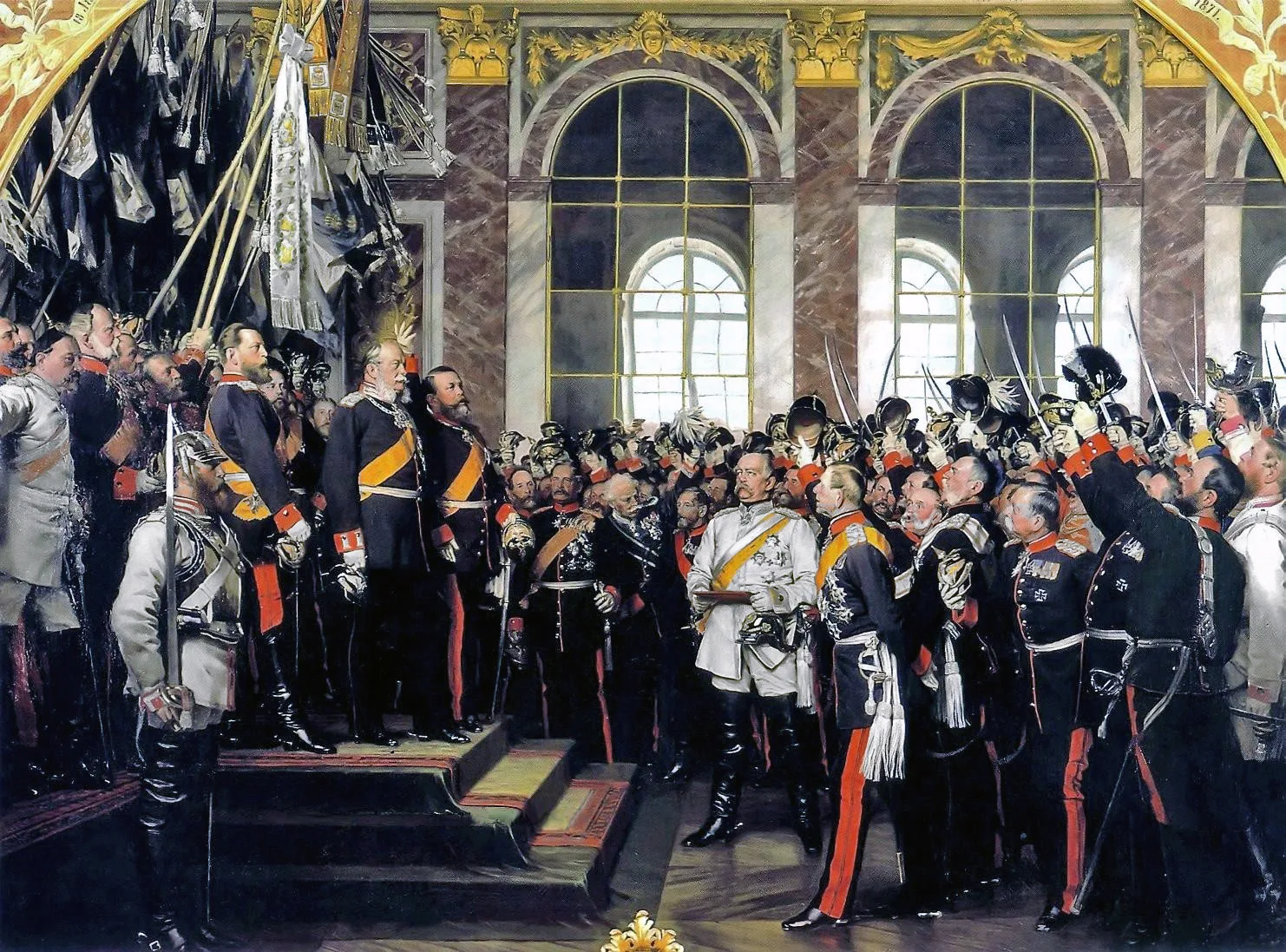
Between the armistice and the final treaty, France convulsed. Radicals seized Paris and established the short-lived Paris Commune; the republican government suppressed it after two months. The war's crowning humiliation for France came even before the treaty: on 18 January 1871, Wilhelm I was proclaimed German Emperor in the Hall of Mirrors at Versailles — the palace of the French kings.
Casualties of the Franco-Prussian War
Casualty figures for 1870–71 are estimates, not exact counts. The figures below come from the two sides' official histories, with an alternative scholarly estimate noted.
- German dead: The Prussian official history records approximately 44,000–45,000 German dead (about 28,300 killed in battle or of wounds, roughly 12,000 dead of disease, plus missing presumed dead), with 89,732 wounded and about 10,000 missing or captured. A much-cited summary gives 44,781 dead.
- French dead: French official records put military deaths at 138,871 — some 77,000 killed in battle or of wounds and more than 45,000 dead of sickness — with 143,000 wounded, 383,860 prisoners of war, plus 90,192 men interned in Switzerland and 6,300 in Belgium.
- The dispute: Historian Jeffrey Zalar (Encyclopedia of the Age of Imperialism, 2014) gives a notably lower combined battle-casualty figure — about 150,000 French killed and wounded and 117,000 on the German side — reflecting narrower counting of disease deaths and prisoners. Civilian deaths are the most uncertain of all: estimates of French civilian dead from famine and disease range from the low hundreds of thousands to roughly 450,000. Treat any single civilian number with skepticism.
Economic effects
The Treaty of Frankfurt's financial terms were among the harshest imposed in nineteenth-century Europe — and France absorbed them with surprising speed.
- The indemnity: Five billion francs — about 25 percent of France's GDP, two and a half times the annual government budget, and roughly 1.7 times yearly exports (per Jha, Koudijs and Salgado's 2023 study of wartime French bond markets, Stanford GSB). France raised the sum through borrowing and taxation and paid it in full by September 1873, ending the German occupation — a financial feat that surprised contemporaries.
- The cost of the peace: Beyond the indemnity, France covered the expense of the German occupation of its northern departments (Britannica). Paris bond markets tracked the war's fortunes throughout, with provincial and capital prices diverging through the siege and peace talks as investors weighed continued resistance against a quick settlement.
- What France lost: Alsace-Lorraine's coal and iron went to Germany, along with the fortresses of Metz and Strasbourg. The war's disruption — sieges, requisitions, severed railways — hit industry and agriculture in the northeast hardest, though France's debt markets and fiscal machinery proved resilient enough to carry the indemnity without default.
- What Germany gained: Unification itself was the economic event. On the eve of war, as Wawro documents, Prussia already had 5,000 miles of railway and was producing more coal and steel in a year than France, Russia, or Austria; the Zollverein customs union had been integrating German markets since 1834. France, for all of Napoleon III's own railway boom, entered the war as the relatively declining industrial power — and the gap widened: on the eve of 1914 France produced about a sixth as much coal and a quarter as much steel as Germany.
How it shaped the world
The German Empire. The war completed Bismarck's unification project: with the notable exceptions of Austria and German Switzerland, the German-speaking states united under a Prussian king for the first time. The new Reich instantly displaced France as the dominant continental land power, and Bismarck's diplomatic authority dominated European affairs for the next two decades.
The Second Empire died at Sedan; the Third Republic born on 4 September 1870 became France's first lasting republican government, enduring until 1940. But it was born in humiliation: the loss of Alsace-Lorraine bred revanchisme — a determination to recover the lost provinces that poisoned French politics for decades and, in Britannica's judgment, made Franco-German mutual animosity "the driving force" behind the Western Front's prolonged slaughter in 1914–18.
Italy completed — and the military template. With Napoleon III's fall removing the garrison that had protected the Pope, Italian troops entered Rome on 20 September 1870 and the Papal States were annexed — completing Italian unification as a side effect of a war fought on the Rhine. Meanwhile the Prussian system — conscript armies directed by a highly trained general staff, mobilized by railway and telegraph, and fought with breech-loading steel artillery — was, in Britannica's words, "soon adopted by the other great powers." But Wawro argues the lesson was half-learned: Europe's armies absorbed the Prussian model while embracing an infantry "cult of the offensive," even though German victories had owed more to artillery and staff work than to frontal infantry assaults.
The unstable peace. From 1871 to 1914 Europe lived, in Britannica's phrase, in "an extremely unstable peace": France determined to recover Alsace-Lorraine, Germany mounting in imperial ambition, the two constantly poised for conflict. Wawro adds that the war imposed a conservative, militaristic character on German nationalism that played a part in the coming of the First World War — making 1870–71 not just the prelude to 1914 but one of its causes. The Franco-Prussian War thus closed the era of French dominance and opened the era of German power — the hinge on which modern European history turns.