The Balkan Wars were two short wars fought in the Balkan Peninsula in 1912–13 that stripped the Ottoman Empire of almost all its remaining European territory. In the First Balkan War (October 8, 1912 – May 30, 1913), the Balkan League — Serbia, Bulgaria, Greece, and Montenegro — crushed the Ottomans. In the Second (June 29 – August 10, 1913), the victors quarreled over the spoils and turned on Bulgaria, which was defeated by its former allies, Romania, and the Ottomans. The wars redrew southeastern Europe and, in Britannica's assessment, "heightened tensions in the Balkans and helped spark World War I."
Key takeaways
- A coalition of the small. Serbia, Bulgaria, Greece, and Montenegro formed the Balkan League in spring 1912 under Russian auspices, fielding some 750,000 men against the Ottomans (Britannica).
- Lightning victory, then fratricide. The League won in months; Bulgaria attacked its own allies over Macedonia on June 29–30, 1913, and was crushed when Romania and the Ottomans joined against it.
- The Ottoman Empire left Europe. The treaties of London (May 30, 1913) and Bucharest (August 10, 1913) ended the Ottoman presence in the Balkans except Eastern Thrace; Albania became independent; Serbia and Greece roughly doubled in territory.
- Historians disagree on the dead. Military deaths run roughly 65,000 Bulgarian, 36,000 Serbian, 9,500 Greek, 3,000 Montenegrin, and up to 125,000 Ottoman (Hall, 1914–1918 Online); a peer-reviewed study puts Muslim-side soldier and civilian losses at 620,000, with 440,000 displaced to Anatolia.
- The road to 1914. Hall argues the wars were "the first phase of the greater and wider conflict of the First World War" (Routledge, 2000): an enlarged Serbia, an alarmed Austria-Hungary, and a vengeful Bulgaria set the terms of the 1914 July crisis.
Contents
- Overview
- Causes
- The First Balkan War
- The Second Balkan War
- How the wars ended
- Casualties
- Economic effects
- How it shaped the world
Overview
The Balkan Wars were two successive conflicts in 1912–13 that "deprived the Ottoman Empire of all its remaining territory in Europe except part of Thrace" (Britannica). The second erupted when the victorious allies quarreled over the partitioning of their conquests.
Historiography treats the wars as one connected event. Richard C. Hall — The Balkan Wars 1912–1913: Prelude to the First World War (Routledge, 2000) — argues from archival and published sources that the wars were the first phase of the 1914–18 conflict. Edward J. Erickson (Defeat in Detail: The Ottoman Army in the Balkans, 1912–1913, Praeger, 2003), drawing on Ottoman archives, gives the standard operational account of the Ottoman collapse.
What caused the Balkan Wars?
The wars grew out of discontent in Serbia, Bulgaria, and Greece over disorder in Macedonia, the remaining Ottoman-held region where Serbs, Bulgarians, Greeks, Macedonians, and Vlachs lived (Britannica). The Young Turk Revolution of 1908 brought a centralizing regime to Constantinople that offered Macedonia's Christian nationalities no concessions — and left Albanians equally discontented.
Nationalist pressure groups made war thinkable: the Internal Macedonian Revolutionary Organization (IMRO, founded 1893) armed bands against Ottoman rule; in Serbia, the patriotic society Narodna Odbrana was infiltrated by "Union or Death" — founded May 1911, better known as the Black Hand; Greek bands defended Greek interests in Macedonia while Athens also sought Aegean territory and union with Crete (Britannica).
International circumstances did the rest. Austria-Hungary's 1908 annexation of Bosnia and Herzegovina shut Serbia out of the north, turning Belgrade toward Macedonia, where "a weaker power like Turkey could more easily be attacked if an alliance could be achieved with Bulgaria." The Agadir Incident of 1911 showed the great-power blocs evenly balanced, giving small powers room for initiative. The Balkan League was formed under Russian auspices in spring 1912 "to take Macedonia away from Turkey" (Britannica); Tsar Ferdinand I of Bulgaria spearheaded it, "prodded by Russia."
What happened in the First Balkan War?
Montenegro declared war on October 8, 1912; the rest of the League followed ten days later, fielding some 750,000 men against an Ottoman army still tied down by its war with Italy in Libya. The allies won on every front (Britannica): in Thrace, Bulgaria defeated the main Ottoman forces, advanced to the outskirts of Constantinople, and besieged Adrianople (Edirne); in Macedonia, Serbia won at Kumanovo, took Bitola, and joined the Montenegrins in Skopje; Greece took Salonika and advanced on Ioánnina; the Montenegrins besieged Shkodër and the Serbs entered Durrës.
The Ottoman collapse was so complete that all parties accepted an armistice on December 3, 1912 — until a Young Turk coup in January 1913 resumed the war, and the allies won again: Ioánnina fell to the Greeks and Adrianople to the Bulgarians. The Treaty of London (May 30, 1913) then stripped the Ottomans of nearly all their European territory; Albanian independence was insisted upon by the European powers, and Macedonia was to be divided among the allies.
What happened in the Second Balkan War?
The Second Balkan War began when Serbia, Greece, and Romania quarreled with Bulgaria over their joint conquests in Macedonia (Britannica). On June 1, 1913, Serbia and Greece allied against Bulgaria — and on the night of June 29–30, King Ferdinand ordered the attack.
Initially successful, the Bulgarian offensive stalled by July 10 after the Serbian counterattack (July 2) and Greek reserves (July 3). Then the encirclement closed: Romania crossed into Bulgaria on July 11 and marched on Sofia; the Turks violated their armistice on July 12 and entered Thrace; the Turks reoccupied Adrianople on July 22.
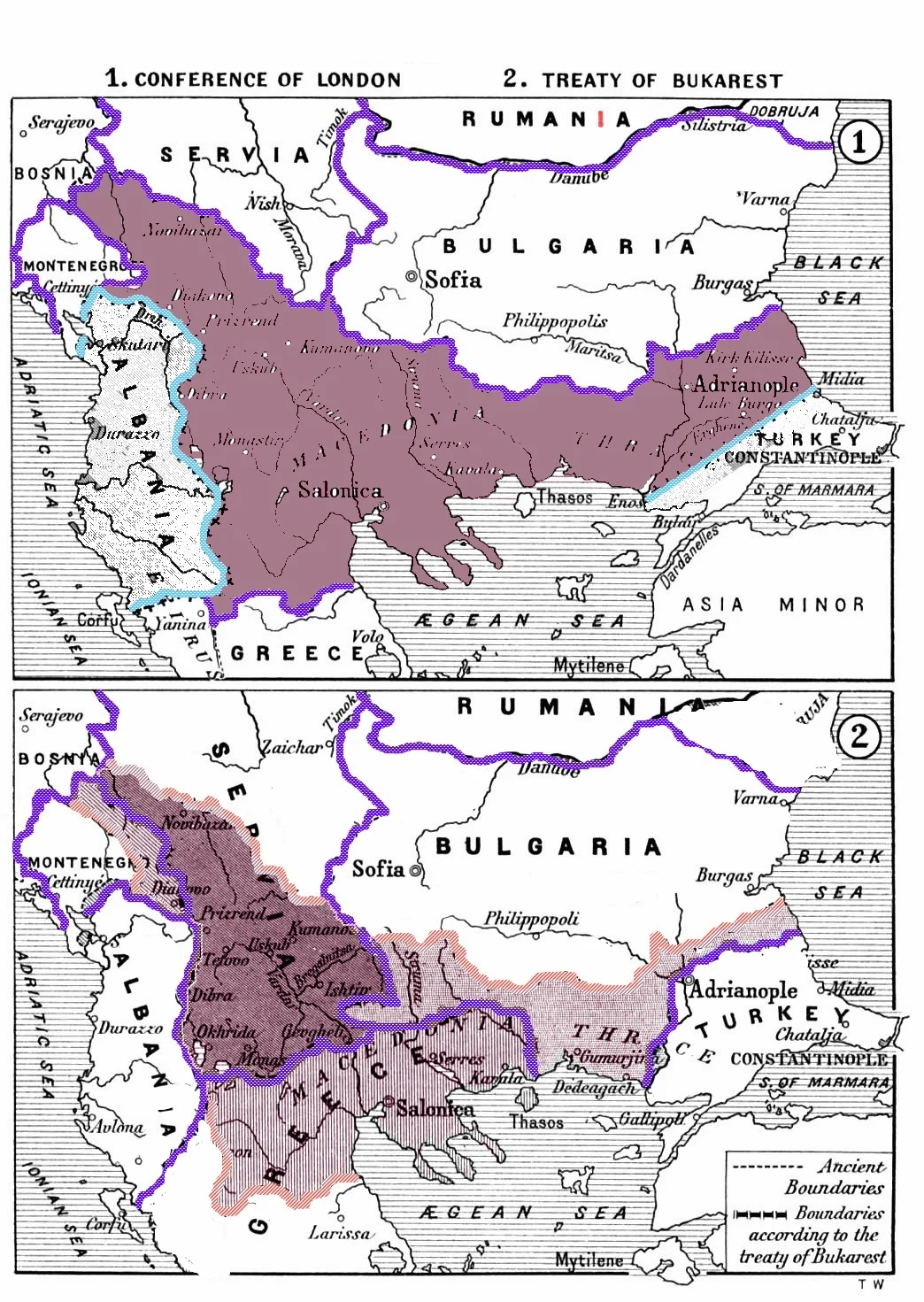
With enemy columns converging on Sofia, Bulgaria capitulated: an armistice on July 30 and the Treaty of Bucharest on August 10, 1913 — Greece and Serbia divided most of Macedonia, leaving Bulgaria only a small part.
How did the wars end?
The settlement came in treaties. London (May 30, 1913) ended the First War, creating independent Albania and dividing Ottoman Europe among the allies. Bucharest (August 10, 1913) settled the Second: Serbia took Kosovo and northern and central Macedonia; Greece took southern Macedonia and Crete; Romania gained southern Dobruja; Bulgaria kept only a small part of Macedonia. A separate Ottoman–Bulgarian Treaty of Constantinople (September 1913) fixed their frontier after the Turks retook Eastern Thrace.
The map above comes from the Carnegie Endowment's 1914 Report of the International Commission to Inquire into the Causes and Conduct of the Balkan Wars — the first international non-governmental fact-finding mission on the wars — and shows both settlements: the London Conference boundaries (top) and the frontiers fixed at Bucharest (bottom).
Casualties of the Balkan Wars
Casualty figures for the Balkan Wars are disputed, and historians present ranges, not single numbers — records were confused by the chaos of the fighting, poor record-keeping, and epidemic disease, which killed in numbers comparable to the battles.
The peer-reviewed 1914–1918 Online encyclopedia (Richard C. Hall) gives the commonly cited military dead: Bulgaria around 65,000, Serbia at least 36,000, Greece around 9,500, and Montenegro around 3,000, while the Ottomans lost as many as 125,000 dead — plus tens of thousands of civilians dead from disease. (The encyclopedia page was bot-blocked this run; figures are cited from the verified search crawl of that exact page.)
The Muslim-side toll is the most contested figure. Marek Dymarski, in the peer-reviewed Balcanica Posnaniensia (2012), puts Muslim-side losses — Turkish soldiers and civilians — at 620,000, with a further 440,000 displaced to Anatolia. Berna Pekesen of the Institute of European History (Mainz) estimates about 400,000 Muslim refugees after the First War and 135,000 refugees arriving in Salonika alone after the Second, citing Justin McCarthy's disputed demographic work on the more than one million who perished in flight. Disease killed as surely as shells: Dymarski notes hundreds of thousands of soldiers "fallen, wounded or killed by cholera."
Economic effects
The Balkan Wars were an economic catastrophe for winners as well as losers. Dymarski's peer-reviewed study (2012) documents that the Balkan states had "severely exceeded their economic and demographic capabilities" in pre-war arms spending, producing "extraordinary debt" — and the wars then brought all five belligerents "to the brink of economical breakdown and major social turbulence."
The mechanism was mobilization: calling 1.3 million men to arms halted industrial production and caused an agricultural crisis; military requisitioning destroyed civilian transport, which "proved fatal to the commerce"; collapsing commerce then shrank tax income. The states had financed the wars partly with Great Power loans — and had repaid little of them by August 1914, and none thereafter.
Greece, the war's great territorial winner, illustrates the paradox. Ioannis-Dionysios Salavrakos (Journal of Military and Strategic Studies, 2019) records the Greek state growing from 63,211 to 120,308 square kilometers and 2.63 to 4.72 million people, while the Army Ministry budget rose from 45.7 to 118.3 million drachmae between 1912 and 1913. Yet Greece, he concludes, "remained a weakened state in military and economic terms" — the new territories had to be defended and administered at a cost the treasury could not easily bear.
How it shaped the world
The Ottoman Empire, in Europe since the 14th century, was reduced to Eastern Thrace; Greece became the peninsula's largest state and Serbia its strongest power. But the settlements were not self-enforcing: they partitioned Macedonia and Thrace by force and left every loser with a claim for revenge.
Apart from Turkey, Britannica judges the real loser to have been Austria-Hungary: partitioning the Sanjak of Novi Pazar between Serbia and Montenegro left Vienna unable to intervene in the Balkans during the June–July 1914 crisis, so its ultimatum to Serbia of July 23, 1914 appeared as naked aggression. Dissatisfied Bulgaria "henceforth looked to Austria-Hungary for support," while Romania "tended to move out of the influence of the Triple Alliance and toward the Triple Entente." The Ottomans secured German Gen. Otto Liman von Sanders and technical advisers in November 1913 to rebuild their army — a step that helped steer the Empire toward Germany in 1914.
Britannica's judgment is that the wars "heightened tensions in the Balkans and helped spark World War I." Hall goes further, arguing they "were the first phase of the greater and wider conflict of the First World War." In 1915, Noel and Charles Buxton wrote that awarding southeastern Macedonia to Serbia had created "a new Alsace-Lorraine, destined, so long as it remained, to render peace impossible" — and in Bulgaria, defeat fed revanchism: Ferdinand's resentments over 1913, Britannica notes, "largely determined Bulgaria's participation (1915–18) in World War I on the side of Germany and Austria-Hungary."
The wars also taught a military lesson the belligerents of 1914 ignored: the Balkan conflicts had already turned into a war of attrition — "a harbinger of what was to come during the World War I" (Dymarski).