Sudan's civil war between the army and the paramilitary Rapid Support Forces has produced what the United Nations describes as the world's largest humanitarian crisis — and the Sudan humanitarian crisis is still getting worse. Nearly 20 million people face acute hunger, up to 14 million have been driven from their homes, and the funding keeping the aid response alive is running out.
Key takeaways
- The UN-backed IPC monitors classify about 19.5 million Sudanese — more than 40 percent of the population — as facing acute food insecurity, with some 135,000 people at catastrophic, famine-like levels of hunger.
- The World Food Programme's acting executive director, Carl Skau, told reporters after an eight-day mission in September 2026 that Sudan remains "the world's largest hunger and displacement crisis," with 20 million people in acute hunger and 14 million displaced.
- The epicentre of the fighting has moved from Darfur to the Kordofan region and Blue Nile state, and a new exodus into Chad is accelerating: more than 400 people a day are crossing into eastern Chad, a 20-fold increase, as aid agencies report that only 18 percent of their funding needs have arrived.
- Humanitarians are being attacked and aid convoys hit; WFP says it may have to scale back operations within weeks unless donors step up.
Contents
- The roots of the crisis
- The Sudan humanitarian crisis in numbers
- A famine made by war
- The aid system is breaking
- What to watch
The roots of the crisis
The war began in April 2023 as a power struggle between Sudan's army and the paramilitary Rapid Support Forces (RSF), former partners who had jointly seized power and then turned on each other. More than three years on, it has devastated wide swathes of the country, ruined harvests and decimated the economy, according to UN estimates cited by Reuters.
The geography of the war has shifted. The World Food Programme's Carl Skau, speaking after visiting Khartoum, El Obeid, El Fasher and Tawila in September 2026, said the epicentre of fighting has moved: "If the epicentre a year ago of the fighting was in Darfur, now it's in the Kordofan in the Blue Nile." We have covered the military side of this shift in our earlier [explainer on the war itself](/articles/2026-09-27-sudan-civil-war-explained) and in our report on the [RSF's offensive buildup around El Obeid](/articles/2026-09-28-sudan-rsf-el-obeid-offensive-buildup).
Drone warfare has become the war's leading mode of violence. Reuters reported in May 2026 that fighting had raged through Kordofan and Blue Nile state, with the UN's human rights office saying drones had killed at least 880 civilians since January — striking markets, hospitals and power stations. The RSF completed its takeover of El Fasher in October 2025, largely emptying the city, while the army broke the RSF's siege of Kadugli earlier in 2026.
The Sudan humanitarian crisis in numbers
The scale is difficult to absorb. The UN-backed Integrated Food Security Phase Classification (IPC) estimated that about 19.5 million Sudanese — over 40 percent of the analysed population — faced IPC Phase 3 (crisis) levels of acute food insecurity or worse through May 2026. That includes more than 5 million people in Phase 4 (emergency) and 135,000 in Phase 5 (catastrophe), characterised by extreme food gaps, starvation and death from disease or acute malnutrition.
Skau's figures from September 2026 were starker still: 20 million people in acute hunger, 14 million displaced, about 5 million of those in emergency-level hunger and some 200,000 at IPC Phase 5 starvation levels. The UN's food and agriculture agency estimated about 8.6 million internally displaced people as of the end of July 2026, while UNHCR puts total displacement — including refugees — at up to 14 million.
The hunger numbers translate into children dying. An estimated 825,000 children under five will suffer severe acute malnutrition in 2026, a condition carrying a real risk of death — 25 percent more than before the conflict, according to data published by Action Against Hunger. The same agency said almost 34 million people, two-thirds of Sudan's population, will need humanitarian aid this year — the highest figure anywhere in the world.
A famine made by war
This is not a natural disaster. Conflict is the main driver: since April 2023 it has destroyed livelihoods, wrecked economic infrastructure, blocked humanitarian access and triggered the mass displacement, the IPC has said. Cereal prices sit at exceptionally high levels; the 2025 harvest was below average because of insecurity and input shortages; and drought has compounded the damage — Darfur, Skau said, has not been this dry since 1984, "and right now is the rainy season."
The IPC has identified 14 areas in North Darfur, South Darfur and South Kordofan at risk of famine under a worst-case scenario of intensified violence and displacement. El Fasher and Kadugli were judged to be experiencing famine last year, largely as a result of RSF sieges, Reuters reported.
"The people suffered through famine. They suffered through these unspeakable atrocities. It's a city that once was, you know, home to a million people, the sprawling kind of capital of Darfur. Now there are only a few tens of thousands of people still."
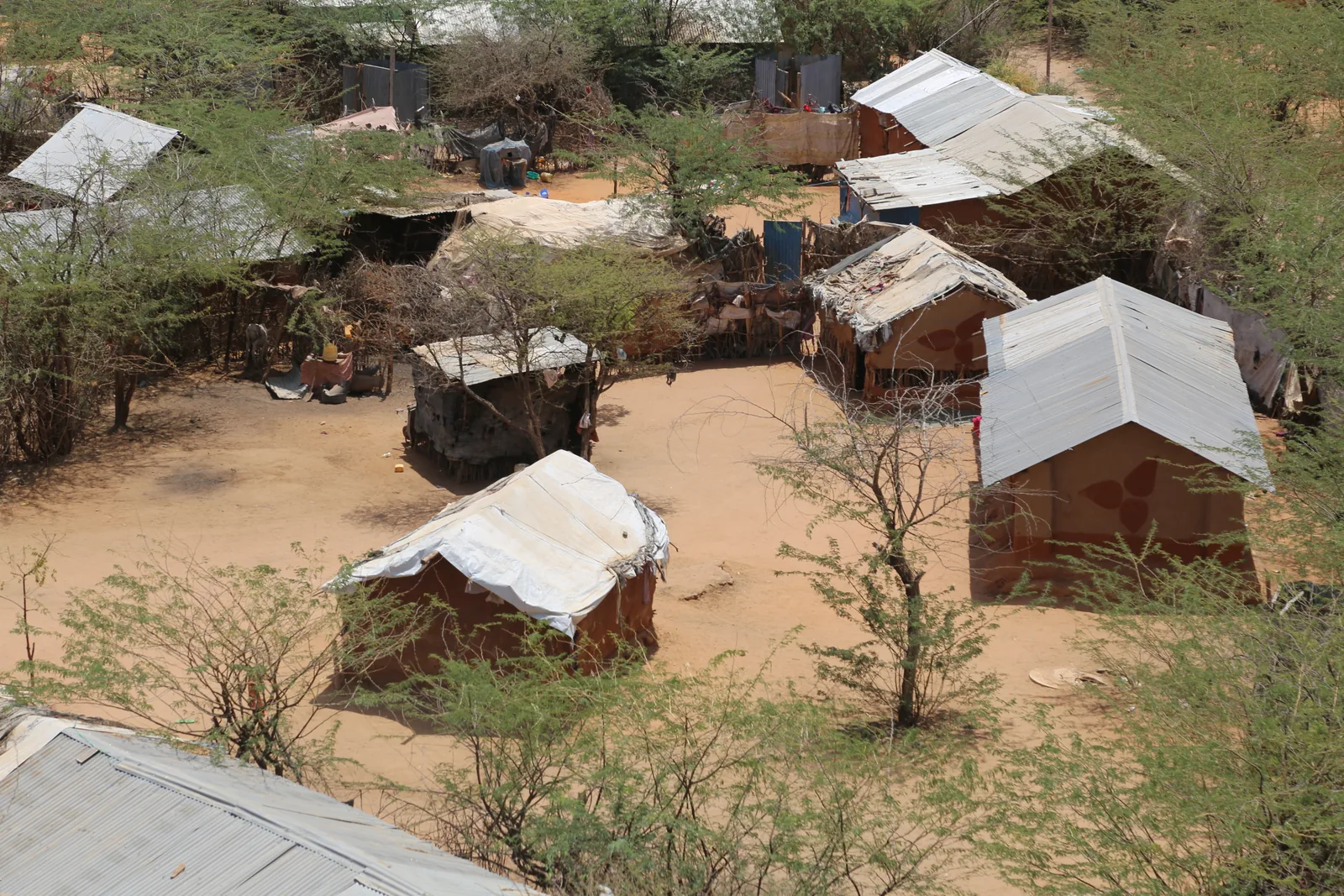
That was Skau's description of El Fasher after its 18-month siege. He drove through street after street of homes riddled with bullets, burned cars on every corner, no markets, no economic activity. The Zamzam displacement camp outside the city was, he said, "a complete ghost town." Meanwhile Tawila, where survivors fled, has become "an endless ocean of grass huts" — close to a million people, 250,000 more than when Skau visited in April, surviving on half rations that last two weeks a month.
El Obeid, in North Kordofan, tells the same story from the war's new epicentre: a city of a million before the war that has roughly doubled in size as the displaced arrive, with eight overstretched IDP camps. Skau watched women registering who had walked for five days from destroyed villages in western and southern Kordofan.
The aid system is breaking
Even the response that exists is collapsing under a funding crisis. On September 25, 2026, UNHCR said only 18 percent of the $1.6 billion it needed for Sudan operations this year had arrived. The consequence, in the words of UN regional refugee coordinator Mamadou Dian Balde:
"It means less food. It means less capacity for people to be relocated to safer areas. It means less capacity to shelter themselves."
The same week, UNHCR reported a sharp spike in flight into Chad: more than 400 people a day crossing into eastern Chad over the previous week — a 20-fold increase over recent months — fleeing Darfur, Kordofan and Blue Nile. Almost a million refugees have crossed into Chad since the war began, with more than 55,000 so far in 2026. The agency warned that if basic needs go unmet, many refugees keep moving toward Europe after failed attempts to find safety. Aid agencies broadly face major shortfalls after the United States and other donor countries cut billions in foreign assistance over the past year, Reuters reported.
Access is the other stranglehold. Skau described a journey from El Obeid to El Fasher — six hours by car before the war — that took him three days, three flights and a 30-hour drive through the Jebel Mara mountains, "because we are not able to go cross-line, across the fighting lines." WFP reaches 4 to 5 million people a month, half of them in the hardest-to-reach areas — but one of its convoys was hit in Kordofan two weeks before his briefing. "We are really failing to protect the civilians now in the Kordofan, in the Blue Nile," Skau said. "We certainly failed to protect and prevent the atrocities in El Fasher last year."
The Norwegian Refugee Council's 2026 assessment ranked Sudan the world's most neglected displacement crisis for 2025 — a measure not of suffering alone, but of the gap between suffering and the world's response in funding, media coverage and political engagement. Skau put the attention deficit bluntly: Sudan, he said, "does, in my view, not get by far the attention it deserves."
What to watch
Three things will decide whether the crisis deepens. Kordofan: the fighting around El Obeid and the region's supply routes is the war's new centre of gravity — the IPC warns that renewed siege-like conditions there would heighten famine risk. Funding: WFP says it will have to scale back significantly within weeks unless donors provide money, and UNHCR is at 18 percent of its target. Harvest and rain: a drought-hit lean season in Darfur, combined with conflict-blocked farming in Kordofan, could push the 14 famine-risk areas over the edge. Skau's closing appeal, delivered ahead of the UN General Assembly's high-level week, was twofold: "an end to this conflict," and, short of that, the basic humanitarian assistance he said the world is failing to provide.