The Russian Civil War explained in one line: between 1917 and 1922 Lenin's Bolsheviks fought a multi-party war for the former Russian Empire against White armies, Green peasants, anarchists, national movements and foreign interveners — and won it from the centre outward, because Trotsky built the larger army on the industrial heartland's short railway lines while Kolchak, Denikin and Yudenich attacked separately from the periphery, at a cost no historian can fix to a single figure — 7–12 million casualties on the compiled record's count, as many as 10 million lives lost on Britannica's, and 7–14 million dead on Bullock's famine-inclusive reckoning.
Key takeaways
- It was never only Reds against Whites: the two largest combatants were the Red Army and the White movement, but Green peasant armies, Nestor Makhno's anarchists, independence movements from Finland to Central Asia, and thirteen foreign states intervened (see Overview).
- The centre beat the edges: the Bolsheviks held Moscow, Petrograd and the industrial heartland throughout, with short lines of communication, while the Whites were dispersed as far as the Pacific (see How did the war unfold?).
- 1919 decided it: Kolchak advanced from the east, Denikin from the south and Yudenich toward Petrograd in a single year — separately, and each was defeated separately (see How did the war unfold?).
- The cost is three attributed measures, not one toll: 7–12 million casualties in the compiled record, as many as 10 million lives lost in Britannica, 7–14 million dead in Bullock's reckoning once famine is counted — each kept separate by what it counts (see How many people died?).
- The war made the state that won it: War Communism, the Cheka and one-party rule were civil-war products, and the victory produced the USSR in 1922 (see How did it shape the world?).
Contents
- Overview
- Why did the war start?
- How did the war unfold?
- How many people died?
- What were the economic effects?
- How did it shape the world?
- What do historians debate?
Overview
The Russian Civil War was a multi-party civil war in the former Russian Empire, dated in the compiled record from 7 November 1917 to 25 October 1922, when Vladivostok fell to the Red Army, with full-scale war from May–June 1918 — and the Bolsheviks won it: their victory formed the Russian Socialist Federative Soviet Republic and then the Soviet Union across most of the empire's territory (compiled record). Britannica dates the headword conflict more narrowly, to 1918–20, the years in which the Red Army defended the new Bolshevik government led by Vladimir Lenin against various Russian and interventionist anti-Bolshevik armies (Britannica). The dating gap is itself part of the history, and this article uses the wider 1917–1922 span while noting where the narrower one applies.
The two largest combatants were the Red Army, fighting for a Bolshevik-led socialist state, and the forces known as the White movement, led mainly by right-leaning former imperial officers and united around Admiral Alexander Kolchak (compiled record). Around that central contest turned the others: rival militant socialists, notably the Ukrainian anarchists of the Makhnovshchina under Nestor Makhno and the Left Socialist Revolutionaries; non-ideological Green armies of peasants, who opposed Bolsheviks, Whites and foreign interventionists alike; national movements seeking independence for Poland, Finland, Ukraine, the Baltic states, the Caucasus and Central Asia; and foreign interveners — thirteen states against the Red Army in the Allied intervention, and three Central Powers states intervening on the other side to hold what Brest-Litovsk had given them (compiled record). It was, in Jonathan Smele's phrase as his reviewer reports it, "a World War condensed" (World History Connected review).
Why did the war start?
The war started because a revolution made in a losing world war could not be consented to by the country it claimed. Russia's disastrous performance in the First World War was one of the primary causes of the Russian Revolution of 1917, which swept aside the Romanov dynasty (Britannica) and installed a Provisional Government that, in the compiled record's account, was unable to solve the country's most pressing issues, most importantly to end the war with the Central Powers (compiled record). The Bolsheviks overthrew that government in the October Revolution, promising peace, land and bread — and then, in Britannica's Russia history, found only part of Russia under their control: Moscow, Petrograd and much of the industrial heartland, while the countryside belonged to the Socialist Revolutionaries, so that given the Bolshevik desire to dominate the whole of Russia and the rest of the former tsarist empire, civil war was inevitable (Britannica).
Three acts in the first months turned opposition into armies. First, Lenin dissolved the Constituent Assembly, finally alienating the non-Bolshevik left, whose deputies the Mensheviks and Socialist Revolutionaries were then expelled from the soviets and barred from organised political activity (Britannica). Second, the Treaty of Brest-Litovsk of 1918, by which Russia yielded large portions of its territory to Germany, caused a breach between the Bolsheviks and the Left Socialist Revolutionaries, who thereupon left the coalition (Britannica); the Spartacus account of the terms puts the loss at a third of Russia's population, a third of her factories and three-quarters of her coal and iron producing areas (Spartacus Educational). The rightist Whites, meanwhile, had their main asset in the Volunteer Army in the Kuban steppes, which survived the winter of 1917–18 and came under General Anton Denikin in April 1918 (Britannica). Third, in May 1918 the Czechoslovak Legion — Czech and Slovak former prisoners and deserters evacuating via the Far East — refused Trotsky's order of 29 May to surrender its arms, defeated the local soviets and took control of the Trans-Siberian Railroad; in the vacuum, two anti-Bolshevik authorities appeared, the West Siberian Commissariat at Omsk and the Socialist Revolutionaries' Committee of Members of the Constituent Assembly at Samara (Britannica). Moscow answered with a crackdown, and in September 1918 proclaimed the Red Terror, with the Cheka given powers of summary arrest, trial and execution (Britannica). Among the terror's early context was the killing of the former imperial family at Yekaterinburg in the night of 16–17 July 1918, shot in their prison house as anti-Bolshevik forces developed in Siberia (Britannica).
How did the war unfold?
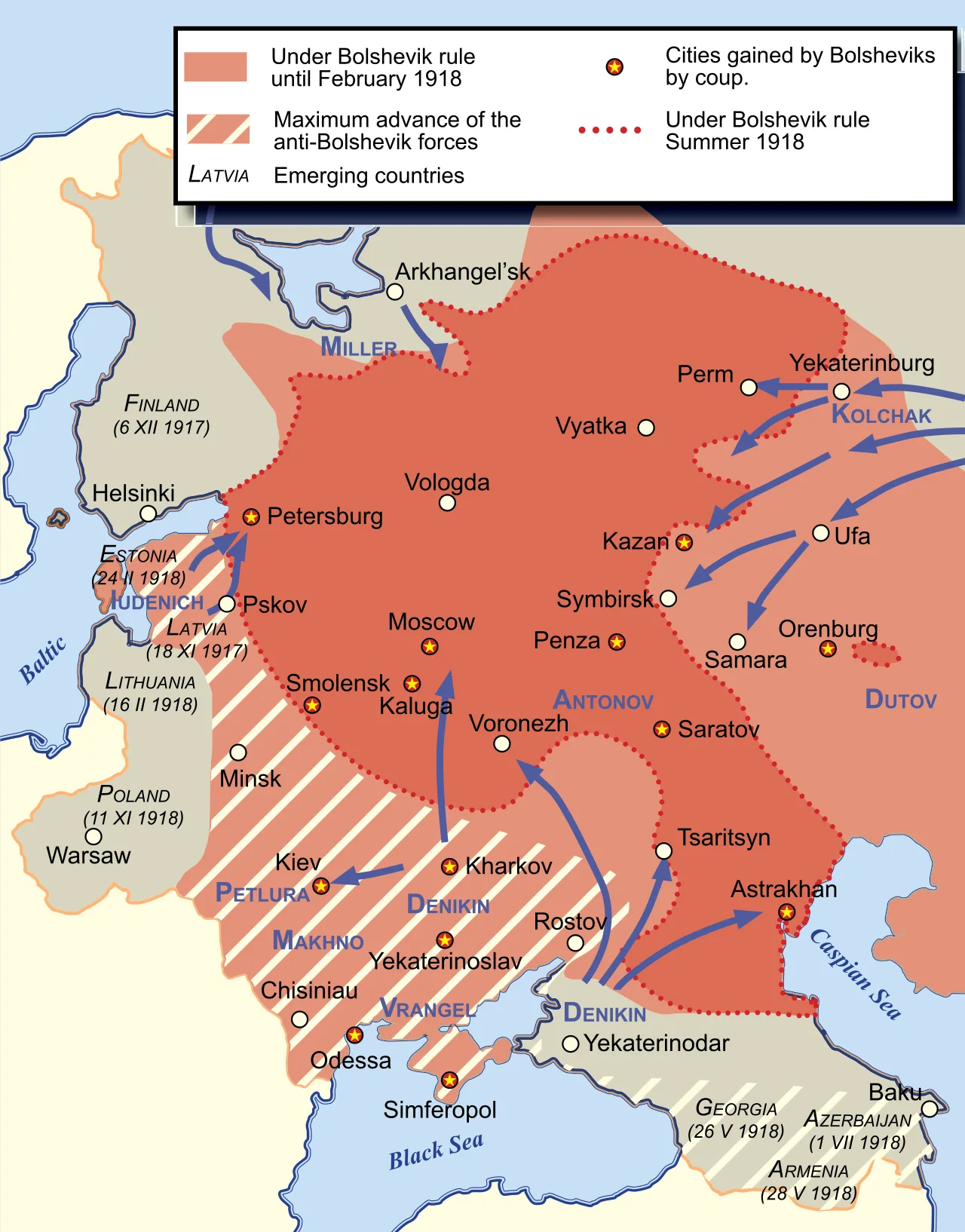
The war unfolded as a contest between a centre and a ring. The Red Army was formed in February 1918, and Trotsky, its leader, was to reveal great leadership and military skill, fashioning a rabble into a formidable fighting force (Britannica). The Reds recruited many ex-tsarist officers as military specialists, conscripted the peasantry, and by the compiled record's tabulation reached a peak strength of 5,498,000, against a White peak of 1,023,000, with the Czechoslovak Legion at 50,000 and Japanese intervention forces at 70,000 (compiled record). The strategic fact underneath the numbers was geographic: the Bolsheviks controlled the industrial heartland of Russia and their lines of communication were short, while those of the Whites, dispersed all the way to the Pacific, were long (Britannica). Foreign help did not close the gap. Direct Allied intervention was on a very small scale — perhaps 200,000 soldiers in total — the French in Ukraine withdrew in March and April 1919 having hardly fired a shot, the northern front at Arkhangelsk and Murmansk was of minor importance, and only the Japanese, established systematically in the Far Eastern provinces, represented a real danger (Britannica). The Allies' one diplomatic initiative, the Prinkipo armistice talks proposed on American initiative in January 1919, was accepted by the Communists and refused by the Whites (Britannica).
The decision came in 1919, in three uncoordinated White offensives — sequenced in the compiled record by their launch, Kolchak from the east in March, Denikin from the south in July, and Yudenich from the west in October, each checked in turn (compiled record). By 1919, Britannica records, the Red Army had become much better than the armies of its White opponents (Britannica). In the east, Kolchak — who had set up his own dictatorship at Omsk on 18 November 1918 — advanced through the Urals and attained his greatest success by April 1919; the Red counteroffensive began on 28 April, Ufa fell in June, and the retreat through Siberia became a rout, ending with Kolchak handed over to the Communists in January 1920 and shot on 7 February (Britannica). In the south, Denikin took most of Ukraine by the end of August 1919, moved north and took Oryol on 13 October, while General Nikolay Yudenich advanced from Estonia to the outskirts of Petrograd; both cities were saved by Red counterattacks, Yudenich retreated into Estonia, and Denikin's overextended army was driven back to evacuation from Novorossiysk in March 1920 (Britannica). In 1920 the last organised White force, General Pyotr Wrangel's in Crimea, struck north and for a time occupied part of Ukraine and the Kuban, until the Red Army battered it back and its rearguards covered the evacuation of 150,000 soldiers and civilians by sea in November 1920 — which ended the civil war in the south (Britannica). What followed was consolidation, not peace: an alliance between the Ukrainian leader Symon Petlyura and Poland's Józef Piłsudski in April 1920 sparked the Polish-Soviet War, settled by the Treaty of Riga in March 1921; the Red Army conquered Georgia between February and April 1921; peasant revolts, above all the Tambov rebellion of 1920, and the Kronstadt naval mutiny of March 1921 were crushed; and in the Far East the Japanese withdrawal at the end of October 1922 let Vladivostok fall on 25 October, after which the Far Eastern Republic voted itself out of existence and joined Soviet Russia (Britannica; compiled record).
How many people died?
No agreed total exists, and the estimates differ because they count different things — battle, disease, terror, famine, or all of them together. The compiled record gives an estimated 7 to 12 million casualties during the war, mostly civilians, citing Evan Mawdsley's The Russian Civil War (2007 edition, p. 287), and tabulates the military core beneath that range as single-source estimates — the Red Army at 939,755 killed and missing, with 7,731,538 total casualties including the sick and wounded, and the White Army at 650,000 killed — figures printed here as that record gives them, not as agreed totals (compiled record). Britannica gives as many as 10 million lives lost, the overwhelming majority of them civilian casualties, with thousands of perceived opponents murdered by the Cheka and death coming mainly through disease, starvation and mass murder (Britannica). David Bullock, in The Russian Civil War (2008) as carried by Spartacus Educational, argues that no one has been able to calculate the cost accurately: his reasoned estimates place Red Army dead from battle and disease as low as 425,000 and as high as 1,213,000, their opponents at 325,000 to 1,287,000, and his total, counting a further 5 million believed to have died in the famines of 1921–22, runs to between 7 and 14 million (Spartacus Educational). The Soviet demographer Boris Urlanis, by contrast, counted only 300,000 men killed in action in the civil war and the Polish-Soviet War together — 125,000 in the Red Army and 175,500 among White armies and Poles — with a further 450,000 military personnel dead from disease on both sides (compiled record). The distance between Urlanis's 750,000 military dead and Bullock's 14 million is the distance between counting soldiers killed in action and counting a society's excess deaths, and this article prints both ends rather than splitting them.
The components show why the totals move. Disease killed on a military scale: the compiled record puts typhus deaths at an estimated 3,000,000 throughout the war, and the droughts of 1920 and 1921 and the Russian famine of 1921 worsened the disaster further, killing roughly 5 million people (compiled record); the World History Connected review of Smele puts the same famine at another five million dead on top of at least ten-and-a-half million who had died fighting in and around Russia by 1921 (World History Connected review). Political violence is the most contested component of all. For the Red Terror, the compiled record reports execution estimates for the whole period running from a low of 50,000 to highs of 140,000 and 200,000, with most estimations putting the total at about 100,000; Robert Conquest's figure is 140,000 shot in 1917–1922, Jonathan Smele estimates considerably fewer — perhaps less than half that many — and Nikolay Zayats puts Cheka and tribunal shootings together at about 50,000–55,000, while Vadim Erlikhman's investigation gives at least 1,200,000 victims and Sergei Volkov 2 million, a calculation the record notes does not appear to have been confirmed by other major scholars (compiled record). For the White Terror the same record gives about 300,000 killed in total, including figures it tabulates of 25,000 sentenced to death by the Don Cossack Host's punitive organs between May 1918 and January 1919 and 25,000 shot in Ekaterinburg province alone under Kolchak's government, where Bullock's account gives the lower figure of some 50,000 White Terror victims overall (compiled record; Spartacus Educational). An estimated 100,000 Jews were killed in Ukraine, and some 10,000–500,000 Cossacks were killed or deported in Decossackization, out of a population of around three million (compiled record). Around one to two million people, the White émigrés, fled Russia altogether (compiled record).
What were the economic effects?
The economic effects were a collapse deep enough to change the regime's own policy. The civil war caused the Bolsheviks to adopt War Communism, characterised chiefly by the expropriation of private business and industry and the forced requisition of grain and other food products from the peasants (Britannica). The compiled record's figures measure the result: by 1921 heavy industry output had fallen to 20 percent of 1913 levels, 90 percent of wages were paid with goods rather than money as barter replaced the collapsed rouble — whose exchange rate fell from two roubles to the dollar in 1914 to 1,200 in 1920 — and 70 percent of locomotives needed repair (compiled record). Coal production decreased from 27.5 million tons in 1913 to 7 million tons in 1920, overall factory production fell from 10,000 million roubles to 1,000 million, and, according to the historian David Christian as cited in the record, the grain harvest was slashed from 80.1 million tons in 1913 to 46.5 million tons in 1920 (compiled record). Britannica's transport figure matches the industrial one: between 1914 and 1920 the number of working locomotives declined from more than 17,000 to fewer than 4,000, the railway system was devastated, wooden houses in the cities were pulled down for fuel, and urban workers began to vanish back to the countryside (Britannica). By 1921 cultivated land had shrunk to 62 percent of the pre-war area, the harvest yield was only about 37 percent of normal, horses had declined from 35 million in 1916 to 24 million in 1920 and cattle from 58 to 37 million (compiled record).
The political feedback was immediate. Food requisitioning, combined with seven years of war and severe drought, contributed to the 1921 famine; peasants responded to requisitions by refusing to till the land, and forced requisitioning led to peasant revolts — the Tambov province revolt of 1920 in particular forced Lenin to change the policy (Britannica; compiled record). In March 1921, in the same weeks the regime slaughtered the mutinous sailors of Kronstadt, Lenin inaugurated the New Economic Policy, the tactical retreat from enforced socialism: heavy industry, communications and transport remained in state hands, light and consumer-goods industries reopened to entrepreneurs, and the monetary reform of 1923 provided a money tax that brought an end to forced requisitioning — with the economy back to its 1913 level by the mid-1920s (Britannica). War Communism, in the compiled record's verdict, saved the Soviet government during the civil war, but much of the Russian economy had ground to a standstill (compiled record).
How did it shape the world?
The war shaped the world first by deciding what state would stand where the Russian Empire had stood. The political system that emerged victorious bore the name Russian Soviet Federated Socialist Republic, but in fact the soviets were of small importance and all power belonged to the Communist Party, whose members occupied every key post, the party itself governed by a Central Committee Lenin dominated, with Trotsky second only to him as commissar for war (Britannica). Soviet Russia gave way to the Union of Soviet Socialist Republics in 1922, with Moscow as capital dominating the union (Britannica). The methods of victory became the habits of the state: Britannica notes that the feat of winning the civil war, and the organisational methods adopted to do so, made a deep impact on Bolshevik thinking — Stalin talked of the party in terms of an army, of political fronts and economic campaigns — and the Cheka, formed in December 1917, had become a powerful force by the war's end (Britannica).
Second, the victory was partial at the empire's edges, and the map of 1922 is the war's territorial verdict. The Communist victory was at the same time a defeat for the various nationalist movements of the non-Russian peoples: the hopes of the Tatars and Bashkirs were ruined, self-determination was proclaimed while the party's dictatorship was imposed in practice, and in Central Asia the Basmachi guerrillas harassed the authorities for years — resistance the Soviets did not completely dismantle until 1934 (Britannica; compiled record). But Finland and the Baltic states were lost for good: Estonia, Latvia and Lithuania all repelled Soviet invasions, the Treaty of Riga split Belarus and Ukraine between Poland and the Soviet republics, and only in the Caucasus did the Red Army fully restore the old frontier, taking Azerbaijan in April 1920, Armenia in December 1920 and Georgia by conquest in early 1921 (Britannica; compiled record). The human export matched the territorial one: the one to two million White émigrés included a large percentage of the educated and skilled population of Russia (compiled record).
Third, the war set the Soviet state's founding argument with the outside world. Allied intervention — small in troops, large in Bolshevik memory — had begun as an attempt to revive an eastern front against Germany and continued as support for the Whites against a regime the Allied governments regarded as a menace to Europe; its failure left the new state isolated, suspicious, and, after the failure of the Communist International-inspired revolutions elsewhere, moving in the compiled record's account from world revolution toward socialism in one country, sealed diplomatically by the Treaty of Rapallo with Germany in April 1922 (Britannica; compiled record).
What do historians debate?
Historians debate, first, what the war even was. Evan Mawdsley's The Russian Civil War (Allen & Unwin, 1987, and later editions) is the standard single-volume synthesis behind the compiled record's headline range of 7–12 million casualties — a Red-versus-White war, in the main (compiled record). Jonathan Smele's The "Russian" Civil Wars, 1916–1926: Ten Years That Shook the World (Hurst, 2015; Oxford University Press, 2016) rejects that frame on three counts: the collapse of the empire produced several overlapping civil wars, not one; "Russian" belongs in quotation marks, since many combatants were not Russian and much fighting occurred outside Russia proper; and the span was a decade, from the Central Asian revolt of 1916 against the mobilisation of nearly 400,000 previously exempted men to the Turkestan Front's conversion into the Central Asian Military District in June 1926 (Smele book record; World History Connected review). His reviewers divide on the frame: Eric Lohr praised the book's erudition while seeing no continuity from the 1916 steppe rebellion to the wars of 1918–21, Rex Wade called the 1916–26 dating its least persuasive point, and Anatol Shmelev called the 1926 endpoint a pure formality (Smele book record).
Second, they debate why the Reds won. Britannica's verdict is military and geographic: the victory is mainly due to the simple fact of military superiority, reinforced by holding the central core of European Russia throughout, which let the Communists plan operations and move men more easily than enemies based on the periphery and cut off from one another (Britannica). The narrative record supports the complementary explanations without needing to choose among them: the Whites never combined — Kolchak's dictatorship at Omsk, Denikin's Volunteer Army in the south and Yudenich's advance on Petrograd were separate commands with separate politics, and their 1919 offensives peaked months apart (Britannica); Allied intervention stayed tentative, at perhaps 200,000 troops with the northern front of minor importance (Britannica); and the Bolsheviks, for all the unpopularity of requisitioning, held the population and industry from which a five-million-man army could be conscripted, ex-tsarist officers included (Britannica; compiled record). Smele qualifies even the word "winning": the Bolsheviks won nominal control of most of the empire and its western urban centres, but suffered significant defeats in Finland, the Baltic states and Poland and a retreat from much of the peasant countryside, so that it was the New Economic Policy that secured the revolution's survival and a nominal win (Smele book record).
Third, they debate how the war should be periodised inside Russia's longer violence. Peter Holquist's phrase "Russia's continuum of crisis", quoted in the World History Connected review, treats world war, revolution and civil war as one span of violence rather than three events — the review notes that by that reckoning Russia sustained far more casualties after withdrawing from the world war than during it (World History Connected review). On that reading, and on Smele's, the civil war is not an epilogue to 1917 but the central catastrophe of Russia's twentieth century: the event that killed the most people, destroyed the economy the Soviet Union then had to rebuild, and taught the winning party to govern as it had fought.