The Ogaden War explained in one line: Somalia invaded Ethiopia in July 1977 to annex the Somali-inhabited Ogaden, won victory after victory and took Jijiga, and lost the region again within eight months — because its own patron, the Soviet Union, switched sides mid-war and armed its enemy instead. No Cold War conflict shows the era's alliance logic more nakedly. Somalia's army was Soviet-built; Ethiopia's emperor had been America's largest aid recipient in sub-Saharan Africa. By March 1978 the positions had inverted completely: Soviet advisers and Cuban troops were fighting for Ethiopia, Somalia had expelled its Soviet mission and broken with the socialist bloc, and the United States was moving toward the Somali side. The war is the deep background to the Horn of Africa this site still reports — the same Ethiopia-Somalia-Eritrea triangle behind today's Ethiopian civil war explainer and the Eritrean-Ethiopian War of 1998–2000.
Why did Somalia invade the Ogaden in 1977?
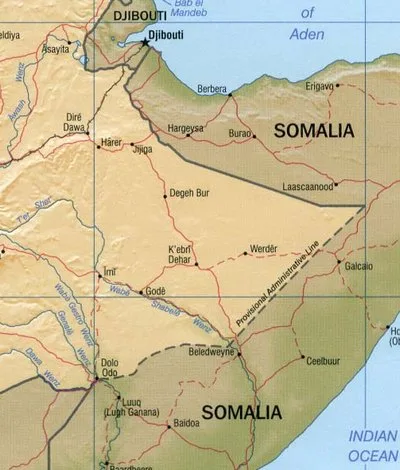
Because its president believed Ethiopia was too weak to stop him, and the Ogaden was the unfinished business of Somali nationalism. The Ogaden is a vast plateau overwhelmingly inhabited by Somali people, inside Ethiopia's borders since Britain ceded the territory under the Anglo-Ethiopian Treaty of 1897; the last British-administered parts were transferred only in 1955. President Muhammad Siad Barre, who had taken power in a 1969 coup, had long wanted to incorporate the region into a Greater Somalia, EBSCO's Research Starters account says. His method was phased: Mogadishu trained and armed a guerrilla group, the Western Somali Liberation Front (WSLF), which became very active among the Ogaden's ethnic Somali population, staging hit-and-run attacks meant to wear down the Ethiopian army before regular troops invaded. The opportunity was Ethiopia's collapse into revolution. Emperor Haile Selassie — a longtime American ally whose country had received more than $180 million in US military assistance between 1946 and 1972 — was removed by the military Dergue on 12 September 1974, amid famine, corruption and strikes. The junta adopted Marxism, its leader Mengistu Haile Mariam arranged a $385 million arms agreement in Moscow in December 1976, and Washington ended arms sales. To Barre, counting on international acceptance of a fait accompli, Ethiopia in mid-1977 looked like a state in disarray. Regular Somali troops crossed the border in July 1977. (Reference works differ on the war's exact days: EBSCO dates it 23 July 1977 to 15 March 1978; the compiled record gives 13 July 1977 to 23 March 1978. Both versions are carried in this article, and neither is silently preferred.)
How did the invasion succeed — and then stall?
The Somali army won several victories and took Jijiga, then stalled on overextended supply lines as Ethiopian resolve stiffened. The invading army, trained and equipped by the Soviet Union since 1962, faced an Ethiopian military demoralised by political turmoil, purges, poor supplies and mutinies in retreating units. Jijiga, a major city of the Ogaden, fell to the invaders. Then the geometry of the invasion caught up with it: overextended supply lines and stiffening Ethiopian resolve halted the Somali army, EBSCO records, and a stalemate ensued throughout the rest of 1977. Ethiopia used the pause to mobilise on a scale Somalia could not match. The government appealed to patriotism and recruited a vast militia, variously estimated at between 100,000 and 300,000, to fight alongside the regular army — against a Somali force the compiled record puts at 31,000–39,000 soldiers at the war's start, rising to 45,000–63,000. The second change was external, and it decided the war.
How did the Soviet Union switch sides?
Moscow abandoned its Somali ally of fifteen years and armed Ethiopia instead, because Soviet leader Leonid Brezhnev saw the larger, newly Marxist Ethiopia as the bigger prize. The Soviet Union had built Somalia's military for fifteen years — advisers, an air base near Mogadishu, a naval base at Berbera, a communications facility at Kismayu, and a 1974 friendship treaty. But Marxist Ethiopia was the larger state, and Soviet leader Leonid Brezhnev saw an opportunity to extend his influence, EBSCO says. Moscow disapproved of the invasion, withdrew its support from Somalia and backed Ethiopia instead. Barre retaliated in November 1977 by evicting the Soviet military mission — many of whose advisers simply travelled to Ethiopia, where their knowledge of the Somali military proved invaluable. What followed was one of the largest airlifts of the Cold War: military supplies worth an estimated $1 billion, 1,500 Soviet advisers led by General Vasily Petrov, and Cuban troops on a scale the sources count differently — EBSCO says Fidel Castro supplied 18,000 soldiers, half of them fresh from the Angolan battlefields; the compiled record gives a range of 12,000–18,000 Cuban soldiers and airmen, alongside 2,000 South Yemeni troops. Ethiopian, Cuban and Soviet officers formed a unified command. On 23 January 1978, Cuban armoured brigades inflicted the worst losses the Somali forces had ever taken in a single action; the Ethiopian-Cuban force — 300 tanks, 156 artillery pieces and 46 combat aircraft on the compiled figures — prevailed at Harar and Jijiga and pushed the Somalis systematically out of the Ogaden. Ethiopia declared the last border post regained on 23 March 1978 (EBSCO dates the war's end to 15 March; the discrepancy is in the sources and is published here as such).
What did the Ogaden War cost, and what did it set in motion?
On the compiled casualty record: 5,059–6,133 Ethiopian soldiers killed and 8,207–10,563 wounded; 5,676–6,453 Somali soldiers killed; 163–400 Cuban dead; 100 South Yemeni and 33 Soviet advisers killed; 25,000 civilians killed; and some 500,000 Somali inhabitants of Ethiopia displaced. Somalia lost almost a third of its regular army's soldiers, three-eighths of its armoured units and half its air force. The ranges, drawn from different cited studies, are published as ranges — there is no single settled toll. One limitation is stated plainly: these casualty and displacement ranges rest on the compiled record alone. EBSCO's account, this article's second opened source, publishes no casualty figures, and no second independent compilation was opened in this run — so the figures are published as that compilation's figures, attributed as such, not as a toll two sources agree on. The strategic consequences ran for decades. Ethiopia's victory encouraged the Dergue to believe a similar military solution would work against secessionists in Eritrea and other provinces, EBSCO notes — costly, ultimately unsuccessful campaigns that consumed the regime until Mengistu was overthrown in 1991. In Somalia the defeat destabilised and bankrupted Barre's government; he relied increasingly on force, was overthrown the same year, 1991, and died in Nigerian exile in 1995, leaving the power vacuum from which Somalia's civil war grew. And the Ogaden itself never left the map of Horn conflicts: an Ethiopian region, Somali in population, claimed in Mogadishu's national story — the same contested geography that frames the region's wars to this day.
Sources: EBSCO Research Starters, 'Ogaden War Between Somalia and Ethiopia' (read in full), for the narrative account, the WSLF sequence, the militia estimates, the $385 million 1976 arms agreement and the 1991 consequences; Wikipedia, 'Ogaden War' (read in full), for the compiled strength and casualty ranges, the $1 billion airlift figure, the January and March 1978 dates and the 1897/1955 territorial background. Where the two differ — the war's exact start and end days, and the Cuban troop count (18,000 in EBSCO; 12,000–18,000 in the compiled record) — both versions are stated and neither is silently preferred.