The Ethiopian Civil War explained in one line: for seventeen years Ethiopia's Marxist military rulers, the Derg, fought Eritrean separatists, Tigrayan rebels and a Somali invasion at once — and lost, in the end, less to any single army than to the famine, terror and economic ruin their own rule produced. The war ran from 12 September 1974 to 28 May 1991. It left at least 1.4 million people dead on the compiled record — about a million of them by famine — dissolved an empire that traced itself back centuries, made Eritrea independent, and left Ethiopia landlocked.
Key takeaways
- It was several wars at once: a revolution in Addis Ababa, a thirty-year Eritrean independence war, a Somali invasion of the Ogaden, and Tigrayan and Oromo insurgencies — all running together under one Cold War roof (see Overview).
- The death toll is a set of disputed ranges, not a number: about 400,000–579,000 violent deaths and about 1.2 million famine deaths on the compiled record, with the Red Terror alone estimated anywhere from 30,000 to 750,000 victims (see How many people died?).
- The regime armed itself into bankruptcy and starved its own base: Soviet weapons saved the Derg in 1978; Soviet withdrawal doomed it after 1989, while land collectivisation, forced grain deliveries and resettlement alienated the peasantry the revolution claimed to serve (see What were the economic effects?).
Contents
- Overview
- Why did the war start?
- How did the war unfold?
- How many people died?
- What were the economic effects?
- How did it shape the world?
- What do historians debate?
Overview
The Ethiopian Civil War was fought between the Derg — the military junta that seized power on 12 September 1974 — and a shifting field of Ethiopian and Eritrean rebel movements, until 28 May 1991. The Derg overthrew Emperor Haile Selassie, abolished the monarchy on 21 March 1975, established Ethiopia as a Marxist-Leninist state, and ruled first as the Provisional Military Administrative Council and, from 1987, as the People's Democratic Republic of Ethiopia under Mengistu Haile Mariam. Against it stood the Eritrean People's Liberation Front (EPLF), completing an independence struggle begun in 1961; the Tigray People's Liberation Front (TPLF), fighting for Tigrayan autonomy inside a reconstituted Ethiopia; the rival Marxist Ethiopian People's Revolutionary Party (EPRP); and the Oromo Liberation Front (OLF). The Soviet Union and Cuba backed the government; in 1977–78 Somalia invaded in support of the Western Somali Liberation Front (WSLF). The war ended with the TPLF-led Ethiopian People's Revolutionary Democratic Front (EPRDF) in Addis Ababa, Mengistu in exile in Zimbabwe, and Eritrea independent in all but name.
Why did the war start?
Because the empire was already coming apart, and the men who replaced it chose terror over consent. Discontent with Haile Selassie's stagnating, repressive regime had been building since the 1950s: a radicalised student movement demanded land reform and democratisation, peasant uprisings multiplied, Eritrean armed resistance escalated after annexation in the early 1960s, and Somali insurgency grew in the Ogaden — while the army, used to suppress all of them, mutinied in 1974 over its own pay and conditions. The Derg's coup answered that crisis with a revolution from above. But the new rulers borrowed their ideology from the very student Marxist parties they then fought: the EPRP, insisting on civilian rule, waged urban guerrilla war against the junta — the White Terror, in Britannica's account — and Mengistu answered with the Red Terror, the Qey Shibir: begun in 1976 and escalated on 3 February 1977, when he became chairman of the Derg, against the EPRP first and later the All-Ethiopia Socialist Movement (MEISON) — a campaign in which, Britannica records, thousands of Ethiopia's best-educated and idealistic young people were killed or exiled. A state born in a palace coup thus spent its first years at war with the cities, the north and the east simultaneously — the pattern traced in other revolutionary civil wars, from the Russian Civil War to the Chinese Civil War.
How did the war unfold?
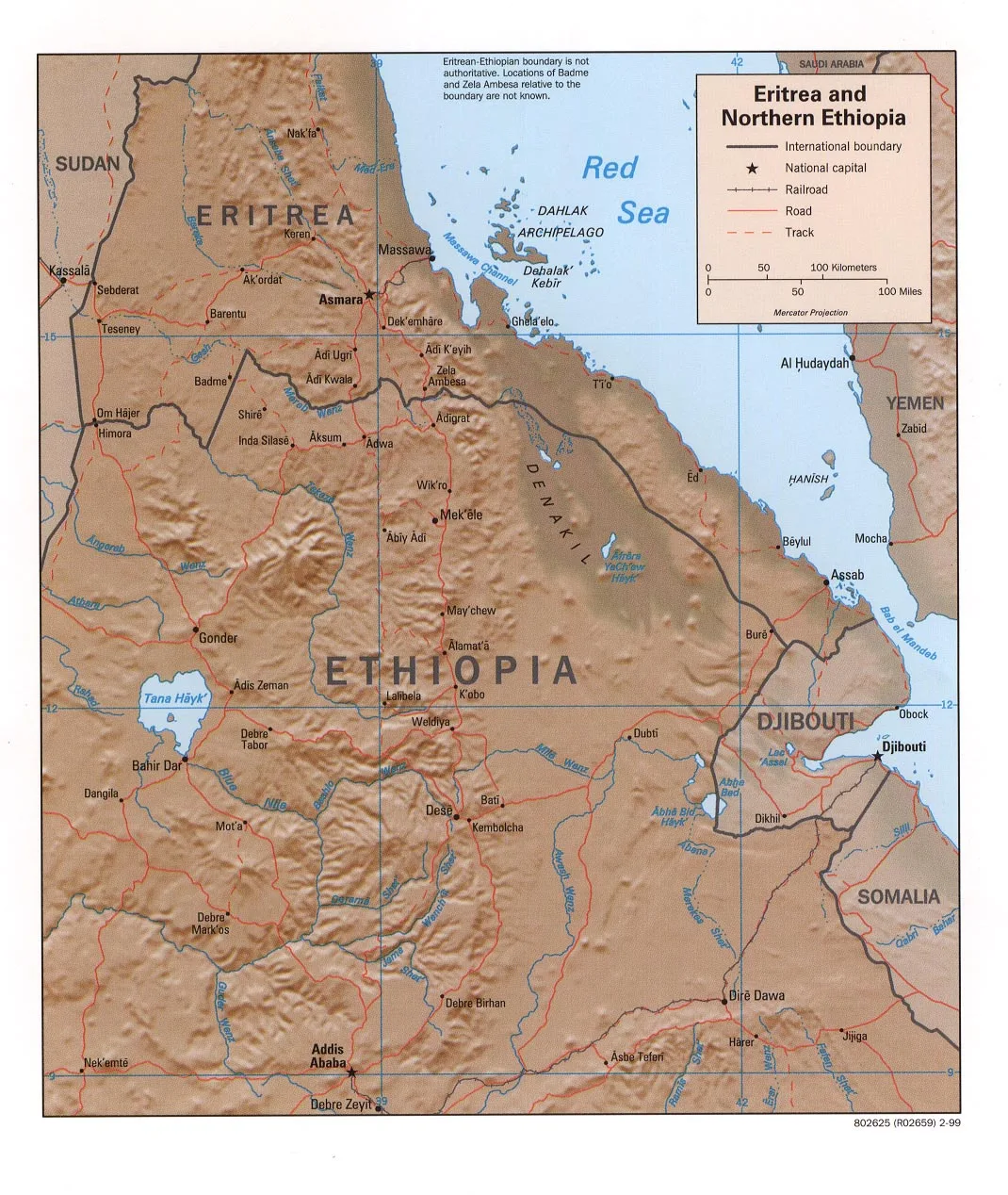
In three acts: survival by Soviet rescue, stalemate by famine, collapse by abandonment. The first crisis was external. Somalia invaded the Ogaden in 1977 in support of the WSLF — Britannica dates the Somali army's advance into the region to May and June 1977, and the compiled record dates the invasion itself to 13 July 1977. The Soviet Union labelled Somalia the aggressor and diverted its arms to Ethiopia — around two billion dollars' worth of equipment on the compiled record, with 1,700 Soviet advisors and 17,000 Cuban troops — and by early 1978 the Somali forces had been driven back. Mengistu turned the rebuilt army on Eritrea, pushing the nationalists back around Nakfa by the end of 1978. The second act was slower and deadlier. Through the early 1980s the government held the towns while the EPLF and TPLF held much of the northern countryside; drought intensified yearly from 1980 to its 1984 climax, and the famine of 1983–85 — deepened, Britannica records, by government controls on peasant movement and by an official cover-up in the autumn of 1984 — killed on a scale no battle matched. The third act began in December 1987, when the EPLF broke through before Nakfa and began coordinating with the TPLF. The Soviets refused further arms; in February 1989 government forces evacuated Tigray after the defeat at the Battle of Shire (15–19 February 1989); in 1990 the EPLF took Massawa; and on 28 May 1991 Mengistu fled to Zimbabwe and the rebels took Addis Ababa.
How many people died?
No count was ever agreed, and the honest answer is a stack of attributed ranges. For the war as a whole, the compiled record's casualty box gives approximately 400,000–579,000 people killed and about 1,200,000 deaths from famine, and its summary states that the war left at least 1.4 million people dead, with 1 million of the deaths related to famine — the record's own components do not sum exactly, which is itself part of the dispute. For the Red Terror of 1976–78, the spread is wider still: the compiled record gives an estimated 30,000 to 750,000 victims, the majority believed to be innocents; Britannica gives as many as 100,000 killed, with thousands more tortured or imprisoned; and the compiled casualties record reports that Amnesty International and Reuters estimated the terror's death rate at 150,000, while Amnesty's figure could be higher than 500,000. For the 1983–85 famine, the United Nations estimated deaths by hunger at about 1 million, the compiled casualties record gives a range of approximately 300,000 to 1.2 million dead — 7.75 million people affected out of a population of 38–40 million, 2.5 million internally displaced and 400,000 refugees — the compiled war record separately estimates 400,000–590,000 deaths in the 1983–85 famine itself, and Alex de Waal, in the research behind Evil Days (1991), estimated 400,000 to 500,000 famine deaths. Even the Ogaden War's toll is disputed, from more than 10,000 deaths on one count in the casualties record to a New York Times estimate of about 60,000, including 25,000 civilians. What the sources agree on is the structure: famine killed more Ethiopians than combat did, and the terror killed the educated young of the cities out of all proportion to any military purpose.
What were the economic effects?
The revolution destroyed the old economy faster than it built a new one. The 1975 land proclamation transferred all land to the state — allotments of no more than 25 acres (10 hectares), in practice averaging probably not much more than 3.7 acres (1.5 hectares) — and nationalisation wiped out the economic base of the old ruling class, in Britannica's phrase. But the peasants' associations were forced to deliver grain at below-market prices, which alienated the peasantry and did nothing to stimulate production: food production fell by 6 percent in the Derg's first six years on the casualties record, and crop production declined by 12.2 percent per year from 1982 to 1984. Forest cover in Wollo Province stood at about 2.2 percent in 1980 and in Tigray at 0.5 percent, roughly a 50 percent decline since 1960. The state's answer to famine, a resettlement programme that moved 600,000 farming families, was handled, Britannica records, callously and without the resources to house, feed or equip the people moved. Above all sat the war bill: an army rebuilt with Soviet billions held Eritrea and the Ogaden but produced nothing, and when Soviet support ended the state had neither the economy nor the arsenal left — the same arithmetic this archive traced in the Angolan Civil War.
How did it shape the world?
It redrew the Horn of Africa and reset how the world thinks about famine. Eritrea's victory made its independence official on 24 May 1993 and left Ethiopia — the region's largest state — landlocked. Inside Ethiopia, the victors built the country's first federal structure from ethnically based regions, with a constitutional right of nationalities to secede: the settlement of 1991 became the frame — celebrated and contested in turn — for every Ethiopian conflict since, including the Tigray War of 2020–22. The legal reckoning was partial: in December 2006, 72 Derg officials were found guilty of genocide, 25 of them, including Mengistu, tried in absentia while he remained in Zimbabwe. And the famine changed humanitarian politics permanently — and, in de Waal's account in Evil Days, taught a harder lesson: that the Mengistu government bore direct responsibility for the deaths of at least half a million civilians, and that famine in Ethiopia was made by war and policy, not by weather alone.
What do historians debate?
Three questions organise the scholarship. The first is famine's cause. The drought was real — Britannica records the rains failing altogether in 1984, the government controls that limited the mobility with which peasants had once answered shortfalls, and the official cover-up of the developing famine in the autumn of 1984. De Waal's Evil Days (Human Rights Watch, 1991) argues the wider case: violations by all sides, and above all the Mengistu government's conduct, made the government directly responsible for the deaths of at least half a million civilians; his famine estimate of 400,000–500,000 sits below the UN's roughly one million, a reminder that even the critics dispute the scale. The second is the revolution's military logic. Gebru Tareke's The Ethiopian Revolution: War in the Horn of Africa (Yale University Press, 2009), a pioneering military history built on new archival materials and interviews, argues the regime lacked imagination in responding to crises and alienated the peasantry by destroying human and material resources. John Young's Peasant Revolution in Ethiopia (Cambridge University Press, 1997) works the same ground from below — why the revolution began, how the Derg affected the nation, and the peasantry's decisive role in Tigray and Eritrea. The third debate is the settlement: whether ethnic federalism was the only peace available after seventeen years of ethnically organised war, or a structure that stored up the next ones. Historians agree on the sequence and the ranges; they disagree — openly, and with the figures above — on responsibility.
Sources: Encyclopaedia Britannica's history of Socialist Ethiopia, 1974–91 (read in full, updated 11 November 2026); the compiled reference record of the war and its companion casualties-and-impact record (both read in full); Alex de Waal's Evil Days (Human Rights Watch, 1991) via its publisher's book record; and Gebru Tareke's The Ethiopian Revolution (Yale University Press, 2009) via its publisher's book record. Contested figures — above all the death tolls — are published as attributed ranges from those sources, never as single settled numbers.