The Democratic Republic of the Congo is fighting one of the world's largest and longest-running wars — and most of it happens out of view. In late September 2026, the UN Security Council met in New York to confront a stark reality: clashes between Congolese government forces and the M23 rebels continue in eastern DRC despite a series of peace agreements, while the country's worst Ebola outbreak on record — more than 3,900 dead — deepens the crisis.
Understanding this war means looking past the latest offensive. The fighting around Minembwe in South Kivu, the drone strikes over Rubaya's coltan mines, and the failed ceasefires all sit on top of political fractures that have been open since the 1990s. This explainer covers who is fighting, what they want, why the deals keep failing, and where the conflict stands now.
Who is M23?
M23 — the March 23 Movement — is a rebel force estimated at 30,000 to 40,000 fighters, operating under the broader Congo River Alliance (AFC) political banner. It is dominated by fighters of Banyamulenge origin, but portrays itself as a national movement.
M23 is widely reported to be backed by Rwanda and Uganda, according to the Africa Center for Strategic Studies. Rwanda denies providing military support to the group, though it publicly sympathizes with M23's stated aims and the protection of local communities in the Kivu provinces. This disputed backing is the axis around which the regional dimension of the war turns: Kinshasa treats M23 as a Rwandan proxy; Kigali denies it.
M23 is only one piece of a much more crowded battlefield. More than 120 armed groups operate across eastern DRC, concentrated in North and South Kivu, Ituri, and Tanganyika provinces. On the government's side, the Congolese armed forces (FARDC) fight alongside the Wazalendo militias, Burundian forces, and the Democratic Forces for the Liberation of Rwanda (FDLR) — remnants of the Interahamwe forces implicated in the 1994 genocide against the Tutsi in Rwanda.
The human cost is enormous: more than 4.3 million people have been displaced across the Kivu provinces since M23's resurgence, and humanitarian access to the region has been severely restricted for more than a year, according to the Africa Center.
Why this conflict is really about citizenship
The Africa Center's central argument is one of the most clarifying frames available for this war: although often framed as ethnic, these conflicts are fundamentally about citizenship, constitutional recognition, and political inclusion.
The populations at the center of the dispute — the Banyamulenge, Banyamasisi, and Barundi communities of the Kivu regions — have roots around the Great Lakes that predate the colonial borders drawn at the end of the 19th century. Successive Congolese administrations have alternately granted, withdrawn, and reinstated their Congolese citizenship, relegating them to second-tier status despite constitutional recognition of their rights.
Ambiguities over citizenship have been repeatedly exploited by political actors, fueling discrimination, land disputes, and armed mobilization. The Africa Center draws a pointed comparison with Uganda, where the 1995 Constitution recognized the Banyarwanda — Ugandans of Rwandan descent — as a legal ethnic community with equal rights, and with Tanzania's birth-and-descent-based framework. Both approaches, the analysis argues, reduced uncertainty over political belonging. The DRC has yet to achieve similar clarity.
Minerals, militias, and a conflict economy
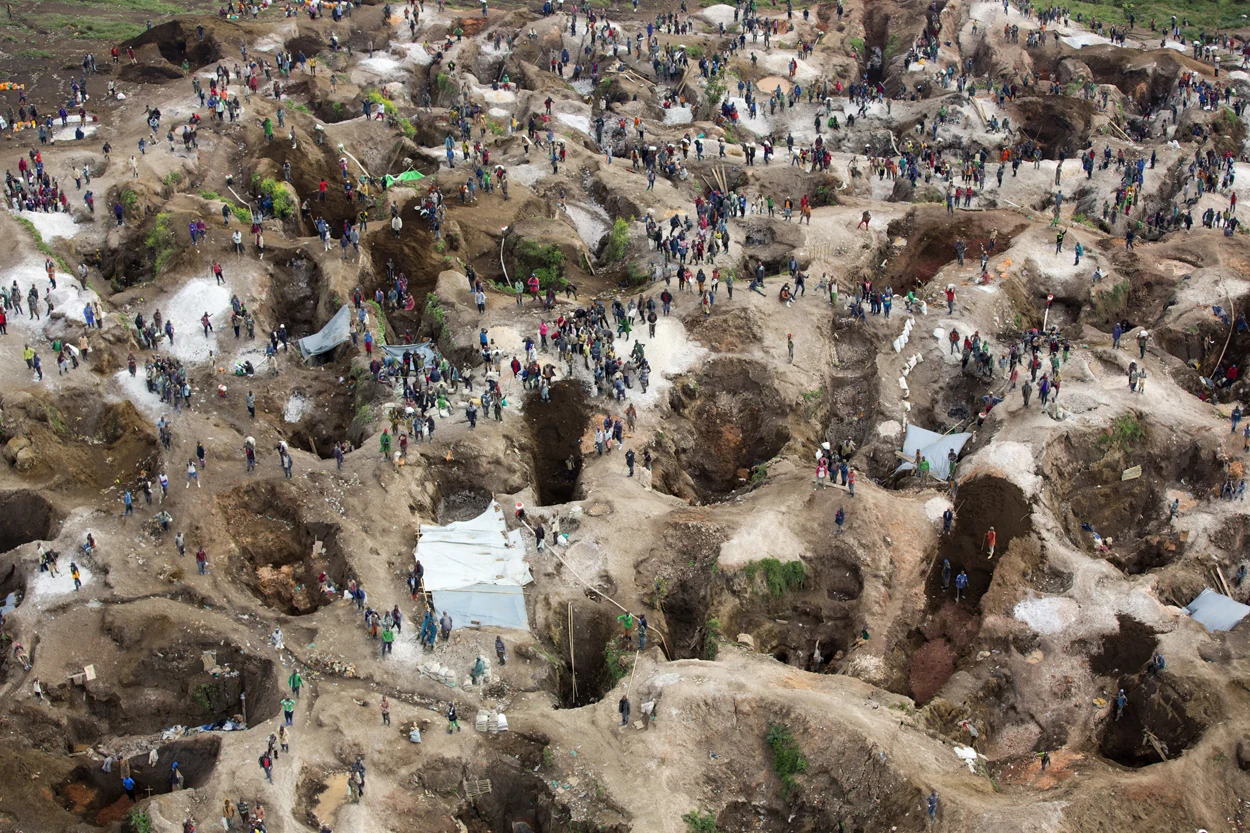
Eastern DRC holds some of the world's richest deposits of cobalt, copper, lithium, gold, and coltan — and those minerals help finance the war. The killing of M23 spokesperson Willy Ngoma in a drone strike in February 2026 near Rubaya, in North Kivu, was itself a signal of the war's layered dimensions: Rubaya produces 15 to 30 percent of the world's coltan supply.
Weak oversight has allowed armed actors to control mining sites, impose informal taxes, and use resource revenues to sustain their operations, the Africa Center reports. Rwanda and Uganda have both been widely reported to have seen surges in coltan exports despite having little known reserves of their own — a dynamic both countries' governments would dispute in their own framing of events. The result is a conflict economy in which resource wealth strengthens armed networks rather than funding the state.
A second dynamic worsens the battlefield picture: the proliferation of Wazalendo militias. While these government-aligned militias have provided additional manpower against M23, their proliferation complicates command structures, creates competing centers of authority, and undermines long-term security-sector reform. Some Wazalendo groups have been accused of human rights abuses, particularly against Banyamulenge communities.
The Congolese state itself spends heavily on war — military expenditure has nearly tripled since 2022 to roughly $1.1 billion — yet the 235,000-strong FARDC still suffers from fragmentation, poor discipline, and competing chains of authority, per the Africa Center. The government's drawdown of the UN peacekeeping force MONUSCO in 2024 and the shuttering of the East African Community Regional Force in 2022 removed important stabilizing mechanisms, in the Center's assessment, leaving space for competing armed actors to fill the void.
The failed deals — and why they failed
The current diplomatic picture is a graveyard of agreements. The Security Council's September 29, 2026 session — reported by UN News — noted that Kinshasa and M23 signed the Doha peace framework, and the DRC and Rwanda signed the Washington Accords in December 2025. Fighting continued anyway.
The reasons, according to the Africa Center's analysis of this and previous failures, are structural rather than accidental:
- Short-term bargains over implementation. The 1999 Lusaka Peace Agreement, the 2001–2003 Inter-Congolese Dialogue, and the 2003 Sun City Agreement all identified the same core problems — security-sector reform, political inclusion, citizenship, and resource governance. Successive governments tended to prioritize short-term political bargains over fidelity to the agreements they negotiated.
- Forum shopping. Signatories learned they could circumvent checks and balances by abrogating agreements or negotiating new ones in a different venue.
- Weak monitoring. Regional and international guarantors failed to monitor implementation and uphold it. Bypassing commitments carried no meaningful consequences.
At the September 29 session, the DRC alleged that more than 300 people were killed in June and July in areas held by Rwandan forces and M23 — claims Rwanda rejects, a dispute the two-source rule keeps on the table as contested rather than settled. MONUSCO's mandate comes up for renewal in December, a decision that will shape the international presence on the ground.
Where it stands now
The war's trajectory is not confined to the battlefield. In February 2026, the killing of M23's spokesman by drone underscored how aerial and unmanned systems have become central to the fighting, alongside heavy artillery and explosives used in civilian areas. Meanwhile the parallel crises compound: an Ebola outbreak that has infected more than 8,000 people across seven provinces, killing 3,901 as of late September 2026.
The Africa Center's conclusion points away from purely military solutions: stabilizing eastern DRC will not ultimately be achieved on the battlefield, it argues, but by rebuilding Congolese and African processes to address citizenship, security-sector reform, and transparency in the mineral sector. The African Union has launched a high-level mediation initiative, and the Thabo Mbeki Foundation is hosting dialogues with the key actors, including M23 itself.
That is the unresolved core: a war driven less by what happens on any given front line than by who counts as a citizen, who controls the mines, and whether any agreement can survive its signatories.