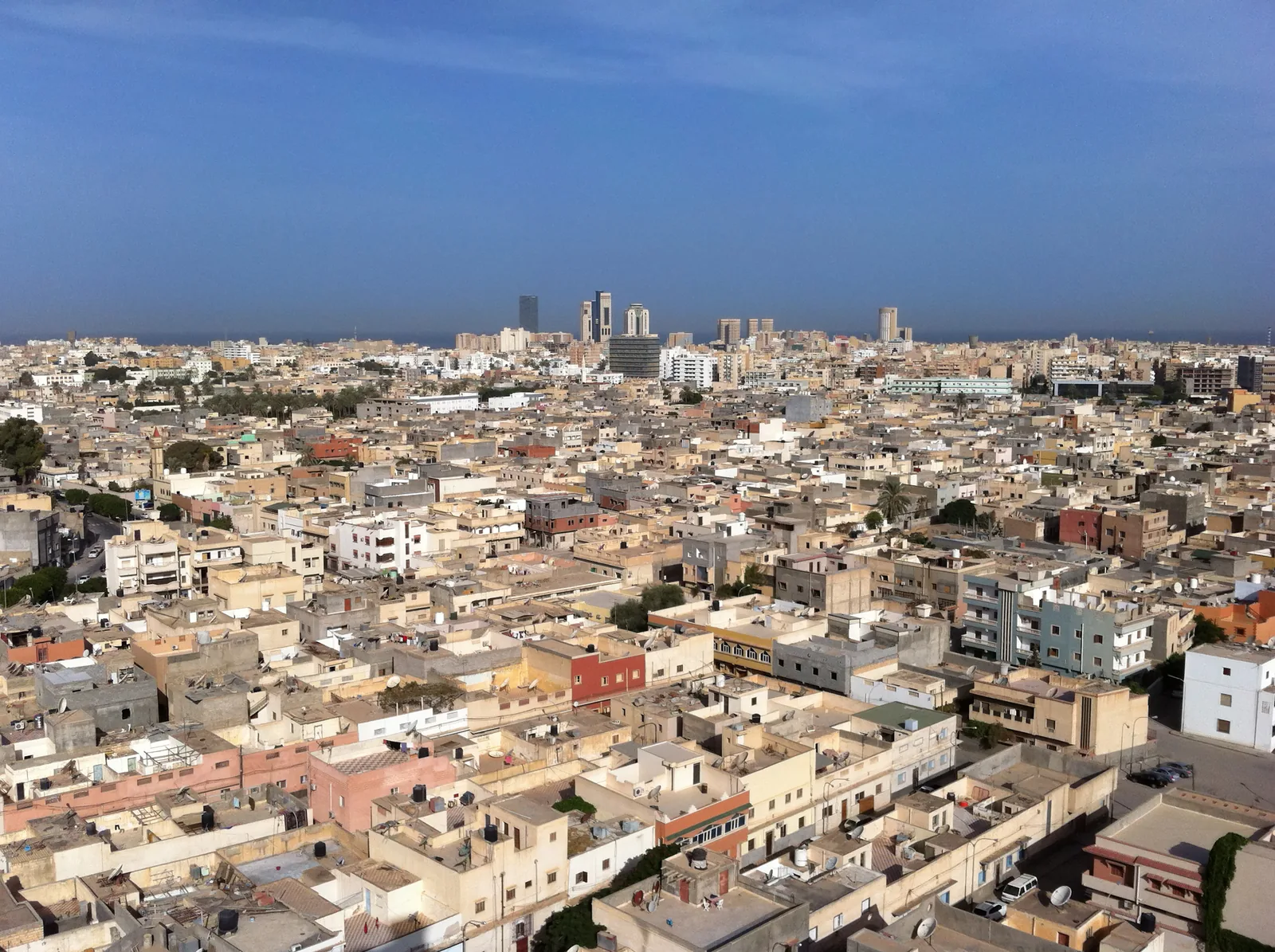
Libya's frozen conflict is one of the strangest wars in the world: a country split in two since 2014, with rival governments, rival armies and rival foreign backers — yet no full-scale fighting for years, because the elites on both sides discovered that sharing the oil money is more profitable than winning. Fifteen years after the fall of Muammar Gaddafi in 2011, Libya's sovereignty remains torn apart, and as Le Monde reported in September 2026, outside powers are now openly carving up the country behind closed embassy doors.
Key takeaways
- Libya has been effectively divided since 2014 between Tripolitania in the west — seat of the UN-recognised Government of National Unity in Tripoli under Prime Minister Abdulhamid Dbeibah — and Cyrenaica in the east, dominated by Field Marshal Khalifa Haftar's Libyan National Army and a rival administration.
- Oil is the prize and the weapon: Libya holds Africa's largest proven oil reserves. Armed groups routinely shut fields and pipelines to press demands — in September 2026 an unnamed group closed a valve on the El Sharara pipeline, and the National Oil Corporation warned it could declare force majeure.
- The freeze is maintained by a transactional bargain between the rival camps and their foreign backers. As Le Monde put it: "The clash of 2019 has become collusion by 2026."
- The US has re-entered Libyan diplomacy under Trump's adviser Massad Boulos, pushing a reunification plan that would reportedly make Haftar president and Dbeibah prime minister — while Russia's Africa Corps keeps bases in Haftar-controlled territory as a logistics hub for the Sahel.
Contents
- Two governments, one country
- Oil: the prize that froze the war
- Why Libya's frozen conflict endures
- What could break the freeze
Two governments, one country
The division dates to 2014, when Field Marshal Khalifa Haftar launched Operation "Karama" (Dignity) from Cyrenaica at the head of a coalition he named the Libyan National Army (LNA). Haftar — a former companion of Gaddafi who helped orchestrate the 1969 coup, was captured in Chad in 1987, disavowed by Gaddafi, and spent years in American exile — returned to Libya during the 2011 revolution and rebuilt himself as the east's strongman. He became the protégé of the United Arab Emirates and Egypt, both determined to arm a counter-revolution against the Muslim Brotherhood empowered by the Arab Spring. His failure to seize Tripolitania cemented the division between west and east, Le Monde reported.
The decisive test came in April 2019, when Haftar launched a full offensive against Tripoli, backed by the UAE, Egypt, Saudi Arabia and — in a new development — Russian Wagner paramilitaries. The assault failed at the capital's gates. The decisive factor, Le Monde reported, was Turkey: in early 2020 President Recep Tayyip Erdogan sent troops and Bayraktar TB2 drones to back Fayez al-Sarraj's besieged government, turning the tide. The October 2020 ceasefire ended the fighting but settled nothing. Since then, Libya has lived under what Le Monde calls a de facto security condominium: Turks control the west, Russians dominate the east and part of the south.
Today Tripoli hosts the UN-recognised Government of National Unity led by Abdulhamid Dbeibah; Benghazi and Tobruk host a rival administration backed by Haftar, who at 80-plus remains entrenched as the east's military ruler. The west, unlike Haftar's tightly held east, is fragmented into rival militia strongholds with shifting alliances. Elections meant to reunify the country have never happened; the UN launched a new diplomatic initiative in 2025 aimed at presidential and legislative elections, but the process has stalled.
Oil: the prize that froze the war
Libya holds Africa's largest proven oil reserves, and control of the revenue is the war's true centre of gravity. The National Oil Corporation (NOC) is the state oil operator both sides need — and both sides periodically strangle. The pattern repeated in September 2026, when an unnamed armed group shut a valve on the pipeline linking the El Sharara field — Libya's largest, about 900 kilometres south of Tripoli — to the Zawiya export terminal.
"The closure caused a pressure buildup within the crude oil pipeline, leading to a significant reduction in production at the Sharara field."
So said the NOC in its statement, carried by Africanews with AFP. The company warned it could be "compelled to declare force majeure," which would let suppliers suspend contractual obligations — and warned the Zawiya refinery itself could shut down if the disruption continued. El Sharara is operated by Akakus Oil Operations, a joint venture of the NOC with Spain's Repsol, France's TotalEnergies, Austria's OMV and Norway's Equinor; at full capacity it produces around 350,000 barrels per day, roughly a third of Libya's total output. It was shut for two years between 2014 and 2016 after an earlier blockade, and has suffered repeated stoppages since Gaddafi's fall.
The oil weapon is double-edged: it hurts whoever holds power in Tripoli by cutting state revenue, and it hurts the east by cutting the revenue stream the east also feeds from. That mutual hostage-taking is part of what froze the conflict. But the freezing went further than stalemate — into outright partnership. In 2022, Abu Dhabi brokered a leadership change at the NOC addressing the east's demands for a fairer distribution of oil revenues. A March 2026 UN panel of experts report found that "the scale and level of the organization of illicit petroleum exports (...) reached unprecedented levels," and said this "was only feasible due to the direct involvement of Ibrahim Al Dabiba and Saddam Haftar" — the nephew and national security adviser of the Tripoli prime minister, and the son of the eastern strongman. As Le Monde summarised the arrangement: "The clash of 2019 has become collusion by 2026. The peace of recent years has been maintained at this cost."
Why Libya's frozen conflict endures
The freeze endures because everyone who matters profits from it — and because the outside powers now prefer the transaction to a settlement. Turkey, which once called Haftar a "criminal," now delivers weapons to Benghazi and courts him for reconstruction contracts; Ankara's strategic goal is ratification by the Tobruk parliament of the 2019 maritime boundary agreement it signed with Tripoli, which requires Haftar's approval. The UAE, once exclusively Haftar's sponsor, has opened increasingly to Tripolitania. Yesterday's ideological polarities over political Islam have given way to what Le Monde calls an emerging mercantilism.
Russia's position is colder and more strategic. Africa Corps — the paramilitary force that replaced Wagner — remains sheltered in Haftar-controlled areas, with bases at Al-Qardabiya near Sirte, Al-Djoufra, Maaten Al-Sarra and Birak Al-Chati. Its deployment, Le Monde reported, "is more logistical than combat-oriented," serving as a transit and staging platform for personnel and equipment headed toward the Sahel. "For the Russians, Libya is a means, not an end," a UN source said — the objective being a strategic corridor from Port Sudan to the Gulf of Guinea. Saddam Haftar, the heir to the Benghazi clan, is meanwhile playing both sides: he visited Washington (meeting Secretary of State Marco Rubio alongside Trump's adviser) and then Moscow on August 19. The same Africa Corps footprint that props up the Sahel's military juntas — see our [Sahel conflict explainer](/articles/2026-09-28-sahel-conflict-explained) — is anchored in eastern Libya.
The deepest blockage, though, is domestic. Boulos's reunification plan — a Libyan "mini-Yalta" that would reportedly make Haftar president of a reunified Libya and Dbeibah prime minister — founders on the military command question. The east gives the military primacy; the west places it under civilian authority. In April, eastern and western forces took part in joint US Africa Command "Flintlock" maneuvers at Sirte — but as Anas El-Gomati of the Tripoli-based Sadeq Institute told Le Monde, "the two military apparatuses did not integrate either their chains of command or their communication systems." The marshal's clan is unlikely to surrender the supreme command, which is both the real power and the family inheritance.
What could break the freeze
Two scenarios could crack the arrangement. The first is Tripolitania's inherent instability: the west's fragmented militia strongholds, already jockeying over the political prospects Boulos's plan opens, could turn on each other — and on Dbeibah. The second is the oil lever itself: every pipeline shutdown of the kind seen at El Sharara in September reminds both camps that the revenue-sharing bargain can be unilaterally renegotiated by whoever holds a valve. Watch the NOC leadership, the next round of UN election diplomacy, and Saddam Haftar's balancing act between Washington and Moscow — the three hinges on which Libya's frozen war either stays frozen or thaws violently.