The Nigerian Civil War explained in one line: from 6 July 1967 to 15 January 1970, Nigeria's federal government fought to reverse the Eastern Region's secession as Biafra — a war decided less by its battles than by a blockade that starved the enclave, killed most of its dead, and, televised worldwide, invented the modern humanitarian response.
Key takeaways
- The trigger was protection, the cause a federation that could not protect: after the September 1966 massacres killed an estimated 5,000–50,000 Igbo in the north and up to two million fled east, the East concluded Lagos could not guarantee their safety (see Why did the war start?).
- The death toll is a range, not a number: 500,000 to 3,000,000 on Britannica's span, up to two million on the Oxford history's — the great majority civilians who starved (see How many people died?).
- The famine built the modern aid world: the night airlift into Biafra was a relief operation unprecedented in scale, and the doctors who broke the Red Cross's silence over it founded Doctors Without Borders in 1971 (see How did it shape the world?).
Contents
- Overview
- Why did the war start?
- How did the war unfold?
- How many people died?
- What were the economic effects?
- How did it shape the world?
- What do historians debate?
Overview
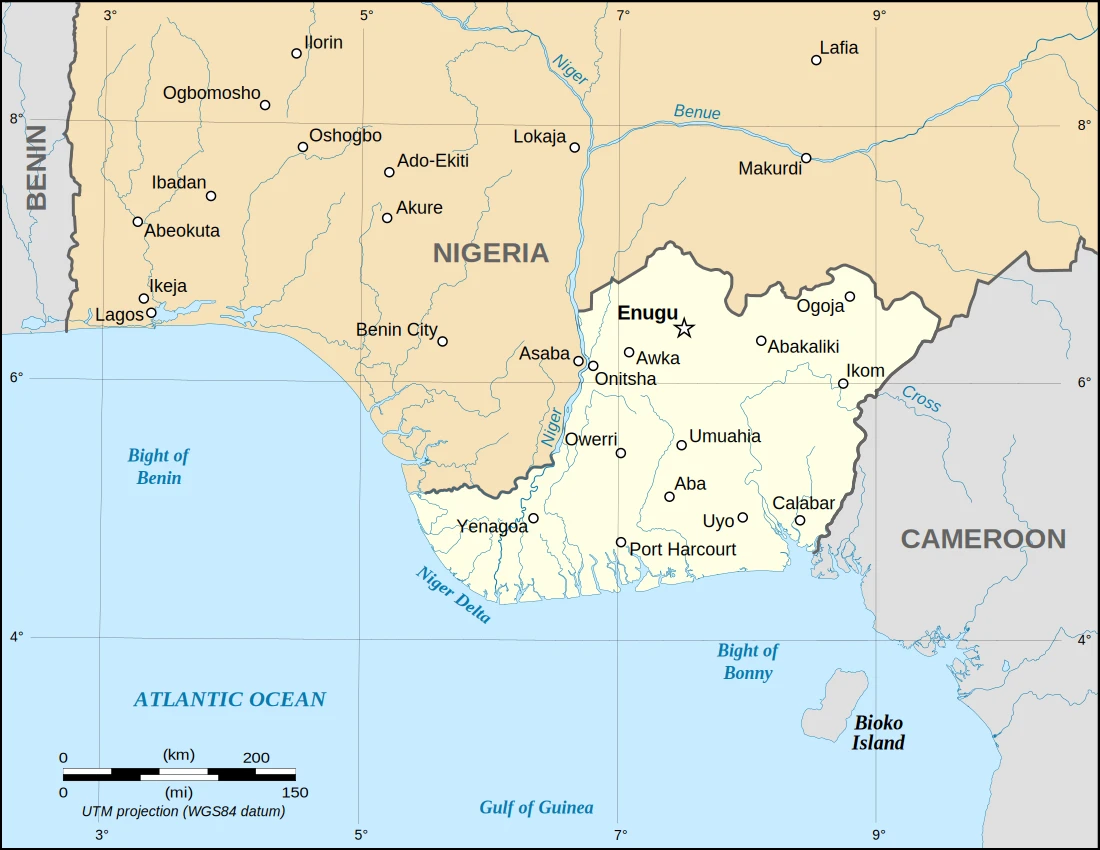
The Nigerian Civil War explained: a war in south-eastern Nigeria fought from 6 July 1967 to 15 January 1970 between Nigeria's federal government under General Yakubu Gowon and the Republic of Biafra, declared on 30 May 1967 by the Eastern Region's governor, Lieutenant Colonel Chukwuemeka Odumegwu Ojukwu (compiled record; Britannica). Within a year federal troops had surrounded Biafra and taken its coast; the blockade that followed produced mass starvation, and most of the war's dead — between 500,000 and 3,000,000 on the range of published estimates — were civilians who starved rather than soldiers killed in battle (compiled record; Britannica; Oxford chapter). Alongside Vietnam, it was one of the first wars televised worldwide, and its relief effort reshaped humanitarian action (compiled record). Biafra surrendered in January 1970 and Nigeria was reunified under Gowon's formula of "no victor, no vanquished" (Origins).
Why did the war start?
The war started because Nigeria's federation broke down in a sequence of coups and massacres that destroyed the East's confidence that Lagos would protect it. The deeper structure was colonial: Britain amalgamated its Northern and Southern protectorates in 1914, ruled the North indirectly through the Sultan of Sokoto and the emirs while shielding it from the missionary schools that educated the south, and left three regions each dominated by one large group — Hausa-Fulani, Yoruba, Igbo — among more than 300 ethnic groups (Oxford chapter; compiled record; Origins). At independence in 1960 the imbalance was measurable: English literacy stood at 2 percent in the north against 19.2 percent in the east (compiled record). Oil sharpened the stakes: commercial quantities were found in the Eastern Region in 1958, and the fiscal settlement that followed centralised mining rents (Oxford chapter, citing Uche 2008).
The collapse came in 1966. In January mostly Igbo officers overthrew the First Republic, killing Prime Minister Tafawa Balewa, Northern Premier Ahmad Bello and 22 senior figures in all, most of them northerners; General Aguiyi-Ironsi neither prosecuted the plotters nor abandoned a unitary-state decree many northerners read as an Igbo-domination plan (Origins; Oxford chapter). Northern officers answered with the counter-coup of 29 July 1966, in which more than 200 mostly Igbo soldiers were killed and Gowon took power; in September massacres in the north killed an estimated 5,000–50,000 Igbo and drove up to two million east (Oxford chapter, citing Anthony 2014 and Stremlau 1977). A last settlement attempt at Aburi, Ghana, in January 1967 foundered on rival interpretations (Britannica). On 27 May 1967 Gowon divided the four regions into 12 states, splitting the East so the Igbo heartland lost most of the petroleum; three days later Ojukwu declared Biafra independent (compiled record; Britannica).
How did the war unfold?
The war unfolded in two unequal halves: a mobile war in 1967, then a siege. The federal government moved first with embargo — extended to oil after Shell-BP paid royalties to Biafra at the end of June — and attacked on 6 July 1967, escalating what Gowon had called police action into "total war" on 10 August (compiled record; Oxford chapter, citing Stremlau 1977). Biafra struck back across the Niger that August, seizing Benin City and advancing toward Lagos before being checked at Ore; federal troops then took Enugu, the Biafran capital (Britannica). A quarter to a third of the region's 12 to 14 million people were ethnic minorities, many of whom stayed in place as federal forces advanced, while Igbo civilians fell back into the shrinking enclave (Oxford chapter, citing Heerten 2017 and Stremlau 1977).
The siege turned on the coast. On 19 May 1968 Port Harcourt — Biafra's port, airport and refinery — fell, leaving the secessionists surrounded and cut off from the sea; the Oxford chapter, following Lasse Heerten, judges that from that moment there was probably no real chance of a Biafran victory (Oxford chapter, citing Heerten 2017). By August 1968 two-thirds of Biafra's territory was in federal hands and up to 8 million people were crowded into the remaining 9,000 square miles, in a region that was not self-sufficient in food — it had relied on the north, and even on Iceland, for protein — so blockade and lost farmland produced famine (Oxford chapter, citing Anthony 2014 and Omaka 2016). Abroad, the war split along interest rather than ideology: Britain and the Soviet Union armed Lagos, France armed Biafra covertly without recognising it, and only four African states recognised Biafra (Oxford chapter; Britannica). The final federal offensive opened on 24 December 1969; Ojukwu fled on 11 January 1970, and the surrender followed within days (Britannica; Oxford chapter).
How many people died?
No agreed total exists, and the honest figure is a range with its attributions. Britannica gives the widest published span: 500,000 to 3,000,000 dead, from battlefield deaths, ethnic cleansing and starvation combined (Britannica). The compiled record's tabulation sits inside it: 45,000–100,000 combatants killed, and 500,000 to 3 million Biafran civilians — mostly women and children — dead by starvation, alongside a narrower modern-expert famine estimate of 500,000 to one million (compiled record). The Oxford humanitarian history states the total as up to two million, mostly Biafran civilians, most killed by starvation and disease rather than by military action (Oxford chapter). What the sources agree on is the structure of the toll: soldiers were a small minority of the dead, and famine inside the blockade was the main killer. Displacement is given at 2,000,000–4,500,000, of whom 500,000 fled abroad (compiled record).
What were the economic effects?
The economic effects ran through oil, the war's prize and paymaster. The 12-state decree of May 1967 excised the main oil-producing areas from the Igbo core state, and the fight over Shell-BP's royalties that June turned a shipping embargo into a full blockade (compiled record). Britain's position followed the same logic — London sold arms to Lagos while holding Shell-BP investments to protect and oil supplies to secure, not least after the June 1967 Arab-Israeli war disrupted Middle Eastern supply (Oxford chapter, citing Uche 2008 and Heerten 2017). Inside the enclave the economy became a relief economy: the ICRC spent CHF 158 million on Biafra across the war, and Joint Church Aid's airlift cost USD 116 million (Oxford chapter, citing Davis 1975 and de Waal 1997). After the war the oil boom let the federal government finance development and consolidate its power (Britannica) — but the peace carried an economic penalty: returning Igbo found their posts and houses taken, property in places like Port Harcourt was treated as abandoned, the currency change voided Biafran-held notes, and every easterner received a flat £20 regardless of prior bank balances — widely seen, the compiled record notes, as a deliberate holding-back of the Igbo middle class (compiled record).
How did it shape the world?
The war shaped the world first inside Nigeria. Secession was defeated and the state held: Gowon's "no victor, no vanquished" reintegrated the former Biafran states without formal blame, and the Origins assessment credits Nigeria's survival with enabling its leadership in founding ECOWAS in 1972 — while judging that the federal government won the war but lost the peace, as the grievances behind MASSOB and, from 2012, IPOB attest (Origins; Britannica; compiled record). The war also hardened an African norm: the Organisation of African Unity backed Nigeria's territorial integrity throughout, and most African states refused Biafra recognition for fear of secessionist precedents at home (Oxford chapter, citing Stremlau 1977).
Second, it remade humanitarianism. The combined relief effort flew around 7,800 flights and up to 100,000 metric tons of food and medicine into the enclave — an operation unprecedented in scale, run mainly by the ICRC, churches and NGOs, with the UN agencies largely absent (Oxford chapter, citing Stremlau 1977). Because Lagos would not authorise night flights and Biafra would not accept daylight ones, relief and arms shared the same dark runways, and the Oxford history concludes the aid almost certainly lengthened the war even as it saved lives (Oxford chapter). The aftershock produced institutions: French doctors who had served in Biafra under the Red Cross's vow of silence — among them Bernard Kouchner and Max Recamier — broke with discretion, and in 1971 their group merged into Médecins Sans Frontières; the Oxford chapter lists MSF and Concern Worldwide among the organisations the crisis brought into being (MSF founding history; Oxford chapter).
What do historians debate?
Historians debate, first, what to call the killing. Biafra's campaign framed the war as genocide from 1968, drawing the Holocaust parallel Heerten documents, and the legal scholar Herbert Ekwe-Ekwe and others have since argued it was a genocide for which no perpetrator has been held accountable (compiled record; Oxford chapter). Critics accept that starvation was pursued deliberately, but argue the label sits ill with the fact that the Igbo were not exterminated after the war — Nigeria fought to keep Biafra and its people, not to expel or destroy them (compiled record). Chinua Achebe's memoir There Was a Country (Penguin Press, 2012) reopened the argument: Achebe, who had helped provide Biafra's intellectual foundation, presented the starvation policy as genocide and Finance Minister Obafemi Awolowo as its architect — a depiction his Ife Journal reviewer records was widely attacked as Igbo chauvinism (Somotan, reviewing Achebe).
Second, they debate whether the aid helped or harmed. John Stremlau's 1977 study The International Politics of the Nigerian Civil War established that private relief strengthened the secessionists and shaped the war's course; the Oxford history restates it as aid almost certainly lengthening the conflict (Oxford chapter, citing Stremlau 1977). Set against it stands the position of the doctors who were there: Recamier and Kouchner held that the world needed to know of civilians being murdered and starved by blockading forces — the stance that produced MSF (MSF founding history). The Oxford chapter adds the dilemma's other edge: absent international relief, the war would likely have been much shorter, and with far fewer casualties (Oxford chapter).
Third, they debate the war's meaning for Africa. The Origins assessment calls it, in a judgement it says most historians share, the most unambiguous testimony of the failure of colonial rule in Africa, while noting the same state then held together for fifty years (Origins). Heerten shifts the frame outward: the war's global moment, on his argument, is closely linked to the ascendance of human rights, humanitarianism and Holocaust memory in a postcolonial world (Heerten, publisher's record).