The Second Congo War explained in one line: between 1998 and 2003 the Democratic Republic of the Congo — a country the size of Western Europe — was fought over by nine African nations and about 25 armed groups, in a war that began when the president ordered his own foreign sponsors out, froze along a 2,400-kilometre front, and killed, on estimates that still span an order of magnitude, somewhere between several hundred thousand and several million people, most of them by disease and hunger rather than battle.
Key takeaways
- It began as a divorce, not an invasion plan: Laurent-Désiré Kabila owed his presidency to Rwanda and Uganda; when he ordered their troops out on 27 July 1998, they backed the rebellion that opened the war six days later (see Why did the war start?).
- Foreign armies decided the opening, then cancelled each other out: Angola and Zimbabwe saved Kinshasa in August 1998, and by mid-1999 neither coalition could advance (see How did the war unfold?).
- The death toll is a methods dispute, not a number: 5.4 million excess deaths on the IRC's survey count, about 860,000 on the Human Security Report Project's recalculation, 1–1.9 million on demographic modelling (see How many people died?).
- The war paid for itself: a UN panel found resource exploitation had become the means of sustaining the conflict — which is why the 1999 ceasefire, silent on mining profits, did not end it (see What were the economic effects?).
- It ended by partition of power, not victory: after Kabila's assassination, his son Joseph traded withdrawal for power-sharing — and the east's wars continued under new names (see How did it shape the world?).
Contents
- Overview
- Why did the war start?
- How did the war unfold?
- How many people died?
- What were the economic effects?
- How did it shape the world?
- What do historians debate?
Overview
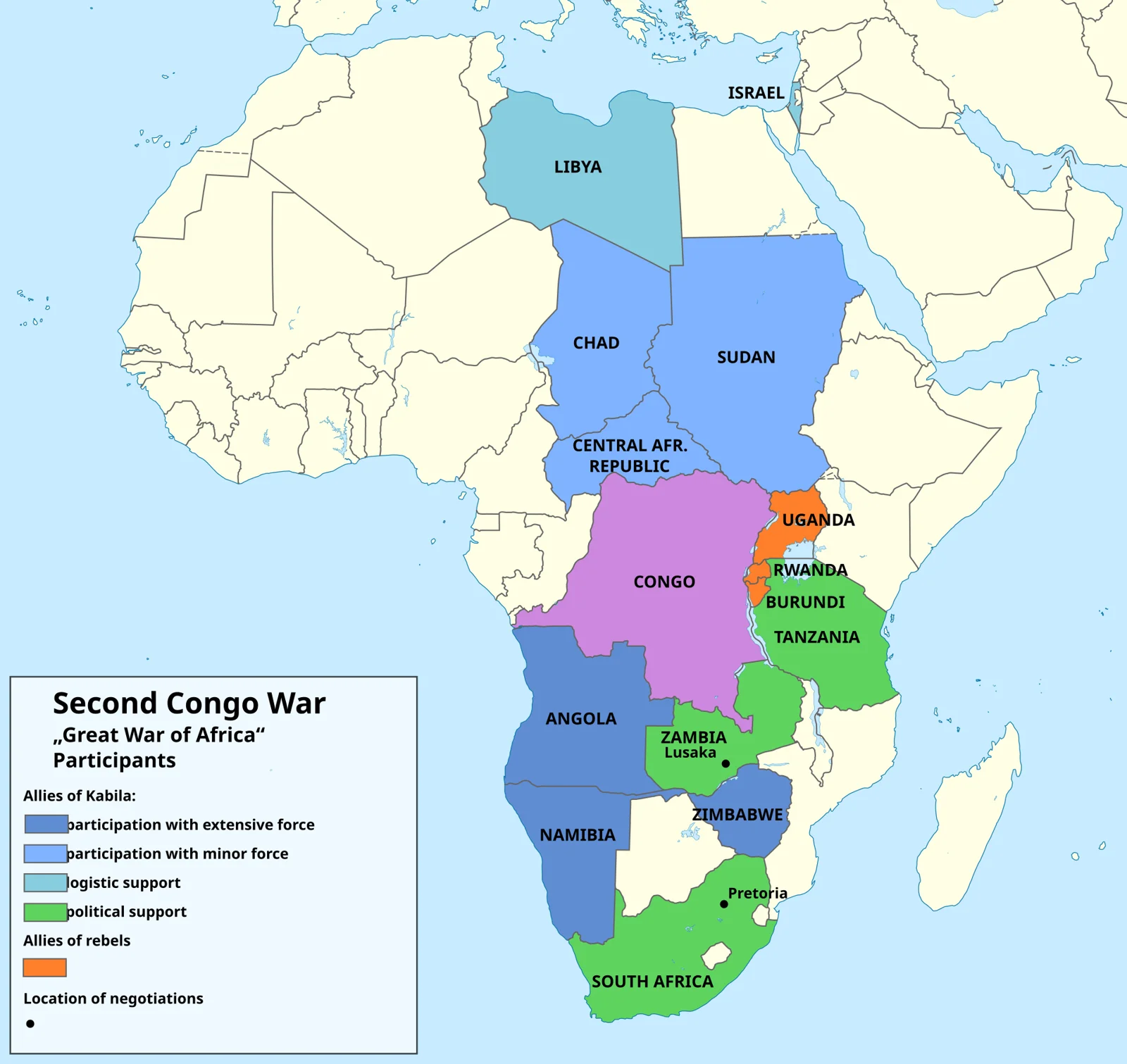
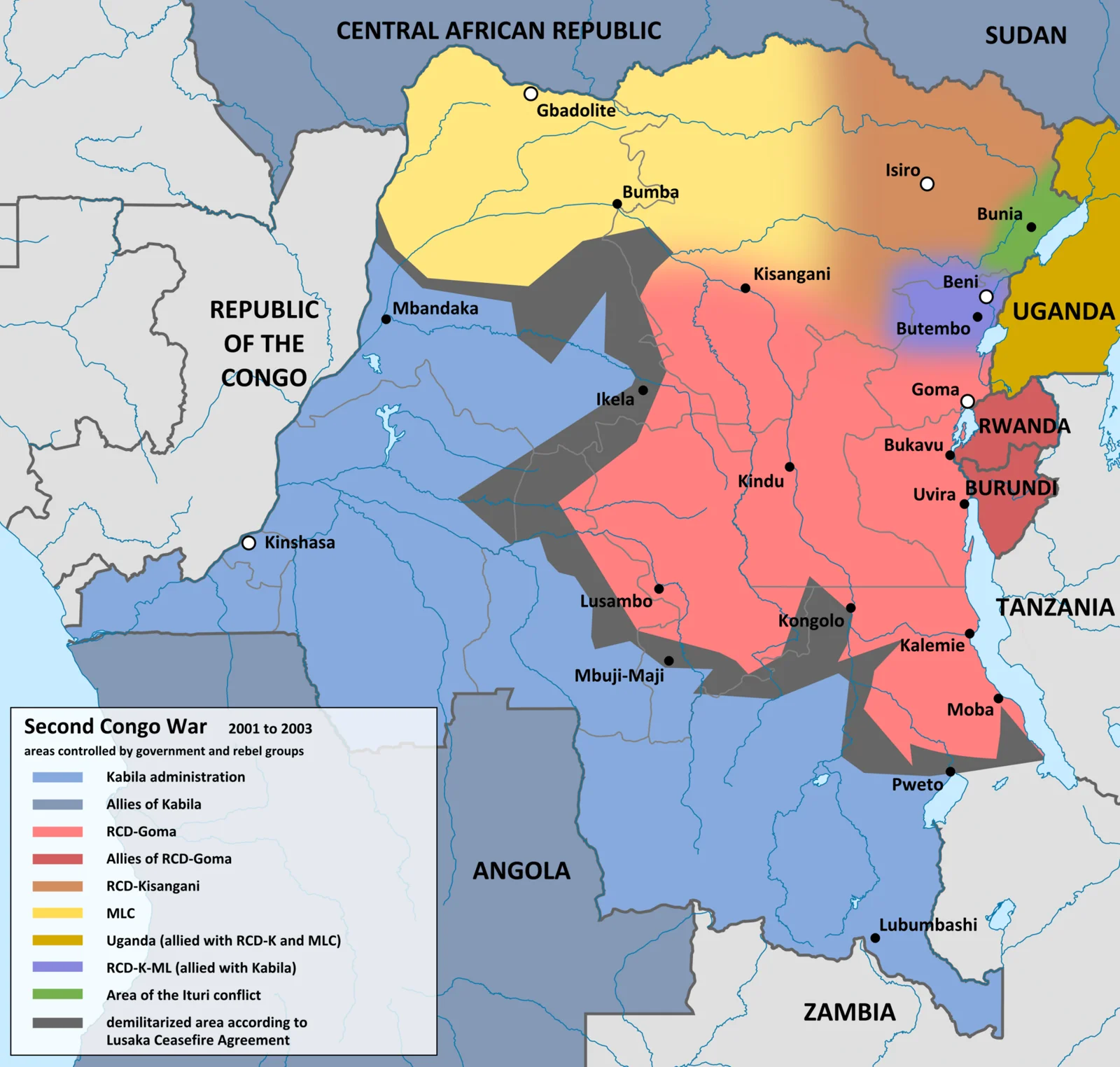
The Second Congo War was a regional war fought inside the Democratic Republic of the Congo from 2 August 1998 to 18 July 2003, when the Transitional Government took power — the largest war in modern African history by the number of states involved: nine African nations and approximately 25 armed groups, inside a country the size of Western Europe (compiled record; Stearns). Also known as Africa's World War and the Great War of Africa, it was fought by two opposing coalitions through Congolese rebel movements and allied militias, and neither coalition could win. Rwanda and Uganda, with Burundi, backed the rebellions — the Rally for Congolese Democracy (RCD) and Jean-Pierre Bemba's Movement for the Liberation of Congo (MLC) — while Angola, Zimbabwe and Namibia intervened for the government in Kinshasa and Chadian troops deployed in the north (compiled record; Britannica). By the end of 1998 the rebels and their backers controlled a third of the country (Britannica). Around 2 million people were displaced during the war (compiled record).
Why did the war start?
The war started because the settlement of 1997 left Rwanda's security problem inside Congo and Congo's sovereignty problem inside Rwanda's army. In 1996 Rwanda had intervened in Zaire, supported by Uganda and Burundi, officially to drive out the Hutu militias responsible for the 1994 genocide who had taken refuge in North and South Kivu (UN News); in May 1997, with support from Kigali and Kampala, Laurent-Désiré Kabila seized power, forcing Mobutu Sese Seko into exile, and restored the name Democratic Republic of the Congo (UN News). But the génocidaire militias were dispersed, not disarmed, the Banyamulenge's citizenship remained contested, and Rwandan officers — James Kabarebe as chief of staff — sat atop the new Congolese army (compiled record).
Through 1998 the alliance inverted. Kabila, portraying himself as a Congolese nationalist, suspected a Rwandan-backed coup plot; he dismissed Kabarebe on 13 July and on 27 July ordered all Rwandan troops to leave (compiled record). The Banyamulenge, feeling threatened, declared a rebellion on 2 August with Ugandan and Rwandan backing (compiled record). Jason Stearns finds the second war's causes less clear than the first's: Rwandan hubris after the victories of 1994 and 1997, Congolese divisions, and the weakness of a government built on Mobutu's kleptocracy all contributed (H-Net review of Stearns). Gérard Prunier's framing is structural: the genocide of 1994 was the beginning of endless regional warfare, and Kagame's pursuit of the génocidaires into eastern Congo produced the continental catastrophe (H-Net review of Prunier).
How did the war unfold?
The war unfolded in three phases: a failed bid for Kinshasa, a frozen front, and an unwinding that only Kabila's death unlocked. On 4 August 1998 Kabarebe airlifted Rwandan and allied troops to Kitona airbase in the west, seized Matadi and the Inga dams and cut Kinshasa's electricity (compiled record). The bid was stopped by Zimbabwean and Angolan intervention — Angolan forces retook Bas-Congo within 48 hours of entering on 22 August (compiled record). In the east, Rwandan troops and RCD rebels overran North and South Kivu from 2 August, captured Kisangani on 23 August and Kindu on 16 October, while the Ugandan-backed MLC took Équateur from November (compiled record).
From November 1998 to mid-1999 neither side could advance. The rebel offensive toward the diamond centre of Mbuji-Mayi in June 1999 yielded the Lusaka Ceasefire Agreement, signed by six heads of state by 11 July 1999 and by the rebel movements that August (compiled record). Lusaka largely stopped movement along a 2,400-kilometre front but was not implemented on schedule, and fighting continued (compiled record; Britannica). It called for the génocidaire groups' disarmament, foreign withdrawal and a national dialogue, and brought in MONUC — created on 30 November 1999 and authorised at 5,537 troops on 24 February 2000 to monitor the ceasefire (compiled record). The anti-Kabila coalition also fractured: Rwanda and Uganda fought each other for Kisangani in August 1999 and again in the Six-Day War of June 2000 (compiled record).
The deadlock broke politically. On 16 January 2001 Laurent Kabila was shot by a bodyguard; his son Joseph was sworn in on 26 January and on 15 February revived the Lusaka agreement his father had not implemented (compiled record). Withdrawals were then bought one by one: the Sun City Agreement of April 2002 with the MLC; the Pretoria Accord of 30 July 2002, under which Rwanda withdrew — MONUC confirmed more than 20,000 Rwandan soldiers gone by October — in exchange for the Hutu militias' disarmament; and the Luanda Agreement of 6 September 2002 for Uganda's withdrawal (compiled record). The Global and All-Inclusive Agreement of 17 December 2002 created the power-sharing transition, its Final Act was signed on 2 April 2003, and the Transitional Government took power on 18 July 2003 (compiled record).
How many people died?
No agreed total exists, because the studies measure excess deaths above a peacetime baseline nobody can observe directly, in a country whose last pre-war census was in 1984. The highest and most cited figure is the International Rescue Committee's: an estimated 5.4 million excess deaths from August 1998 to April 2007, principally through disease and starvation, with 3.8 million to April 2004 and at least 350,000 people directly killed by violence as of 2001 (compiled record). The IRC's five surveys over seven years surveyed as many as 19,500 households in a single round, and its results were published in The Lancet (Congo Research Group). A UN Panel of Experts separately put the excess deaths attributable to Rwandan and Ugandan occupation in the five eastern provinces alone, to September 2002, at between 3 and 3.5 million (compiled record).
The Human Security Report Project at Simon Fraser University challenged the count on two grounds: two of the IRC's five periodic estimates, covering 1998–2001, were flawed, and the IRC's baseline — a crude death rate of 1.5 per 1,000, the sub-Saharan average — was far too low for a country near the bottom of almost every regional development indicator, so most of those counted would likely have died anyway (compiled record; Congo Research Group). Its revised total was about 860,000 war-related excess deaths (compiled record). Demographic modelling points between the poles: Richard Kapend, Andrew Hinde and Jakub Bijak, combining the 1984 census, the 1995 and 2001 household surveys and the 2007 Demographic and Health Survey, estimated excess population loss at 2.4 million for a closed population and 1.7 million with migration incorporated, and advocated a plausible range of 1 to 1.9 million rather than any single best estimate — noting published estimates run from 5.4 million down to the 200,000 that Lambert and Lohlé-Tart derived from voter-registration data (Kapend et al.). Stearns's verdict is the honest summary: the doubt persists because the true baseline will never be known, and unrepresentative sampling could bias the result either way — the IRC could not visit some of the most violent areas at all (Congo Research Group). No party contests the composition: the overwhelming majority of the dead were civilians, killed by malnutrition and disease after the health system collapsed, not by weapons (compiled record; H-Net review of Stearns).
What were the economic effects?
The economic effects ran in both directions: Congo's economy collapsed for its population while becoming profitable for the armies occupying it — and that profit is the documented reason the war outlasted its ceasefire. The UN Panel of Experts on the illegal exploitation of Congolese resources found that the collapse of state institutions had produced continuing and systematic exploitation by predatory groups; its chairman, Mahmoud Kassem, told the Security Council in December 2001 that exploitation had become the means for sustaining the conflict, and that Lusaka had never addressed the profits from it (UN News). The panel's April 2001 report accused Rwanda, Uganda and Zimbabwe of systematically exploiting coltan, diamonds, gold, copper, cobalt, timber and coffee, and its October 2002 report described three criminal networks linked to the Rwandan, Ugandan and Congolese-Zimbabwean sides continuing the plunder after the armies formally withdrew (compiled record; UN News).
For ordinary Congolese the war economy meant disconnection: overland travel became impossible, internal trade came to a standstill, the Congo River carried no ship traffic between the rival zones for years, and food prices in Kinshasa quadrupled within a year (compiled record). The interveners paid at home as well: Zimbabwe spent $166 million on its Congo deployment in the first six months of 2000 alone, on a leaked finance-ministry memo reported by the Financial Times — a drain the compiled record lists among the contributors to the instability that culminated in Zimbabwe's hyperinflation of 2007–2009 — while Namibia's smaller deployment was costed at $150,000 a day (compiled record).
How did it shape the world?
The war shaped the world first by deciding that Congo would survive as one state — at the price of sharing its government with the men who had fought it. The transition kept Joseph Kabila as president, divided office among the government, the MLC, the RCD and the civilian opposition, and was charged with drafting a constitution and holding elections (compiled record; Britannica). South Africa's arbitration at Sun City and Pretoria, Prunier's reviewer notes, nudged the rebels to the table and began the withdrawals — by default, as the only power significant enough, and African enough, to move the parties (H-Net review of Prunier).
Second, it created structures that still define Congo's place in the world. The International Criminal Court opened its Congo investigation in 2004 (compiled record), and in December 2005 the International Court of Justice ruled that Uganda had violated Congolese sovereignty, in a case in which Kinshasa sought $10 billion (compiled record). MONUC never left: renamed MONUSCO in 2010, it remained in the east with its mandate extended through the end of 2025 (UN News).
Third, the war subdivided rather than ended. Congolese Tutsi officers under Laurent Nkunda refused integration into the new army in July 2003 and rebelled in February 2004, becoming the CNDP; the Hutu FDLR — the génocidaire successor whose disarmament Rwanda had traded its withdrawal for — remained active; and the Ituri conflict, ignited under Ugandan occupation in 1999, produced more than a dozen militias by 2003 (compiled record).
What do historians debate?
Historians debate, first, what kind of war this was. Prunier's Africa's World War (Oxford University Press, 2009) supplies the name and the model: not the First World War, his reviewer stresses, but the Thirty Years' War — regional conflicts and perceived national identities melting local violence into successive regionalised wars, with Rwanda, from the 1994 genocide onward, as the catalyst (H-Net review of Prunier). Stearns's Dancing in the Glory of Monsters (2011) works at the opposite scale — a micro-level narrative built on years of interviews, through the actors' own eyes — and reaches a complementary point: the Congo wars are hard to explain because no single individual or group directed the killing, no Hitler or Stalin, which is why they spiralled as outside powers advanced their own interests (H-Net reviews of Prunier and Stearns). His reviewer adds the saying Stearns heard repeatedly: where elephants fight, the grass is trampled (H-Net review of Stearns).
Second, they debate whether resources caused the war or merely prolonged it. The UN Panel's finding supports prolongation on documentary evidence (UN News; compiled record). The origins evidence points elsewhere — the triggers in the record are security and sovereignty: the génocidaire camps, the Banyamulenge's contested citizenship, Kabila's expulsion order — with the mining economy consolidating after the front froze in 1999 (compiled record). The careful literature generally holds both: resources did not start Africa's World War, but they are why a ceasefire signed in 1999 took four more years to take effect.
Third, they debate the dead — the mortality controversy above, in which survey epidemiology, the baseline critique and demographic reconstruction produce figures an order of magnitude apart from substantially the same country (Congo Research Group; Kapend et al.). Prunier closes the question of scale from the other end: whatever the true toll, the death and rebirth of Zaire was a unique case — no other African country, he argues, has the potential to create such a continent-wide upheaval again (H-Net review of Prunier).