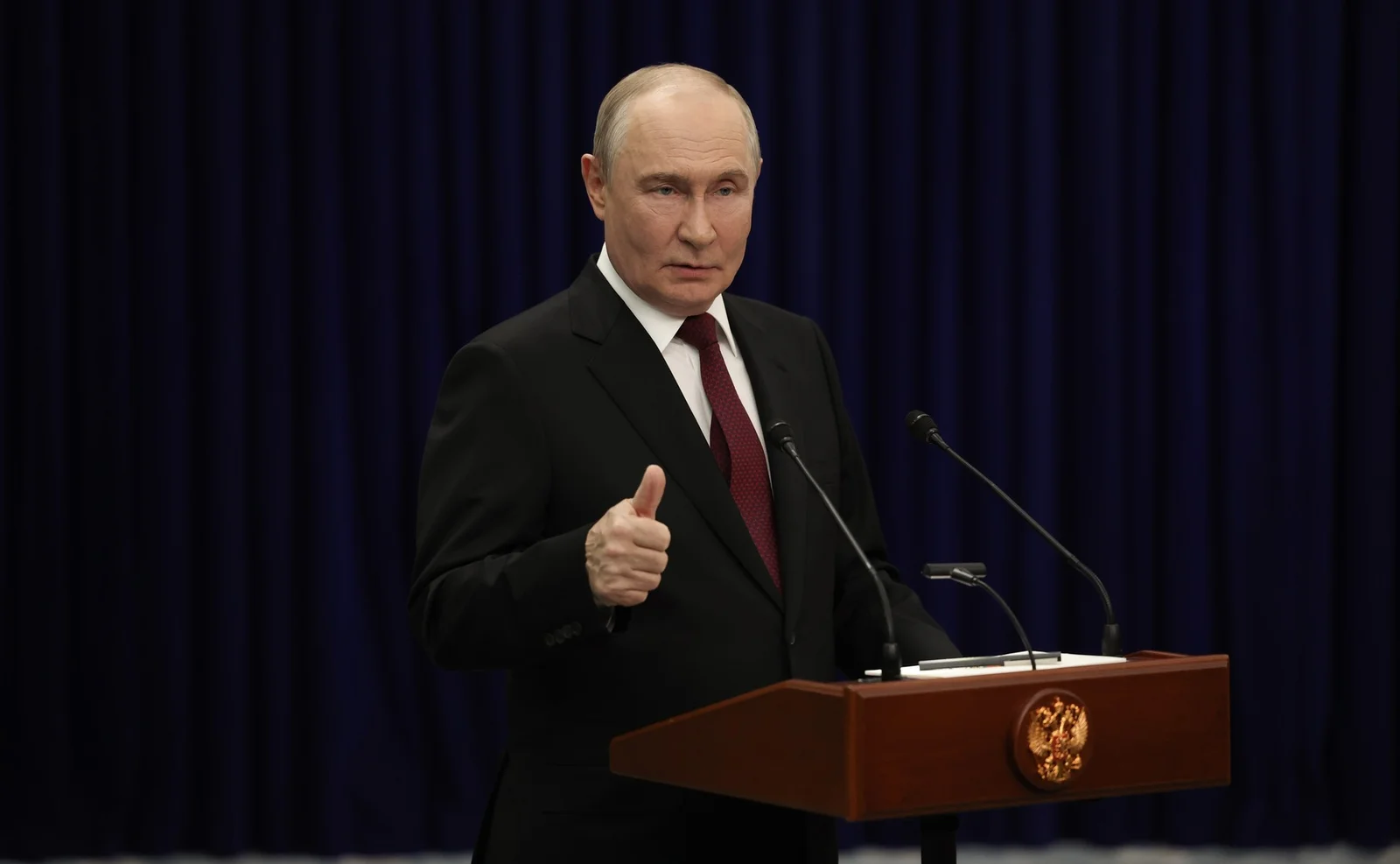
Russian President Vladimir Putin said on Thursday that Moscow would resort to all weapons in its arsenal — including nuclear weapons — if its most westerly territory, the Baltic exclave of Kaliningrad, were attacked. Speaking at the Valdai Discussion Club's annual meeting in Moscow, Putin personally endorsed a warning Russia had first delivered to NATO through diplomatic channels earlier this week.
What did Putin say?
"If it comes to a direct attack on the Russian Federation — in this case, we are referring to Kaliningrad, and perhaps other territories as well — the question of the Russian Federation deploying all the weapons at our country's disposal will, of course, inevitably and immediately be on the agenda," Putin told the Valdai Forum of international Russia experts in Moscow, according to Reuters. "This is inevitable."
Putin said the world was living through a dangerous moment and warned the West not to escalate a standoff over Ukraine by threatening Kaliningrad, the heavily militarized Russian exclave wedged between NATO members Poland and Lithuania. He cited successive NATO military exercises in the Baltic Sea and what he described as attempts to intercept Russian vessels: "All this constitutes an escalation," he said, according to CNN.
At the same time, Putin said Russia had no plans to attack any European country and wanted to coexist peacefully, framing the warning as a response to intimidation rather than a threat of aggression. "It's not intimidation, it's a response to an attempt to intimidate us," he said. He added: "We have no intention of attacking anyone — neither in 2029, nor in 2030, nor in 2050. However, if we face aggression, we will be compelled to respond."
Why is Kaliningrad the flashpoint now?
Putin's remarks followed a diplomatic note Russia sent to NATO this week, warning the alliance it would be ready to resort to nuclear weapons if NATO attempted to cut off Russia's Baltic exclave, Reuters reported. Russian embassies in several European countries had also issued statements claiming Moscow had "information that NATO is preparing an air and naval blockade of Kaliningrad" — claims for which Russia has provided no public evidence.
NATO Secretary General Mark Rutte said the alliance had responded by emphasizing that it is a defensive alliance and that nuclear threats were not helpful, according to Reuters. Relations between Moscow and the West, already dire since Russia's full-scale invasion of Ukraine in 2022, have worsened this year as European governments accuse Moscow of stepping up a "hybrid war" on the continent through acts including sabotage and arson — accusations Russia denies and rejects, along with Western statements that it is preparing an attack on a NATO country.
What else came out of the Valdai session?
Putin acknowledged that Ukrainian strikes on Russian oil refineries had cost Russia about 1 percent of its gross domestic product this summer, but said Russia was responding in kind against Ukrainian steel plants, railways, warehouses and Black Sea grain exports, Reuters reported. He said he was ready for a trilateral meeting with Chinese President Xi Jinping and U.S. President Donald Trump if a proper agenda was worked out first, and ruled out stopping Russian strikes on Ukrainian targets in the Black Sea area — while adding that Moscow was not planning to attack European arms factories supplying Ukraine "tomorrow."
He also warned that cycles of escalation in international conflict could quickly lead to dangerous scenarios. "The logic of escalating, increasingly harsh retaliatory measures leads to a fatal point of no return," he said. "Can we be certain that these weapons will never be used? Well, of course not. We must bear this in mind and avoid such an outcome."
Related: our [September 30 report on Russia's nuclear warning to NATO over Kaliningrad](/articles/2026-09-30-1005-russia-nuclear-warning-nato-kaliningrad) and [October 3 report on Russia's strikes on Kyiv's bridges](/articles/2026-10-03-0530-kyiv-northern-bridge-strike-third-day).