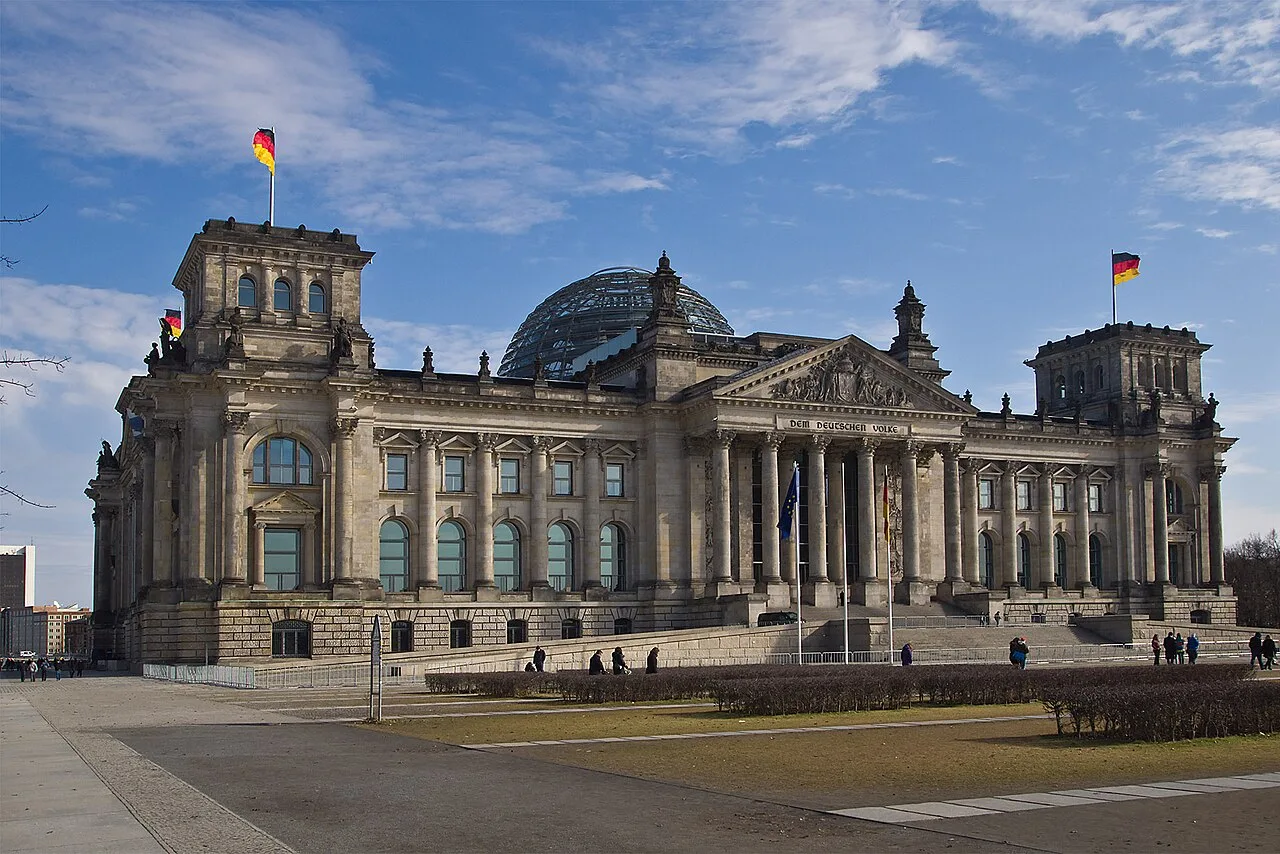
The Coalition of the Willing met in Berlin on Thursday — Ukraine's main European allies, NATO's secretary-general and two US envoys in one room — to reaffirm legally binding security guarantees for Ukraine that would take effect after a ceasefire, hours after the Trump-Putin-Xi summit opened in Shenzhen. The Berlin meeting of the coalition of the willing was built around a single anxiety, reported by Reuters, DW and AFP alike: that decisions on the war could be taken in China without European input. Its timing, German officials told Reuters, was chosen so Europe could give a quick, joint response to any announcement from Shenzhen. The war itself is tracked on this site's Ukraine hub, and the guarantee question the Berlin leaders came to reaffirm is set out in our Ukraine security guarantees explainer.
Who was in Berlin, and what was the meeting for?
The meeting brought together the leaders of Germany, France, Britain, Poland and Italy, NATO head Mark Rutte, and US President Donald Trump's special envoys Steve Witkoff and Jared Kushner, Reuters reported; AFP put the wider attendance at more than 30 European government leaders plus Ukrainian President Volodymyr Zelensky, with the summit co-hosted by the leaders of Germany, France and Britain. German officials said the focus was reaffirming a commitment to robust and legally binding security guarantees, which would come into force following a ceasefire. DW's account of the same German position added Foreign Minister Johann Wadephul's framing: the meeting should send a signal to Russia — "It's really about time to be serious with the negotiations" — and the allies were readying themselves for all possibilities, including the failure of negotiations, which would require supporting Kyiv's energy and food needs. "We will also be on Ukraine's side militarily," Wadephul said.
Zelenskiy set out Kyiv's purpose plainly. The meeting, he said, would provide an opportunity to discuss the negotiations with Witkoff and Kushner and to hear details of the talks that Trump has held in China. "Ukraine clearly states its desire for peace, and we always work constructively," he said, in Reuters' report. AFP reported the same two-track purpose from the European side: boost Europe's role in a process so far dominated by Washington, Moscow and Kyiv, and state the need for Western security guarantees for the post-war period to deter any future aggression. A senior Ukrainian diplomatic source told AFP the expected outcome was "a commitment on financing and weapons" that might "help crystallise Europe's role."

Why did Shenzhen overshadow Berlin?
Only hours before the Berlin meeting was due to start, Trump and Putin were meeting in China at the trilateral summit with Xi Jinping in Shenzhen — a sequence Reuters said had fuelled concerns in Europe that decisions affecting the war and the future of the continent could be taken without European input. The Kremlin made the hierarchy explicit: foreign policy aide Yuri Ushakov, speaking in China, said the Shenzhen trilateral would overshadow the Berlin talks — "What is happening here is the main thing. And what is happening there is important, but it's secondary," AFP reported him telling Russian state media.
Europe's exclusion is not hypothetical in the reporting. European countries, which provide the bulk of aid to Ukraine, have largely been sidelined from the US-led talks with Moscow, Reuters reported: they sent representatives to talks in Abu Dhabi last week, but Kremlin officials said they had not agreed to European officials joining future talks. Chancellor Friedrich Merz's message to Washington, delivered at an EU summit in Dublin last week and quoted by AFP, was aimed at exactly that risk: "Please, no surprises. Stay on Team Europe and Team Ukraine, and let us work together for a genuine peace in Ukraine." British Prime Minister Andy Burnham said the Berlin meeting would signal that Ukraine's European allies "are united as ever in securing a just and lasting peace that sees an end to this senseless war," Reuters reported.
What support was on the table?
The meeting sat on top of a week of concrete commitments. Britain was to announce new details on a support package including long-range drones capable of striking deep into Russia, plus surveillance and logistical drones, Reuters reported; AFP put the expected British announcement at more than 1,000 long-range strike drones, including ones capable of striking beyond 1,000 kilometres. On Wednesday, the European Commission proposed a new €45 billion loan to Ukraine for 2027, against a €70 billion financing gap for next year — a gap Merz has insisted all 27 EU member states must help finance, AFP reported. The Ukraine Defense Contact Group also agreed this week to supply more arms to Kyiv to enable it to keep fighting over the winter, Reuters reported, and a major military exercise in Poland by the military arm of the Coalition of the Willing began this month to test how Western troops could support peace in Ukraine after any agreement.
The transatlantic friction underneath the show of unity was also on the record. The United States and Europe have increasingly moved apart as the Trump administration has scaled back support for Ukraine and insisted its NATO partners pay more for their own defence, Reuters reported, and on Tuesday Germany and Britain rejected US criticism of Ukraine's campaign of deep strikes on Russian oil infrastructure and commercial warehouses. Germany, AFP noted, has emerged as the biggest military aid supporter of Ukraine since Trump scaled back US support. Thursday's meeting, in other words, was both a guarantee negotiation and a demonstration — aimed at Shenzhen as much as at Moscow — that the financing, the weapons and the guarantee language still run through Europe.
Sources: Reuters (19 November 2026, read in full via the rostered 947thebeast.com verbatim carrier), Deutsche Welle (19 November 2026, read in full via the europesays.com DW carriage) and AFP (19 November 2026, read in full via newsworm.de). The convening, attendance and guarantee purpose of the Berlin meeting are confirmed by all three outlets across different tiers and owners — Reuters (Tier 1 wire), DW (Tier 2, German public broadcaster) and AFP (Tier 1 wire). The British drone package is reported as an expected announcement in both the Reuters and AFP accounts and is published as such. No casualty or battlefield claim is made in this article.