
The European Commission proposed a new €45 billion ($49.5 billion) loan to Ukraine for 2027 on Wednesday — an EU loan for Ukraine in 2027 that would cover around two thirds of the €70 billion financing gap Kyiv faces next year, and that Ukraine would repay only once Russia pays for the damage it has caused. Commission President Ursula von der Leyen announced the proposal in Brussels, saying it was the best way to give Ukraine a strong hand at the negotiation table. The measure requires approval from EU member countries, and EU leaders will discuss it at a summit in Brussels next week. It is a separate step from the €90 billion Ukraine Support Loan already being paid out, whose own 2027 tranche the Commission moved to approve last month — two different decisions that both carry a €45 billion figure, set out separately below.
What was proposed on Wednesday?
Von der Leyen said the loan should help cover around two thirds of an anticipated financing gap of €70 billion faced by Ukraine next year as it continues its fight against Russia's 2022 invasion, Reuters reported. "We think this is the best way to give Ukraine a strong hand at the negotiation table," she told reporters in Brussels. "And Ukraine only needs to repay once Russia pays for the damage it has caused in Ukraine." Kyiv's other international partners would be expected to provide the rest of the money needed to fill the gap.
AFP, reporting the same announcement, put the framing in her words at the launch: "Five years since the start of this war of aggression, Europe stands united. We are as committed as ever to support Ukraine in war and in peace." AFP said the funding would go two-thirds of the way towards filling the €70 billion shortfall, with Brussels looking to incentivise other Ukraine backers to do the rest, and that the new loan would follow the same format as the current one — borrowed against headroom in the EU's central budget, and linked to Kyiv pressing on with reforms. In her own presentation of the proposal, von der Leyen named it an Instrument for Coordinated Support to Ukraine, comprising €20 billion for budget support and €25 billion for military needs: "The budget support will keep essential civilian services running, it will keep schools and hospitals operating. And the military support will give Ukraine the means to defend itself." She said she would present the proposal at the European Council next week and discuss it in Berlin tomorrow with partners in the Coalition of the Willing.
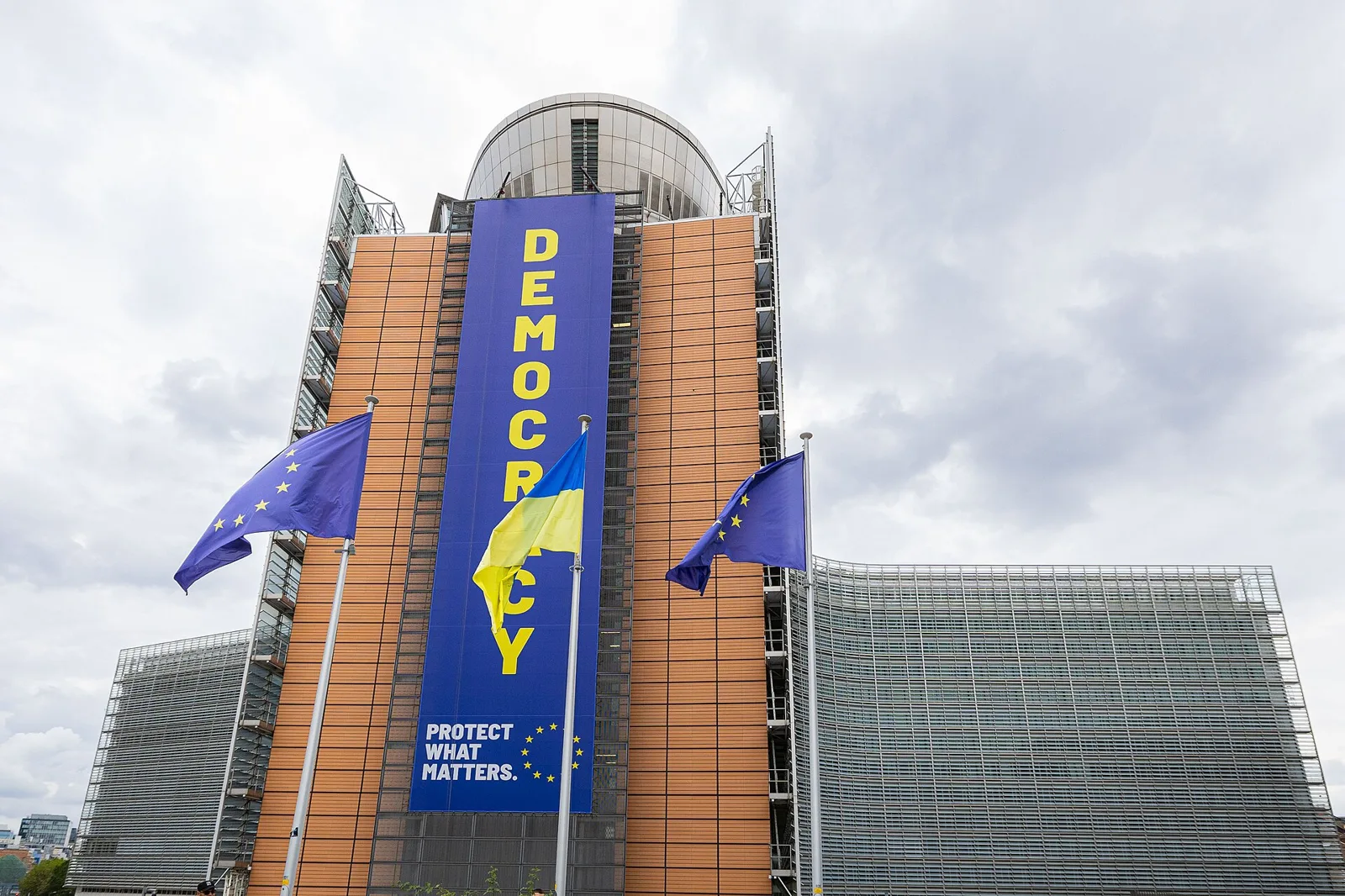
How is this different from the €90 billion loan already under way?
The distinction matters, because two €45 billion figures for 2027 are now in play and they are not the same money. The €90 billion Ukraine Support Loan was established by Regulation (EU) 2026/467, adopted by the European Parliament and the Council in February 2026, and covers Ukraine's needs over 2026 and 2027: €60 billion for defence capabilities and defence industrial capacity, and €30 billion in budget support, according to the Commission. The Council allocated up to €45 billion of it for 2026 in April, of which €19.8 billion has already been disbursed.
On 30 October, the Commission proposed that the Council approve the remaining €45 billion of that same loan for 2027 — up to €13.3 billion in budget support, split equally between the Ukraine Facility and Macro-Financial Assistance, and €31.7 billion for Ukraine's defence industrial capacity, under conditions on the rule of law, anti-corruption, economic resilience and sustainability. Wednesday's proposal is a further step on top of that framework: Reuters described it as a new loan that "would come on top of a similar loan of €90 billion to Ukraine agreed by EU leaders at the end of last year," and AFP reported that the EU is currently paying out the €90 billion loan it had hoped would see Kyiv through to the end of next year, but that as Russia has intensified its attacks it has become clear those funds would not be enough.
Who else is being asked to pay, and what could block it?
The remaining third of the €70 billion gap is being sought outside the bloc. Brussels is pushing other allies of Ukraine — such as Britain, Canada and Japan — to fill in the rest of Kyiv's needs next year, AFP reported, adding that similar pleas have previously fallen short, and that this time Brussels says others could provide guarantees to help bolster the loan or use the interest on frozen Russian assets in the EU to cover their own financing.
Inside the bloc, the politics are the obstacle. German Chancellor Friedrich Merz has insisted that all of the EU must settle the financing and all 27 member states must be involved before a deal can be reached on the budget, AFP reported — a position that has rankled several of the EU's least pro-Ukraine countries who want to be left out of backing the loan, such as Bulgaria, the Czech Republic, Hungary and Slovakia. Last time round, Budapest, Bratislava and Prague managed to get themselves exempted from having to help cover the financing. Von der Leyen insisted the aim this time remains to get all countries on board. The proposal also means that, for now, the EU will not try to directly tap the over €200 billion of frozen Russian central bank assets held in the bloc to fund Ukraine: that plan was shot down in 2025 by Belgium, where the majority of the assets are held, and the position of its government has not shifted, AFP reported.
Why does it matter?
The Commission's own accounting shows the scale of what is already committed: since the start of Russia's war of aggression, the EU and its member states have provided €231.6 billion in overall support to Ukraine, including €3.8 billion from the proceeds of immobilised Russian assets — more than any other partners, the Commission says. Wednesday's proposal tests whether that commitment can stretch to a second, larger financing gap in 2027, at the very moment Ukraine's battlefield position and its negotiating hand are under pressure. The summit in Brussels next week, where leaders hope to reach a deal, is the first test of whether the proposal survives contact with the member states who must approve it.
Sources: Reuters (18 November 2026, read in full on reuters.com) and the AFP wire report of 18 November 2026 (read in full via warriaproko.com; the identical AFP text was verified against a second independent carrier, rapporteur.com, during this run's cabinet review) for Wednesday's proposal, its terms and the summit; the European Commission's press point of 18 November 2026 (primary, read in full via app.1848.nl) for the instrument's name and its €20 billion / €25 billion composition; and the Commission's own statement of 30 October 2026 (read in full on enlargement.ec.europa.eu) for the structure of the existing €90 billion Ukraine Support Loan and its 2027 tranche. The two €45 billion figures are distinct steps — the remaining 2027 tranche of the existing loan, proposed for Council approval on 30 October, and the new loan proposed on Wednesday — and are reported as such above; readers should not add Wednesday's figure to the October tranche as if both were the same decision, nor treat either as money already approved. No markets snapshot box is included: no source opened for this article reported a market move on the proposal.