
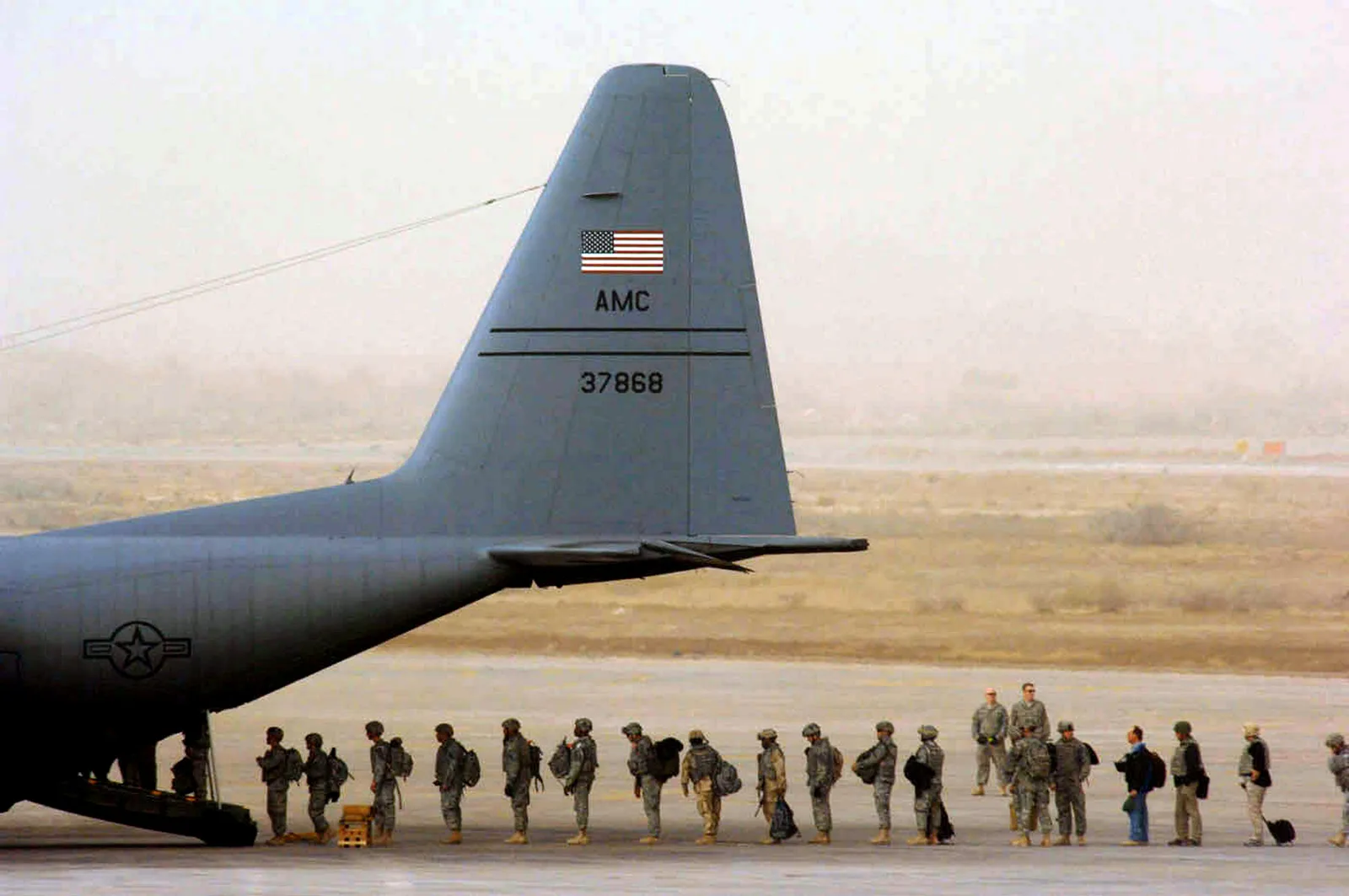
The United States is ending its military presence in Iraq. U.S. forces are withdrawing from their remaining bases in the country on Wednesday, September 30, closing a chapter that began with the 2003 invasion and ended with a U.S.-Iran war still raging around the departing troops.
The departure is being carried out under an agreement struck in 2024 by President Joe Biden's administration and executed by President Donald Trump's — an unusual continuity: the withdrawal proceeds even as the United States wages war against Iran, which wields deep influence in Iraq through allied armed groups. Tehran and its allies are celebrating the exit as a victory, casting it as a triumph for Iran's "axis of resistance."
A withdrawal negotiated in 2024, executed in a war
The core facts are confirmed by both Reuters and the Associated Press. Washington and Baghdad agreed in 2024 to wind down the U.S.-led mission; troops pulled out of bases across most of Iraq last year, with only a few hundred remaining in the semiautonomous northern Kurdish region. Those final personnel are expected to leave by the September 30 deadline, a U.S. military official told the AP, with most redeployed to Jordan and other countries in the region. Military equipment — including air defense systems — is being removed as well.
U.S. forces invaded Iraq in 2003 to topple Saddam Hussein, departed at the end of 2011, and returned less than three years later to help Iraqi forces defeat the Islamic State in the 2014–2017 war. Reuters reports that roughly 4,500 American forces died across over 20 years of war and operations in the country. Bases in northern Iraq have come under regular attack since the U.S. and Israel attacked Iran on February 28; the U.S. official told AP the withdrawal "will reduce our risk" — the Irbil counterterrorism base had lost its operational importance and was increasingly just a target. Iraq has said a "normal bilateral security cooperation" agreement could follow, though neither side has described what it would look like.
The day after: militias, the Islamic State, and an anxious Kurdistan
Three sets of actors are positioning for the vacuum, and none of the outcomes is settled.
Iran's allies claim victory. Abu Mojtaba al-Yasiri, a commander in the Islamic Resistance in Iraq, told Reuters the withdrawal was "a historic victory for the Iraqi Islamic resistance groups" and announced September 30 celebrations. Iraqi analyst Jassim al-Bahadli — who advises the Iraqi security forces — told Reuters he expects pro-Iranian militias to "seek to translate that momentum into greater influence over security and political decision-making."
The militia-disarmament ultimatum is unlikely to hold. Baghdad has tied the U.S. departure to a demand that non-state armed groups surrender their weapons — but as the AP reported, most groups have indicated they have no intention of doing so. The most powerful factions closest to Iran — Kataib Hezbollah, Harakat al-Nujaba, and Kataib Sayyid al-Shuhada — have rejected disarmament or set conditions analysts describe as unmeetable in the near term. "There will be no disarming of any groups by the 30th of September," Iraqi analyst Sajad Jiyad said at an Atlantic Centre panel. Baghdad's stated strategy is to fold the armed factions — many formally part of the Popular Mobilisation Forces — under Iraqi military command; government spokesperson Sabah al-Numan said the file would be "resolved after the withdrawal of the international coalition forces."
The Islamic State's remnants could benefit. Iraqi security officials, both in Baghdad and the Kurdish region, told Reuters the pullout risks giving new life to Islamic State sleeper cells. U.S. troops had been providing Iraqi forces with intelligence on Islamic State movements plus aerial surveillance and reconnaissance. Retired Iraqi Army General Mohammed al-Jubouri flagged a worst-case scenario in which the group obtains armed drones while Iraq "still lacks sufficient air defense capabilities."
The Kurdish region feels exposed. The removal of U.S. air defenses from the Kurdistan region has prompted public anxiety from regional officials, including Prime Minister Masrour Barzani. Analyst Mohammed A. Salih noted that Iran and affiliated groups have struck energy facilities and dissident bases in the region unrelated to the U.S. presence, and warned that "the withdrawal will expose the Kurdistan region even further." Baghdad says it is close to procuring new air defense systems from South Korea, Türkiye, and the United States.
For now, the one certainty is the date. On October 1, for the first time in 23 years, Iraq will have no U.S. military presence — in the middle of a regional war.
---
Sources
- Reuters, "US forces exit Iraq, emboldening Iran's proxies and Islamic State," published September 30, 2026: https://www.reuters.com/world/us-forces-exit-iraq-emboldening-irans-proxies-islamic-state-2026-09-30/
- Associated Press (carried by the Sowetan), "As last US troops pack up in Iraq, militias signal their weapons will stay," published September 15, 2026: https://www.sowetan.co.za/news/world/2026-09-15-as-last-us-troops-pack-up-in-iraq-militias-signal-their-weapons-will-stay/


