
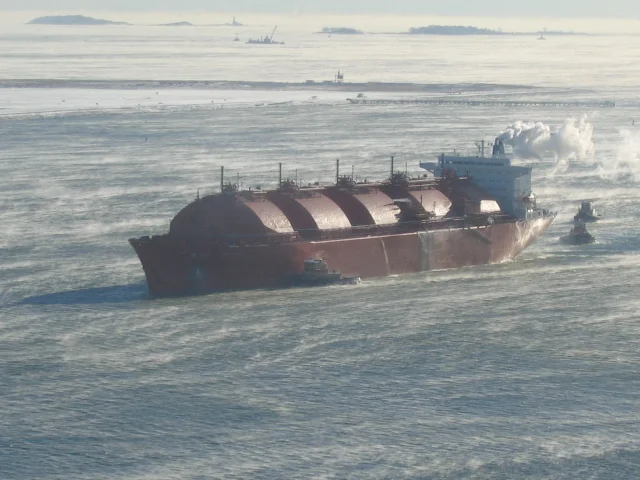
A Kuwaiti-flagged supertanker was struck by an unidentified projectile while transiting the Strait of Hormuz on Thursday, triggering a fire onboard, the UK Maritime Trade Operations center (UKMTO) reported. The crew was reported safe, with damage and any environmental impact still unknown. The Wall Street Journal described it as the fifth UKMTO-reported tanker strike or suspected strike in the strait since September 28.
Maritime security firm Vanguard Tech identified the vessel as the Kazimah III, a 317,250-deadweight-ton very large crude carrier operated by the Kuwait Oil Tanker Company. It is the second KOTC supertanker hit in four days: the Al Funtas was struck while passing through Hormuz on September 28, with a fire that was later extinguished and no pollution reported. Three more tankers — the ADNOC-operated Mersin Prosperity and Al Ruwais, and the Sinbad — were struck earlier in the week, all transiting with their AIS transponders switched off, according to maritime security sources cited by Reuters.
No party has claimed responsibility for Thursday's strike, and the vessel was not identified by UKMTO, which said it received the report from a third party. Iran's semi-official Fars News Agency, citing the Persian Gulf Shipping Authority, claimed the targeted vessel was a supertanker on an "unauthorized route" about 8 kilometers off the Omani coast — a claim with no independent confirmation.
A projectile inside Yanbu port
On the same day, an unidentified projectile struck inside Yanbu port on Saudi Arabia's Red Sea coast, sparking a fire and prompting authorities to temporarily suspend loading operations, according to Vanguard Tech and Clearwater Dynamics. The incident was reported by the master of a Liberian-flagged tanker and described as an aerial attack; loading with the reporting vessel was halted before subsequently resuming. No casualties or extent of damage to port infrastructure have been confirmed, and neither Saudi Aramco nor Saudi port authorities have publicly confirmed the incident or attributed it.
The Yanbu strike matters because the port is Saudi Arabia's main Hormuz bypass. It had only just returned to crude export operations after drone attacks forced the kingdom to shut its East-West Pipeline on September 11; the pipeline restarted September 22, and Yanbu was exporting an estimated 2 million barrels per day before Thursday's attack. Satellite imagery from September 27 showed nearly 10 million barrels being loaded across Yanbu and the nearby Al Muajjiz terminal as Riyadh pushed crude west to reduce reliance on Hormuz.
The strike also came days after French President Emmanuel Macron pledged to deploy soldiers, radars and air-defense systems to protect the Yanbu terminal. Saudi forces reported shooting down a small number of attempted drone and ballistic-missile strikes at Jazan and the inland city of Khamis Mushait on the same day, according to The Maritime Executive.
Markets and the wider campaign
Brent crude jumped 4.4% on Thursday to settle at $102.31 as supply risks stayed in focus, then eased Friday after the G-7 agreed to release 100 million barrels of crude and fuel from emergency stocks. The International Maritime Organization had confirmed 85 attacks on commercial shipping in and around Hormuz by September 24, before the latest series.
Kpler data cited this week put September crude flows through Hormuz at about 9.72 million barrels per day — up from lows of 2.2 million in late July — with Saudi exports around 5.4 million bpd. But the recovery runs on a changed system: some 40% of Gulf exports now leave without crossing Hormuz, versus 17% before the war, as the UAE and Saudi Arabia lean on pipeline routes that are themselves coming under repeated attack.
The identity of Thursday's attackers — in Hormuz and at Yanbu — remains unresolved in all reporting reviewed. Until a party claims responsibility or a government attributes the strikes, the two incidents stand as confirmed attacks with unconfirmed authorship.


