
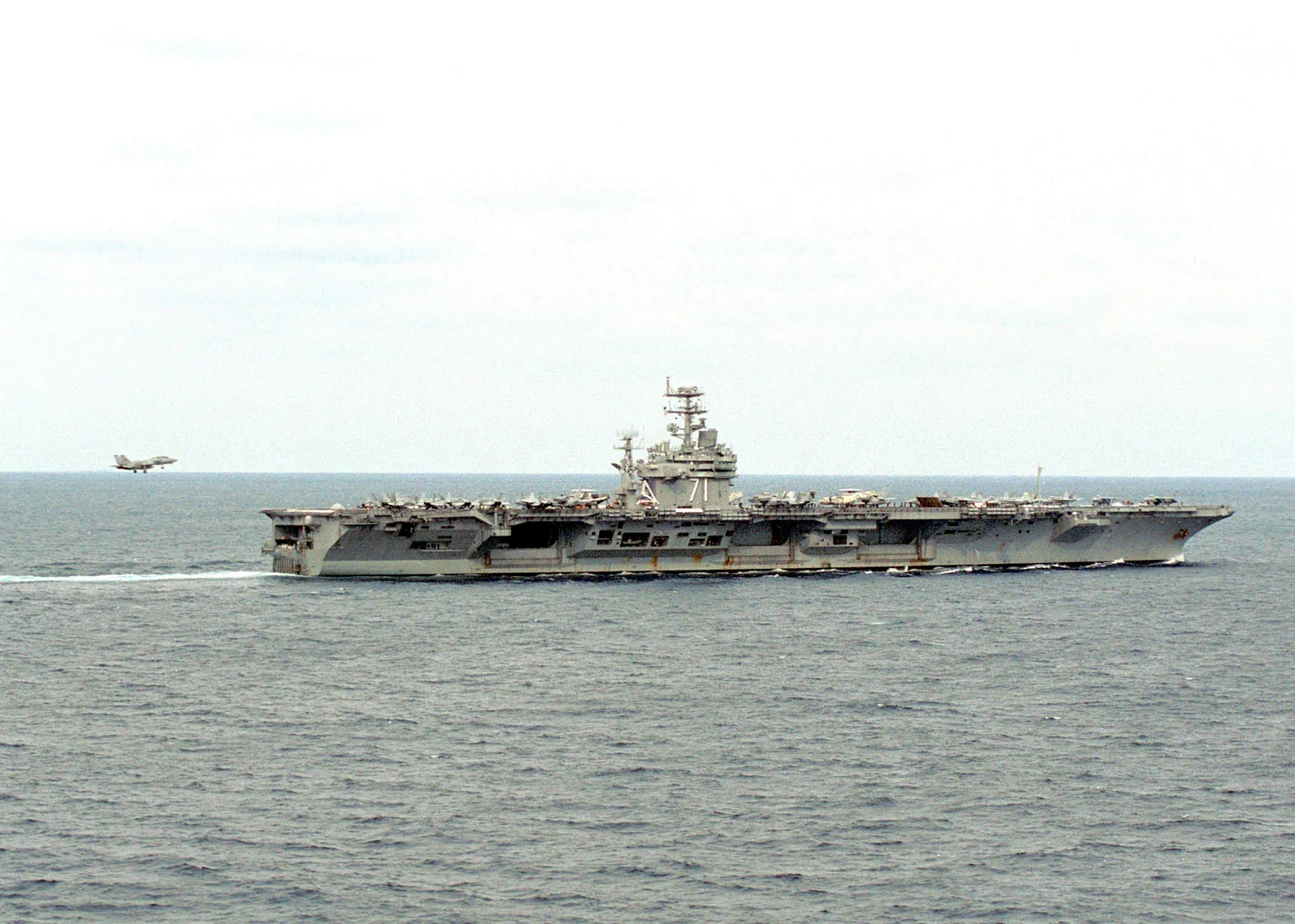
The United States is sending roughly 9,000 to 10,000 more sailors and Marines to the Middle East aboard a group of ships that includes a third aircraft carrier, a U.S. official said Thursday, as President Donald Trump weighs whether to resume large-scale strikes against Iran after the Nov. 3 midterm elections.
The troop movement includes the USS Theodore Roosevelt carrier strike group and the USS Makin Island amphibious readiness group, according to reporting by the Associated Press and the Wall Street Journal, citing U.S. officials. Together the ships carry more than 7,000 sailors and 2,000 Marines.
The heaviest buildup since April
The Roosevelt strike group, which includes the cruiser USS Chosin, departed its home port of San Diego on Sunday on what the Navy described as a scheduled deployment. The Makin Island group — comprising three amphibious ships carrying Marines from the 13th Marine Expeditionary Unit, including the USS John P. Murtha and USS Anchorage — departed Monday, the Wall Street Journal reported.
Two carriers are already in the region: the USS George H.W. Bush and the USS George Washington, along with the USS Boxer amphibious readiness group. If the Washington remains in the Middle East after the Roosevelt arrives, the region would host three carrier strike groups for the first time since April — itself the first such concentration since 2003. The Washington was moved to the region to relieve the USS Abraham Lincoln, whose crew spent more than 260 days straight at sea, the AP reported.
Combined with forces already in place, the new deployments would bring the U.S. naval presence to more than 20,000 sailors and Marines and hundreds of aircraft, according to the AP. The additional servicemembers would add to more than 50,000 troops already in the region, the Journal reported. It is possible, however, that the Washington heads back to its home port in Japan, which would bring the force back down to two carriers, officials told the Journal.
Trump signals a possible post-election escalation
The buildup comes days after Trump rejected Iran's latest proposal for a seven-day ceasefire. In a Time magazine interview published Thursday and conducted Monday, the president said it was "possible" he would ramp up bombing in Iran after the elections if no deal is in place, and offered no further detail on his strategy. "I can't tell you that because look, you know, you're asking, where are you going to bomb?" he said.
Trump said he rejected Tehran's latest truce offer because "things that I wouldn't have approved a year ago I wouldn't have today." The Journal reported that the rejected proposal would have led to the reopening of the Strait of Hormuz — the key waterway through which about a fifth of the world's oil ordinarily flows — and resumed talks over Iran's nuclear ambitions, in return for the U.S. lifting its blockade of Iranian ports. Trump said Iran had offered to "open up" the strait but judged the overall proposal "not good enough."
A strained force on a longer war
The deployments underscore a conflict that has grown far beyond the campaign of weeks Trump initially promised. U.S. and Iranian forces fought from Feb. 28 this year; a fragile ceasefire clinched in April collapsed, and the two sides have fought sporadically since, the Journal noted.
The military effort is stretching the Navy. The U.S. has maintained about 20 Navy ships in the region in recent months to enforce its blockade and help escort commercial ships transiting the Strait of Hormuz, according to Navy officials cited by the Journal — a blockade that is shutting down Iran's own oil exports while U.S. forces work to loosen what the AP described as Tehran's grip over the waterway. In recent weeks, Defense Secretary Pete Hegseth has extended the deployments of other troops critical to major combat operations, including air-defense units that counter Iranian missiles and drones and the Army's 82nd Airborne Division.
The Journal reported that Iran has fired ballistic missiles at American warships in recent weeks, and that the crew of the Roosevelt is prepared for a longer-than-normal deployment — a signal that U.S. planners expect the confrontation to continue well past the elections.


